

































Portugal Halves IRS Withholding on November 2026 Pay and Pensions: Withholding Is a Prepayment, and the 2027 Return Settles the Bill
Portugal IRS withholding (retenção na fonte) is tax your employer or pension payer deducts each month on account of your annual bill; under Article 97 of the IRS Code, everything withheld is credited against your final tax when you file the annual return between 1 April and 30 June of the following year, and any difference is refunded or paid.
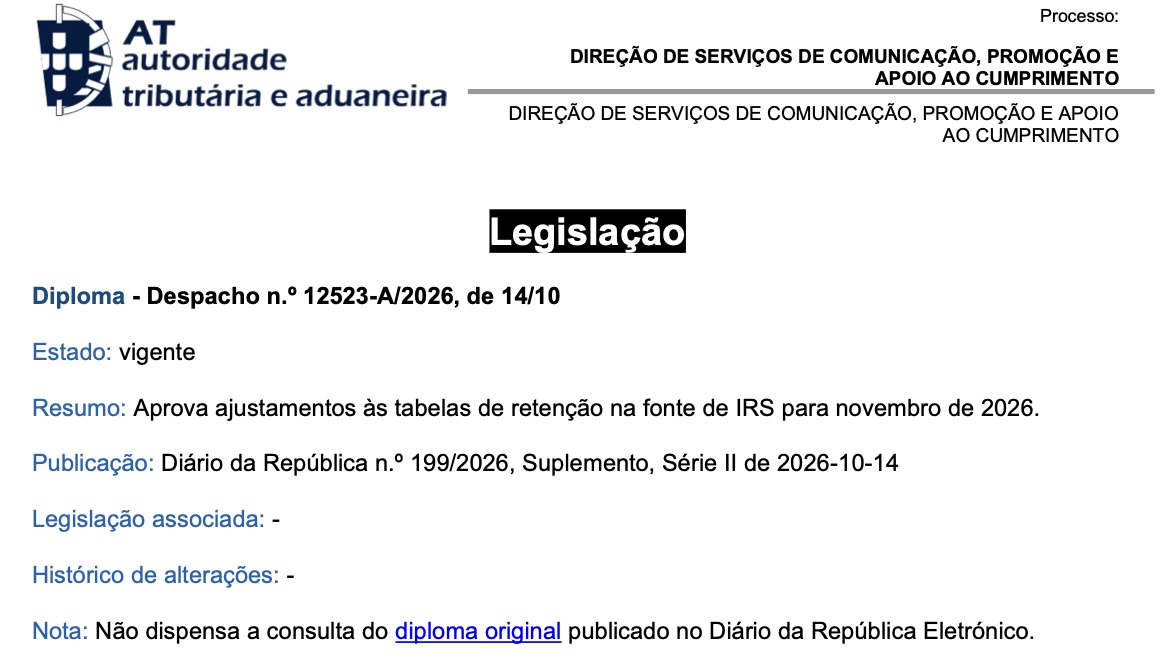
On 14 October 2026, Portugal’s official gazette, the Diário da República, published Order (Despacho) No. 12523-A/2026 from the Minister of State and Finance. It provides that salaries and pensions paid in November 2026 will have only half the usual income tax withheld, including Christmas bonuses paid that month, with the normal withholding tables returning on 1 December. The order was signed by Finance Minister Joaquim Miranda Sarmento on 13 October and covers salaries and pensions on which tax is withheld by employers or pension payers in mainland Portugal.
Will the tax you keep in November have to be paid back when you file? To answer that, you first need to understand how withholding and the annual return fit together. This guide uses the November change as a starting point and explains how withholding is calculated, when the annual return is due, when refunds or payments happen, and what new foreign residents should sort out first.
Key Points
- Who should pay attention: foreign employees on a Portuguese payroll, retirees receiving a Portuguese or foreign pension while living in Portugal, and people who moved to Portugal in 2026 and will file their first return in 2027.
- Monthly Portugal IRS withholding is only a prepayment. Your tax for the year is settled after you file between 1 April and 30 June of the following year; for returns filed on time, the tax authority must issue its assessment by 31 July, and refunds and payments are due by 31 August.
- The November 2026 halving is meant to pass on a 2026 rate cut for the first six income brackets early. Whether you end up with a refund or a bill still depends on your 2027 settlement.
- New residents most often get caught out by tax residency, by foreign pensions that must be declared on their own return, and by the conditions attached to IRS Jovem and IFICI.
How Is Portugal IRS Withholding Calculated? Employers Apply Official Monthly Tables
Who withholds, and on what basis
Under Article 99 of the IRS Code, employers paying salaries and entities paying pensions must deduct tax when they pay. Before the first payment they must ask for your personal and family details, such as marital status and dependants, and you must tell them about later changes, because these details determine which withholding table applies.
The tables are set each year by order of the Ministry of Finance. For mainland Portugal in 2026 they are in Order No. 233-A/2026; the autonomous regions of the Azores and Madeira have their own tables. Since the second half of 2023, withholding has used a progressive marginal-rate method designed to bring monthly withholding closer to the final annual tax. For a single employee with no dependants, the calculation is:
Monthly withholding = monthly pay × marginal rate − deduction amount (minus an extra amount for each dependant, where relevant)
Extract from the 2026 salary withholding table
All of the figures below come from Table I of Order No. 233-A/2026 (employment income, unmarried with no dependants or married with two earners), showing common salary bands only:
| Monthly pay (€) | Marginal rate | Deduction (€) |
|---|---|---|
| Up to 920 | 0% | 0 |
| 1,212.01–1,819 | 24.10% | 193.33 |
| 1,819.01–2,119 | 31.10% | 320.66 |
| 2,119.01–2,499 | 34.90% | 401.19 |
| 2,499.01–3,305 | 38.36% | 487.66 |
€920 is Portugal’s 2026 monthly minimum wage, and employees earning up to that amount have nothing withheld. Each dependant adds €21.43 to the deduction. Pensions use a separate set of tables (from Table VIII), with slightly different bands and rates.
Worked examples: a €1,500 salary and a €1,200 pension
These are Zagdim’s calculations using the official tables, rounded down to the euro as Article 99-E of the IRS Code requires:
- Single, salary of €1,500 a month: 1,500 × 24.10% − 193.33 = 168.17, so €168 is withheld each month; in November 2026, about €84.
- Single, Portuguese pension of €1,200 a month (Table VIII, 21.20% rate, €174.02 deduction): about €80 a month; in November, about €40.
What you can adjust
- Ask for more to be withheld: under Article 98(6) of the IRS Code, you can ask your employer or pension payer in writing to withhold at a whole-number rate higher than the legal one, which can reduce the bill on the annual return.
- Read your payslip: Article 99(9) requires payers to show the effective monthly withholding rate on the payslip or payment statement.
- Bonuses are separate: holiday and Christmas bonuses are subject to their own withholding calculation and are not added to that month’s salary.
The details of the November 2026 halving
Order No. 12523-A/2026 sets the following scope:
- It applies to salaries and pensions paid from 1 to 30 November 2026: withholding is 50% of the amount produced by the normal tables, and this also applies when a single payment includes more than one salary, such as a Christmas bonus.
- It does not apply to people whose monthly income is above the upper limit of the second-highest band of their table; for single people with no dependants on the salary table, that limit is €20,221.
- It covers residents of mainland Portugal only. The Azores have a separate order, and Madeira falls outside this one.
- Employers that do not apply it correctly in November can correct it in withholding up to the end of December. From 1 December the normal tables apply again.
The order’s preamble says parliament has authorised the government to cut the general rates for the first six brackets with effect for all 2026 income, and that the November adjustment also reflects the extra tax withheld at the old rates since January. In other words, the halving is not an extra refund but an early pass-through of the rate cut; whether you personally get money back or owe more is only known at the annual settlement.
The Annual IRS Return in Portugal: File Modelo 3 Online Between 1 April and 30 June
Under Article 60 of the IRS Code, the return for the previous year’s income (Modelo 3) is filed electronically on the Portal das Finanças between 1 April and 30 June, and 30 June is the deadline even if it falls on a weekend or holiday. Income earned in 2026 is therefore reported in this window in 2027.
- IRS Automático (automatic return): for eligible taxpayers, the tax authority prepares a provisional return and provisional assessment on the Portal das Finanças, which you check and confirm. If you neither confirm it nor file your own return by the deadline, the provisional return is treated as filed. Household details such as marriage and dependants can be updated online until the end of February.
- Foreign income must be added: Portuguese tax residents are taxed on worldwide income. Pensions, salaries, rent and other income from abroad go on Annex J (Anexo J), and tax paid abroad can be credited under the rules. These cases are usually not a good fit for the automatic return.
- A few people do not need to file: for example, someone whose only income is salary or pension totalling no more than €8,500 with no withholding. Article 58 sets out further conditions and exceptions; if in doubt, file.
The timeline below runs from withholding to settlement for 2026 income; each row has a different legal basis:
| When | What happens | Basis |
|---|---|---|
| January to December 2026 | Employer or pension payer withholds tax each month | IRS Code Article 99; Order No. 233-A/2026 |
| November 2026 | Withholding halved on mainland salaries and pensions | Order No. 12523-A/2026 |
| By end of February 2027 | Update household details on the Portal das Finanças (affects the automatic return) | IRS Code Article 58-A |
| 1 April to 30 June 2027 | File the annual Modelo 3 return | IRS Code Article 60 |
| By 31 July 2027 | Tax authority issues the assessment | IRS Code Article 77 |
| By 31 August 2027 | Any tax due must be paid; overpaid tax is refunded | IRS Code Articles 96 and 97 |
Refunds and Balances Due: When Portugal IRS Withholding Was Too High or Too Low
At settlement, the tax authority calculates your tax for the year and subtracts everything withheld during the year (Article 97(3) of the IRS Code):
- Withholding higher than the tax due: the difference is refunded. For returns filed on time, the refund must be made by 31 August, and under Article 96 compensatory interest is due on the overpayment.
- Withholding lower than the tax due: the balance must be paid by 31 August.
Refunds are paid to the bank account registered on the Portal das Finanças, so keep it up to date. In practice, people who file early with straightforward returns usually receive refunds sooner, but the legal deadline remains 31 August.
Five Things New Foreign Residents in Portugal Should Sort Out First
- Get a tax number (NIF): Portugal’s government services portal states that anyone, Portuguese or foreign, resident or not, can apply for an individual tax number (NIF), which is needed to sign contracts, open bank accounts and work.
- Check whether you are a Portuguese tax resident: under Article 16 of the IRS Code, you are resident for a year if you spend more than 183 days in Portugal in any 12-month period, or have a home there during that period in circumstances suggesting you intend to keep it as your habitual residence; residency generally starts from the first day of your stay. Only residents use the standard withholding tables and annual settlement.
- Non-residents follow different rules: under Article 71, Portuguese salaries and pensions paid to non-residents are generally subject to a final 25% withholding tax; for salary from a single employer, the portion up to the minimum monthly wage is not taxed.
- No one withholds on a foreign pension: tax is not deducted in Portugal when a foreign pension is paid, so it must all be declared on Annex J the following year, with a credit for foreign tax paid where the rules allow. These pensions are not affected by the November halving.
- IRS Jovem, NHR and IFICI:
- IRS Jovem: people aged up to 35 who are not someone else’s dependant can have employment and self-employment income partly exempt for 10 years: 100% in year 1, 75% in years 2–4, 50% in years 5–7 and 25% in years 8–10, capped at 55 times the social support index (IAS). It is chosen on the annual return, and you can tell your employer so withholding reflects it in advance.
- The non-habitual resident regime (NHR) was abolished in the 2024 State Budget law; only people meeting the transitional conditions can keep using it.
- Its successor, IFICI (tax incentive for scientific research and innovation), taxes employment and self-employment income from eligible research, innovation and highly qualified roles at a special 20% rate for 10 consecutive years. One condition is not having been a Portuguese resident in the previous five years, and you must register by 15 January of the year after you become resident. Anyone who has used NHR or IFICI cannot use IRS Jovem.
Common Misunderstandings About Portuguese Income Tax
- Myth: the November halving is extra money from the government. The order is meant to pass on the 2026 rate cut and the extra tax withheld since January early, not to pay a subsidy. Tip: do not treat the extra November pay as certain until your 2027 settlement.
- Myth: once tax is withheld every month, there is no need to file. Most residents still file between April and June of the following year; withholding is only a prepayment. Tip: even with the automatic return, check your details online.
- Myth: a foreign pension taxed at source abroad has nothing to do with Portugal. Portuguese tax residents declare worldwide income, so foreign pensions go on Annex J and foreign tax is then credited. Tip: keep proof of tax deducted abroad.
- Myth: refunds always arrive within a few weeks of filing. The legal deadline is 31 August, and returns with queries can take longer. Tip: watch your return status and bank details on the Portal das Finanças.
- Myth: choosing the wrong withholding table does not matter because it evens out at year end. The annual settlement does adjust it, but Article 99-F says improper use of the “married, single earner” table means paying compensatory interest on the shortfall. Tip: update your employer as soon as your family situation changes.
Scenarios: Three People Living in Portugal
Scenario 1: a single foreign engineer working in Lisbon on €1,500 a month. Under the 2026 tables, about €168 is normally withheld each month; in November only about €84, and the same halving applies to a Christmas bonus paid in November. When the return is filed from April 2027, the tax authority will calculate the year’s tax at the reduced rates and subtract everything withheld; any overpayment is refunded and any shortfall paid, by 31 August.
Scenario 2: a retiree who moved to Portugal and lives only on a pension from their home country. No one withholds tax on this pension in Portugal, so the November halving does not apply. From the year they become tax resident, they must declare the pension on Annex J between April and June each year and attach proof of tax deducted at home to claim a foreign tax credit.
Scenario 3: a 30-year-old software engineer who moved in 2026. He first needs to confirm whether he was already tax resident in 2026, then decide whether IRS Jovem or IFICI suits him better. IFICI requires registration by 15 January of the year after becoming resident, and the two cannot be used one after the other: once IFICI is used, IRS Jovem is ruled out. It is worth asking a qualified accountant before choosing.
Portugal IRS Withholding and Tax Return FAQ
Will I owe tax next year because Portugal IRS withholding was halved in November?
Not necessarily. Order No. 12523-A/2026 is designed to reflect the 2026 rate cut for the first six brackets, and the extra tax withheld since January, all in November. When you file in 2027, the tax authority will calculate your annual tax at the reduced rates and subtract what was actually withheld; whether you get a refund or owe more depends on your income, household and deductions.
Can I ask for more Portugal IRS withholding each month?
Yes. Under Article 98(6) of the IRS Code, employees and pensioners can ask the payer in writing to withhold at a whole-number rate above the legal one. Some people do this to avoid a large bill the following year, but any excess is only refunded at the annual settlement.
When is the IRS tax return due in Portugal?
Every year from 1 April to 30 June, filed online on the Portal das Finanças for the previous year’s income (Modelo 3). 30 June is the deadline even if it is a holiday. Where foreign tax on foreign income has not yet been determined, Article 60 allows an extension to 31 December, provided you notify the tax authority within the normal deadline.
When will my Portuguese tax refund arrive?
For returns filed on time, the tax authority must issue the assessment by 31 July and pay any refund by 31 August, with compensatory interest on the overpayment. Refunds go to the bank account registered on the Portal das Finanças; in practice, early filers with simple returns usually receive them sooner.
How long do foreigners have to live in Portugal before filing an IRS return?
Under Article 16 of the IRS Code, you are tax resident for a year if you spend more than 183 days in Portugal in any 12-month period, or have a home there that suggests you intend to keep it as your habitual residence. Residents declare worldwide income. Non-residents generally have a final 25% withheld from Portuguese salaries and pensions.
Does the November halving affect foreign pensions?
No. The November halving only applies to salaries and pensions on which tax is withheld by employers or pension payers in mainland Portugal. Foreign pensions are not subject to Portuguese withholding; they are declared on Annex J the following year, with a credit for foreign tax paid under the rules.
Planning to Work or Retire in Portugal? Ask Zagdim
If you want to understand what to prepare before working, retiring or filing taxes in Portugal, or compare long-stay options across countries, Ask Zagdim.
Life abroad? Ask Zagdim.
Your first stop for international property and global living.
Research and insights. Know what’s changing. Understand what matters.
Newsletter for overseas updatesSubscribe →
Important Disclaimer
This article is general information only and is not tax or legal advice. It is based on the IRS Code, 2026 Ministry of Finance orders and official guidance published by the Portuguese Tax and Customs Authority (AT) on the Portal das Finanças. Rates, withholding tables and filing rules can change every year; check the latest AT notices for your situation and consult a qualified Portuguese accountant or tax adviser.
Information is current as of 20 October 2026; please check the latest notices from the Portuguese Tax and Customs Authority (AT) and the Diário da República.
References
Portuguese Tax and Customs Authority – Order No. 12523-A/2026 (November 2026 withholding adjustment) / Portuguese Tax and Customs Authority – Order No. 233-A/2026 (2026 mainland withholding tables) / Portuguese Tax and Customs Authority – IRS Code Article 16, Residence / Portuguese Tax and Customs Authority – IRS Code Article 12-B, IRS Jovem / Portuguese Tax and Customs Authority – IRS Code Article 58-A, Automatic return / Portuguese Tax and Customs Authority – IRS Code Article 60, Filing deadline / Portuguese Tax and Customs Authority – IRS Code Article 71, Final withholding rates / Portuguese Tax and Customs Authority – IRS Code Article 77, Assessment deadline / Portuguese Tax and Customs Authority – IRS Code Article 96, Refunds / Portuguese Tax and Customs Authority – IRS Code Article 97, Payment / Portuguese Tax and Customs Authority – IRS Code Article 98, Withholding rules / Portuguese Tax and Customs Authority – IRS Code Article 99, Withholding on salaries and pensions / Portuguese Tax and Customs Authority – Foreign income (Rendimentos obtidos no estrangeiro) / Portuguese Tax and Customs Authority – IFICI guide / Portuguese Government Services Portal – Applying for a tax identification number (NIF)