































This article is part of Zagdim’s wiki series on buying property in Japan. It works through how to check whether rental income can actually cover the mortgage on a Japanese rental property, once cash flow, vacancy, and management fees are factored in. It is written for anyone considering buying Japanese rental property with financing.
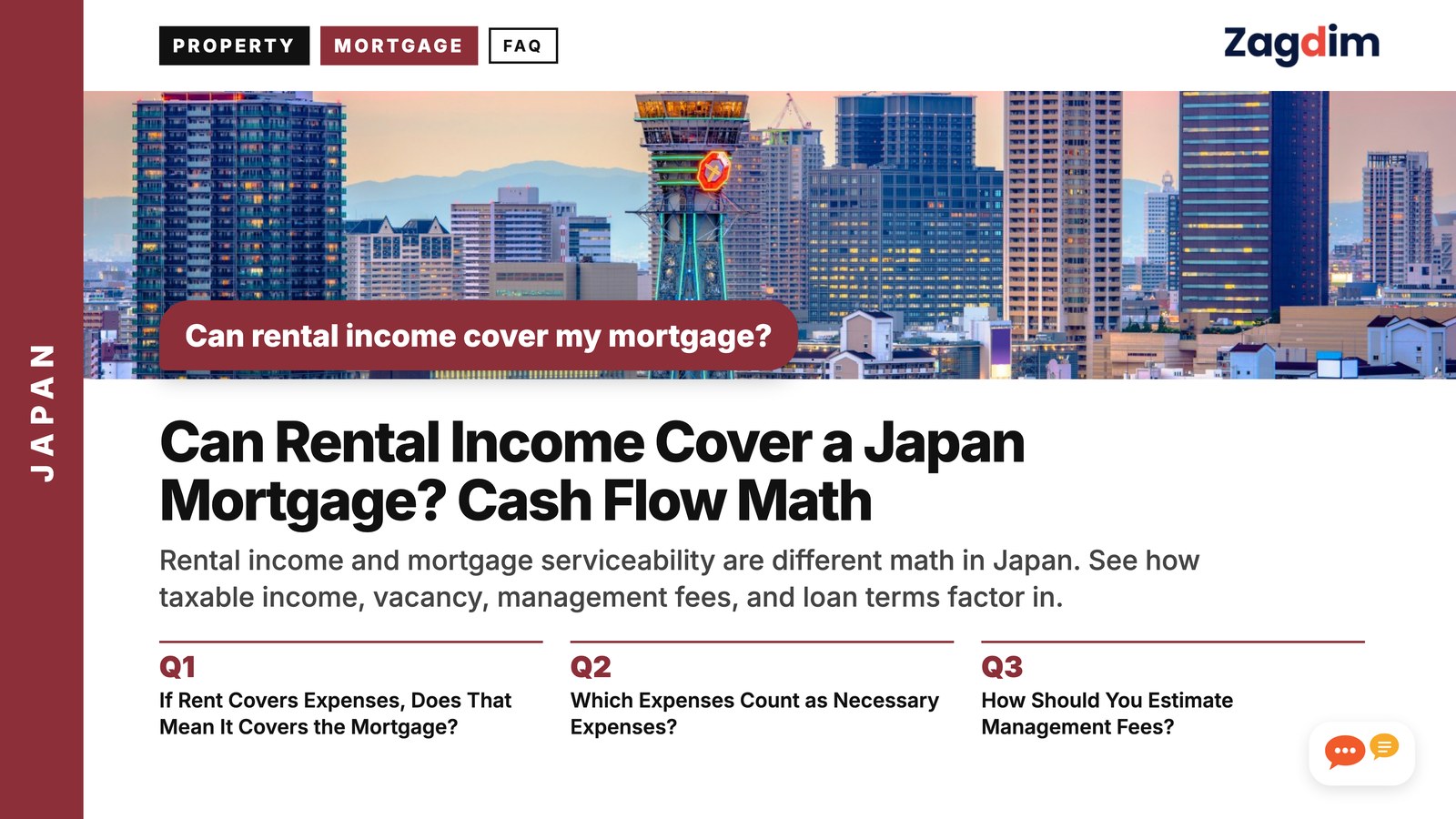
If Rent Covers Expenses, Does That Mean It Covers the Mortgage?
Not automatically. Japan’s National Tax Agency defines “real estate income” (不動産所得) as gross rental income minus “necessary expenses” (必要経費). That is a formula for calculating income tax, not a cash flow formula. The actual principal repayment and other real cash outflows due each month have to be worked out separately. Having rental income on the books is not the same as having that amount of cash in hand to make the month’s loan payment.
Which Expenses Count as Necessary Expenses?
A necessary expense must be a cost directly required to earn the rental income, and it must be clearly distinguishable from personal or household expenses. Interest on a loan taken for business purposes can be counted as a necessary expense, but this applies only to the interest portion, not to principal repayment. If a loss arises on real estate income, the portion of that loss attributable to interest on a loan used to acquire the land cannot be offset against other income. So the principal portion of a monthly loan payment needs to be kept separate both from the interest portion and from the necessary-expense calculation used for tax purposes.
What Rate and Term Should You Confirm Before Estimating Monthly Payments?
Do not assume a flat “35-year term at some fixed percentage of the purchase price.” Taking the Shinsei Overseas Investor Loan as an example, as of the date stated on the source page (October 1, 2026), the annual variable interest rate was 3.90%, and the loan term ran from 1 to 20 years. Under a balloon-repayment structure, the monthly payment can be calculated as if amortized over as long as 35 years, but the full remaining principal is due in one lump sum on the final payment date. In other words, a lower-looking monthly payment does not mean a large principal sum will not be due before the loan matures.
| Item | Detail |
|---|---|
| Shinsei Overseas Investor Loan annual variable rate | 3.90% (as of October 1, 2026) |
| Shinsei Overseas Investor Loan loan term | 1 to 20 years |
| Balloon-repayment monthly payment calculation | Can be calculated as if amortized over up to 35 years; the remaining principal is due in full on the final payment date |
| Shinsei Overseas Investor Loan arrangement fee | 1.50% of the loan amount (per the product page as of October 1, 2026; other fees may also apply) |
Variable rates are not fixed. Using The 77 Bank’s apartment loan as an example, the variable rate adjusts whenever that bank’s short-term prime rate changes, so any estimate should leave room for the rate to rise.
Can You Use the National Vacancy Rate of 13.8% to Estimate Your Own Vacancy Risk?
Not directly. Japan’s 2023 Housing and Land Survey found about 9.002 million vacant homes nationwide, for a vacancy rate of 13.8%. That figure covers all vacant housing nationwide; it is not the vacancy probability for any one rental property. Vacancy periods vary by the property’s city, the type of rental housing, and the rent level, so vacancy needs to be estimated separately for each property’s own conditions.
How Should You Estimate Management Fees?
The management fee amount should be confirmed with the management company based on the scope of services and the property’s location. When appointing a manager, it is worth checking whether the company is registered: a business managing at least 200 units of rental housing is generally required to register, though units it owns itself are not counted toward that threshold. The actual management fee paid also needs to go into the cash flow calculation, and whether it qualifies as a necessary expense is judged under the same necessary-expense rules described above.
Is Tax Withheld From Rental Income Before It Reaches a Non-Resident Owner?
That depends on your status and on how the tenant uses the property. If you are a non-resident, a tenant paying you rent in Japan is generally required to withhold income tax and the special reconstruction surtax, at a combined rate of 20.42%, at the time of payment. An exception applies when an individual tenant rents the property for their own or a family member’s residence, in which case no withholding is required on that rent. Where a tax treaty exists between Japan and the owner’s country of residence, that treaty may exempt or reduce the withholding rate that would otherwise apply under Japanese domestic law, but it should not be assumed that any particular country’s residents automatically qualify for that relief.
So How Do You Judge Whether Rental Income Can Cover the Mortgage?
Keep “real estate income for tax purposes” and “actual monthly cash flow” separate. For actual cash flow, rental income needs to be weighed against vacancy, management fees, other necessary outlays, loan interest, principal repayment, arrangement fees, and any withholding tax for non-resident owners. For tax purposes, only expenses that meet the necessary-expense test are counted, and interest must be tracked separately from principal repayment. Whether rental income can cover the mortgage depends on the owner’s country of residence, their tax residency status, the property’s city, and the type of tenant. For the fuller picture on bank approval criteria and exit risk, see the related guide, “Before Using a Loan to Buy Japanese Investment Property, Understand Bank Approval, Rental Cash Flow, and Exit Risk.”
Frequently Asked Questions
If the rent on paper shows a surplus, does that mean it covers the mortgage?
Not necessarily. Real estate income is a tax calculation of gross income minus necessary expenses. Principal repayment, vacancy, management fees, and other actual cash outlays have to be worked out separately as part of cash flow.
If I live abroad and collect rent from a Japanese property, is tax withheld before I receive it?
If you are a non-resident, a tenant paying rent in Japan is generally required to withhold income tax and the special reconstruction surtax at a combined rate of 20.42% at the time of payment. No withholding is required when an individual tenant rents the property for their own or a family member’s residence. A tax treaty may exempt or reduce the withholding rate, but it should not be assumed that residents of any particular country automatically qualify for that relief.
Can I use the national vacancy rate of 13.8% to estimate vacancy on my own property?
No. That figure is a 2023 nationwide statistic covering all vacant housing; it is not the vacancy probability for any individual rental property.
Can the Shinsei Overseas Investor Loan be taken out over 35 years?
No. As of the product page dated October 1, 2026, the loan term runs from 1 to 20 years. The 35-year figure is only the amortization schedule used to calculate the monthly payment under a balloon-repayment structure; the remaining principal is due in full on the final payment date.
Glossary
- Real estate income (不動産所得): Under Japanese tax law, the amount left over after deducting necessary expenses from rental income.
- Necessary expenses (必要経費): Costs directly required to earn rental income that can be clearly distinguished from personal or household spending.
- Withholding tax (源泉徴収): A system under which the payer deducts tax from a payment and remits it to the government before the recipient receives the balance.
- Balloon repayment: A loan structure in which the monthly payment is calculated as if amortized over a longer term, with the remaining principal due in one lump sum at maturity.
Notes on the Data
Data checked as of October 21, 2026. The interest rate, loan term, and fee details cited for the loan products reflect each lender’s product page as stated at the source, dated October 1, 2026; they summarize that product page only and do not constitute a bank’s loan quote or approval commitment. The official national vacancy rate statistic covers all vacant housing nationwide, not the vacancy rate of any individual rental property. Loan interest can be counted as a necessary expense; the source confirms this only for the interest portion, and this article does not extend that conclusion to principal repayment. Whether withholding tax is reduced or exempted under a tax treaty is described by the authorities only as a possibility; this article does not assume that residents of any particular country automatically qualify for that relief.
Have a question about this guide? Leave a comment below, or ask Zagdim directly.
Your first stop for international property and global living.
Research and insights. Know what’s changing. Understand what matters.
Sources
- Shinsei Investment & Finance: Loans for Overseas Investors (新生インベストメント&ファイナンス-海外投資家向けローン)
- The 77 Bank: Apartment Loan (<七十七>アパートローン)
- National Tax Agency – No. 1370: Receiving Real Estate Income (不動産所得)
- National Tax Agency – No. 2210: Understanding Necessary Expenses
- National Tax Agency – No. 2880: Paying Rent to Non-Residents
- National Tax Agency – No. 2884
- Statistics Bureau of Japan – 2023 Housing and Land Survey (PDF)
- Ministry of Land, Infrastructure, Transport and Tourism – How to Register as a Rental Housing Management Business
Important Notice
This article is a general information summary and does not constitute tax or legal advice for any individual case. Data checked as of October 21, 2026. Rules in Japan and in the reader’s home country may be updated; please check current notices from the relevant authorities and consult a qualified professional for your own situation.