































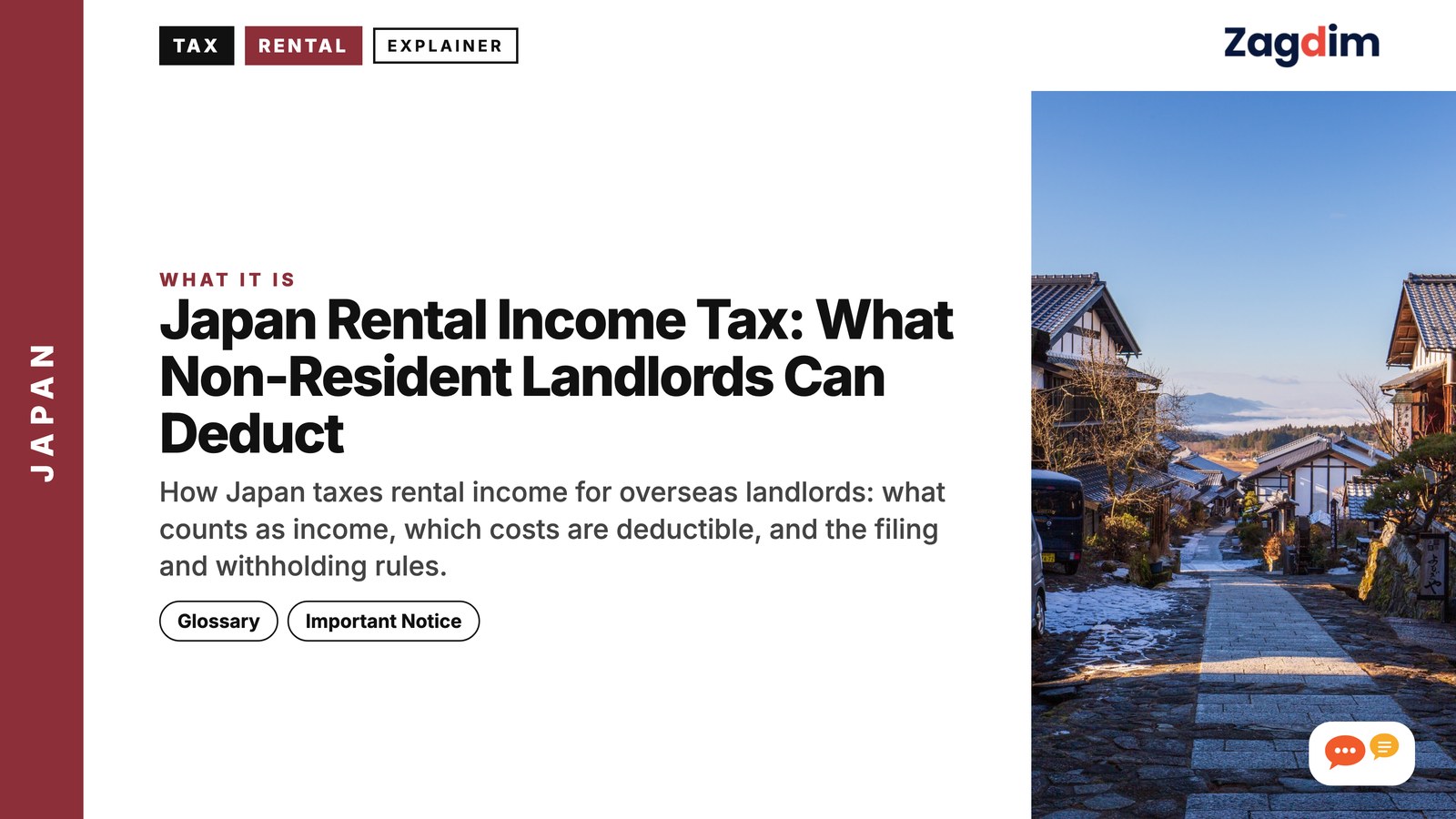
Japan treats profit from renting out land or buildings as a specific category of income, and non-resident landlords face their own set of rules on withholding and filing. This article covers what counts as rental income in Japan, which costs can be deducted, how management fees, reserve-fund contributions, and repair costs are treated, and how an owner living outside Japan reports the income.
**Example**: Mr. Chen lives outside Japan and rents out an apartment there. For this example, assume Mr. Chen is a non-resident under Japanese tax law. The sections below use his situation to show how the rules apply. (The person and situation are illustrative only.)
How Is Rental Income From a Japan Property Taxed?
In short: take what you received, subtract the related costs, and the remainder is what gets taxed.
Japan classifies profit from renting out land or buildings as “real estate income” (不動産所得, *fudōsan shotoku*). Income that falls under business income or capital gains is not included in this category.
The calculation:
Real estate income = total revenue − necessary expenses
- Necessary expenses (必要経費, *hitsuyō keihi*): costs paid directly to earn the rental income, which can be clearly separated from personal living expenses.
Total revenue is not limited to the monthly rent. The following also count:
| Type of receipt | Counted as revenue? |
|---|---|
| Fees charged under names such as name-change fee, consent fee, renewal fee, or key money | Yes |
| The portion of a deposit or security deposit that does not have to be returned | Yes |
| Electricity, water, or cleaning charges collected under a “common area fee” (共益費, *kyōekihi*, the utilities and cleaning costs for a condominium’s shared areas) | Yes |
**Example**: When Mr. Chen’s tenant renews the lease and pays a renewal fee, that amount counts toward total revenue. If part of the security deposit does not have to be returned, that part counts too.
What Expenses Can Be Deducted From Rental Income?
What’s deductible is money spent directly to earn the rental income that can be separated from personal living costs.
The following costs for the rented property can be included in necessary expenses:
- Fixed asset tax
- Casualty insurance premiums
- Depreciation (spreading the cost of the asset as an expense over several years)
- Repair costs
Not deductible:
- Costs for the owner’s own personal use of the property
- Income tax and resident tax
Only the portion of fixed asset tax attributable to the rented part of the property can be deducted. For how this tax applies while the property is held, see our article on the annual taxes due while holding Japanese property: fixed asset tax, city planning tax, and rental reporting.
Are Condominium Management Fees and Reserve-Fund Contributions Always Deductible in the Year Paid?
Not automatically; it depends on conditions.
Management fees: both of the following must be true before a fee can be booked as a necessary expense.
- It relates to that year’s rental activity or revenue; and
- The obligation to pay was fixed within that year, meaning the amount became due and certain that year.
Where an expense mixes personal and rental use, only the portion clearly attributable to the rental can be deducted.
Reserve-fund contributions (修繕積立金, *shūzen tsumitatekin*, funds collected from unit owners in advance for future building repairs): in principle, these are deductible only in the year the actual repair work is completed, for the amount used on that specific work. They cannot automatically be deducted in the year they are paid.
Exception: if the payments are made under a proper management agreement (管理規約, the rules unit owners jointly follow) and all four of the following conditions are met, the contribution can be deducted in the year payment comes due:
- The owner has an obligation to pay;
- The management association (管理組合, the body formed by unit owners to manage the building) is not required to refund the money;
- The funds are to be used only for future repairs; and
- The amount is reasonably calculated based on the long-term repair plan and the owner’s share of the common areas.
**Example**: Mr. Chen pays a reserve-fund contribution every month. In principle, it can only be deducted in the year the building’s repair work is actually completed. Only when all four conditions above are met can it be deducted in the year the payment comes due.
Can Repair Costs Be Deducted in Full, in the Year Paid?
Ordinary maintenance, yes. Work that makes the property more durable or more valuable, no.
- Ordinary maintenance and repairs: booked as a necessary expense in the year incurred.
- Work that extends the property’s useful life or increases its value: treated as a capital expenditure (an improvement, not just maintenance) and deducted over time through depreciation.
- How it’s classified: based on what the work actually involved, not on what the project is called.
Japan’s National Tax Agency (国税庁) states that a repair or improvement can be treated as a current-year repair expense if either of the following applies:
- The repair or improvement is the kind of work that would typically recur roughly every three years; or
- The cost of the repair or improvement is under 200,000 yen.
This test is applied per individual repair or improvement project.
**Example**: Before doing repair work, Mr. Chen first needs to work out whether it’s ordinary maintenance or an improvement that makes the property more durable or valuable.
Do Tenants Have to Withhold Tax Before Paying Rent to an Overseas Owner?
In principle, yes.
Withholding here means the person making the payment deducts the tax from the rent before paying it, and then remits that tax to the tax office.
| Item | Rule |
|---|---|
| Who must withhold | A tenant or payer renting Japan-based real estate from a non-resident (someone not treated as a resident of Japan under Japanese tax law) or a foreign corporation |
| When it’s withheld | When rent is paid within Japan; in principle, at the time of payment |
| How much | 20.42%, under income tax plus the special reconstruction income tax (復興特別所得税) |
| Starting 2027 | The description of the tax category will also include a special defense income tax (防衛特別所得税) |
| When it’s remitted | In principle, by the 10th of the month following the month the payment was made |
| When withholding doesn’t apply | Rent an individual pays for land or a building they or a relative live in is not subject to this withholding rule |
**Example**: If Mr. Chen’s tenant is an individual renting the apartment to live in, this withholding rule does not apply. If the tenant is a company paying rent within Japan, it must in principle withhold 20.42% first.
How Do Overseas Owners File Japanese Income Tax on Rental Income?
The first step is confirming whether you need to file at all.
The National Tax Agency states that rental income from real estate located in Japan is Japan-source income for a non-resident. This type of income is calculated using aggregate taxation (総合課税, combining income types to compute the tax) and requires a final income tax return (確定申告, Japan’s annual income tax filing). That said, whether an individual must file, how withholding applies to their situation, and which tax treaty provisions may apply all need to be checked case by case.
If a final return is required by law:
- A non-resident must file a notification with the tax office responsible for their place of taxation, appointing (or removing) a tax administrator (納税管理人) for income tax and consumption tax purposes.
- In plain terms, this means telling the tax office who has been designated to act as the administrator, or that someone no longer holds that role.
Note: this income-tax administrator is a separate role from the tax administrator used for local fixed asset tax; the two should not be confused. For how the fixed asset tax bill and payment are handled, see our article for overseas owners on receiving the tax bill and arranging payment for Japanese property.
Can a Rental Loss Offset Other Income?
Not entirely; part of it cannot.
- Interest on a loan taken out to acquire land for rental purposes can be included in necessary expenses.
- But if real estate income for the year is a loss, the portion of that loss equal to the interest on the land loan cannot be offset against other types of income (損益通算, offsetting a loss in one income category against another).
**Example**: If Mr. Chen borrowed money to buy the land under his rental apartment, the interest on that portion of the loan can be included in necessary expenses. But in a year when the rental produces a loss, the part of the loss equal to that land-loan interest cannot be used to offset his other income.
Frequently Asked Questions
What category of income is rental income in Japan?
Rent from a Japanese property is, in principle, real estate income. It is calculated as total revenue minus necessary expenses.
Does a tenant have to withhold tax for an overseas owner?
In principle, yes. When a tenant pays Japan-based rental income to a non-resident, 20.42% must be withheld. This does not apply to rent an individual pays to live in the property themselves or house a relative.
Can a reserve-fund contribution be deducted in the year it’s paid?
In principle, it can only be deducted in the year the actual repair work is completed. Only when it is paid under a proper management agreement and all four conditions are met can it be deducted in the year payment comes due.
Can all repair costs be deducted in the year incurred?
Ordinary maintenance can. Work that extends the property’s useful life or increases its value is a capital expenditure and must be depreciated over time.
Glossary
- Real estate income (不動産所得): the income category for profit from renting out land or buildings.
- Necessary expenses (必要経費): costs that can be deducted when calculating income, paid directly to earn that income.
- Final income tax return (確定申告): Japan’s annual individual income tax filing procedure.
- Reserve-fund contribution (修繕積立金): funds collected from condominium unit owners in advance for future repairs.
- Common area fee (共益費): utilities, cleaning, and similar costs for a condominium’s shared areas.
- Tax administrator (納税管理人): the administrator a non-resident appoints when filing a Japanese income tax return; distinct from the tax administrator used for local fixed asset tax.
Source Notes
This article is based on information published by Japan’s National Tax Agency, checked as of October 21, 2026. The explanation of non-resident filing obligations and the tax administrator comes from the Agency’s No. 1926 guidance, whose primary example is an employee posted overseas; for an owner who has never resided in Japan, the filing obligation, place of taxation, and applicable tax treaty need to be checked separately, and this article does not apply that guidance’s details on departure timing, income deductions, or filing deadlines. Whether management fees, reserve-fund contributions, and repair costs are deductible is stated by the National Tax Agency as conditional, and this article summarizes those conditions as given, without reaching a conclusion for any individual case. Starting in 2027, the withholding tax category will also include a special defense income tax; this article does not state its rate or application details. “Mr. Chen” is a fictional example used for illustration and applies only the rules already stated in this article.
Have a question about this guide? Leave a comment below, or ask Zagdim directly.
Your first stop for international property and global living.
Research and insights. Know what’s changing. Understand what matters.
Sources
- National Tax Agency, No. 1370: Receiving Real Estate Income (Fudōsan Shotoku)
- National Tax Agency, No. 2210: Understanding Necessary Expenses
- National Tax Agency, No. 2880: Paying Real Estate Rent to a Non-Resident
- National Tax Agency, No. 1926: Real Estate Income While Working Overseas
- National Tax Agency, Treatment of Reserve-Fund Contributions for Rented Condominiums
- National Tax Agency, No. 1379: Determining What Is Not a Repair Expense
Important Notice
This article is general information and is not tax or legal advice for any individual case. Information was checked as of October 21, 2026. Japanese rules may be updated; please check current announcements from the relevant authorities, and consult a qualified professional for your specific situation.