



























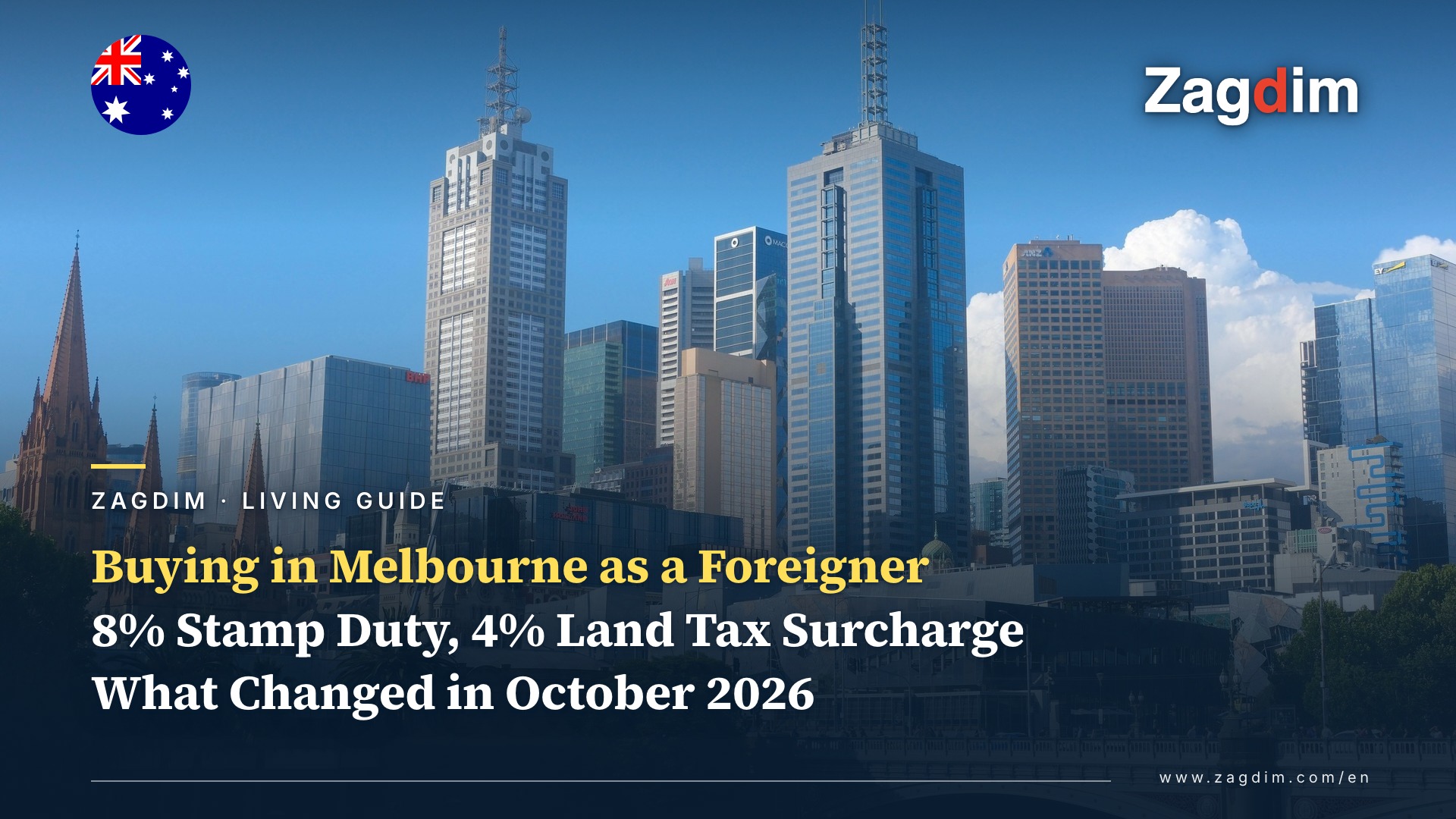
Victoria’s October 2026 Relief Is for Developers: Foreign Buyers in Melbourne Still Pay the 8% Duty and the Yearly 4% Surcharge
According to State Revenue Office Victoria (SRO), foreign buyers in Melbourne pay an 8% foreign purchaser additional duty on top of general stamp duty, plus a yearly 4% absentee owner surcharge on land tax if they live overseas; the relief the Victorian government announced on 14 October 2026 applies only to developers, and rates for individual buyers have not changed.
On 14 October 2026, Victorian Treasurer Colin Brooks announced updated guidelines: developers building affordable housing who meet the Development Facilitation Program criteria can be exempt from the absentee owner surcharge during construction, and residential developments for up to two years after completion. On 23 October, Property Update covered the move under the headline “Victoria eases foreign investor tax”, drawing attention from overseas buyers eyeing Melbourne.
This guide uses that news as a starting point to set out every tax overseas buyers face, roughly how much extra a new apartment costs, how the rules differ by residency status, and the federal FIRB approval and established-home ban.
Key Points
- Who should pay attention: overseas buyers looking at Melbourne or elsewhere in Victoria, temporary visa holders working or studying in Melbourne, and owners of Victorian property who live overseas.
- What the relief covers: the 14 October announcement exempts qualifying developers from the absentee owner surcharge; no new rate or start date was given, and the 8% and 4% rates for individual buyers stay.
- The main taxes: general stamp duty plus the 8% foreign purchaser additional duty (paid once), the 4% absentee owner surcharge (every year), and vacant residential land tax (only if the home is empty for more than six months in a year).
- The limit people miss: federal policy generally bars foreign persons, including temporary residents, from buying established homes until 30 June 2029, and new homes still need foreign investment approval.
Taxes for Foreign Buyers in Melbourne Before and After 14 October 2026
The table compares what individual overseas buyers and developers pay before and after the 14 October announcement:
| Tax | Who pays and when | Before 14 October | After the 14 October announcement | Source |
|---|---|---|---|---|
| General stamp duty (land transfer duty) | All buyers, once at purchase | Sliding scale; A$130,000 to A$960,000 is A$2,870 plus 6% of the amount over A$130,000 | Unchanged | SRO general rates (updated 29 September 2026) |
| Foreign purchaser additional duty (FPAD) | Foreign buyers, once at purchase | 8% | Unchanged for individuals (media report a review if Labor is re-elected) | SRO, Understanding FPAD |
| Absentee owner surcharge (AOS) | Absentee owners, yearly with land tax | 4% of taxable land value (from the 2024 land tax year) | Unchanged for individuals; qualifying developers exempt during construction and for up to two years after | SRO, Absentee individuals; Victorian Premier, 14 October 2026 |
| Vacant residential land tax (VRLT) | All owners, if empty more than six months in the previous year | 1% in year one, 2% in year two, 3% from year three | Unchanged | SRO VRLT current rates |
| Federal vacancy fee | Foreign owners, if not lived in or genuinely available to rent for more than 183 days a year | Applies | Unchanged | FIRB Guidance Note 6 (1 July 2026) |
To qualify for the new exemption, a developer must meet the Development Facilitation Program criteria: for housing, development costs of at least A$50 million in metropolitan Melbourne or A$15 million in regional Victoria, with at least 10% of homes affordable housing. Someone buying a single apartment will not fall into this group.
How the Foreign Purchaser Additional Duty Is Calculated
FPAD is 8% of the dutiable value, which is the higher of the price paid and the market value, worked out before any concessions. A first home buyer or other stamp duty concession therefore does not reduce the 8%. If a foreign buyer purchases with an Australian citizen or permanent resident, the duty applies only to the foreign buyer’s share.
How the Absentee Owner Surcharge Is Calculated
Victorian land tax is based on the total taxable value of land held on 31 December each year, with nothing to pay below A$50,000. The absentee owner rate table adds 4% to each band of the general rates. With a taxable land value of A$200,000, an ordinary owner pays A$975, while an absentee owner pays A$4,975 plus 4% of the amount over A$100,000, or A$8,975. Land tax is based on land value, not the purchase price; an apartment’s land value is usually far below its price, so check the SRO assessment for the actual figure.
Worked Example: Taxes on an A$700,000 New Apartment in Melbourne
This example assumes a buyer who lives overseas and is neither an Australian citizen nor a permanent resident, buying a new A$700,000 Melbourne apartment, with no stamp duty concessions, using current SRO rates (Zagdim calculation):
| Item | Calculation | Amount (A$) |
|---|---|---|
| General stamp duty | 2,870 + (700,000 − 130,000) × 6% | About 37,070 |
| Foreign purchaser additional duty | 700,000 × 8% | 56,000 |
| Total tax at purchase | Sum of the two | About 93,070 |
In other words, a foreign buyer pays A$56,000 more in tax at purchase than a local buyer of the same apartment. After that, land tax with the 4% surcharge applies each year if the taxable land value is over A$50,000, and a home left empty for more than six months in a year may attract vacant residential land tax and the federal vacancy fee. Legal fees, loan costs and strata fees are not included.
Who Counts as a Foreign Buyer or an Absentee Owner: Overseas Buyers, Temporary Visa Holders and Permanent Residents
FPAD and AOS use different tests. FPAD looks at status: anyone who is not an Australian citizen and does not hold a permanent residence visa is a foreign buyer, including someone whose visa application is still pending. AOS looks at status and residence: you are an absentee individual only if you are not an Australian citizen or resident and were absent from Australia on 31 December of the previous year, or for more than six months in total that year; people who ordinarily reside in Australia are not absentees.
The table draws on the SRO pages on FPAD and on absentee individuals:
| Status | 8% foreign purchaser duty | 4% absentee owner surcharge | Federal FIRB approval |
|---|---|---|---|
| Foreign national living overseas | Pays | Usually pays | Required; established homes generally banned |
| Temporary visa holder ordinarily living in Australia | Pays | Usually not an absentee | Required; established homes generally banned |
| Australian permanent resident | Does not pay | Does not pay, even if living overseas | Not required |
| Australian citizen | Does not pay | Does not pay, even if living overseas | Not required |
| New Zealand citizen | Depends on living in Australia for six consecutive months within 12 months before or after settlement | Same rules as other foreign citizens from 1 January 2026 | Generally not required |
Whether a temporary visa holder’s own home is exempt from land tax depends on the SRO principal place of residence rules and individual circumstances.
FIRB Approval and the Established-Home Ban for Foreign Buyers in Melbourne
Beyond tax, overseas buyers also face a federal hurdle. Under the Foreign Investment Review Board (FIRB) residential land guidance dated 1 July 2026, foreign persons generally need foreign investment approval before buying residential land, whatever the price.
- Established homes: from 1 April 2025 to 30 June 2029, government policy generally bars foreign persons, including temporary residents and foreign-owned companies, from buying established dwellings; exceptions are limited to cases such as projects that significantly add to housing supply.
- New homes and off-the-plan: foreign buyers can apply, and approval is not usually subject to conditions on use; if the developer already holds a new dwelling approval for the project, the buyer generally does not need their own.
- Vacancy fee: a foreign owner whose home is not lived in or genuinely available to rent for more than 183 days in a year pays a federal annual vacancy fee, separate from Victoria’s vacant residential land tax.
Common Misconceptions About Taxes for Foreign Buyers in Melbourne
- “Victoria has cut foreign investor tax, so buying is cheaper now.” The 14 October announcement is an absentee owner surcharge exemption for developers; the 8% duty and 4% surcharge for individual buyers are unchanged. Check who the relief is for before reading the headline as a price cut.
- “Rates will fall after the election.” Media report Labor will review AOS and FPAD if re-elected on 28 November, but the official release does not say so, and a review is not a cut. Plan on current SRO rates until new rules are published.
- “I live in Melbourne, so I don’t pay the foreign purchaser duty.” Living in Australia may mean you are not an absentee owner, but FPAD depends only on citizenship or permanent residence, so temporary visa holders still pay 8%.
- “A first home concession will reduce the surcharge too.” FPAD is calculated before concessions, so stamp duty concessions do not reduce the 8%.
- “An established apartment is better value.” Until 30 June 2029, foreign persons generally cannot buy established homes, which leaves new homes, off-the-plan purchases or vacant land.
Scenarios: How Three Buyers Should Think About Melbourne Property Taxes
- A Hong Kong-based professional buying a new Melbourne apartment to rent out. She is neither a citizen nor a permanent resident, so she pays general stamp duty plus 8% FPAD. If she is in Hong Kong on 31 December each year, she is an absentee owner, pays 4% extra land tax and must notify the SRO by 15 January the following year. She should watch vacancy periods to avoid vacant residential land tax and the federal vacancy fee.
- An engineer on a temporary work visa in Melbourne buying a home to live in. He still pays 8% FPAD, needs FIRB approval and can buy only a new or off-the-plan home. Because he ordinarily lives in Australia, he is generally not an absentee owner. Once he becomes a permanent resident, FPAD no longer applies.
- A family with Australian permanent residence now working in Taiwan. Permanent residents do not pay FPAD or need FIRB approval, and are not absentee owners even when overseas; but if their Victorian home is empty for more than six months in a year, vacant residential land tax may still apply.
Taxes for Foreign Buyers in Melbourne: Frequently Asked Questions
Did the October 2026 relief lower taxes for foreign buyers in Melbourne?
No. On 14 October 2026 the Victorian government announced updated guidelines exempting developers who build affordable housing under the Development Facilitation Program from the absentee owner surcharge during construction, and residential developments for up to two years after completion. The official release did not change rates for individual buyers or give a start date, so the 8% duty and the 4% surcharge still apply.
How much is the foreign purchaser additional duty for foreign buyers in Melbourne?
It is 8% for contracts entered into from 1 July 2019, calculated on the higher of the price and market value, before any concessions, and paid on top of general stamp duty. On an A$700,000 home, FPAD is A$56,000, plus about A$37,070 in general stamp duty with no concessions.
Do I pay the 8% if I live in Melbourne on a student or work visa?
Yes. The foreign purchaser duty depends only on whether you are an Australian citizen or permanent resident, so temporary visa holders count as foreign buyers, as do people whose visa applications are pending. If you ordinarily live in Australia, you are generally not an absentee owner and do not pay the 4% surcharge. You also need FIRB approval first and can buy only a new or off-the-plan home.
How much is the absentee owner surcharge each year?
Under current SRO rates, absentee owners pay 4% more on each band of land tax, and there is nothing to pay if total taxable land value is below A$50,000. With a taxable land value of A$200,000, an ordinary owner pays A$975 and an absentee owner A$8,975. Land tax is based on land value, not the purchase price, and an apartment’s land value is usually much lower than its price.
Can foreigners buy an established home in Melbourne?
Generally not. Federal government policy generally bars foreign persons, including temporary visa holders, from buying established homes from 1 April 2025 to 30 June 2029, with limited exceptions such as projects that significantly increase housing supply. Foreign persons can apply to buy new homes, off-the-plan homes or vacant land, and if the developer holds a new dwelling approval, the buyer generally does not need their own.
What tax applies if my Melbourne home is left empty?
Victoria’s vacant residential land tax applies to homes empty for more than six months in the previous calendar year. Since 2025 it covers the whole state, at 1% in year one, 2% in year two and 3% from year three, based on capital improved value, regardless of the owner’s nationality; owners must notify the SRO by 15 February. Foreign owners may also owe the federal annual vacancy fee if the home is not lived in or genuinely available to rent for more than 183 days in a year.
Thinking About Buying in Melbourne? Ask Zagdim
If you are weighing a home purchase in Melbourne or elsewhere in Australia and have questions about residency status, taxes or FIRB approval, tell us your situation at Ask Zagdim.
Life abroad? Ask Zagdim.
Your first stop for international property and global living.
Research and insights. Know what’s changing. Understand what matters.
Newsletter for overseas updatesSubscribe →
Important Disclaimer
This article is general information and does not constitute legal, tax or financial advice. It is based mainly on 2025 to 2026 information from State Revenue Office Victoria, the Victorian Premier’s office, the Department of Transport and Planning and the Foreign Investment Review Board, and on media reports from October 2026. The worked example excludes concessions; actual tax depends on individual circumstances and official assessments. The announced relief still awaits updated guidelines, and the surcharges may be reviewed after the election, so check the latest official information and consult a qualified professional where needed.
The Victorian rates and federal rules in this article are current as of 24 October 2026; check State Revenue Office Victoria and FIRB for the latest updates.
References
Victorian Premier – Build Affordable Homes: Pay Less Tax With Labor (14 October 2026) / State Revenue Office Victoria – Understanding foreign purchaser additional duty / State Revenue Office Victoria – Calculating foreign purchaser additional duty / State Revenue Office Victoria – General land transfer duty current rates / State Revenue Office Victoria – Land tax current rates / State Revenue Office Victoria – Absentee individuals / State Revenue Office Victoria – Understanding the absentee owner surcharge / State Revenue Office Victoria – Vacant residential land tax current rates / State Revenue Office Victoria – Understanding vacant residential land tax / Foreign Investment Review Board – Guidance Note 6: Residential Land (version 5, 1 July 2026) / Department of Transport and Planning – Development Facilitation Program: Expedited planning pathways / Property Update – Victoria eases foreign investor tax giving property a welcome confidence boost (23 October 2026) / Elite Agent – Victoria property tax changes for foreign investors (15 October 2026) / Zagdim – Stamp Duty Rates by State in Australia