

































If you are based in Hong Kong, Taiwan or Singapore, do not hold Japanese residency status, and want to bring a dog or cat with you to Japan, here is how the departure procedures in each place connect to Japan’s entry requirements.
Is Japan’s Quarantine Procedure the Same From All Three Places?
In principle, yes. Dogs and cats from all three places go through the same Japanese import procedure.
As of October 31, 2026, Hong Kong, Taiwan and Singapore are all absent from the list of designated regions kept by Japan’s Animal Quarantine Service. A designated region is a place on the list Japan uses to assign specific import procedures by origin.
So dogs and cats from all three places follow the “non-designated region” import procedure, covered in detail in Zagdim’s guide on rabies quarantine, documents, waiting periods and flight arrangements for moving to Japan with pets (anchor text only; see notes for the link target).
This classification is based only on comparing the list. Japan separately reviews the animal’s residency history (a record of where it has lived) and its transit conditions as well.
For example: an owner based in Hong Kong, one based in Taipei, and one based in Singapore all want to bring their dog or cat to Japan. All three face the same Japanese entry procedure, but different departure procedures.
For the details Japan requires, see these two related guides:
- Microchip, vaccination, antibody test, waiting period and declaration: Zagdim’s guide on what documents you need to bring a dog or cat to Japan (anchor text only; see notes).
- Checks after arrival at the airport: Zagdim’s guide on Japan’s pet import quarantine process (anchor text only; see notes).
The 180-day wait is the general procedure. Two situations need separate treatment:
- Short-term re-entry after leaving Japan: this has its own advance-preparation procedure.
- Waiving the repeat wait after a retested antibody level: this requires meeting every continuity condition in full.
Where Do the Real Differences Lie?
The differences mainly come down to three things: who performs the official certification, whether a separate export permit is needed, and which documents must accompany the animal at handover.
| Departure Point | Official Certification or Export Quarantine | Also Required | Official Time or Fee Stated |
|---|---|---|---|
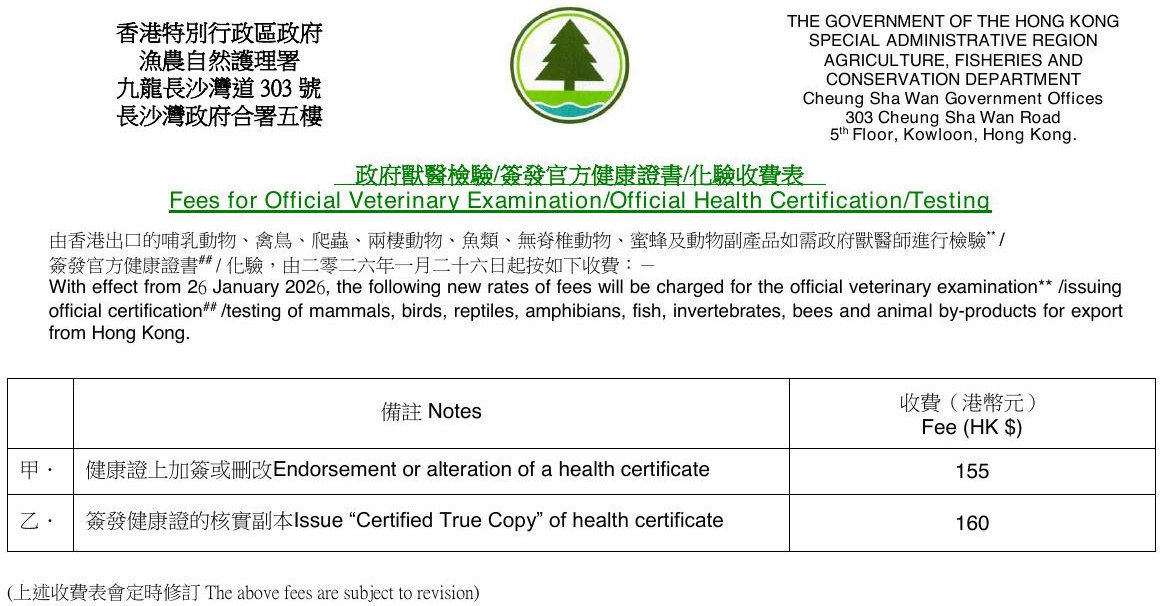
| Hong Kong | Endorsement or document verification by the Agriculture, Fisheries and Conservation Department (AFCD) | Proof the animal has lived in Hong Kong; dogs 5 months or older need a valid dog license | Endorsement or document verification: 1 working day; endorsement or amendment fee: HKD 155 |
| Taiwan | In-person field quarantine inspection at a branch or quarantine station of the Animal and Plant Health Inspection Agency (APHIA) | Pet registration certificate, immunization certificate | Declare within the validity period set by the importing country’s rules |
| Singapore | Manual endorsement by the Animal & Veterinary Service (AVS) | GoBusiness export permit | Manual endorsement: 2 working days; export permit standard service: SGD 50, 2 working days |
All three places also share one common requirement: dogs and cats must undergo a clinical examination within 10 days before departure, carried out by a private veterinarian or a government veterinarian of the exporting country.
- Dogs: must be confirmed free of, or showing no suspicion of, rabies and leptospirosis.
- Cats: only rabies needs to be confirmed.
Japan recommends using the Form AC certificate format, but it is not the only legally acceptable format. It can be completed in two ways:
- A private veterinarian completes it, and the exporting country’s government then endorses it (the government formally confirms the document).
- A government veterinarian completes every required item directly.
If there is not enough space on the form, additional information can be attached separately.
What Extra Do You Need From Hong Kong?
Two extra things are needed: official confirmation from AFCD, and proof that the animal has lived in Hong Kong.
Once a registered veterinarian has issued the animal health certificate, you can apply to AFCD for an official endorsement or document verification, that is, to have the government formally confirm the document. The application requires original copies of:
- The completed health certificate
- Vaccination records
- Dog license (dogs only)
- Import permit (if applicable)
- Other supporting documents
The health certificate generally must be issued within 10 days of departure, or as otherwise required by the destination. This Hong Kong deadline does not replace Japan’s separate requirement for a clinical examination within 10 days before departure.
Processing times and validity:
- Official endorsement or document verification: 1 working day.
- Government animal health certificate: available within 2 working days once all destination import requirements are met and documents are complete.
- Health certificate validity: as set by the destination, generally 10 days from the date of issue.
The proof-of-residency requirement is about establishing that the animal has lived in Hong Kong, not about the owner’s Hong Kong residency status. Acceptable documents include:
- Purchase or adoption records
- Ownership or transfer records
- Vaccination or medical records from a Hong Kong-registered veterinarian
- Records of the animal’s import into Hong Kong
Without proof of residency, the pet must be taken to AFCD to have its microchip scanned and its documents checked. The residency period is then counted from the day of the scan, and an additional endorsement fee applies. Applications that do not follow this procedure may be refused.
For example: if a dog is already over 5 months old, it needs a valid dog license. If there is no proof the dog has lived in Hong Kong, it must be taken to AFCD to have its microchip scanned.
A government veterinary examination with AFCD only needs to be booked when Japan specifically requires one, and the booking must be made at least 10 working days before the examination date. Not every dog or cat traveling from Hong Kong to Japan needs an in-person government veterinary examination.
The fee for endorsing or amending a health certificate is HKD 155. This is from the official fee schedule effective January 26, 2026; fees are revised periodically. This fee is not all-inclusive and does not cover the veterinary examination, vaccination, antibody testing or a government officer’s attendance.
What Order Do Steps Go in From Taiwan?
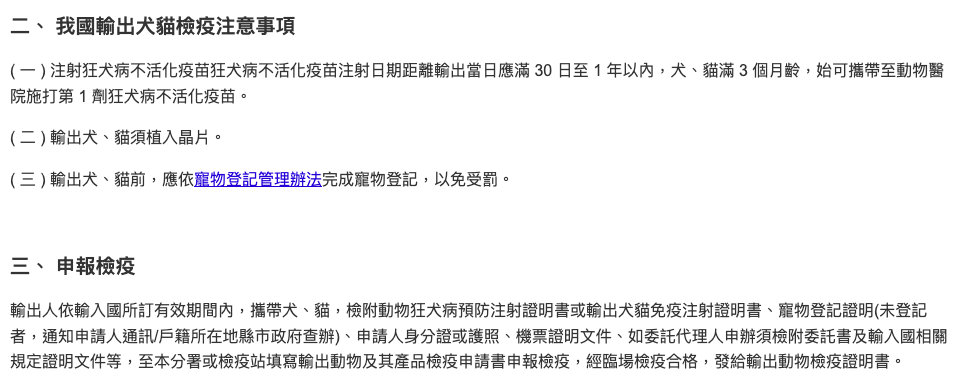
Complete microchipping, pet registration and vaccination first, then bring the dog or cat for field quarantine inspection, that is, an in-person check by quarantine officers.
According to the Taichung Branch of the Animal and Plant Health Inspection Agency (APHIA), the Taiwan side must:
- Vaccination: give the first dose of inactivated rabies vaccine only once the dog or cat is at least 3 months old.
- Timing: at least 30 days, and no more than 1 year, between the vaccination date and the export date.
- Microchip: implant a chip that meets the destination’s specifications.
- Registration: complete pet registration under the Regulations for Pet Registration Management before export.
- Certificate: the immunization certificate is issued by the administering veterinarian, stating the microchip number, date and vaccine type, and can be issued in English if the destination requires it.
These Taiwan export conditions do not replace Japan’s requirements. Japan’s general procedure requires vaccination after the animal is at least 91 days old, at least two vaccinations, an antibody test and a 180-day wait.
Before departure, the dog or cat must be declared at an APHIA branch or quarantine station within the validity period set by the importing country, in this case Japan. The declaration requires:
- The quarantine or health certificate Japan requires to be signed
- The test report signed by a designated laboratory
- Rabies or immunization certificate
- Pet registration certificate
- The applicant’s ID card or passport
- Flight ticket
- Any documents the destination requires
- A letter of authorization (if using an agent)
The export animal quarantine certificate is only issued once the in-person inspection is passed. Same-day issuance is not guaranteed; confirm available appointment slots directly with the branch or quarantine station handling the case.
For example: even if a cat has had the vaccination Taiwan requires, it still separately needs to meet Japan’s requirement for two vaccinations, an antibody test and the 180-day wait.
What Extra Procedures Does Singapore Require?
An export permit is required, that is, Singapore’s official permission for a dog or cat to leave the country, along with a manual endorsement for the certificate format Japan requires.
Key points on the export permit:
- Application: apply for and obtain it through GoBusiness within 90 days of departure.
- Validity: 90 days from the date of issue. This is the permit’s own validity period; it does not mean the health certificate is also valid for 90 days.
- Standard service: SGD 50 for a non-food animal permit for personal use, issued within 2 working days of complete document submission.
- Expedited service: SGD 100, issued within 1 working day of complete document submission.
The health certificate Japan requires follows this order:
- A licensed private veterinarian in Singapore examines the dog or cat and completes and signs the certificate.
- Apply to the Animal & Veterinary Service (AVS) through GoBusiness for endorsement in the destination’s format.
- Submit the original certificate, original vaccination and test records (where applicable), and the application number, per the checklist.
Once AVS has received the complete documents, the standard service time for manual endorsement is 2 working days, with no expedited option.
Singapore also offers a QR-code-verifiable government health certificate, valid for 7 days from the date of issue. This service is only available when the destination has no specific health certificate format. Since Japan has a recommended format, Form AC, it should not be assumed that this QR option is available for trips to Japan.
If Japan lists a pre-export examination as an entry condition, the appointment must be made at least 5 days (not 5 working days) before the animal’s departure. Booking is through the National Parks Board (NParks) e-service, and the examination must take place during the Changi Animal & Plant Quarantine Station’s operating hours. Showing up without an appointment incurs an examination fee.
Before departure, ground handling must be arranged through the carrying airline. On departure day, before handover to ground handling, the dog or cat must be accompanied by:
- A copy of the AVS export permit
- The original veterinary health certificate meeting the destination’s import or entry requirements
- Any other supporting documents the destination requires
For example: on departure day, a copy of the export permit is acceptable, but the original veterinary health certificate is required.
If You Are Not on a Direct Flight, Do Documents and Quarantine Locations Change?
Whether documents change depends on whether you enter the transit country; the quarantine authority handling the case does not change because of a layover.
- Transiting through an airport without entering the country: the exporting country’s government certificate is sufficient for Japan’s quarantine purposes.
- Bringing the dog or cat into the transit country: a separate government certificate from that country is also required.
- Connecting to a domestic flight after arriving in Japan: import quarantine is still handled by the Animal Quarantine Service office responsible for the international arrival airport.
Where the inspection happens after arrival in Japan depends on how the dog or cat is transported:
- Carried on board or checked as baggage: inspected at the animal quarantine counter in the baggage claim area, before the customs check.
- Shipped as manifest cargo: the pet is moved to the cargo warehouse in the cargo area, where animal quarantine is completed before customs procedures.
For cargo shipments, confirm the actual location and processing hours directly with the responsible Animal Quarantine Service office. Having a confirmed flight booking does not mean these arrangements are already in place.
Meeting Japan’s document requirements does not mean the transit country or the airline has no additional restrictions of their own. Before booking, check Japan’s declaration requirements, the airline’s requirements and the transit country’s rules separately. For how pets travel to Japan by cabin, checked baggage, cargo and airline rules, see Zagdim’s related guide (anchor text only; see notes).
What Document Should You Keep After Arriving in Japan?
Keep the import quarantine certificate (輸入検疫証明書). This certificate cannot be reissued, and it will be needed later if the pet leaves Japan again. For post-arrival procedures, see Zagdim’s guide on rabies quarantine, documents, waiting periods and flight arrangements for moving to Japan with pets (anchor text only; see notes).
FAQ
Does departing from Hong Kong require a government veterinary examination? Not necessarily. A government veterinary examination with AFCD only needs to be booked when Japan explicitly requires it, and the booking must be made at least 10 working days before the examination date. When this is not required, a health certificate issued by a registered veterinarian can be used to apply for AFCD’s endorsement or document verification.
Can Taiwan’s vaccination rules replace Japan’s 180-day wait? No. Taiwan’s export rules require the first dose of inactivated vaccine once the animal is at least 3 months old, with 30 days to 1 year between vaccination and export. Japan’s general procedure separately requires vaccination after the animal is at least 91 days old, at least two vaccinations, an antibody test and a 180-day wait.
Can Singapore’s QR-code health certificate be used for travel to Japan? It should not be assumed usable. The QR-code service is only offered when the destination has no specific health certificate format. Since Japan has a recommended format, Form AC, whether the QR certificate applies cannot be assumed on your own.
Glossary
- Designated region: the list of origin regions that Japan’s Ministry of Agriculture, Forestry and Fisheries (MAFF) Animal Quarantine Service places under a specific import procedure when classifying where dogs and cats come from. Hong Kong, Taiwan and Singapore are not on this list.
- Form AC: the certificate format Japan’s Animal Quarantine Service recommends for importing dogs and cats. It can be completed by a private veterinarian and then endorsed by the exporting country’s government, or completed entirely by a government veterinarian.
- AFCD: the Hong Kong Agriculture, Fisheries and Conservation Department, responsible for official endorsement and related certification of animal health certificates.
- AVS: Singapore’s Animal & Veterinary Service, responsible for export permits and endorsement of destination-format certificates.
- Export permit: the official permit required before a dog or cat can leave Singapore, valid for 90 days from the date of issue.
Research Notes
Facts in this article were checked as of October 31, 2026.
The following three points are this article’s own synthesis, or details the official sources do not state directly:
- The statement that Hong Kong, Taiwan and Singapore are all non-designated regions, and therefore all follow the non-designated-region procedure, is a conclusion drawn from comparing Japan’s list of designated regions. The official sources do not list the three places together.
- That Hong Kong applications without a government veterinary examination requirement instead use a registered veterinarian’s certificate to apply for endorsement is drawn from two of AFCD’s separate procedures.
- The relationship between Japan’s recommended Form AC and Singapore’s QR-code service is not stated directly by either official source.
Details on Japan-side documents and waiting periods follow the “non-designated region” section of the MAFF Animal Quarantine Service. Hong Kong and Singapore’s departure documents and timelines are compiled from each authority’s current pages. The Taiwan section is compiled from the Taichung Branch of APHIA’s pages.
This check did not verify actual appointment availability or same-day certificate issuance at each individual quarantine station in Taiwan. Hong Kong’s fee schedule also notes that fees are revised periodically. This article does not cover departure documents or official certification procedures for mainland China, and Malaysia’s departure procedures are also outside the scope of this comparison.
Have a question about this guide? Leave a comment below, or ask Zagdim directly.
Your first stop for international property and global living.
Research and insights. Know what’s changing. Understand what matters.
Sources
- Ministry of Agriculture, Forestry and Fisheries (MAFF), Animal Quarantine Service — 犬、猫の日本への入国(指定地域編)
- MAFF Animal Quarantine Service — 犬、猫の日本への入国(指定地域以外編)
- MAFF Animal Quarantine Service — 日本への犬、猫の持ち込みQ&A
- Hong Kong Agriculture, Fisheries and Conservation Department (AFCD) — the issue of an official Animal Health Certificate
- AFCD — Updates on Procedure for Official Endorsement/Certification of Export Documents for Dogs and Cats without Proof of Residency
- AFCD — Fees for Official Certification Services
- Taiwan Animal and Plant Health Inspection Agency (APHIA), Taichung Branch — 輸出犬貓專區
- National Parks Board, Animal & Veterinary Service (NParks/AVS) — Exporting dogs and cats
Important Notice
This article is a general information summary and does not constitute quarantine or legal advice for any individual case. Facts were checked as of October 31, 2026. Rules in Japan, Taiwan, Hong Kong and Singapore may be updated; refer to each authority’s current announcements, and consult a qualified professional for individual cases.