
































This article is part of Zagdim’s wiki series on setting up a company in Vietnam. It lays out the basic structure a foreign investor needs to understand before incorporating: who counts as a foreign-invested entity, what charter capital actually means, and what visa, work-permit, and compliance obligations follow from setting up a limited liability company (LLC) in Vietnam. It is written for an international reader considering setting up a company in Vietnam, working there, or living there long term, regardless of where that reader currently lives, including someone who is not currently in Vietnam at all.
To keep the explanation concrete, this article follows one example throughout: a foreign national, referred to here as the owner, who plans to set up and fully own a one-member LLC in Vietnam.
Who Counts as a Foreign Investor? Does Living Abroad Still Count?
This question is answered by nationality, not by where you live. Living abroad still counts: an individual holding foreign nationality is a foreign investor whether they are physically in Vietnam or overseas.
The test is nationality, or, for an organization, the law under which it was established, not residence. This status affects the market access rules that apply afterward (whether you can enter a given industry and what conditions apply), as well as investment registration and capital account procedures.
Vietnam’s Investment Law (Luật Đầu tư) defines these terms as follows:
- Foreign investor (nhà đầu tư nước ngoài): an individual holding foreign nationality, or an organization established under foreign law, that carries out investment and business activities in Vietnam.
- Foreign-invested economic organization (tổ chức kinh tế có vốn đầu tư nước ngoài): an economic organization (think of this, for a start, as a company or other business entity) that has a foreign investor as a member or shareholder, even if the foreign share is small.
**Term: Foreign-invested economic organization.** An economic organization with a foreign investor as a member or shareholder. The definition itself does not set a minimum ownership threshold.
For the reader, it does not matter whether you currently live in Taipei, Hong Kong, or Singapore: if you are an individual with foreign nationality, or you operate through a company established under foreign law to invest or do business in Vietnam, you fall within the foreign-investor framework. Investment registration, capital accounts, and reinvestment procedures each have their own separate rules, and should not be confused with the simple question of whether you count as a foreign investor at all.
In the example, the owner holds foreign nationality, so the owner counts as a foreign investor regardless of where the owner lives.
What Types of LLC Does Vietnam Have, and How Far Does Liability Go?
Vietnam has two kinds of LLC. A multi-member LLC has between 2 and 50 members; a single-member LLC has exactly one owner. For both, how far liability extends depends on whether the committed capital has actually been paid in full.
Multi-Member LLCs
A multi-member LLC (công ty trách nhiệm hữu hạn hai thành viên trở lên) can have 2 to 50 members, who may be organizations or individuals.
- General rule: each member is liable for the company’s debts and other property obligations only up to the amount they have actually contributed.
- Exception: if a member has not paid, or has not fully paid, their committed contribution, they remain liable, in proportion to their committed contribution, for the company’s financial obligations that arose before the charter capital and contribution-ratio registration was updated.
- Transfer: transferring a contributed capital portion (the share of the company your contribution represents) must follow the procedure set out in the Enterprise Law (Luật Doanh nghiệp).
Single-Member LLCs
An LLC owned by a single organization or individual is called a single-member LLC (công ty trách nhiệm hữu hạn một thành viên).
- General rule: the owner is liable for the company’s debts and other property obligations only up to the amount of the company’s charter capital.
- Exception: if a financial obligation or loss arises because capital was not contributed, was contributed incompletely, or was not contributed on time, the owner becomes liable using the whole of their personal or organizational property.
In other words, limited liability does not mean “you only ever lose the charter capital amount, no matter what.” If the committed capital is not paid in full on time, both types of LLC must, within 30 days of the deadline for full payment, register a change of charter capital to the amount actually paid in. For obligations that arose before that change is registered, multi-member LLC members remain liable in proportion to their committed contribution, and single-member LLC owners remain liable up to their committed contribution amount. A single-member LLC owner may also end up liable with their entire property if a financial obligation or loss arises from non-contribution, incomplete contribution, or late contribution.
In the example, if the owner failed to contribute capital on time and this caused a financial obligation or loss for the company, the owner would be liable using the whole of their personal property.
What Is Charter Capital, and Does It Have to Match the Project Budget?
Charter capital and project budget are two different things. They do not have to be equal: when a foreign investor sets up an economic organization to carry out an investment project, the organization’s charter capital does not have to equal that project’s investment capital (vốn đầu tư).
An LLC’s charter capital (vốn điều lệ) is the total value of the assets that the company’s members or owner have invested, or committed to invest, at the time of establishment. In other words, the registered capital figure is not the same as the amount of assets that has actually been paid into the company by any given moment.
The company has to contribute capital according to the schedule set out in its Investment Registration Certificate (Giấy chứng nhận đăng ký đầu tư, IRC), and must also raise whatever other funding the project needs. For a first understanding, think of the IRC as the registration document for the investment project itself.
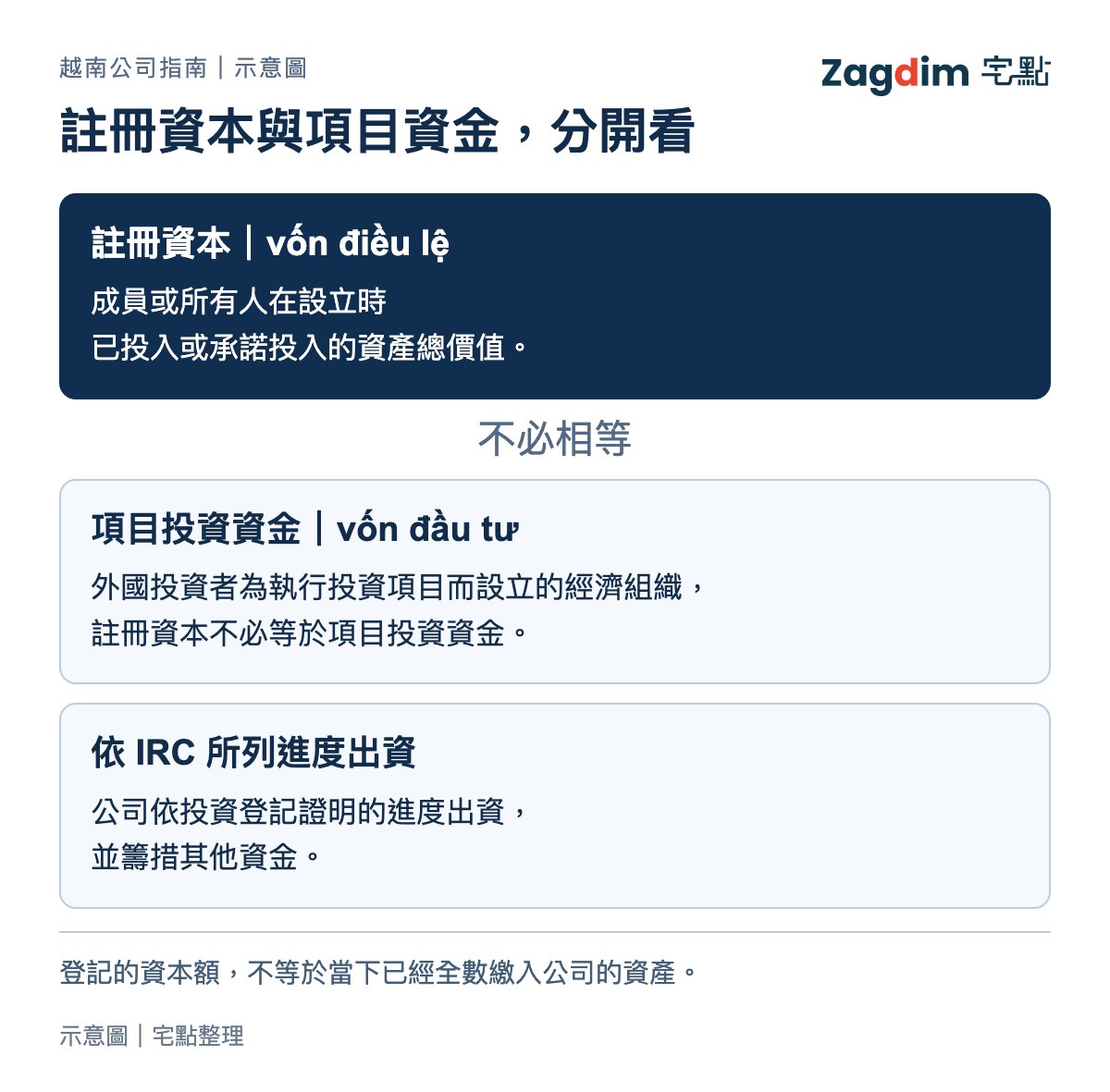
So do not simply enter the project’s total budget as the charter capital figure. For more detail on this distinction, see the related Zagdim wiki article on how much charter capital to register for a Vietnamese company and how that figure affects banking, tax, and day-to-day operations.
How Long Do You Have to Pay In the Capital, and What Happens If You Don’t?
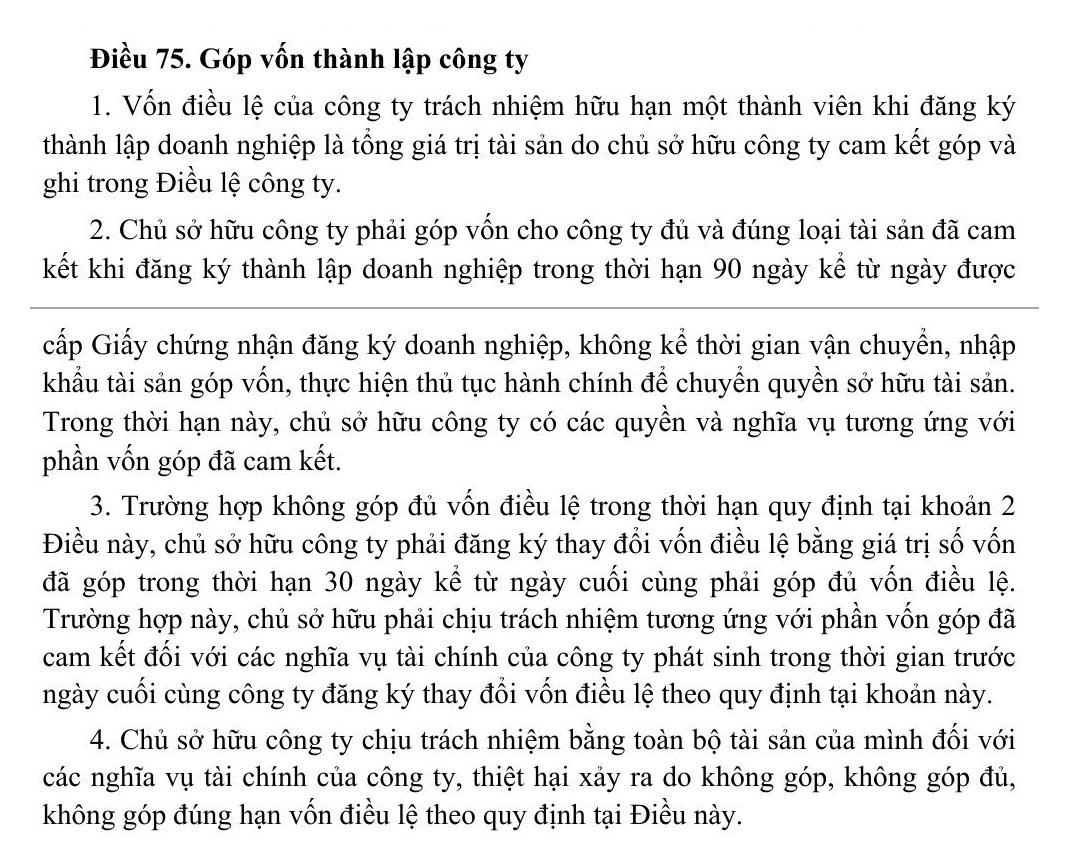
There is a hard deadline for paying in capital, and it is 90 days. Whether the LLC is a multi-member or single-member company, members or the owner must contribute the full committed amount, in the committed asset types, within 90 days from the date the Enterprise Registration Certificate (Giấy chứng nhận đăng ký doanh nghiệp, ERC) is issued.
- Time not counted toward the 90 days: time spent transporting or importing the contributed assets, and time spent on the administrative procedures for transferring ownership of those assets.
- Rights and obligations during this period: calculated according to the committed contribution ratio for multi-member LLC members, and according to the committed contribution amount for single-member LLC owners.
- Switching to a different contributed asset: for a multi-member LLC, this requires the approval of more than half of the remaining members.
Failing to pay in full has at least two direct consequences:
- Liability: if capital is not paid in full, both types of company must, within 30 days, register a change of charter capital to the amount actually paid in. For financial obligations that arose before that change is registered, multi-member LLC members remain liable in proportion to their committed contribution, and single-member LLC owners remain liable up to their committed contribution amount. If a single-member LLC’s financial obligation or loss arises from non-contribution, incomplete contribution, or late contribution, the owner may need to answer for it with the whole of their personal or organizational property.
- Tax deduction for loan interest: when calculating taxable corporate income, interest on loans that correspond to the charter-capital contribution schedule, for the portion of charter capital not yet paid in full, is not deductible. The charter schedule itself cannot run longer than the contribution deadline set by the Enterprise Law, even once the company has already started operating.
In the example, the owner’s 90-day period runs from the date the ERC is issued, and only the specific exclusions listed above stop that clock.
For more on the related capital-account procedures, including whether a capital account can be opened before the IRC is issued, see the Zagdim wiki articles on how to set up a Vietnamese LLC (company name, shareholders, legal representative, and charter capital) and on which licenses a foreign-owned Vietnamese company needs (IRC, ERC, and industry restrictions).
Does Setting Up a Company Mean You Can Live or Work in Vietnam?
No, it does not. Incorporating a company does not automatically bring a visa or residency with it. Company registration and personal visa status are two separate systems.
Investment Visas and How They Match Your Capital Contribution
Visa category depends on how much you have contributed. Investment visas are categorized according to the contribution value of the foreign investor, or of the representative of a foreign investing organization. Three of the categories are:
| Category | Contribution Value | Maximum Visa Validity |
|---|---|---|
| Investment Visa Category 1 (ĐT1) | At least 100 billion VND, or investment in an industry or region the government has designated for investment incentives | 5 years |
| Investment Visa Category 3 (ĐT3) | At least 3 billion but less than 50 billion VND | 3 years |
| Investment Visa Category 4 (ĐT4) | Less than 3 billion VND | 1 year |
- All of the validity periods above must be at least 30 days shorter than the validity of the holder’s passport or other international travel document.
- Where an international treaty Vietnam has joined sets a different period, the treaty’s terms apply instead.
- The threshold is based on the contribution value, not the company’s total capital.
- A maximum validity period is not a guarantee that a visa of that length will actually be issued.
The Work Permit Threshold and What Still Applies
Reaching the contribution threshold lets you skip one document, but it does not exempt you from everything. If you are an LLC owner or a capital-contributing member, and your contribution value is at least 3 billion VND:
- You are not among those who need to obtain a work permit (giấy phép lao động), and you also do not need to apply for a work-permit exemption confirmation.
- You still need to notify the confirming authority for your intended place of work, at least 3 working days before you expect to start working in Vietnam, giving your name, date of birth, nationality, passport number, employer’s name, and the location and period of the work.
Investment-Category Temporary Residence Cards
Temporary residence cards are also tied to category. The investment-category temporary residence card (thẻ tạm trú) covers ĐT1, ĐT2, and ĐT3, but not ĐT4.
- A foreigner already residing temporarily in Vietnam who is eligible for an ĐT1 visa is within scope to apply for a temporary residence card.
- The ĐT1-linked temporary residence card has a maximum validity of 10 years, and its issued period must be at least 30 days shorter than the holder’s remaining passport validity.
- A holder of an ĐT4 visa may still be able to apply under a different, independent qualification, such as employment or a family relationship, which needs to be assessed separately.
Applying for an investment visa also requires:
- Holding a passport or other international travel document.
- Submitting documents that prove the Vietnam-based investment under the Investment Law.
- Not falling under any of the grounds for refusal of entry.
- Being invited or sponsored by an agency, organization, or individual inside Vietnam, subject to statutory exceptions to this invitation/sponsorship requirement.
In the example, if the owner’s contribution value is 3 billion VND, that falls within the ĐT3 contribution range and also meets the work-permit contribution threshold, but the owner would still need to give advance notice, and the visa itself is not automatically granted.
For a fuller picture of how the investment visa, work permit, and temporary residence card fit together, see the Zagdim wiki article on whether setting up a Vietnamese company solves the visa question.
What Ongoing Responsibilities Come After the Company Is Set Up?
Setting up the company is only the start. A series of fixed obligations follow, mainly around accounting and audit, tax, employee social insurance, investment project reporting, and restrictions on repatriating profit.
Accounting and Audit
The company must keep annual accounts, and a foreign-invested enterprise’s annual financial statements must additionally be audited (checked by an auditing firm).
- Accounting year (kỳ kế toán năm): normally the 12 months from January 1 to December 31. If the organization or its operations have particular characteristics, it may instead choose a full 12-month period running from the first day of a quarter to the last day of the corresponding quarter the following year, but it must notify the finance and tax authorities of this choice.
- Annual financial statements (báo cáo tài chính năm): must be submitted to the competent state authority within 90 days of the end of the accounting year.
- Audit: under the law, a foreign-invested enterprise’s (doanh nghiệp có vốn đầu tư nước ngoài) annual financial statements fall within the scope of statements that must be audited by an auditing firm, or by the Vietnam branch of a foreign auditing firm. A company cannot decide on its own that it is exempt from audit simply because it is small, has no revenue yet, or was only just established.
Main Taxes
Vietnamese companies mainly encounter corporate income tax and value-added tax.
Corporate income tax (thuế thu nhập doanh nghiệp) is a tax on income, with a general rate of 20 percent, alongside preferential rates and exemptions, and higher rates for certain resource-based industries. The rules for lower-revenue companies are as follows:
| Previous Taxable Year’s Total Revenue | Corporate Income Tax Rule |
|---|---|
| Not exceeding 1 billion VND | Income falls within the tax-exempt range |
| Not exceeding 3 billion VND | 15% rate applies |
| Over 3 billion up to 50 billion VND | 17% rate applies |
These rules do not apply to related-party subsidiaries or affiliated enterprises that fail to meet the conditions, nor to income that is excluded by law, such as income from capital transfers; being exempt from tax is also not the same as being exempt from filing a return.
Value-added tax (thuế giá trị gia tăng, VAT) taxes the value added to goods and services as they move from production through distribution to consumption. Goods and services produced, traded, or consumed in Vietnam fall within the scope of VAT unless the law specifically excludes them.
Separately, the collection of the business license fee (lệ phí môn bài) stopped as of January 1, 2026, but this does not mean exemption from enterprise registration fees, other taxes and fees, or any existing arrears.
Employee Social Insurance
If the company hires staff, it also has to consider mandatory social insurance (bảo hiểm xã hội bắt buộc), meaning insurance that must be joined once the conditions for it are met.
- Vietnamese employees: anyone working under an indefinite-term labor contract, or a fixed-term contract of at least one month, falls within mandatory social insurance. This applies regardless of what the contract is called, as long as the substance is paid work carried out under another party’s management, direction, and supervision. For part-time employees, the monthly salary needs to reach the minimum wage base used to calculate mandatory social insurance contributions.
- Foreign employees: anyone who signs a fixed-term labor contract of at least 12 months with an employer inside Vietnam falls within mandatory social insurance, except for intra-company transferees, those who had already reached statutory retirement age at the time of signing, or cases otherwise covered by an international treaty Vietnam has joined.
- Not within the mandatory scope: people already drawing a pension or otherwise excluded by law, people receiving a monthly allowance, and household domestic workers.
Investment Project Reporting
Investment projects have to be reported to the government on a regular basis. The economic organization carrying out the investment project must submit the following reports to the local investment registration and statistics authority:
| Report | Due By | Content |
|---|---|---|
| Quarterly report | By the 10th of the first month of the following quarter | Investment disbursement, net revenue, imports and exports, labor use, taxes and fees, and land and water-surface use |
| Annual report | By March 31 of the following year | All of the above, plus profit, employee income, R&D spending and investment, environmental treatment and protection measures, and the source of technology used |
Restrictions on Repatriating Profit
Money the company earns cannot necessarily be sent out of Vietnam whenever the owner wants. A foreign investor’s annual direct-investment profit can only be remitted abroad once the following have been completed:
- The accounting year has closed.
- The invested enterprise has fulfilled its financial obligations to the Vietnamese state.
- The audited financial statements and the annual corporate income tax settlement return (the filing that finalizes the full year’s tax liability after year-end) have been submitted to the directly competent tax authority.
If, after lawfully carrying forward prior losses, the financial statement for the profit-making year still shows an accumulated loss, that year’s profit cannot be remitted. The investor, or the enterprise entrusted to handle the remittance, must also notify the tax authority, in the prescribed format, at least 7 working days before the remittance is made.
In the example, even in a year when the owner’s company made a profit, these procedures would all have to be completed before that year’s profit could be sent abroad.
For more detail on accounting, tax, social insurance, and annual compliance, see the Zagdim wiki article on what comes after a Vietnamese company is set up: accounting, tax, social insurance, and annual compliance obligations.
What Other Structural Points Should You Settle Before Incorporating?
This section covers the head office address, the legal representative, beneficial owner declaration, and the order in which the ERC and IRC are obtained.
Head Office Address and the Legal Representative’s Residency Requirement
Both the address and at least one person have to be anchored in Vietnam. The enterprise’s head office (trụ sở chính) must be located inside Vietnam, serving as the company’s contact address, defined by administrative area, and it must have a phone number; a fax number and an email address, if the company has them, should also be listed. In other words, an overseas address cannot be used as the registered address of a Vietnamese company.
The legal representative (người đại diện theo pháp luật) is the person who legally represents the company. The requirements are:
- The enterprise must always have at least one legal representative who resides in Vietnam.
- If only one Vietnam-resident legal representative remains and that person leaves the country, they must give written authorization to another individual who resides in Vietnam to exercise the relevant rights and obligations on their behalf.
- The original legal representative remains responsible for the matters they authorized.
- This residency obligation applies only to the legal representative, not to every shareholder.
In the example, the owner would not have to relocate to Vietnam because of this rule; but if the owner continues living outside Vietnam, the company still needs a legal representative who resides in Vietnam.
Beneficial Owner Declaration
The company has to make clear who is really behind it. A beneficial owner (chủ sở hữu hưởng lợi) is the individual who ultimately owns or controls the enterprise in practice.
The company’s founders and the company itself must identify the beneficial owner, declare and notify that information to the business registration authority, and examine the ownership structure layer by layer. Simply listing the direct shareholders is not enough to count as identification complete; if a higher layer in the structure is an overseas company, the tracing has to continue up to the ultimate individual. Where the structure includes a legal arrangement covered by anti-money-laundering law, that arrangement’s beneficial owner is determined according to the anti-money-laundering rules.
Identification can follow this order:
- Look at the shareholding: a natural person (a real individual) who holds, directly, indirectly, or in aggregate, at least 25 percent of the charter capital or voting shares.
- Look at the group: a group of natural persons connected by a statutory family or contractual relationship who together hold 25 percent must each be identified individually.
- Look at actual control: if no one meets the shareholding test, or there is reason to believe that whoever nominally meets it is not the real beneficial owner, the inquiry goes further, for example into who appoints or removes management, amends the charter, sets financial and operating policy, or decides on restructuring or dissolution.
- Look at the managers: if still no one is identified, the manager with the highest authority who can act on the company’s behalf is identified instead.
Related to this, company owners, shareholders, and members must not contribute capital on someone else’s behalf while putting their own name on the record. “Nominee holding” means the name on record is yours while the real contributor is someone else. That is different from a legitimate corporate shareholder appointing an authorized representative, which is not the same as using a false name to conceal the real contributor.
Can You Get the ERC First and the IRC Later?
Yes, but when a foreign investor first sets up the economic organization that will carry out the investment project, and only later obtains or adjusts the IRC, the following conditions apply:
- The organization must already meet the foreign market-access conditions at the time it is set up.
- It must complete the procedure to obtain an IRC matching its business lines within 12 months of being set up.
- Additional business lines can only be added after the IRC has been obtained.
- The IRC issuance or adjustment procedure must be completed before the investment project can actually be carried out.
In short, “set up the company first and sort out the IRC later” is not an unconditional shortcut. For the fuller picture of the related licenses and industry restrictions, see the Zagdim wiki article on which licenses a foreign-owned Vietnamese company needs (IRC, ERC, and industry restrictions).
Frequently Asked Questions
Can a foreigner own 100 percent of any Vietnamese company? Not in every industry. Foreign investors are, in principle, subject to the same market-access conditions as domestic investors, but the list of restrictions on foreign investment separately divides industries into “market access not yet open” and “conditional market access.” Conditional access can involve limits on the foreign ownership ratio, the permitted investment form, the scope of activity, and other conditions set by law or by an international treaty Vietnam has joined.
Does getting the ERC mean every line of business can start right away? No. The ERC also serves as the enterprise’s tax registration certificate, but it is not a business license (giấy phép kinh doanh). A company operating in a conditional business line (one that requires specific conditions to be met before it can operate), or in an industry where foreign investors face conditional market access, still has to meet the relevant conditions under the law, and keep meeting them throughout the whole period it stays in business.
Can the owner of a one-person company simply treat household spending as company spending? No. A single-member LLC owner’s personal property must be clearly separated from the company’s property. Where the owner is an individual, personal and family spending must also be kept separate from spending related to roles such as chairman, manager, or general director of the company.
Does applying for dissolution end all responsibility if the company no longer wants to operate? No. An enterprise can only be dissolved once it has ensured that all debts and other property obligations have been settled, and only if it is not involved in a court or arbitration dispute. Enterprises dissolved because their ERC was revoked, and the relevant managers, bear joint liability for the enterprise’s debts, meaning they are jointly responsible for those debts together.
Has the new list under the amended Investment Law already taken effect? Not yet. As of November 2, 2026, the provisions of the Law Amending and Supplementing a Number of Articles of the Investment Law (Luật sửa đổi, bổ sung một số điều của Luật Đầu tư) that would replace the list of conditional investment and business lines have not yet taken effect; they are due to take effect from March 1, 2027. Some other provisions of that same law take effect separately from January 1, 2027.
Glossary
- Enterprise Registration Certificate (ERC): the document that gives an LLC legal-person status (makes it a separate legal entity in its own right) from the date it is issued. It also serves as the enterprise’s tax registration certificate, but it is not a business license.
- Investment Registration Certificate (IRC): the registration document for a foreign investor’s investment project under the Investment Law. Whether one is required depends on the specific circumstances set out by law.
- Charter capital: the total value of assets that a company’s members or owner have invested, or committed to invest, at the time of establishment. It is distinct from project investment capital.
- Legal representative: a Vietnamese enterprise must always have at least one legal representative who resides in Vietnam, but this residency obligation does not extend to every shareholder.
About the Information in This Article
This article’s facts were checked on November 2, 2026. Its conclusions on the definitions of foreign investor and foreign-invested economic organization, LLC liability, charter capital and the contribution deadline, the legal representative’s residency requirement, beneficial owner declaration, investment visas and temporary residence cards, the work-permit exemption, the corporate income tax and VAT framework, the scope of mandatory social insurance, annual financial statements and audit, investment reporting, and profit repatriation, are drawn from Vietnamese laws, government decrees, and ministry circulars; the authorities have not combined all of this into a single official question-and-answer document. Two points, in particular, are inferences drawn from the wording of the law rather than something stated directly by the authorities: that the definition of a foreign-invested economic organization sets no minimum ownership threshold, and that an overseas address cannot be used as the registered address of a Vietnamese company.
The section on investment visas lists only ĐT1, ĐT3, and ĐT4; it does not list the contribution threshold and validity period for Investment Visa Category 2 (ĐT2).
The rules on transferring a contributed capital portion are found in Articles 51 through 53 of the Enterprise Law. The Investment Law 143/2025/QH15 generally took effect from March 1, 2026, with some provisions taking effect separately from January 1, 2026 and July 1, 2026; the Law Amending and Supplementing a Number of Articles of the Investment Law, 24/2026/QH16, takes effect separately from January 1, 2027 and March 1, 2027, and had not yet taken effect as of the fact-check date.
The owner referred to throughout this article is an illustrative example, not a real case.
Need help with this? Talk to the Zagdim reader desk
If you are weighing whether to set up a company in Vietnam, or want help thinking through the capital and compliance steps, the Zagdim reader desk can arrange a suitable specialist for your situation. The first consultation is free.
Message the Zagdim reader desk on WhatsApp Message the Zagdim reader desk on LINE
Have a question about this guide? Leave a comment below, or ask Zagdim directly.
Your first stop for international property and global living.
Research and insights. Know what’s changing. Understand what matters.
Sources
- Quốc hội-Luật số 143/2025/QH15 luật Đầu tư
- Văn phòng Quốc hội-Văn bản hợp nhất số 67/VBHN-VPQH hợp nhất Luật Doanh nghiệp
- Chính phủ-Nghị định số 96/2026/NĐ-CP quy định chi tiết và hướng dẫn thi hành một số điều của Luật Đầu tư
- Chính phủ-Nghị định số 168/2025/NĐ-CP về đăng ký doanh nghiệp
- Chính phủ-Nghị định số 296/2026/NĐ-CP sửa đổi, bổ sung một số điều của Nghị định số 168/2025/NĐ-CP
- Văn phòng Quốc hội-Văn bản hợp nhất số 62/VBHN-VPQH hợp nhất Luật Nhập cảnh, xuất cảnh, quá cảnh, cư trú của người nước ngoài tại Việt Nam
- Chính phủ-Nghị định số 219/2025/NĐ-CP quy định về người lao động nước ngoài làm việc tại Việt Nam
- Bộ Tài chính-Văn bản hợp nhất số 19/VBHN-BTC hợp nhất Nghị định Quy định chi tiết một số điều và biện pháp để tổ chức, hướng dẫn thi hành Luật Thuế thu nhập doanh nghiệp
- Bộ Tài chính-Thông tư số 186/2010/TT-BTC hướng dẫn thực hiện việc chuyển lợi nhuận ra nước ngoài
- Văn phòng Quốc hội-Văn bản hợp nhất số 41/VBHN-VPQH hợp nhất Luật Kế toán
- Văn phòng Quốc hội-Văn bản hợp nhất số 17/VBHN-VPQH hợp nhất Luật Kiểm toán độc lập
- Văn phòng Quốc hội-Văn bản hợp nhất số 113/VBHN-VPQH hợp nhất Luật Thuế Thu nhập doanh nghiệp
- Văn phòng Quốc hội-Văn bản hợp nhất số 19/VBHN-VPQH hợp nhất Luật Bảo hiểm xã hội
- Quốc hội-Nghị quyết số 198/2025/QH15 về một số cơ chế, chính sách đặc biệt phát triển kinh tế tư nhân
- Văn phòng Quốc hội-Văn bản hợp nhất số 114/VBHN-VPQH hợp nhất Luật Thuế Giá trị gia tăng
- Quốc hội-Luật số 24/2026/QH16 luật Sửa đổi, bổ sung một số điều của Luật Đầu tư
Disclaimer
This article is a general information summary and does not constitute tax or legal advice for any individual case. Its facts were checked on November 2, 2026. Vietnamese rules, and the rules of other jurisdictions mentioned for context, may be updated; readers should rely on the current announcements of the relevant authorities, and consult a qualified professional for their own situation.