































Ejari Registration in Dubai Is Not Optional: Unregistered Leases Cannot Be Used for Disputes or Government Procedures
Ejari registration in Dubai is a legal requirement: under Article 4(2) of Law No. 26 of 2007, as amended by Law No. 33 of 2008, every lease covered by the law must be registered with the Real Estate Regulatory Agency (RERA), and courts and government departments may not consider any dispute, claim or other action relating to an unregistered lease.
On 2 November 2026 the Dubai Land Department (DLD) announced that landlords and tenants can now create, register, renew and cancel Ejari contracts in the government’s DubaiNow app, signing electronically with UAE PASS. The same journey lets tenants pay the Dubai Electricity and Water Authority (DEWA) security deposit and activate electricity and water. Khaleej Times and Gulf News reported the launch the same day as a joint effort by the DLD, DEWA and Digital Dubai.
The new app saves a trip, but many newcomers still do not know what Ejari is or who is supposed to handle it. This guide covers what Ejari is, what gets blocked without it, which channels to use and what they cost, and what to do when you renew or move out.
Key Points
- Who should read this: foreign residents renting in Dubai, people relocating for a new job, tenants about to renew or move, and individual landlords letting their own property.
- Ejari registration is not a formality: without it, DEWA activation, using your lease as proof of address, and any deposit or rent dispute all stall.
- DubaiNow became an option on 2 November 2026, but only for individual landlords who own and manage their own property. Properties handled by a management company go through the company or another channel.
- Before you move out, cancel the Ejari and request a DEWA move-out so your deposit is settled properly.
What Is Ejari, and Who Registers It?
Ejari is the online tenancy registration system that RERA developed under Law No. 26 of 2007. It covers all types of property in the Emirate of Dubai. Once a lease is registered, the DLD issues an e-Contract Registration Certificate, commonly called the Ejari certificate.
The law says leases “will be registered with RERA” but does not say whether the landlord or the tenant must do it. In practice it depends on the channel:
- DubaiNow: the landlord starts the contract, fills it in, signs it and sends it to the tenant. The tenant reviews, signs with UAE PASS and pays the service fee.
- Real Estate Services Trustee Centers: the applicant is the tenant or a representative holding an official power of attorney.
- Ejari system (DLD website): used by licensed property management companies and by owners who manage their own property.
Before you sign, ask who manages the property, who will register the Ejari and who pays the fee, and get the answer in the contract or in writing.
What Gets Blocked Without Ejari Registration in Dubai
Article 4(2) is blunt: if a matter relates to the lease, nothing happens until the lease is registered. For tenants, these are the situations that come up most:
| What gets blocked | Why Ejari matters | Source |
|---|---|---|
| DEWA electricity and water | Outside free zones, DEWA requires a valid Ejari number from tenants. Once Ejari is issued, DEWA sends the account number and deposit payment link automatically | DEWA move-in service page |
| Government procedures that rely on your lease | Government departments and bodies may not take any action relating to an unregistered lease | Law No. 26 of 2007, Article 4(2) |
| Housing condition for family residence | Dubai’s GDRFA lists “providing suitable housing for family members” as a condition; if your lease is your proof of housing, it needs to be registered | GDRFA service page; Article 4(2) |
| Deposit and rent disputes | The law requires the landlord to refund the security deposit or its balance when the lease expires, but courts will not hear a dispute over an unregistered lease | Articles 20 and 4(2) |
The GDRFA page does not list which housing document to upload. Check the documents the system asks for when you apply for family residence.
How to Complete Ejari Registration in Dubai: Channels, Documents and Fees
The DLD lists DubaiNow, the Dubai REST app, the Ejari system on the DLD website and the Real Estate Services Trustee Centers as channels for registering or renewing a lease. Everything below comes from the DLD service pages (accessed 3 November 2026):
| Channel | Who can use it | What you need | Fee (AED) | Time |
|---|---|---|---|---|
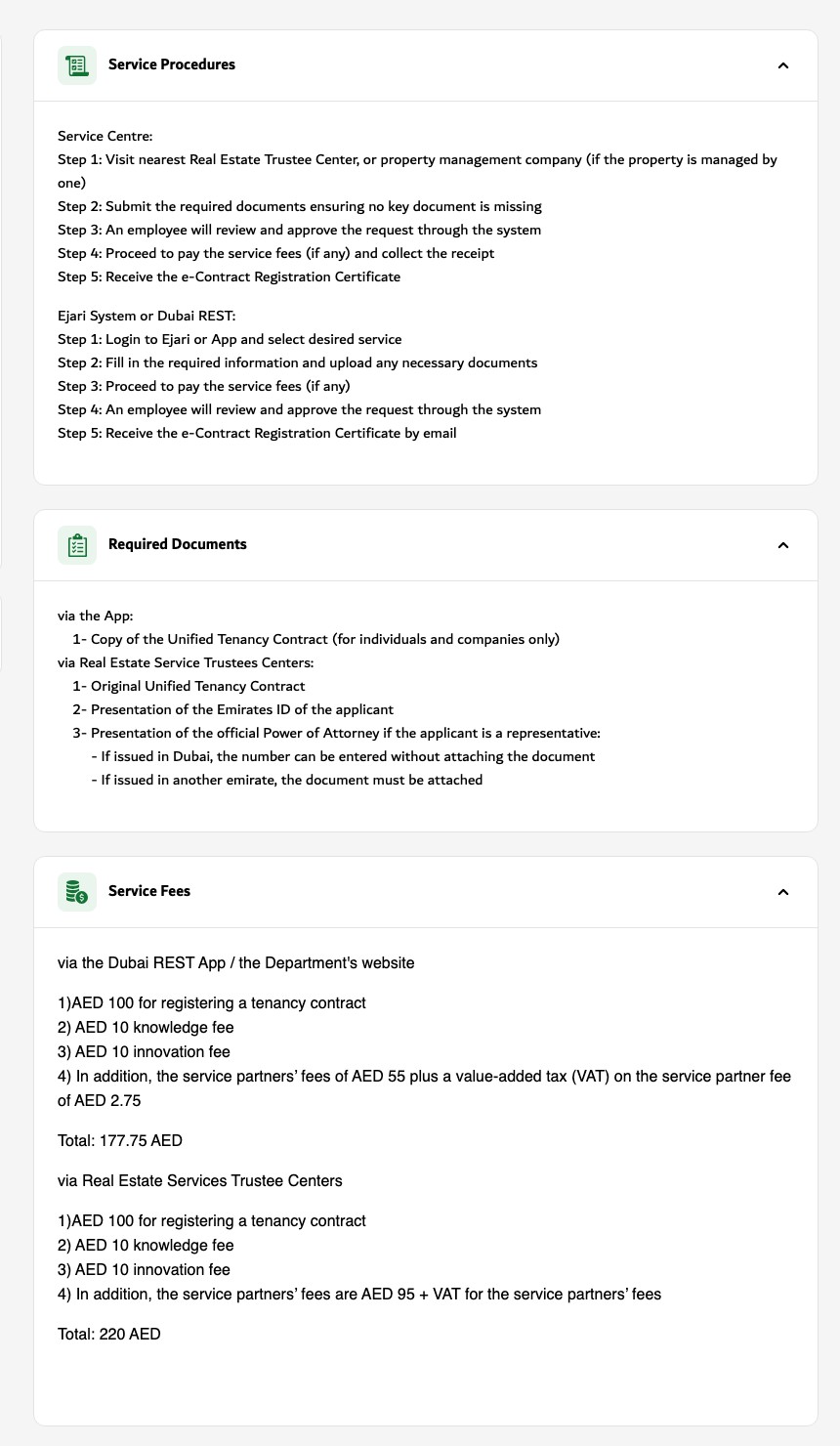
| DubaiNow | Individual landlords who own and manage their property, and their tenants; both need a valid Emirates ID | Valid Emirates ID; electronic signature with UAE PASS | 177.75 | Instant |
| Dubai REST app / DLD website | App: landlord and tenant are both individuals and the owner’s data is up to date; system: licensed management companies or self-managing owners | Copy of the Unified Tenancy Contract | 177.75 | Reviewed by DLD staff; certificate sent by email |
| Real Estate Services Trustee Centers | Property not managed by a real estate company or an owner with Ejari access; applicant is the tenant or a representative | Original Unified Tenancy Contract; applicant’s Emirates ID; official power of attorney for a representative | 220 | 25 minutes, excluding waiting time |
The online fee of AED 177.75 is made up of the AED 100 registration fee, a AED 55 service partner fee, a AED 10 knowledge fee, a AED 10 innovation fee and AED 2.75 in VAT on the service partner fee. At trustee centres the service partner fee is AED 95 plus VAT, bringing the total to AED 220. Trustee centres and the online system accept credit card, cash and the Noqodi wallet; the DubaiNow page lists Noqodi only.
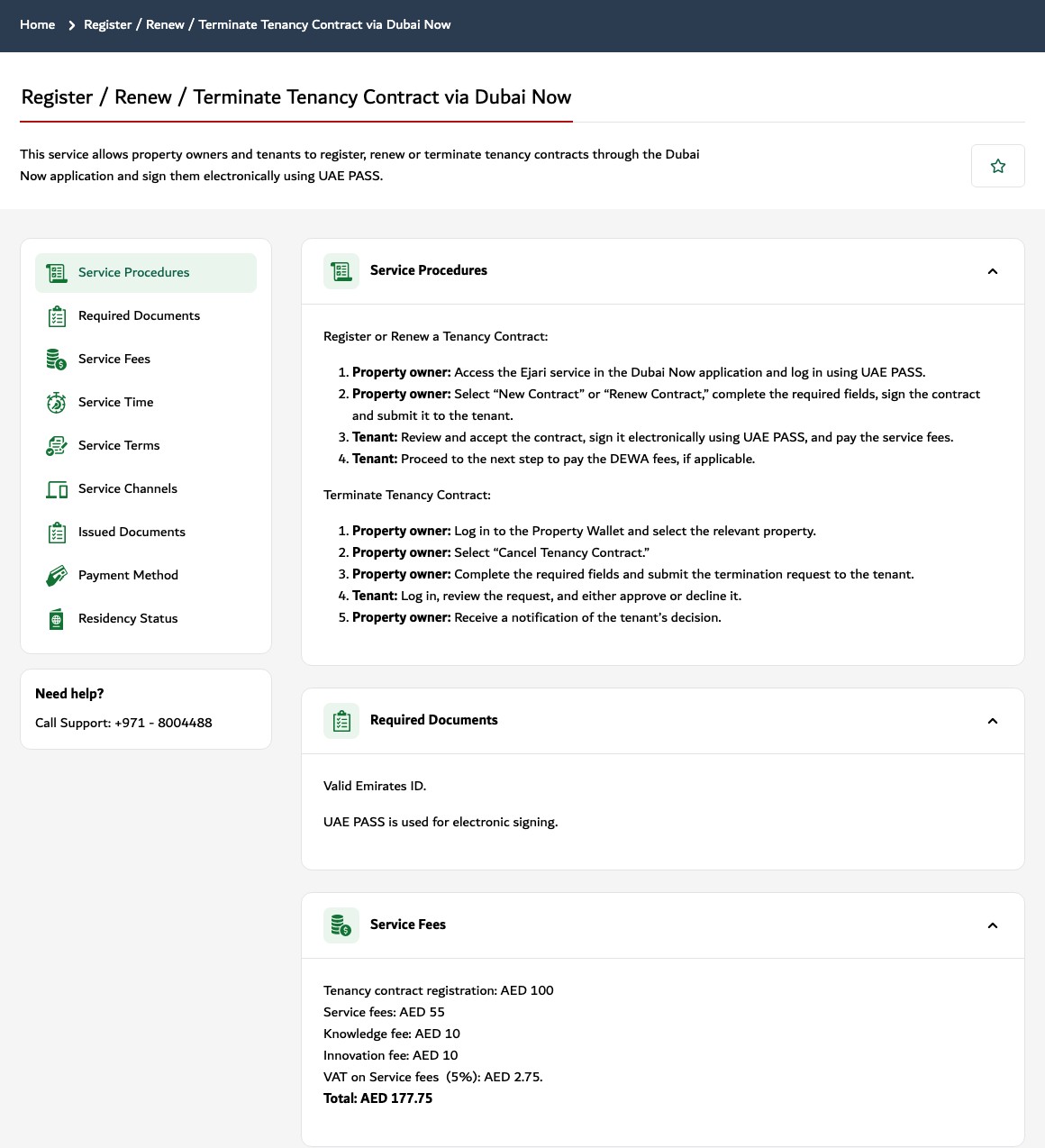
If a management company handles the property, the DLD’s service centre steps say you can go to that company. A power of attorney issued in Dubai only needs its number entered; one issued in another emirate must be attached.
Ejari Registration on DubaiNow: The Landlord Starts, the Tenant Signs and Pays
According to the DLD’s DubaiNow service page, registration and renewal work like this:
- Landlord: opens the Ejari service in DubaiNow and logs in with UAE PASS.
- Landlord: selects “New Contract” or “Renew Contract”, completes the fields, signs and sends it to the tenant.
- Tenant: reviews and accepts the contract, signs with UAE PASS and pays the service fees.
- Tenant: moves on to pay DEWA fees, if applicable.
The DLD said on 2 November that the Ejari certificate is issued as soon as the contract is approved. If you do not yet have an Emirates ID and cannot use UAE PASS, this route is closed to you for now, so agree another channel with your landlord or management company.
Renewing and Cancelling Ejari in Dubai: Renew With the Lease, Cancel Before You Leave
Renewal: the DLD treats registration and renewal as one service, so the channels, documents and fees for a renewal are the same as for a new registration. Each new lease term needs its own renewal. Article 6 of Law No. 26 of 2007 also says that if a lease expires and the tenant stays on without objection from the landlord, the lease is renewed on the same terms for the original term or one year, whichever is shorter.
Cancellation: the DLD’s cancellation service covers leases that have expired for property that has been vacated. Everything below comes from the DLD’s Cancel Tenancy Contract page:
| Channel | How it works | Fee |
|---|---|---|
| Ejari system / Dubai REST app | Log in, select the service and submit; you receive an email once it is approved | Free |
| DubaiNow | The landlord selects the property in Property Wallet and sends a cancellation request; the tenant logs in to approve or decline, and the landlord is notified; no document is issued | No separate fee listed |
| Real Estate Services Trustee Centers | Bring the original Unified Tenancy Contract and Emirates ID (and power of attorney for a representative); if the lease is still active, a letter from the owner requesting cancellation is also needed | Service partner fee of AED 40 plus VAT |
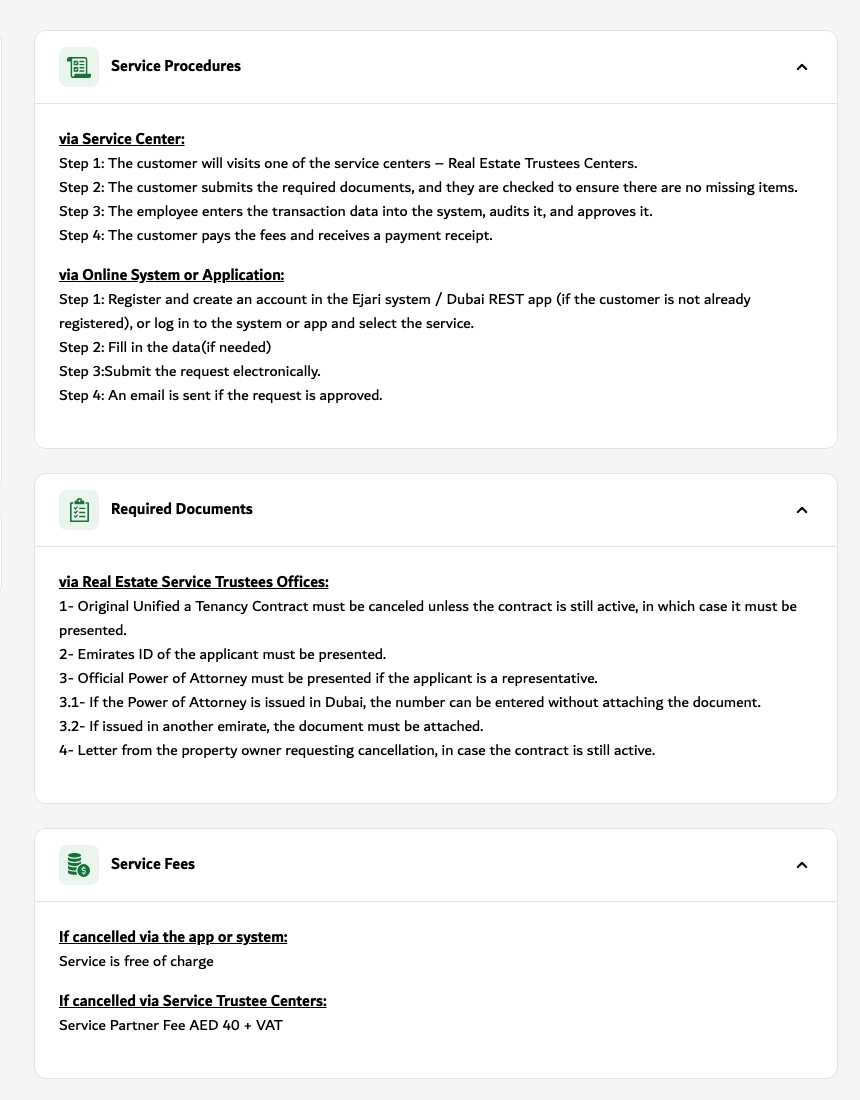
When you move, cancelling Ejari and closing your DEWA account are two separate steps, and you need both. DEWA’s move-out service is integrated with RERA’s tenancy termination, and your details are shared with the DLD.
DEWA Move-In and Move-Out in Dubai: Deposit, Connection Time and Refunds
DEWA’s move-in page says that once Ejari is issued, DEWA automatically emails and texts the tenant an account number, the deposit amount and a payment link, so no separate application is needed. Everything below comes from that page:
| Item | Amount or time |
|---|---|
| Security deposit: flat (residential) | AED 2,000 |
| Security deposit: villa (residential) | AED 4,000 |
| Connection: small meter | AED 125 |
| Connection: large meter | AED 300 |
| Also charged | AED 10 each for registration, knowledge and innovation fees |
| Connection time | Within 15 working hours of paying the deposit (Monday to Saturday, 7:00 to 20:00, excluding public holidays) |
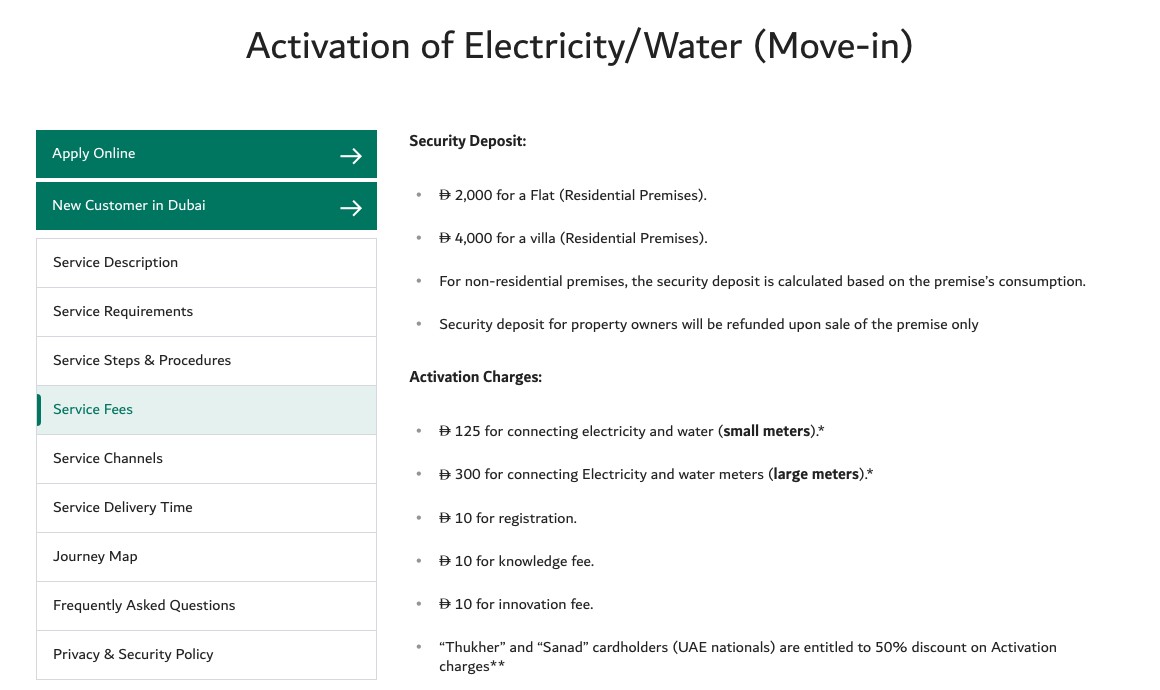
If supply is not connected within 15 working hours, DEWA asks customers to call 04-601 9999. Tenants in free zones that are exempt from Ejari apply through the DEWA website or app and pay the deposit themselves.
When you move out, settle all bills, then choose a move-out date and a refund method for the deposit (IBAN, cheque or transfer to another active account). The deposit is set against the final bill: you pay any shortfall or receive the balance. The final bill is sent within 24 working hours. For an IBAN refund, the account holder’s name must match the name registered with DEWA.
Common Misunderstandings About Ejari Registration in Dubai
- “Signing the lease is enough; registration is optional.” Article 4(2) says courts and government departments will not act on an unregistered lease. Until you have the Ejari certificate, treat the process as unfinished.
- “The new app is Dubai REST.” The 2 November service is on DubaiNow. Dubai REST is still listed among the DLD’s channels for registration and cancellation; both work, under different conditions.
- “Anyone can use DubaiNow.” The DLD page limits it to individual landlords who own and manage their own property, and both parties need a valid Emirates ID. Company landlords and properties run by management companies use other channels.
- “Ejari ends by itself when I move out.” Cancellation is a separate request. Agree with your landlord who will file it, and where.
- “The DEWA deposit is the same as the landlord’s deposit.” They are different. The DEWA deposit is set against your final utility bill; the landlord’s deposit is refunded at the end of the lease under Article 20.
Ejari Registration Scenarios
Scenario 1: new to Dubai, renting from an individual owner. Check that your Emirates ID and UAE PASS are active. If they are not, DubaiNow is not an option yet; ask the landlord to use the Dubai REST app, or register at a trustee centre yourself. Once you have the Ejari certificate, watch for DEWA’s account and deposit message; the deposit for a flat is AED 2,000.
Scenario 2: living in a building run by a management company and about to renew. These properties are usually registered by the management company through the Ejari system. Ask when it will file the renewal and who pays; the fee is the same as for a new registration. If you have questions about the renewal rent, raise them before you sign.
Scenario 3: lease ending and moving to another area. Agree with the landlord who will cancel the Ejari: it is free online and AED 40 plus VAT at a trustee centre. Request a DEWA move-out at the same time and choose a refund method. Your new DEWA account is set up once the new home’s Ejari is registered.
Ejari Registration in Dubai: Frequently Asked Questions
Is Ejari registration mandatory in Dubai, and what happens if I skip it?
Yes. Article 4(2) of Law No. 26 of 2007 requires leases to be registered with RERA, and courts and government departments may not consider any dispute, claim or action relating to an unregistered lease. In practice that means DEWA cannot activate your utilities and you cannot bring a deposit or rent dispute.
How much does Ejari registration cost, and who pays?
Online channels (DubaiNow, the Dubai REST app and the DLD website) cost AED 177.75; trustee centres charge AED 220. The law does not say which party pays. On DubaiNow the tenant pays the service fee when signing. Who pays can be agreed in the lease, so settle it before you sign.
What documents do I need for Ejari registration in Dubai?
DubaiNow needs a valid Emirates ID and an electronic signature through UAE PASS. The app route needs a copy of the Unified Tenancy Contract. At a trustee centre, bring the original Unified Tenancy Contract and the applicant’s Emirates ID, plus an official power of attorney if a representative applies.
Does Ejari registration in Dubai need renewing every year, and does it cost the same?
You need to renew it for each new lease term. The DLD treats registration and renewal as one service with the same channels, documents and fees. If the landlord or management company submits a renewal on DubaiNow, it is complete once the tenant accepts, signs and pays.
Do I have to cancel Ejari before I move out?
The DLD’s cancellation service applies to expired leases on vacated property. It is free online and costs AED 40 plus VAT at a trustee centre. Agree with your landlord who will file it, and request a DEWA move-out at the same time so your utility deposit is settled.
Can I register Ejari before I get my Emirates ID?
DubaiNow needs a valid Emirates ID and UAE PASS, and trustee centres ask the applicant to present an Emirates ID. If you do not have one yet, ask your landlord or management company whether they can register through the Ejari system or the Dubai REST app, or wait until your ID is issued.
Renting or Moving in Dubai? Ask Zagdim
If you are unsure which channel fits your situation, or what to sort out before renewing or moving, you can Ask Zagdim, then confirm with the DLD or DEWA.
Life abroad? Ask Zagdim.
Your first stop for international property and global living.
Research and insights. Know what’s changing. Understand what matters.
Newsletter for overseas updatesSubscribe →
Disclaimer
This article is general information and is not legal, tax or financial advice. It is based mainly on official pages from the Dubai Land Department, the Dubai Electricity and Water Authority and the GDRFA, and on Dubai legislation from 2007 to 2026. Channel conditions and fees may change. Refer to the latest official notices for your case and consult a qualified professional where needed; the DLD helpline is +971 800 4488.
The fees and steps in this article are current as of 3 November 2026; refer to the Dubai Land Department and DEWA for the latest official information.
References
Dubai Land Department – Register / Renew / Terminate Tenancy Contract via Dubai Now / Dubai Land Department – Register / Renew Tenancy Contract / Dubai Land Department – Cancel Tenancy Contract / Dubai Land Department – EJARI Program Tenancy Guide / Dubai Legislation – Law No. (26) of 2007 Regulating the Relationship between Landlords and Tenants / Dubai Legislation – Law No. (33) of 2008 Amending Law No. (26) of 2007 / DEWA – Activation of Electricity/Water (Move-in) / DEWA – Deactivation of Electricity/Water (Move-out) / GDRFA Dubai – Issuance of a residence permit for foreigner family members / Khaleej Times – Dubai tenants, landlords can now register, renew, cancel Ejari contracts using one app (2 November 2026) / Gulf News – Dubai tenants can now register, renew, cancel Ejari, and pay DEWA on DubaiNow app (2 November 2026) / Zagdim – Dubai Tenancy Contract: Can You Back Out After Signing, and How to Check the Other Party First / Zagdim – Renting in Dubai: When Can Your Landlord Legally Ask You to Leave? / Zagdim – Dubai Rent Renewal When Rents Are Falling / Zagdim – UAE Family Sponsorship Guide: Long-Term Residency for Dependants