






























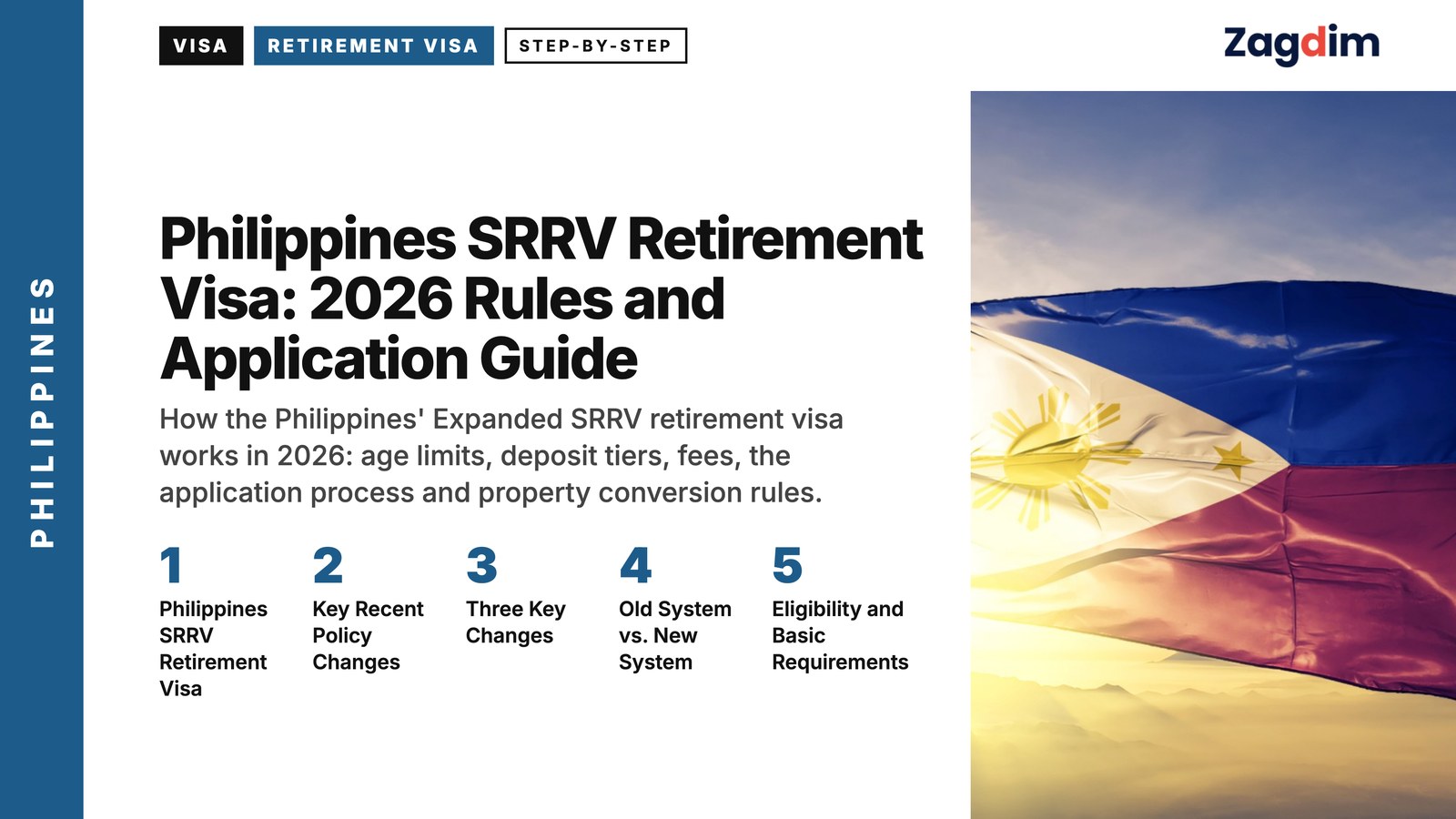
Philippines SRRV Retirement Visa: Three Key Points
The Philippines SRRV (Special Resident Retiree’s Visa) is a special non-immigrant visa promoted by the Philippine Retirement Authority (PRA) and issued by the Bureau of Immigration (BI). It allows qualified foreign nationals and certain eligible individuals to reside in the Philippines on a long-term basis. The program is commonly used for overseas Plan B arrangements, semi-retirement living, or FIRE (Financial Independence, Retire Early) planning.
Starting in 2025, the SRRV program has been reorganized under the Expanded SRRV Program, which standardizes the system and introduces several updates. The minimum application age for new applicants has been lowered to 40, and deposit requirements are now structured based on age and whether the applicant receives a lifetime pension (Pensioner). The program also clearly differentiates between the SRRV Classic category and the Courtesy / Expanded categories.
Under SRRV Classic, the required visa deposit may—under certain conditions—be converted for investment purposes, such as purchasing a PRA-approved condominium. However, this conversion is subject to minimum investment thresholds, timing restrictions, and limitations on how the funds may be used (in many cases only for the final payment portion). Applicants should therefore carefully evaluate liquidity considerations and the risks associated with the Philippine property market before proceeding.
What is the Philippines SRRV Retirement Visa?
The Philippines SRRV (Special Resident Retiree’s Visa) is a special non-immigrant visa promoted by the Philippine Retirement Authority (PRA) and issued by the Bureau of Immigration (BI). It allows qualified foreign nationals and certain eligible individuals to reside in the Philippines on a long-term basis.
Compared with standard short-term visas or employment visas, the SRRV functions more like a long-term residency status. It is particularly suitable for individuals and families who plan to retire in the Philippines, live a semi-retired lifestyle, work remotely, or establish an overseas Plan B.
Through the SRRV program, holders can enjoy relatively stable residency privileges and, subject to regulatory requirements, may convert part of the mandatory visa deposit into property purchases or other eligible investments. This allows applicants to integrate lifestyle planning with asset allocation considerations.
Overview of the Latest Policy and Key Changes
Starting in 2025, the Philippine Retirement Authority (PRA) introduced a series of adjustments to the SRRV framework under the Expanded SRRV Program. The new policy primarily focuses on three areas: age thresholds, tiered deposit requirements, and strengthened compliance standards.
The SRRV Classic category is designed for the general public. Applicants must be 40 years or older and are required to place a deposit ranging from USD 15,000 to USD 50,000, depending on their age and whether they receive a pension. Its main advantage lies in capital flexibility, as the deposit may be converted and used for eligible investments such as property purchases, subject to PRA regulations.
By contrast, SRRV Courtesy / Expanded categories are preferential programs intended for specific groups, including former Filipino citizens, retired military personnel, and members of certain international organizations. The deposit requirement is significantly lower, typically between USD 1,500 and USD 6,000. Although these categories do not allow the deposit to be converted into property investments, they provide long-term residency in the Philippines at a substantially reduced cost, with relatively low deposit and annual maintenance fees.
Three Key Changes
- Lower Minimum Application Age
Starting 1 September 2025, the minimum age for new applicants has been reduced to 40. This adjustment allows mid-career professionals to use the Philippines SRRV program to plan earlier for retirement, long-term residence, or overseas lifestyle arrangements. - More Detailed Tiered Deposit Requirements
Under SRRV Classic, the required visa deposit is now structured more clearly based on age group (40–49 vs. 50 and above) and whether the applicant qualifies as a Pensioner (an individual receiving a lifetime pension).
For example, non-pensioners aged 40–49 must place a USD 50,000 deposit, while non-pensioners aged 50 or above face a lower requirement of USD 30,000. - Clearer Categories and Compliance Rules
The updated framework also clarifies eligibility and compliance conditions across different SRRV categories. Under the Expanded / Courtesy categories, applicants with specific backgrounds—such as former Filipino citizens, diplomatic personnel, or retired military officers—may qualify for significantly lower deposit requirements. At the same time, official guidelines now more clearly define eligibility criteria and exclusion conditions for each category.
Old System vs. New System
The information below is compiled based on official PRA sources and interpretations from legal and professional institutions during 2024–2025. In practice, applicants should always refer to the latest announcements from the Philippine Retirement Authority (PRA).
| Item | Old System (Overview) | New System (Expanded SRRV Program 2025) |
|---|---|---|
| Minimum Application Age | Generally 50 years and above, with some variations depending on the category | Lowered to 40 years old for new applicants (details vary slightly by category) |
| Age Segmentation | Primarily focused on applicants aged 50 and above | Clearly divided into 40–49 years and 50 years and above |
| Deposit Requirement (SRRV Classic) | 35–49 years: USD 50,000 50+ years: USD 20,000 (non-pensioner) / USD 10,000 (pensioner) | 40–49 years: USD 50,000 (non-pensioner) / USD 25,000 (pensioner) 50+ years: USD 30,000 (non-pensioner) / USD 15,000 (pensioner) (Note: amounts include up to two dependents; the deposit may be used toward purchasing property valued at USD 50,000 or more.) |
| Program Structure | Multiple categories such as Classic, Smile, Courtesy, etc. | Categories reorganized under the Expanded SRRV Program, with clearer eligibility rules and Courtesy / Expanded options for specific groups |
Eligibility and Basic Requirements
The Philippines SRRV is not a single visa category. Instead, it provides several pathways—primarily SRRV Classic and Courtesy / Expanded—depending on the applicant’s age, pension status, and personal background.
Age and Target Applicants
Minimum age for the main applicant
- Starting 1 September 2025, under the Expanded SRRV Program, new applicants must be at least 40 years old.
Typical applicant profiles include:
- Foreign nationals planning long-term retirement or semi-retirement in the Philippines.
- Mid-career professionals, entrepreneurs, or remote workers seeking to establish a lifestyle base in the Philippines.
- Former Filipino citizens, as well as individuals with diplomatic or military backgrounds, who may qualify for Courtesy / Expanded categories.
Financial and Pension Requirements (SRRV Classic)
The figures below reflect the ranges most consistently cited across PRA official sources and professional interpretations from 2024–2025. In practice, applicants should always refer to the latest PRA application forms and official guidelines.
Applicants aged 50 and above
Pensioner (with lifetime pension)
- Deposit: USD 15,000
- Pension requirement: Minimum USD 800/month (single) or USD 1,000/month (married couple)
Non-pensioner (without lifetime pension)
- Deposit: USD 30,000
Applicants aged 40–49
Pensioner
- Deposit: USD 25,000
Non-pensioner
- Deposit: USD 50,000
Courtesy / Expanded Categories (Special Background Applicants)
Certain Expanded / Courtesy categories apply to specific groups such as former Filipino citizens, retired military personnel, diplomatic officials, or other eligible individuals.
These programs typically require significantly lower deposits, often ranging from USD 1,500 to USD 6,000, depending on age and pension status.
Documentation and Background Requirements (General)
Applicants must generally provide the following:
Valid Passport
- A passport with sufficient remaining validity.
Police Clearance / Criminal Record Check
- A police clearance certificate from the applicant’s country of residence or origin.
- If the applicant has stayed in the Philippines beyond a specified period (commonly 90 days), an NBI Clearance issued by the Philippine National Bureau of Investigation may also be required.
Medical Certificate
- A health examination or medical certificate, according to the latest PRA health requirements.
Family Relationship Documents (if applicable)
- Marriage certificate or children’s birth certificates to verify dependent eligibility.
SRRV 2025 Core Requirements Overview
SRRV Classic
Eligible Applicants: General foreign retirees or mid-career professionals
Age: From 40 years old
Deposit / Pension Threshold (Overview):
- Age 40–49: Pensioner USD 25,000 / Non-pensioner USD 50,000
- Age 50+: Pensioner USD 15,000 / Non-pensioner USD 30,000
Investment Conversion: Yes. Under PRA regulations, the deposit may be converted into eligible investments such as approved real estate purchases.
Dependents Allowed: Yes. Spouse and unmarried dependent children under 21 years old may be included.
Courtesy / Expanded
Eligible Applicants: Former Filipino citizens, diplomatic personnel, retired military members, and other special-status applicants
Age: From 40 years old
Deposit / Pension Threshold (Overview): Generally USD 1,500–6,000, depending on status and pension eligibility
Investment Conversion: Depends on the specific category and current PRA regulations
Dependents Allowed: Yes, subject to the dependent rules of each category
SRRV Application Process (Step by Step)
The exact procedure may vary depending on the application timing, visa category, and whether the applicant is already in the Philippines. The steps below outline the typical process most applicants follow, particularly mid-career professionals aged 40–55 considering the SRRV Classic category.
1. Determine the Appropriate SRRV Category
First assess which SRRV pathway fits your profile based on factors such as:
- Age
- Whether you receive a lifetime pension
- Whether you are a former Filipino citizen
- Whether you have a diplomatic or military background
These criteria determine whether you should apply under SRRV Classic or a Courtesy / Expanded category.
2. Plan Required Documents and Validity Periods
Key documents such as police clearance certificates and medical certificates usually have validity periods.
For applicants applying from overseas, documents may also require apostille authentication or consular legalization, which is often one of the most common sources of delay.
3. Select a PRA-Accredited Bank and Transfer the Visa Deposit
Following PRA guidelines, applicants must transfer the required visa deposit to a PRA-accredited bank in the Philippines.
- Funds are typically remitted via inward remittance from overseas.
- Once received, the bank issues a deposit certificate, which becomes a core document for the SRRV application.
4. Prepare and Submit the SRRV Application Package
Applicants must complete the official PRA application form and submit supporting documents, including:
- Passport copy
- Photos
- Police clearance
- Medical certificate
- Bank deposit certification
- Family relationship documents (if applying with dependents)
5. Pay Application Fees and the First Annual Fee
Applicants must pay the SRRV application fee and first-year annual maintenance fee at a PRA office.
In many cases, payments are made in cash (USD or PHP), though acceptable payment methods may vary depending on current PRA policies.
6. PRA Review and Immigration Processing
The Philippine Retirement Authority (PRA) first reviews the applicant’s eligibility and documents.
Once approved, PRA will endorse the application to the Bureau of Immigration (BI) for the issuance of the SRRV visa.
Processing time at the BI is typically separate from PRA’s internal processing, so the total approval timeline may vary depending on the case.
7. Visa Issuance and Post-Approval Registration
Once the visa is granted, applicants must complete several final steps, including:
- Obtaining the SRRV ID card
- Completing any passport endorsement or system registration, if required
- Ensuring annual maintenance fees are paid on time to maintain the visa’s validity.
8. Most Common Causes of Application Delays
- Expired police clearance or medical certificates, or incomplete authentication procedures.
- Improper visa deposit transfers, such as remittance methods that do not meet PRA requirements or bank certificates with incorrect formats or amounts.
- Incorrect category selection, for example applying under SRRV Classic when Courtesy / Expanded categories might apply, which may result in additional documentation requests or reassessment.
Fee Structure and Use of Funds
Application Fee and Annual Maintenance Fee
Fee schedules may vary slightly depending on the year and the specific PRA documentation version. The figures below reflect commonly cited amounts from 2024–2025, and applicants should always refer to the latest official PRA fee schedule for confirmation.
Application Fee (Processing / Application Fee)
- Main applicant: approximately USD 1,500 (some sources indicate a range of USD 1,400–1,500)
- Each dependent: USD 300
Annual Maintenance Fee (Annual PRA Fee / PAF)
SRRV Classic:
- USD 360 per year, covering the main applicant plus up to two dependents
- For additional dependents beyond this limit, an extra USD 100 per person per year applies
SRRV Courtesy (certain foreign applicant categories):
- USD 100 per year
- Each additional dependent adds USD 10 per year
Visa Deposit Overview (SRRV Classic)
Applicants aged 50 and above:
Pensioner (with lifetime pension)
- Deposit: USD 15,000
- Pension requirement: minimum USD 800–1,000 per month
Non-pensioner (without lifetime pension)
- Deposit: USD 30,000
Applicants aged 40–49:
Pensioner
- Deposit: USD 25,000
Non-pensioner
- Deposit: USD 50,000
Connection with Property Investment (Classic Deposit Conversion)
Institutional Possibility
According to PRA guidelines, the visa deposit under SRRV Classic may, after the visa has been issued, be converted—subject to eligibility—into what is termed an “active investment.” One of the most common forms of such investment is the purchase of a qualifying condominium unit or participation in certain long-term lease arrangements that meet PRA requirements.
This structure allows some applicants to allocate part of their required deposit into the Philippine real estate market while simultaneously establishing a long-term residency status in the country. In practice, this creates a framework where immigration status and tangible asset allocation can be considered together within a single planning strategy.
Common Rules and Restrictions
The specific conversion requirements and thresholds are subject to the latest PRA checklist and official guidelines. However, several common principles are frequently noted in professional guidance and industry interpretations:
- Only the SRRV Classic category generally allows applicants to convert the visa deposit into designated investments. Whether other categories qualify depends on the latest PRA policy updates.
- The property or investment target must usually meet a minimum value requirement. Many professional sources indicate that a condominium purchase typically needs a minimum value of around USD 50,000 or equivalent, and prior approval from the PRA is normally required.
- Deposit conversion is usually allowed only after the SRRV visa has been issued and after a short waiting period (often around 30 days) to ensure the visa status has been properly activated and registered.
- In many practical cases, the visa deposit can only be applied toward the final payment of a property purchase, meaning that the initial down payment and earlier instalments must typically be funded separately by the applicant’s own capital.
These operational details mean that applicants should carefully review PRA documentation and the financial structure of any property transaction before planning to use the SRRV deposit as part of a real estate investment strategy.
Risks and Considerations
Liquidity Risk
Once the visa deposit is converted into property or other investments, it no longer functions as a liquid cash deposit. If the applicant later decides to terminate the SRRV visa or rebalance their assets, they may need to sell or transfer the property, which could involve additional time, costs, or market uncertainty.
Market and Exchange Rate Risk
The Philippine real estate market follows its own economic cycle, and investment outcomes depend on market conditions. In addition, transactions may involve currency fluctuations between the US dollar (USD) and the Philippine peso (PHP). Rental income and capital appreciation are not guaranteed and should be treated as typical investment risks.
Compliance and Documentation Requirements
The conversion process usually requires written approval from the PRA, along with the submission of complete property documentation and related supporting materials. Before using the SRRV visa deposit for investment purposes, applicants are strongly advised to consult professional advisors and local legal counsel to ensure full compliance with current PRA regulations.
Advantages, Limitations, and Risks
Institutional and Lifestyle Advantages
Structured Long-Term Residency Status
The Philippines SRRV program is jointly administered by the Philippine Retirement Authority (PRA) and the Bureau of Immigration (BI), providing a relatively stable and officially recognized pathway for long-term residence. Compared with short-term visas or repeated border-run arrangements, SRRV offers greater legal certainty and residency stability.
Flexible Age and Financial Thresholds
Under the 2025 policy update, the minimum age requirement has been reduced to 40, expanding eligibility beyond traditional retirees. This provides more options for FIRE practitioners, mid-career professionals, and individuals planning early overseas lifestyle arrangements.
Ability to Combine Residency with Investment
The SRRV Classic category allows the visa deposit to be converted—within regulatory limits—into eligible investments, such as qualifying property purchases. For applicants who are optimistic about the Philippine real estate market or other local assets, this creates a framework where residency planning and asset allocation can be pursued simultaneously.
Practical Limitations and Institutional Constraints
Restricted Use and Liquidity of Funds
The required deposit serves as the financial basis for the visa, and at least initially it functions as designated funds. Even when conversion to investment is permitted, it is subject to restrictions on timing, amount, and usage, making the program less suitable for applicants who require high liquidity and flexible capital access.
Ongoing Cost Structure
Application fees and annual PRA maintenance fees represent recurring costs. As the number of dependents increases, the annual maintenance fee also rises, meaning that long-term holders should factor these costs into their overall financial planning.
Category Selection Affects Cost Structure
There is a significant difference in deposit requirements between SRRV Classic and Courtesy / Expanded categories. However, the latter typically require specific qualifying backgrounds. Selecting the wrong category may lead to unnecessarily high deposits or additional processing time.
Risk Considerations
Policy Change Risk
Between 2024 and 2025, several policy and procedural adjustments have already occurred, including the introduction of the Expanded SRRV Program and the reduction of the minimum age requirement. This suggests that the system remains in a period of policy evolution, and both existing and prospective applicants should closely monitor PRA announcements.
Eligibility and Compliance Risks
Recent documentation indicates stricter eligibility screening for certain industries and backgrounds, including activities associated with specific gaming or gambling sectors. Applicants with potentially sensitive backgrounds are advised to consult legal professionals or experienced advisors before applying.
Exchange Rate and Market Volatility
Any investment linked to Philippine property or local assets carries exposure to real estate market cycles and currency fluctuations between USD and PHP. The SRRV framework provides residency benefits, but it does not guarantee investment performance or capital appreciation.
Who Is It Suitable For? Common Planning Scenarios (Age 40–55)
Scenario 1: FIRE or Semi-Retirement Planning — Securing Overseas Residency Early
Potentially suitable for:
Individuals or couples who have accumulated sufficient assets and wish to obtain stable long-term residency through the Philippines SRRV during the 40–55 age stage, while gradually increasing their time spent in the Philippines in the future.
Points to consider:
For non-pensioners aged 40–49, the deposit requirement is USD 50,000, which represents a relatively high level of capital commitment. Applicants should compare this requirement with retirement visa programs in other countries when planning their asset allocation.
Scenario 2: Still Working but Establishing a “Plan B” Residency for the Family
Potentially suitable for:
Professionals living in high-cost cities such as Hong Kong or Singapore who want to establish a long-term residence base abroad for themselves, their spouse, and children, while continuing to work primarily in their current location in the near term.
Points to consider:
The SRRV is fundamentally a residency program, not a direct work permit or tax residency status. If the applicant intends to work, start a business, or establish tax residency in the Philippines, additional regulatory and tax considerations must be reviewed separately.
Scenario 3: Asset Reallocation — Converting Deposits into Philippine Property
Potentially suitable for:
Applicants who accept the deposit requirements and liquidity constraints of SRRV Classic, and who are optimistic about the medium-to-long-term outlook of the Philippine property market, particularly in areas such as Metro Manila.
Points to consider:
In most cases, the visa deposit can only be used toward the final payment of a property purchase, and the property must meet PRA minimum value requirements and documentation standards. The investment itself still carries market and legal risks.
Scenario 4: Former Filipino Citizens or Applicants with Special Status
Potentially suitable for:
Individuals who were previously Filipino citizens, or who have backgrounds in diplomatic or military service, or other statuses qualifying for Courtesy / Expanded SRRV categories, and who wish to obtain long-term residency with a significantly lower deposit requirement.
Points to consider:
Eligibility criteria and documentation requirements vary significantly across categories, so applicants should consult the latest Expanded SRRV Program guidelines issued by the PRA or seek advice from qualified professional advisors.
Frequently Asked Questions (FAQ)
Q: Does SRRV 2025 require a minimum stay or “residency requirement”?
A: Public information released by the Philippine Retirement Authority (PRA) mainly focuses on eligibility, deposits, fees, and application procedures. Requirements regarding minimum annual stay or residency obligations are not presented in the same way across all official documents. In practice, applicants are advised to refer to the latest PRA announcements at the time of application and confirm the current interpretation with PRA representatives or licensed agents.
Q: Can spouses and children be included? What is the age limit for children?
A: According to the Expanded SRRV Program documentation, eligible dependents may include a legal spouse and unmarried dependent children under 21 years old, including legally adopted children.
The number of dependents may affect annual fees and, in some categories, deposit requirements, so family structure should be considered during planning.
Q: How much are the application and annual fees?
A: Based on PRA information referenced around 2025, the application fee for the main applicant is typically around USD 1,500, with USD 300 for each dependent.
For SRRV Classic, the annual maintenance fee is USD 360, covering the main applicant and up to two dependents. Each additional dependent adds USD 100 per year.
Some Courtesy categories have lower annual fees, starting from around USD 100. Actual fees should always be verified against the latest PRA fee schedule.
Q: Can the SRRV Classic deposit be used to purchase property?
A: Yes, under certain PRA conditions, the SRRV Classic visa deposit may be converted into qualified investments, such as purchasing an eligible condominium unit. However, applicants must comply with minimum investment values, timing restrictions, and usage limitations.
Professional guidance often indicates a minimum property value of around USD 50,000 or equivalent, and in many cases the deposit can only be applied toward the final payment of the property purchase. Applicants should consult the latest PRA conversion guidelines for precise requirements.
Q: Why is the deposit requirement higher for applicants aged 40–49 compared with those aged 50 and above?
A: This structure reflects the policy design of the SRRV program. The PRA uses age and pension status to structure deposit requirements. As a result, non-pensioners aged 40–49 are subject to a higher deposit threshold (USD 50,000), while non-pensioners aged 50 and above face a lower requirement of USD 30,000, reflecting different risk profiles and policy objectives.
Q: Who may be excluded from eligibility?
A: The Expanded SRRV Program includes stricter screening for certain industries or professional backgrounds. Individuals associated with specific offshore gaming or sensitive sectors may face additional compliance scrutiny and could be excluded from eligibility. Applicants should refer to the latest PRA announcements and eligibility guidelines.
Q: When is an NBI Clearance required?
A: In general, if an applicant has stayed in the Philippines for more than a certain period (commonly around 90 days), PRA may require an NBI Clearance issued by the National Bureau of Investigation as part of the background verification process. Exact thresholds depend on the latest PRA procedural requirements.
Q: Will policy changes affect existing SRRV holders?
A: Most updates introduced during 2024–2025, including the Expanded SRRV Program and the lowered minimum age requirement, primarily apply to new applicants. Existing SRRV holders typically continue under their original program terms. However, if significant reforms occur in the future, whether changes will apply retroactively or include transition arrangements will depend on the official PRA announcements at that time.
If you would like professional assistance evaluating your next steps, or want to compare visa and asset allocation strategies across different countries, you may contact the ZDelp Assistant to help connect you with appropriate experts.
You can also leave a message in the contact form at the end of this article, or reach out via Line / WhatsApp / WeChat to speak with our team or the ZDelp Assistant.
References
Philippine Retirement Authority – Special Resident Retiree’s Visa (SRRV) / Philippine Retirement Authority – Expanded SRRV Program / Philippine Embassy in Singapore – Special Resident Retiree Visa (SRRV) 說明頁 / ACCRALAW – Updates on the Philippines’ Retirement Visa Program / Chambers & Partners – Updates on the Philippines’ Retirement Visa Program / Emerhub – Retirement Visa Philippines: Your Ultimate Guide / IMI Daily – Philippines Retirement Visa (SRRV) – 2026 Update
Disclaimer
The information on this page is primarily compiled from publicly available sources published between 2024 and 2025, including materials from the Philippine Retirement Authority (PRA), Philippine overseas missions, and professional organizations and industry publications such as ACCRALAW, Chambers & Partners, Emerhub, and IMI Daily.
This content is intended for general informational purposes only and does not constitute legal, tax, or investment advice.
The eligibility requirements, fees, and procedures for the Philippines SRRV retirement visa may change over time. All specific conditions and operational details should be verified against the latest announcements issued by the Philippine Retirement Authority and relevant government authorities.
Before making significant financial, residency, or immigration decisions, readers are strongly advised to consult qualified legal, tax, or professional advisors.