































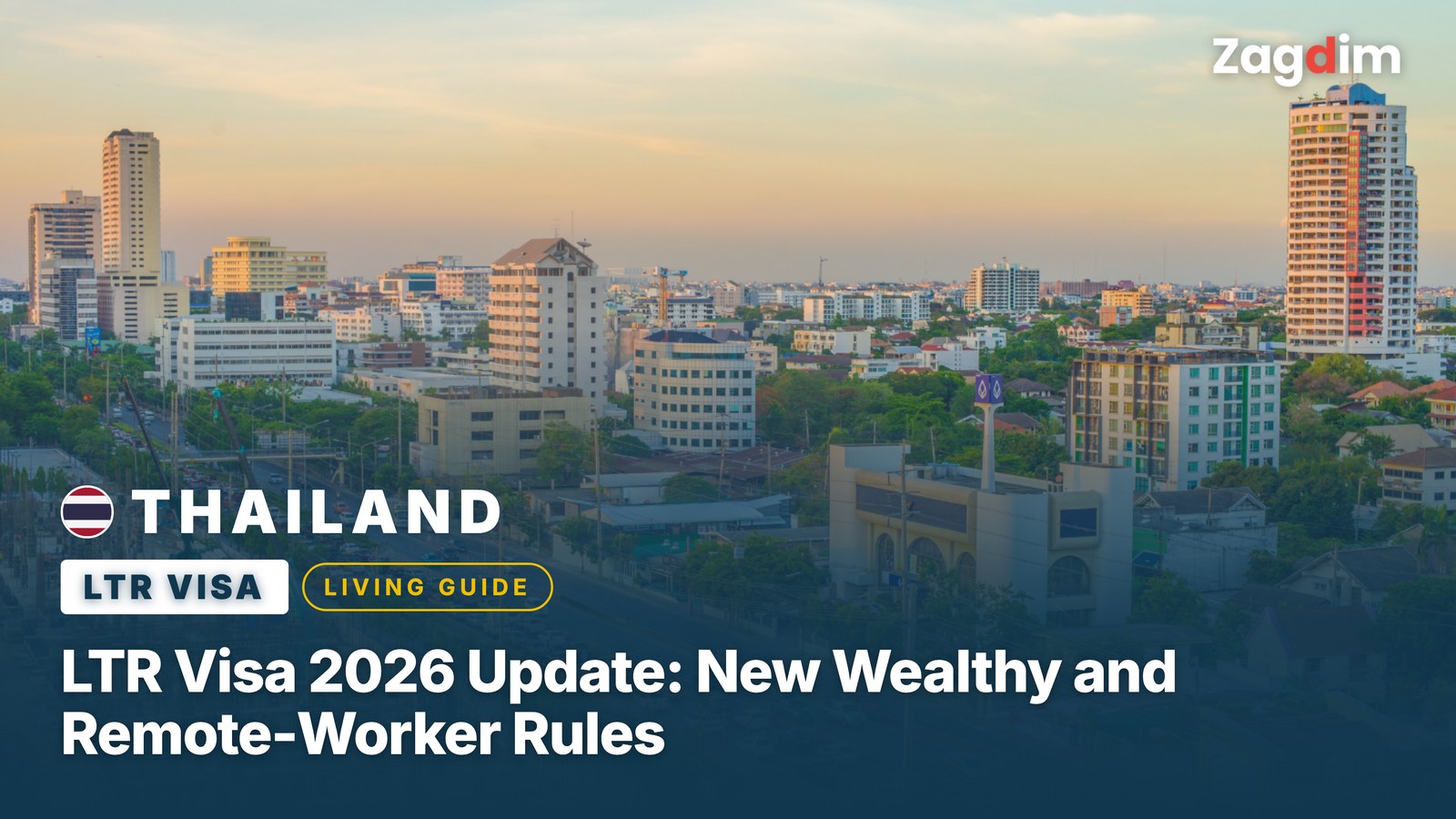
Thailand’s Long-Term Resident (LTR) visa is not a new programme. It has been in place since 2022 as part of Thailand’s broader effort to attract long-stay residents, investors, and skilled professionals. What changed in early 2026 is a set of eligibility adjustments — confirmed in BOI Announcement No. Por 3/2568 and reported by KPMG Thailand — that revise the qualification criteria for several applicant categories. This article explains what changed, what remained the same, and what applicants need to verify before proceeding.
Key Takeaways
- The USD 80,000 annual income requirement for the Wealthy Global Citizen category has been removed
- The USD 1 million global asset requirement and USD 500,000 Thailand investment requirement remain in place
- The Work-from-Thailand category now has a lower employer revenue threshold and no work experience requirement
- The expanded dependent eligibility rules are confirmed but not yet in force — a Ministry of Interior announcement is still required
- Requirements change frequently — confirm your specific situation with BOI Thailand or a licensed Thai immigration lawyer before applying
What Changed in the Thailand LTR Visa Rules?
BOI Announcement No. Por 3/2568, reported by KPMG Thailand in February 2026, introduced adjustments across three LTR applicant categories. The changes affect who can qualify, not how the visa itself works. The 10-year residency structure, insurance requirements, and core investment thresholds remain unchanged.
A summary of what was revised:
- Wealthy Global Citizen: Annual income requirement of USD 80,000 removed
- Highly Skilled Professionals: Work experience requirement removed; scope expanded to include academic professors in all fields within Thailand’s target industries
- Work-from-Thailand Professionals: Work experience requirement removed; employer revenue threshold lowered; wholly-owned subsidiaries now eligible
- Wealthy Pensioners: No changes under this announcement
- Dependents: Expanded to include parents and all legal dependents with no numerical cap — pending Ministry of Interior confirmation
Wealthy Global Citizen: Income Requirement Removed, Investment Requirement Remains
The most widely discussed change in this update is the removal of the USD 80,000 annual income requirement for the Wealthy Global Citizen track.
What this means in practice: applicants who hold significant assets but do not draw a regular salary — such as retired entrepreneurs, property investors, or individuals who have exited a business — are no longer disqualified on income grounds alone.
What has not changed is equally important. The financial thresholds that define this category remain in place:
- Combined worldwide assets: At least USD 1 million
- Thailand investment: At least USD 500,000 in BOI-approved assets within Thailand
Worth noting: The USD 500,000 must be committed to approved investment vehicles within Thailand. The official announcement does not specify a complete list of qualifying vehicles. Applicants should confirm which asset types are accepted directly with the BOI before making any investment decisions. The primary source document is BOI Announcement No. Por 3/2568: https://www.boi.go.th/upload/content/por3_2568.pdf
Work-from-Thailand Professionals: Lower Employer Revenue Threshold
The Work-from-Thailand category has been adjusted in two ways, both reducing the qualification bar for remote professionals employed by overseas companies.
Previous criteria:
- At least five years of work experience in fields relevant to current employment, within the past 10 years
- Overseas employer must be a public company listed on a stock exchange, or a private company with at least three years of operation and combined revenues of at least USD 150 million over the last three years
New criteria:
- Work experience requirement removed entirely
- Overseas employer revenue threshold lowered to USD 50 million over the last three years
- Wholly-owned subsidiaries now eligible — the parent company’s financials may be used to fulfil the revenue criteria
For remote workers employed by mid-size companies or by subsidiaries of larger groups, these changes remove two of the most common barriers that previously made this category inaccessible.
Insurance and Financial Proof Requirements
Insurance requirements across all LTR visa categories remain unchanged under this announcement.
All LTR applicants must meet one of the following:
- Health insurance covering treatment in Thailand of at least USD 50,000, valid for no less than 10 months; or
- Social security coverage in Thailand; or
- A savings deposit of at least USD 100,000 maintained in a Thai bank account for the primary applicant, plus at least USD 25,000 for each dependent
Confirm current acceptable insurance providers and policy terms with the BOI or a licensed adviser before applying.
Dependent Rules: Expanded, But Not Fully Implemented Yet
The BOI announcement expands the dependent category to include parents and all legal dependents, with no limit on the number that can be included.
Note: The inclusion of parents as eligible dependents is subject to formal implementation and should be confirmed with the relevant authorities before application.
One material qualification applies: these expanded rules will take effect only upon a subsequent announcement by the Ministry of Interior. According to KPMG Thailand, this element was still pending implementation at the time of the BOI announcement.
Until that confirming announcement is published, applicants should proceed under the current dependent rules.
Who May Benefit From the LTR Update?
The changes are not relevant to all LTR categories equally. The groups most directly affected by this update are:
Retired entrepreneurs, property investors, and multi-asset holders
Previously disqualified by the income test, this group is the most directly served by the removal of the USD 80,000 annual income requirement. The investment thresholds remain, but the income barrier is gone.
Remote workers at mid-size companies and subsidiaries
The lowered employer revenue threshold — from USD 150 million to USD 50 million — and the removal of the work experience requirement open the Work-from-Thailand category to a substantially wider pool of applicants.
Highly skilled professionals and academics
The removal of the work experience requirement and the expanded inclusion of academic professors in target industries broadens access to this category.
Families considering long-stay options
The expanded dependent rules — if and when the Ministry of Interior confirms them — would allow parents and all legal dependents to be included without a numerical cap. This is worth monitoring, but should not be treated as currently available until confirmed.
Zagdim Analysis
On the strategic direction these changes reflect
The revisions are consistent with Thailand’s stated aim to attract high-value investors, skilled professionals, global talent, and their families. Maintaining the USD 500,000 local investment threshold while removing the income requirement appears to reflect a deliberate shift toward asset-led qualification — a distinction that matters most for individuals with significant capital who are no longer in active employment.
On what the Work-from-Thailand changes signal
The combination of removing the work experience requirement and lowering the employer revenue threshold from USD 150 million to USD 50 million represents a meaningful broadening of the category. It is worth noting, however, that the USD 50 million revenue threshold still excludes very early-stage companies and individual freelancers — the LTR Work-from-Thailand track is designed for employed remote workers, not the self-employed.
What Applicants Should Verify Before Applying
Given the complexity of LTR eligibility and the pending elements of this update, there are several points applicants should confirm directly with the BOI or a licensed Thai immigration lawyer before proceeding:
- Which investment vehicles qualify toward the USD 500,000 Thailand investment requirement
- Whether the Ministry of Interior has published its announcement activating the expanded dependent eligibility rules
- Current acceptable health insurance providers and minimum policy terms
- Processing timelines and documentation requirements for your specific applicant category
The primary BOI source document for this update is available as PDF.
Need Help Checking Whether the Thailand LTR Visa Fits Your Situation?
The eligibility changes in this update are straightforward on paper, but applying them to an individual situation — assets held across multiple jurisdictions, employer structures, family arrangements — is where complexity tends to emerge. If you want to work through the details before committing to an application, ZDelp can help you clarify your position and identify the right next step.
Have a question? We’ll help you work it out — start here.
Sources
KPMG Thailand – Tax News Flash Issue 151 (BOI Announcement No. Por 3/2568) / BOI Thailand – Official Announcement Por 3/2568
Disclaimer: This article is based on officially verified sources current as of February 2026. Requirements change frequently. Always confirm your specific situation with BOI Thailand or a licensed Thai immigration lawyer directly.