Zagdim Overseas
Subscribe
  • News
    • Thailand
    • Japan
    • UK
    • Germany
    • Global Reports
  • Country Guides
    • Thailand
    • Japan
    • Malaysia
    • Vietnam
    • Philippines
    • Indonesia
  • Property Research
    • Zagdim Insights
  • Ask Zagdim
  • About
    • Zagdim Research
    • Expert Network
    • Contact Us — LINE / WhatsApp
  • 中文 EN
No Result
View All Result
Zagdim
No Result
View All Result

Japan Building Structure Types Explained: Wood, S, RC and SRC

Home Japan
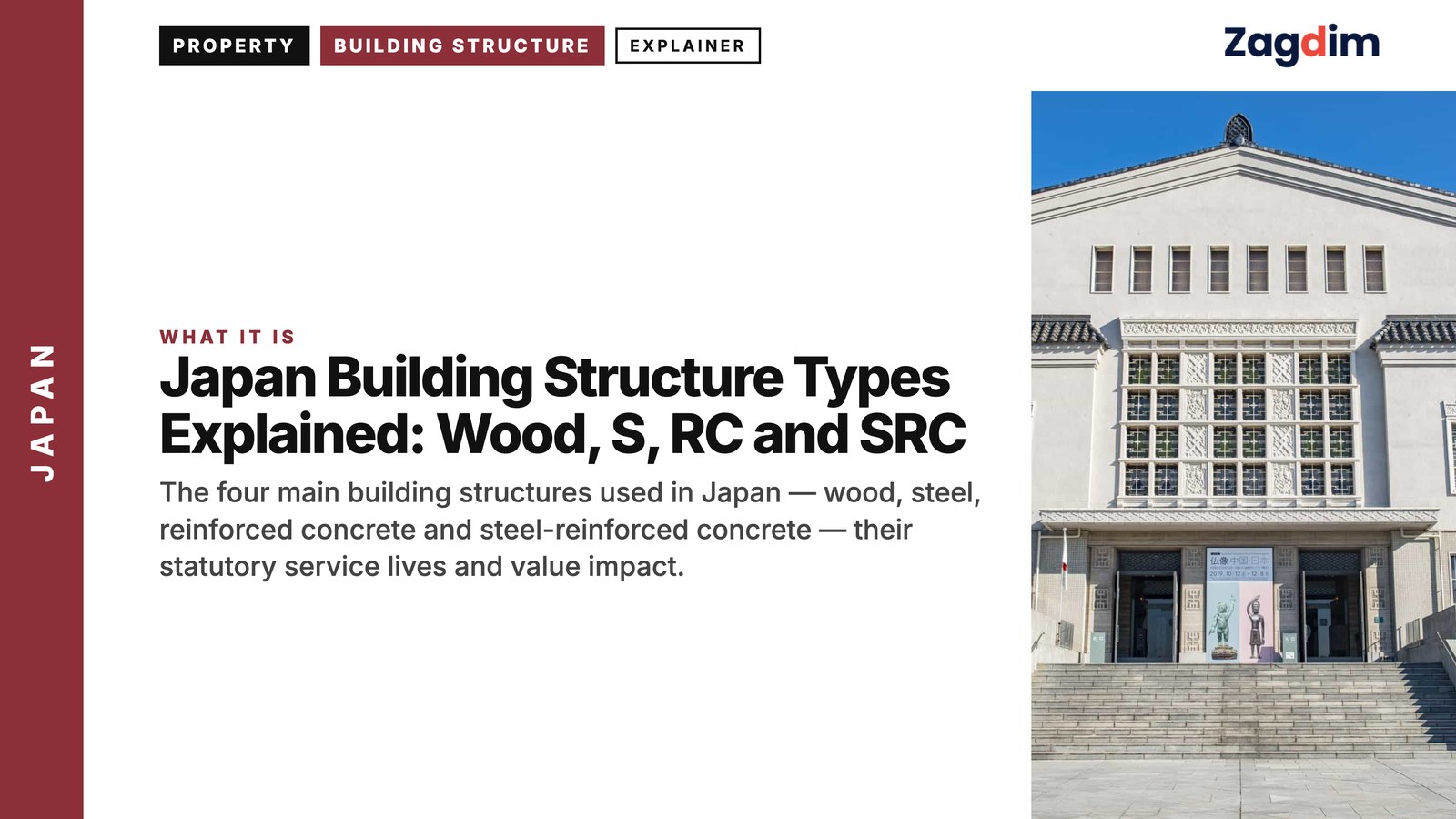
Architecture — Osaka Municipal Museum of Art building facade, illustrating Japan Building Structure Types Explained: Wood, S, RC and SRC

Image: Zagdim

September 24, 2026
in Japan, Living Abroad, Property
Reading Time: 3 mins read
Tags: Buying Property

Japanese properties are built using four main structural types, and the government assigns each one a statutory useful-life value for depreciation purposes (“the legally defined service life,” 法定耐用年数). This figure is easily misread as meaning a building must be demolished and rebuilt once it passes a certain age. In practice, that is not the case — Japan’s statutory service life is purely a tax concept and has no necessary connection to how long a building can actually be used. This article breaks down the structural types used in Japanese buildings and how they affect value.

Structural Types Used in Japan

Wood Construction (W)

Wood construction uses timber as the main building material. It is common in detached houses, has a lower construction cost, resists dampness well, and allows good air circulation. Its drawbacks are weaker soundproofing and fire resistance. Statutory service life for wood-frame or synthetic-resin residential buildings is 22 years — the two materials share one NTA category; 20 years applies to restaurant-use buildings in the same category, not to residential use.

Steel Frame Construction (S)

Steel frame construction uses steel as the main beam and column framework, with walls and floors built from other materials such as wood panelling — hence “steel frame,” using steel for the skeleton. It is further divided into light-gauge and heavy-gauge steel: light-gauge steel refers to frames with a thickness of less than 6mm, and heavy-gauge steel refers to frames with a thickness of 6mm or more. Compared with wood construction, it is sturdier and offers better fire resistance, though its drawback is that exposed steel, despite protective coatings, remains vulnerable to environmental corrosion.

Statutory service life for steel-frame residential buildings:

Steel Thickness Statutory Service Life
3mm or less 19 years
Between 3mm and 4mm 27 years
4mm or more 34 years

Reinforced Concrete Construction (RC)

Reinforced concrete construction embeds steel reinforcing bars (rebar of 1cm thickness or more) within concrete. The combination brings together the advantages of both materials, improving the building’s earthquake resistance, fire resistance and soundproofing. Steel rebar has strong tensile strength, and concrete performs well under compression; encasing the rebar in concrete also protects it from oxidation while giving the structure good tensile capacity, helping it withstand earthquakes and typhoons. The trade-off is a higher cost, and lower density can make it more prone to mould growth. The statutory service life for reinforced concrete residential buildings is 47 years.

Steel-Reinforced Concrete Construction (SRC)

Steel-reinforced concrete construction combines steel framing with rebar, with concrete poured into the gaps between them. It is common in high-rise structures such as towers. In Japan, SRC is generally considered to offer better earthquake and fire resistance than RC, and because its beams and columns take up less cross-sectional area, it leaves more usable interior space. The statutory service life for steel-reinforced concrete residential buildings is also 47 years.

Source: National Tax Agency, Statutory Service Life
https://www.tax.metro.tokyo.lg.jp/shisan/info/hyo01_02.pdf

How Statutory Service Life Affects Value

As noted earlier, Japan’s statutory service life is purely a tax concept used to calculate a building’s depreciation rate, which in turn affects the government’s valuation of the property and, through that, the “fixed asset tax assessed value” — so it indirectly affects taxes such as the fixed asset tax and city planning tax as well. In practice, however, this does not mean a building becomes unusable once it passes its statutory service life. That said, a building beyond its statutory service life may find it harder to secure a bank mortgage, and this can make it harder to sell to a buyer relying on a mortgage in future. At the same time, a building’s structural type has no necessary relationship to its earthquake resistance standard — what matters is whether it meets the earthquake resistance standard currently in force. We recommend using compliance with the current earthquake resistance standard, rather than structural type alone, as the deciding factor before investing in Japanese property.

Related in this series:

  • How to Buy Property in Japan as a Foreigner: Step-by-Step Process
  • Why Japan Has a Housing Shortage Despite High Vacancy Rates
  • Cost of Living in Japan for Foreigners: A Full Budget Breakdown
  • Japan's Pension System for Foreigners: How Much Can You Get?

Have a question about this guide? Leave a comment below, or ask Zagdim directly.

Life abroad? Ask Zagdim.

Your first stop for international property and global living.

Research and insights. Know what’s changing. Understand what matters.

Zagdim AI
All content is researched, written, or authorized for publication by the @Zagdim Overseas team. Sharing and reposting are welcome, but please make sure to credit the source and include the original article link from this website. Any plagiarism or unauthorized use may result in legal action. For article submissions, please contact us via Facebook. Thank you for your support!

For article submissions, press release publication, or interview notices, please contact [email protected]. 

Zagdim Ask

Have a specific question about overseas living, property, visa, or practical arrangements?

Fill in your situation and key concerns through Zagdim Ask. Our team will review your message and get back to you by email where appropriate.

Submit your enquiry →

Similar Topics

UK Landlords Told to Rethink Property Ownership as October Budget Tax Rise Could Wipe Out Profit for Some
News

UK Landlords Told to Rethink Property Ownership as October Budget Tax Rise Could Wipe Out Profit for Some

November 10, 2026
Greece's 15% Property Transfer Tax for Non-EU Tax Residents Is Now a Government Bill in Parliament
News

Greece’s 15% Property Transfer Tax for Non-EU Tax Residents Is Now a Government Bill in Parliament

November 10, 2026
Taiwan's Financial-Proof Thresholds for Naturalisation: NT$5 Million in Assets or Twice the Minimum Wage
News

Taiwan’s Financial-Proof Thresholds for Naturalisation: NT$5 Million in Assets or Twice the Minimum Wage

November 10, 2026
Next Post
Temple — Byodo-in Phoenix Hall reflected in pond at Uji, illustrating Japan's Earthquake Resistance Standards for Property Buyers

Japan's Earthquake Resistance Standards for Property Buyers

Temple — Fushimi Inari torii gate tunnel with person in kimono, illustrating Jiko Bukken: Stigmatized Properties in Japan and How to Check Them

Jiko Bukken: Stigmatized Properties in Japan and How to Check Them

Street — Dotonbori shopping street with tower in daytime, illustrating Defective Properties in Japan: The 4 Types Buyers Should Know

Defective Properties in Japan: The 4 Types Buyers Should Know

Facebook Twitter Youtube

About Us

Zagdim is a global knowledge platform focused on international property, global living, relocation, lifestyle, and location-based decision-making.

We provide insights on overseas real estate, market trends, regional analysis, economic developments, and practical relocation information. Through continuous market observation and on-the-ground research, Zagdim helps readers better understand a place before deciding where to live, invest, buy property, or establish a base abroad.

We currently follow markets including the UK, Japan, Thailand, Malaysia, Germany, Australia, the UAE, Greece, Portugal, and Spain, while continuing to track emerging lifestyle, relocation, and property trends worldwide.

Category

  • Australia
  • Buying & Immigration Guide
  • Cambodia
  • Canada
  • Costa Rica
  • Dubai
  • Encyclopedia
  • Europe
  • Expat Lifestyle Guide
  • Germany
  • Global Reports Analysis
  • Hong Kong
  • Human-Picked
  • Indonesia
  • International Property Buying Guide
  • Japan
  • Japan Market News
  • Kenya
  • Living Abroad
  • Malaysia
  • Mallorca
  • Market Trends Overview
  • News
  • Other Market News
  • Overseas Leasing & Long-Term Stay
  • Partner Content
  • Philippines
  • Policy Interpretation
  • Portugal
  • Property
  • Property Law & Tax
  • Real Estate & Economic News
  • Real Estate Law & Taxation
  • Relocation, Immigration & Visa
  • Singapore
  • South Korea
  • Spain
  • Switzerland
  • Thailand
  • Thailand Market News
  • UK Market News
  • United Kingdom
  • United States
  • Vietnam
  • Vietnam Market News
  • Visa & Immigration
  • Zagdim Insights
  • Zagdim Property Insights

Email:[email protected]


Add Friends


WhatsApp
Contact Us


Wechat:Zagdim

Work with Zagdim

For brand and content partnership enquiries, email [email protected].

©2026 Zagdim Overseas All Rights Reserved · Privacy Policy

No Result
View All Result
  • News
    • Thailand
    • Japan
    • UK
    • Germany
    • Global Reports
  • Country Guides
    • Thailand
    • Japan
    • Malaysia
    • Vietnam
    • Philippines
    • Indonesia
  • Property Research
    • Zagdim Insights
  • Ask Zagdim
  • About
    • Zagdim Research
    • Expert Network
    • Contact Us — LINE / WhatsApp
  • 中文 EN

©2026 Zagdim Overseas All Rights Reserved · Privacy Policy