




























Zagdim Overseas
Subscribe
  • Home
  • Real Estate & Economic News
    • All
    • Japan Market News
    • Other Market News
    • Thailand Market News
    • UK Market News
    • Vietnam Market News
    Prime London Rental Values Jump 67% as Supply Contracts

    Prime London Rental Values Rise 67% as Supply Contracts

    Portugal's One-Bed Rent Now Tops the Minimum Wage

    One-Bedroom Flat Rent in Portugal Now Costs More Than Minimum Wage

    Dubai Rents Fall Up to 15% as Tenants Switch to New Leases

    Dubai Tenants Switch Homes as New-Lease Rents Fall Up to 15%

    Ras Al Khaimah waterfront apartments and palm promenade aerial view

    Ras Al Khaimah Apartment Prices Rise 18% in H1 2026 as Record Hotel Guest Numbers Land

    Halifax Harbour sunset skyline

    Canada Sets 90-Day Deadline for Atlantic Immigration Applicants Facing Employment Changes

    Sydney CBD night skyline

    Australia’s Capital Gains Tax Reform Takes Effect July 2027 — Why a Valuation Now Could Matter

    Trending Tags

  • Zagdim Insights
    • All
    • Market Trends Overview
    • Policy Interpretation
    • Zagdim Insights
    Automated immigration gates at Suvarnabhumi Airport

    Thailand’s Suvarnabhumi Auto Gates Expand to 33 Nationalities: Full List, Eligibility and TDAC Guide

    1960 archive photo of Queen Sirikit at a gala concert in The Hague, with Bank of Thailand specimens of the THB100 and THB500 commemorative notes

    Thailand’s commemorative banknotes return in October: where to exchange the THB100 and THB500 notes

    A document-style cover showing the Thai Revenue Department’s 15 September 2026 GloBE MCAA announcement with the subject line highlighted.

    Thailand joins the global minimum tax information exchange: which businesses need to pay attention, and are individuals affected?

    A 2025 file photo of Australian Home Affairs Minister Tony Burke at a meeting, alongside Zagdim’s analysis title on Australia’s migration reforms.

    Australia announces migration reforms targeting student families, visa switching and longer stays

    China’s Entry-Exit Agency Rules: What Your Business Needs to Prepare. Paper folders labelled Deadlines, Documents and Partners, with a calendar, Chinese gateway and flight route. AI-generated illustration.

    China’s New Entry-Exit Agency Rules: What Your Business Needs to Prepare

    Three UK New-Build Thresholds for 2026: The Building Safety Levy, Second Staircases and the New EPC

    Zagdim Research cover: investigator setting up cameras in an empty Japanese apartment - Japan Prices Death Into Its Housing Market, and Buyers Have Begun to Bite

    Japan Prices Death Into Its Housing Market — and Buyers Have Begun to Bite

    Thailand to Cancel 60-Day Visa Exemption: What Long-Stay Options Are Available for Foreigners?

    Thailand to Cancel 60-Day Visa Exemption: What Long-Stay Options Are Available for Foreigners?

    Thailand Cabinet Approves Cancellation of 60-Day Visa Exemption for 93 Countries; Official Effective Date Still Pending Royal Gazette Publication

    Thailand Cabinet Approves Cancellation of 60-Day Visa Exemption for 93 Countries; Official Effective Date Still Pending Royal Gazette Publication

    • Zagdim Insights
    • Market Trends Overview
    • Policy Interpretation
  • Global Reports
    Zagdim Featured CBRE Thailand Mid-Year Outlook 2026

    CBRE Thailand Mid-Year Outlook: What Is Changing Across Six Real Estate Sectors?

    More Firms, a Busier First Half, a Softer Q2: What Vietnam’s Property Data Show, and Where ‘Repositioning’ Is a Reading

    More Firms, a Busier First Half, a Softer Q2: What Vietnam’s Property Data Show, and Where ‘Repositioning’ Is a Reading

    The Headline Number and the Real One: Reading UK Home Values After Inflation

    The Headline Number and the Real One: Reading UK Home Values After Inflation

    Tokyo’s Property Boom: How to Read AMRO’s ‘Warning, Not a Crisis’

    Tokyo’s Property Boom: How to Read AMRO’s ‘Warning, Not a Crisis’

    A Soft Summer for US Housing: What the Data Show, and Where ‘Hurting’ Is CNBC’s Word

    A Soft Summer for US Housing: What the Data Show, and Where ‘Hurting’ Is CNBC’s Word

    Malaysia’s Property Market Is Getting Choosier — What \”Selective\” Does and Doesn’t Say

    Malaysia’s Property Market Is Getting Choosier — What \”Selective\” Does and Doesn’t Say

    72% at the Top: What Mainland Buyer-Share Data Say About Hong Kong Property — and What They Don’t

    72% at the Top: What Mainland Buyer-Share Data Say About Hong Kong Property — and What They Don’t

    Hong Kong Home Prices Are Up ~10% This Year — but Can the Rebound Last Without Local Owners?

    Hong Kong Home Prices Are Up ~10% This Year — but Can the Rebound Last Without Local Owners?

    193 Deals in Dubai, 94 in Hong Kong: Reading a Super-Prime Quarter Without Calling It a Cycle

    193 Deals in Dubai, 94 in Hong Kong: Reading a Super-Prime Quarter Without Calling It a Cycle

  • Buying & Immigration Guide
    • All
    • Expat Lifestyle Guide
    • International Property Buying Guide
    • Overseas Leasing & Long-Term Stay
    • Real Estate Law & Taxation
    • Relocation, Immigration & Visa
    Five things a first-time overseas buyer must settle before buying in London: entry (SDLT and the two surcharges), financing (interest relief capped at 20%), holding (NRLS and letting compliance), title (leasehold and building safety), exit (NRCGT and your treaty position)

    Is London property worth buying? Five things a first-time overseas buyer must settle first

    Japan’s Revised Condominium Ownership Act (2026): What Overseas Owners Need to Know About Voting Rights, Resolutions, and the New Domestic Manager Requirement

    Japan’s Revised Condominium Ownership Act (2026): What Overseas Owners Need to Know About Voting Rights, Resolutions, and the New Domestic Manager Requirement

    Before You Buy Property in Vietnam: Eligible Assets, Prohibited Categories, and How Land Rights Actually Work for Overseas Buyers

    Before You Buy Property in Vietnam: Eligible Assets, Prohibited Categories, and How Land Rights Actually Work for Overseas Buyers

    Buying Property in London: Key Risks to Check Before You Exchange — Leasehold, Service Charges, Off-Plan Deposits, and Contracts

    Buying Property in London: Key Risks to Check Before You Exchange — Leasehold, Service Charges, Off-Plan Deposits, and Contracts

    Opening a UK Bank Account as an Overseas Resident: Identity, Address, and What to Check Before You Apply

    Opening a UK Bank Account as an Overseas Resident: Identity, Address, and What to Check Before You Apply

    UK Residential Mortgage Readiness for Overseas Buyers: What Lenders Check on Income, Status, and Deposit

    UK Residential Mortgage Readiness for Overseas Buyers: What Lenders Check on Income, Status, and Deposit

    How should overseas owners manage and rent out property in Japan after purchase?

    How should overseas owners manage and rent out property in Japan after purchase?

    The retirees who no longer want to renew their Thai visa every year

    The retirees who no longer want to renew their Thai visa every year

    Same retirement age, different Thailand residence choices: Retirement O, LTR, and Thailand Privilege

    Same retirement age, different Thailand residence choices: Retirement O, LTR, and Thailand Privilege

    Trending Tags

  • About
    • Ask Questions
    • Zagdim Research
    • Contact Us — LINE / WhatsApp
  • 中文 EN
No Result
View All Result
Zagdim
  • Home
  • Real Estate & Economic News
    • All
    • Japan Market News
    • Other Market News
    • Thailand Market News
    • UK Market News
    • Vietnam Market News
    Prime London Rental Values Jump 67% as Supply Contracts

    Prime London Rental Values Rise 67% as Supply Contracts

    Portugal's One-Bed Rent Now Tops the Minimum Wage

    One-Bedroom Flat Rent in Portugal Now Costs More Than Minimum Wage

    Dubai Rents Fall Up to 15% as Tenants Switch to New Leases

    Dubai Tenants Switch Homes as New-Lease Rents Fall Up to 15%

    Ras Al Khaimah waterfront apartments and palm promenade aerial view

    Ras Al Khaimah Apartment Prices Rise 18% in H1 2026 as Record Hotel Guest Numbers Land

    Halifax Harbour sunset skyline

    Canada Sets 90-Day Deadline for Atlantic Immigration Applicants Facing Employment Changes

    Sydney CBD night skyline

    Australia’s Capital Gains Tax Reform Takes Effect July 2027 — Why a Valuation Now Could Matter

    Trending Tags

  • Zagdim Insights
    • All
    • Market Trends Overview
    • Policy Interpretation
    • Zagdim Insights
    Automated immigration gates at Suvarnabhumi Airport

    Thailand’s Suvarnabhumi Auto Gates Expand to 33 Nationalities: Full List, Eligibility and TDAC Guide

    1960 archive photo of Queen Sirikit at a gala concert in The Hague, with Bank of Thailand specimens of the THB100 and THB500 commemorative notes

    Thailand’s commemorative banknotes return in October: where to exchange the THB100 and THB500 notes

    A document-style cover showing the Thai Revenue Department’s 15 September 2026 GloBE MCAA announcement with the subject line highlighted.

    Thailand joins the global minimum tax information exchange: which businesses need to pay attention, and are individuals affected?

    A 2025 file photo of Australian Home Affairs Minister Tony Burke at a meeting, alongside Zagdim’s analysis title on Australia’s migration reforms.

    Australia announces migration reforms targeting student families, visa switching and longer stays

    China’s Entry-Exit Agency Rules: What Your Business Needs to Prepare. Paper folders labelled Deadlines, Documents and Partners, with a calendar, Chinese gateway and flight route. AI-generated illustration.

    China’s New Entry-Exit Agency Rules: What Your Business Needs to Prepare

    Three UK New-Build Thresholds for 2026: The Building Safety Levy, Second Staircases and the New EPC

    Zagdim Research cover: investigator setting up cameras in an empty Japanese apartment - Japan Prices Death Into Its Housing Market, and Buyers Have Begun to Bite

    Japan Prices Death Into Its Housing Market — and Buyers Have Begun to Bite

    Thailand to Cancel 60-Day Visa Exemption: What Long-Stay Options Are Available for Foreigners?

    Thailand to Cancel 60-Day Visa Exemption: What Long-Stay Options Are Available for Foreigners?

    Thailand Cabinet Approves Cancellation of 60-Day Visa Exemption for 93 Countries; Official Effective Date Still Pending Royal Gazette Publication

    Thailand Cabinet Approves Cancellation of 60-Day Visa Exemption for 93 Countries; Official Effective Date Still Pending Royal Gazette Publication

    • Zagdim Insights
    • Market Trends Overview
    • Policy Interpretation
  • Global Reports
    Zagdim Featured CBRE Thailand Mid-Year Outlook 2026

    CBRE Thailand Mid-Year Outlook: What Is Changing Across Six Real Estate Sectors?

    More Firms, a Busier First Half, a Softer Q2: What Vietnam’s Property Data Show, and Where ‘Repositioning’ Is a Reading

    More Firms, a Busier First Half, a Softer Q2: What Vietnam’s Property Data Show, and Where ‘Repositioning’ Is a Reading

    The Headline Number and the Real One: Reading UK Home Values After Inflation

    The Headline Number and the Real One: Reading UK Home Values After Inflation

    Tokyo’s Property Boom: How to Read AMRO’s ‘Warning, Not a Crisis’

    Tokyo’s Property Boom: How to Read AMRO’s ‘Warning, Not a Crisis’

    A Soft Summer for US Housing: What the Data Show, and Where ‘Hurting’ Is CNBC’s Word

    A Soft Summer for US Housing: What the Data Show, and Where ‘Hurting’ Is CNBC’s Word

    Malaysia’s Property Market Is Getting Choosier — What \”Selective\” Does and Doesn’t Say

    Malaysia’s Property Market Is Getting Choosier — What \”Selective\” Does and Doesn’t Say

    72% at the Top: What Mainland Buyer-Share Data Say About Hong Kong Property — and What They Don’t

    72% at the Top: What Mainland Buyer-Share Data Say About Hong Kong Property — and What They Don’t

    Hong Kong Home Prices Are Up ~10% This Year — but Can the Rebound Last Without Local Owners?

    Hong Kong Home Prices Are Up ~10% This Year — but Can the Rebound Last Without Local Owners?

    193 Deals in Dubai, 94 in Hong Kong: Reading a Super-Prime Quarter Without Calling It a Cycle

    193 Deals in Dubai, 94 in Hong Kong: Reading a Super-Prime Quarter Without Calling It a Cycle

  • Buying & Immigration Guide
    • All
    • Expat Lifestyle Guide
    • International Property Buying Guide
    • Overseas Leasing & Long-Term Stay
    • Real Estate Law & Taxation
    • Relocation, Immigration & Visa
    Five things a first-time overseas buyer must settle before buying in London: entry (SDLT and the two surcharges), financing (interest relief capped at 20%), holding (NRLS and letting compliance), title (leasehold and building safety), exit (NRCGT and your treaty position)

    Is London property worth buying? Five things a first-time overseas buyer must settle first

    Japan’s Revised Condominium Ownership Act (2026): What Overseas Owners Need to Know About Voting Rights, Resolutions, and the New Domestic Manager Requirement

    Japan’s Revised Condominium Ownership Act (2026): What Overseas Owners Need to Know About Voting Rights, Resolutions, and the New Domestic Manager Requirement

    Before You Buy Property in Vietnam: Eligible Assets, Prohibited Categories, and How Land Rights Actually Work for Overseas Buyers

    Before You Buy Property in Vietnam: Eligible Assets, Prohibited Categories, and How Land Rights Actually Work for Overseas Buyers

    Buying Property in London: Key Risks to Check Before You Exchange — Leasehold, Service Charges, Off-Plan Deposits, and Contracts

    Buying Property in London: Key Risks to Check Before You Exchange — Leasehold, Service Charges, Off-Plan Deposits, and Contracts

    Opening a UK Bank Account as an Overseas Resident: Identity, Address, and What to Check Before You Apply

    Opening a UK Bank Account as an Overseas Resident: Identity, Address, and What to Check Before You Apply

    UK Residential Mortgage Readiness for Overseas Buyers: What Lenders Check on Income, Status, and Deposit

    UK Residential Mortgage Readiness for Overseas Buyers: What Lenders Check on Income, Status, and Deposit

    How should overseas owners manage and rent out property in Japan after purchase?

    How should overseas owners manage and rent out property in Japan after purchase?

    The retirees who no longer want to renew their Thai visa every year

    The retirees who no longer want to renew their Thai visa every year

    Same retirement age, different Thailand residence choices: Retirement O, LTR, and Thailand Privilege

    Same retirement age, different Thailand residence choices: Retirement O, LTR, and Thailand Privilege

    Trending Tags

  • About
    • Ask Questions
    • Zagdim Research
    • Contact Us — LINE / WhatsApp
  • 中文 EN
No Result
View All Result
Zagdim
No Result
View All Result

Japan’s 2026 Condominium Law Reform: What Overseas Owners Need to Know

Home Japan
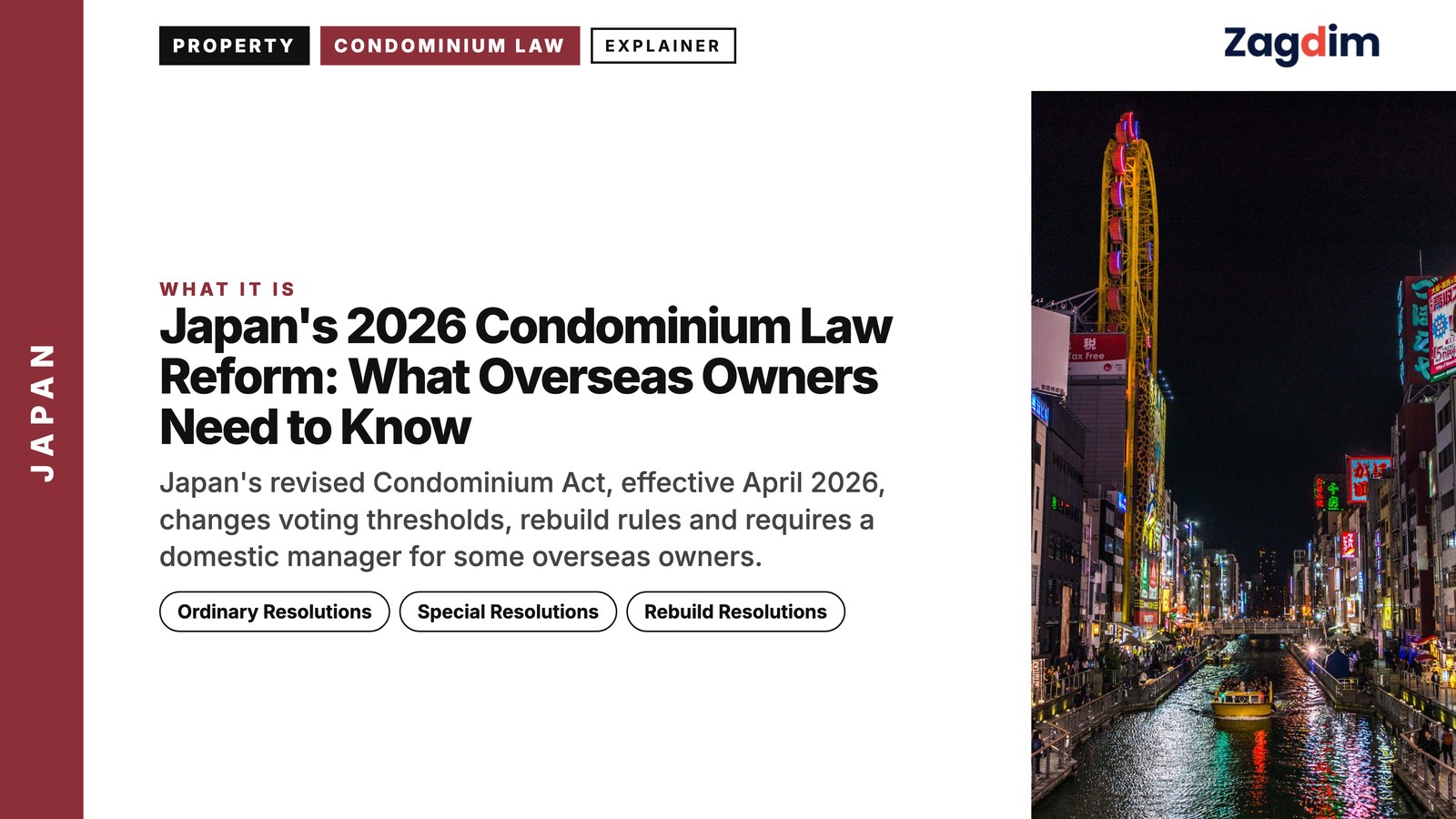
Night — Dotonbori canal at night with neon signs, illustrating Japan's 2026 Condominium Law Reform: What Overseas Owners Need to Know

Image: Zagdim

September 24, 2026
in Japan, Living Abroad, Property
Reading Time: 10 mins read

On April 1, 2026, Japan’s revised Act on Building Unit Ownership, Etc. (commonly known as the Condominium Act) came into force.

For overseas investors and owners who hold a Japanese condominium (bunjo mansion) remotely, this revision directly adjusts multiple core rules covering day-to-day management, owners’ association meetings, and major building-wide resolutions — changes that can affect an owner’s everyday rights as well as decisions on major matters.

The core changes in this revision fall into four areas: the voting base for ordinary resolutions at owners’ meetings; a new two-stage special-resolution mechanism for major matters and management-rule amendments; the voting threshold for building rebuild resolutions; and a new provision letting owners without a residence or domicile in Japan appoint a domestic manager, which an individual building’s own management rules may make mandatory.

This article is based on Japan’s official current legal text and is intended to help owners with an initial self-check and verification. It focuses only on these four core changes and does not cover the process of buying a Japanese condominium or other related matters.

Ordinary Resolutions: The Voting Base Changes to “Attending Owners,” No Longer All Owners

Under Article 39 of the revised Condominium Act, effective April 1, 2026, unless the law or the condominium’s management rules specifically provide otherwise, an ordinary resolution at an owners’ meeting passes when more than half of the attending unit owners with voting rights agree, and the voting rights held by those attending owners also amount to more than half.

In simple terms, the new rule changes the denominator used to calculate an ordinary resolution: in principle, it is no longer based on the total number of all owners, but on the owners who actually attend and hold valid voting rights.

This change particularly affects overseas owners. Because of the distance involved, overseas owners are more likely to miss meeting notices, be unable to attend in person, be unclear on written-voting or proxy procedures, or fail to submit voting documents within the deadline.

Under the new ordinary-resolution system, if an overseas owner cannot participate effectively, the remaining attending owners may be able to pass a resolution with a relatively smaller number of people.

It is therefore advisable for overseas owners to proactively request the latest management rules, the meeting procedure rules, the rules for proxy voting and written voting, how meeting notices and voting documents are sent, and any arrangements for remote attendance or electronic voting from their condominium’s management association.

Owners should confirm in advance how their building handles meeting attendance, voting and proxy procedures, to avoid losing their say in decisions because they did not attend or submit voting documents.

Special Resolutions: A New Two-Stage Vote — First Meet a Participation Threshold, Then Calculate the Approval Ratio

Compared with the single-stage mechanism for ordinary resolutions, this revision creates a new two-stage special-resolution system for three categories of major matters.

These resolutions must first reach the legally required meeting-participation rate, and only then is the required approval ratio among attendees calculated, before the resolution can formally pass.

Major Renovation or Alteration of Common Areas

Under Article 17 of the Condominium Act, in principle more than half of all unit owners with voting rights must first participate in the meeting, after which both the number of attending owners and the voting rights they hold must separately reach at least three-quarters approval.

A building’s management rules may lower the three-quarters approval threshold, but not below one-half. In other words, even if the management rules lower the approval ratio, they cannot remove the basic requirement that more than half of all eligible owners participate in the meeting.

Establishing, Amending or Repealing Management Rules

Under Article 31 of the Condominium Act, more than half of all unit owners with voting rights must first participate in the meeting, after which both the number of attending owners and their voting rights must separately reach at least three-quarters approval.

Management rules cover building governance, cost-sharing, use of common areas, and owners’ rights and obligations, so overseas owners should pay particular attention to any proposal to amend the rules.

Incorporating the Management Association

Under Article 47 of the Condominium Act, when a management association incorporates, the same two-stage voting standard generally applies: more than half of all unit owners with voting rights must participate in the meeting, after which both the number of attending owners and their voting rights must separately reach at least three-quarters approval.

The Key Point of the Two-Stage System

The first threshold in a two-stage resolution is the “participation rate.”

Only once more than half of all unit owners with voting rights have participated in the meeting can the approval ratio among those attending then be calculated.

If the participation threshold is not met, the resolution generally cannot pass even if every owner who did attend voted in favor.

If your condominium is planning a major renovation of common areas, exterior or facility upgrades, an amendment to the management rules, or incorporation of the management association, it is advisable to confirm in advance with the management association how voting rights are calculated, and what written-voting, proxy-attendance and actual meeting procedures apply.

Rebuild Resolutions: Generally Require Four-Fifths Approval, Reducible to Three-Quarters in Five Specific Situations

A resolution to rebuild the building is independent of both ordinary resolutions and the special resolutions described above, does not use the two-stage voting mechanism, and has its own dedicated rules on voting base and approval threshold.

A rebuild resolution can directly affect the property’s asset value, relocation arrangements and owners’ property rights, making it one of the changes overseas owners should pay the most attention to in this reform.

The General Rebuild Threshold

Under Article 62, Paragraph 1 of the revised Condominium Act, in principle a building rebuild resolution requires approval from at least four-fifths of all unit owners with voting rights, and the voting rights held must also reach at least four-fifths.

Here, the denominator used in the calculation is all unit owners with voting rights, not only those who actually attend the meeting.

As a result, owners who do not attend, do not vote, or fail to submit valid voting documents may indirectly affect whether the rebuild resolution reaches the legally required threshold.

Five Specific Situations Where the Threshold Can Drop to Three-Quarters

Under Article 62, Paragraph 2, if the building meets certain statutory safety or functional-deficiency conditions, the rebuild-resolution threshold can be lowered from four-fifths to three-quarters.

The situations covered include:

  • the building does not meet Japan’s current earthquake-resistance safety standards;
  • the building does not meet current fire-safety standards;
  • exterior walls or other building components are at risk of detaching or falling;
  • pipes or equipment are severely deteriorated, creating a hygiene or safety risk;
  • the building does not meet accessibility-related standards.

Where the relevant statutory conditions are met, a rebuild resolution then requires approval from at least three-quarters of all unit owners with voting rights, and the voting rights held must also reach at least three-quarters.

Whether a Building Qualifies for a Special Situation Cannot Be Decided by Owners Themselves

The five categories above are not something individual owners or the management association can determine on their own.

The specific criteria for qualifying must be handled under official technical standards jointly established by Japan’s Minister of Justice and Minister of Land, Infrastructure, Transport and Tourism, including Ministry of Justice Notification No. 21, which took effect on April 1, 2026.

Among these, deterioration of pipes and equipment may also be further defined by additional ministerial ordinances or technical rules.

So whether a building qualifies for a lower rebuild threshold should, in principle, be determined by a licensed Japanese lawyer, architect or other relevant professional, based on formal assessment data and the official technical standards.

Owners should not rely solely on a building’s age, appearance or general repair condition to make this determination themselves, to avoid misunderstanding the rebuild-resolution threshold.

Domestic Manager Obligation: Determined by “Residence or Domicile,” Not by Nationality

This revision adds Article 6-2 to the Condominium Act, establishing a domestic-manager system for unit owners who have no residence or domicile in Japan.

Article 6-2 itself allows (does not by itself require) condominium owners without a residence or domicile in Japan to appoint a domestic manager to handle matters related to condominium management, receiving notices and related affairs; an individual building’s own management rules may make this mandatory for that building.

The scope of this system is easy to misunderstand, so owners should note the following two points.

The Test Is Residence or Domicile, Not Nationality

Whether a domestic manager needs to be appointed depends on whether the owner has a valid residence or domicile within Japan — not on nationality or passport type.

A foreign-national owner who lives in Japan long-term and has a valid residence or domicile there may not be someone required to appoint a manager; conversely, a Japanese-national owner who lives overseas long-term and has no residence or domicile in Japan may also need to appoint a domestic manager.

So it should not be simplified to “all foreign owners must appoint a domestic manager.”

Whether it actually applies still depends on the owner’s residence status, address registration, the building’s management rules, and the individual facts of the case.

The Official Standard Management Rules Are Not Automatically Binding on Every Condominium

The Model Management Rules for Condominiums published by Japan’s Ministry of Land, Infrastructure, Transport and Tourism are a reference template for management associations, and do not automatically become the formal management rules of every individual building.

The official template may separately offer a voluntary model, where owners choose to appoint a domestic manager, and a mandatory model, where the building’s management rules require specific owners to appoint one.

Which system actually applies to a given building still depends on that building’s own management rules, as formally adopted or amended by its owners’ meeting.

Overseas owners should therefore obtain their own building’s current, formally adopted management rules directly from the management association, rather than assuming their obligations based on the official standard template alone.

This article does not go into the legal consequences of failing to appoint a manager, or the specific scope of a domestic manager’s authority. If you need help with the appointment process, confirming a manager’s authority, or assessing compliance risk, it is advisable to consult a licensed Japanese lawyer or other relevant professional.

Self-Check List for Overseas Condominium Owners

In light of the 2026 rules, overseas condominium owners should first confirm whether they have a valid residence or domicile in Japan, and whether they need to appoint a domestic manager. They should also request the management association’s current formal management rules, to check the domestic-manager provisions and how they are implemented.

Owners should also confirm the address and electronic contact method used to receive owners’-meeting notices, understand the procedures for attending in person, attending online, voting in writing, and voting by proxy, and make sure the management association has their current overseas address, email and phone number.

If the building involves renovation of common areas, an amendment to the management rules, or a rebuild, it is advisable to confirm the voting rules, one’s own share of voting rights, and how exclusively-owned floor area is calculated in advance.

Before buying a property, it is also worth checking whether the target condominium has any outstanding management or reserve-fund fees, and whether the building has a long-term maintenance plan, an earthquake-resistance assessment, or ongoing discussion of a rebuild, to reduce future management and asset risk.

Frequently Asked Questions

Q1: Are ordinary resolutions and the new special resolutions calculated the same way?
No. In principle, an ordinary resolution passes when more than half of attending owners with voting rights, and the voting rights they hold, separately reach a majority — calculated mainly based on those who actually attend.

Special resolutions — major changes to common areas, establishing or amending management rules, and incorporating the management association — use a two-stage system instead. First, more than half of all unit owners with voting rights must participate; then, the number of attending owners and the voting rights they hold must separately reach the legally required approval ratio.

The voting threshold and calculation logic differ between the two.

Q2: Does the domestic-manager obligation only apply to foreign owners?
No. In principle, this obligation is determined by whether the owner has a residence or domicile in Japan, not by nationality.

A foreign national who lives in Japan long-term may not need to appoint one; a Japanese national who lives overseas long-term with no residence or domicile in Japan may also need to appoint one.

Whether it actually applies depends on the individual’s residence status, the building’s management rules, and the specific case.

Q3: Has the condominium rebuild threshold been fully lowered to three-quarters?
No. In principle, an ordinary rebuild resolution still requires that both the number of unit owners with voting rights and the voting rights they hold separately reach at least four-fifths approval.

Only where the building meets specific statutory conditions relating to earthquake resistance, fire safety, exterior-wall safety, pipe hygiene or accessibility standards, and meets the official technical certification standard, can the threshold potentially drop to three-quarters.

So three-quarters is not a threshold that applies to every condominium rebuild resolution.

If you have questions about the new rules or how they apply to your situation, you can ask Zagdim for further clarification; if you need to connect with local Japanese professional services, ZDelp can help point you toward relevant assistance.

Important Disclaimer

This article is based on Japan’s official laws, notifications and related documents that took effect on April 1, 2026. It is for general reference only and does not constitute legal, financial, tax or property-purchase professional advice.

How this revision actually applies may vary depending on each condominium’s formal management rules, each owner’s share of voting rights, the building’s condition, and the individual owner’s residence situation.

Before making any legal, management, investment or asset-disposal decision based on this article, you should consult a licensed Japanese lawyer, judicial scrivener, architectural professional or other qualified advisor, and proceed based on the actual facts of your case.

Related in this series:

  • How to Buy Property in Japan as a Foreigner: Step-by-Step Process
  • Why Japan Has a Housing Shortage Despite High Vacancy Rates
  • Cost of Living in Japan for Foreigners: A Full Budget Breakdown
  • Japan's Pension System for Foreigners: How Much Can You Get?

Have a question about this guide? Leave a comment below, or ask Zagdim directly.

Life abroad? Ask Zagdim.

Your first stop for international property and global living.

Research and insights. Know what’s changing. Understand what matters.

Sources

  1. Japan Ministry of Justice: Reiwa 7 Act No. 47, amendments to the Act on Building Unit Ownership, Etc. and related laws
  2. e-Gov Law Search: Showa 37 Act No. 69, Act on Building Unit Ownership, Etc., Reiwa 7 amended version, including Articles 6-2, 17, 31, 39, 47 and 62
  3. Ministry of Justice Notification No. 21, effective April 1, 2026
  4. Japan Ministry of Land, Infrastructure, Transport and Tourism: Model Management Rules for Condominiums (actual version subject to the latest official publication)

Currency of information: This article is based on official Japanese information available as of July 2026, corresponding to the revised regulations that formally took effect on April 1, 2026. If Japan’s Ministry of Justice, Ministry of Land, Infrastructure, Transport and Tourism, or other competent authorities later issue new ministerial ordinances, notifications, notices or official guidance on rebuild-qualification standards, the domestic-manager system, or condominium meeting voting procedures, this article’s content will need to be reverified and updated. Readers should check the latest official documents before relying on this article, to confirm the information remains current.

Zagdim AI
All content is researched, written, or authorized for publication by the @Zagdim Overseas team. Sharing and reposting are welcome, but please make sure to credit the source and include the original article link from this website. Any plagiarism or unauthorized use may result in legal action. For article submissions, please contact us via Facebook. Thank you for your support!

For article submissions, press release publication, or interview notices, please contact [email protected]. 

Zagdim Ask

Have a specific question about overseas living, property, visa, or practical arrangements?

Fill in your situation and key concerns through Zagdim Ask. Our team will review your message and get back to you by email where appropriate.

Submit your enquiry →

Similar Topics

Skyline — Osaka skyline with tower at sunset, illustrating Japan Residence Essentials: How to Apply for the Residence Card, Juminhyo, and My Number Card
Japan

Japan Residence Essentials: How to Apply for the Residence Card, Juminhyo, and My Number Card

September 24, 2026
Architecture — curved modern building with garden terraces, illustrating How to Set Up a Company in Japan as a Foreigner: Requirements and Process
Japan

How to Set Up a Company in Japan as a Foreigner: Requirements and Process

September 24, 2026
Street — shopping street exterior with billboards in Osaka, illustrating How to Find a Job in Japan: 7 Methods for Foreigners
Japan

How to Find a Job in Japan: 7 Methods for Foreigners

September 24, 2026
Next Post
Transport — green train at station platform with mountains, illustrating Understanding Japanese Apartment Layouts: What LDK, 1K and 1R Mean

Understanding Japanese Apartment Layouts: What LDK, 1K and 1R Mean

Aerial — Tokyo cityscape aerial with Tokyo Tower, illustrating Japan Property Purchase Documents: Individuals, Companies, Minors

Japan Property Purchase Documents: Individuals, Companies, Minors

Temple — row of red and white paper lanterns at shrine, illustrating Japan's Important Matters Report: What to Check Before Buying Property

Japan's Important Matters Report: What to Check Before Buying Property

Facebook Twitter Youtube

About Us

Zagdim is a global knowledge platform focused on cross-border property, relocation, lifestyle, and location-based decision-making.

We provide insights on overseas real estate, market trends, regional analysis, economic developments, and practical relocation information. Through continuous market observation and on-the-ground research, Zagdim helps readers better understand a place before deciding where to live, invest, buy property, or establish a base abroad.

We currently follow markets including the UK, Japan, Thailand, Malaysia, Germany, Australia, the UAE, Greece, Portugal, and Spain, while continuing to track emerging lifestyle, relocation, and property trends worldwide.

Category

  • Australia
  • Buying & Immigration Guide
  • Canada
  • Costa Rica
  • Dubai
  • Encyclopedia
  • Europe
  • Expat Lifestyle Guide
  • Global Reports Analysis
  • Hong Kong
  • Human-Picked
  • International Property Buying Guide
  • Japan
  • Japan Market News
  • Kenya
  • Living Abroad
  • Malaysia
  • Mallorca
  • Market Trends Overview
  • News
  • Other Market News
  • Overseas Leasing & Long-Term Stay
  • Philippines
  • Policy Interpretation
  • Portugal
  • Property
  • Property Law & Tax
  • Real Estate & Economic News
  • Real Estate Law & Taxation
  • Relocation, Immigration & Visa
  • Singapore
  • South Korea
  • Spain
  • Switzerland
  • Thailand
  • Thailand Market News
  • UK Market News
  • United Kingdom
  • United States
  • Vietnam Market News
  • Visa & Immigration
  • Zagdim Insights
  • Zagdim Property Insights

Email:[email protected]


Add Friends


WhatsApp
Contact Us


Wechat:Zagdim

Work with Zagdim

Put your brand inside the overseas property research process — in English and in Chinese. Reaching buyers, expats and investors across 19 markets.

View partnership packages →

©2026 Zagdim Overseas All Right Reserved

No Result
View All Result
  • Home
  • Zagdim Property Insights
    • Market Trends Overview
    • Policy Interpretation
    • Forest
    • PLACEHOLDER sub-cate for Zagdim Property Insights
  • Global Reports Analysis
    • In-Depth Project Analysis
  • Real Estate & Economic News
    • Thailand Market News
    • UK Market News
    • Germany Market News
    • Japan Market News
  • Buying & Immigration Guide
    • Expat Lifestyle Guide
    • Real Estate Law & Taxation
    • Overseas Leasing & Long-Term Stay
    • Starting a Business & Company Setup
  • Zagdim Ask
  • 中文 EN

©2026 Zagdim Overseas All Right Reserved