





























How can buyers protect their legal interests under a Private Lease Scheme, given its restrictions on ownership?
What a PLS Is and How It Works: Leasehold Rights in Place of Full Ownership
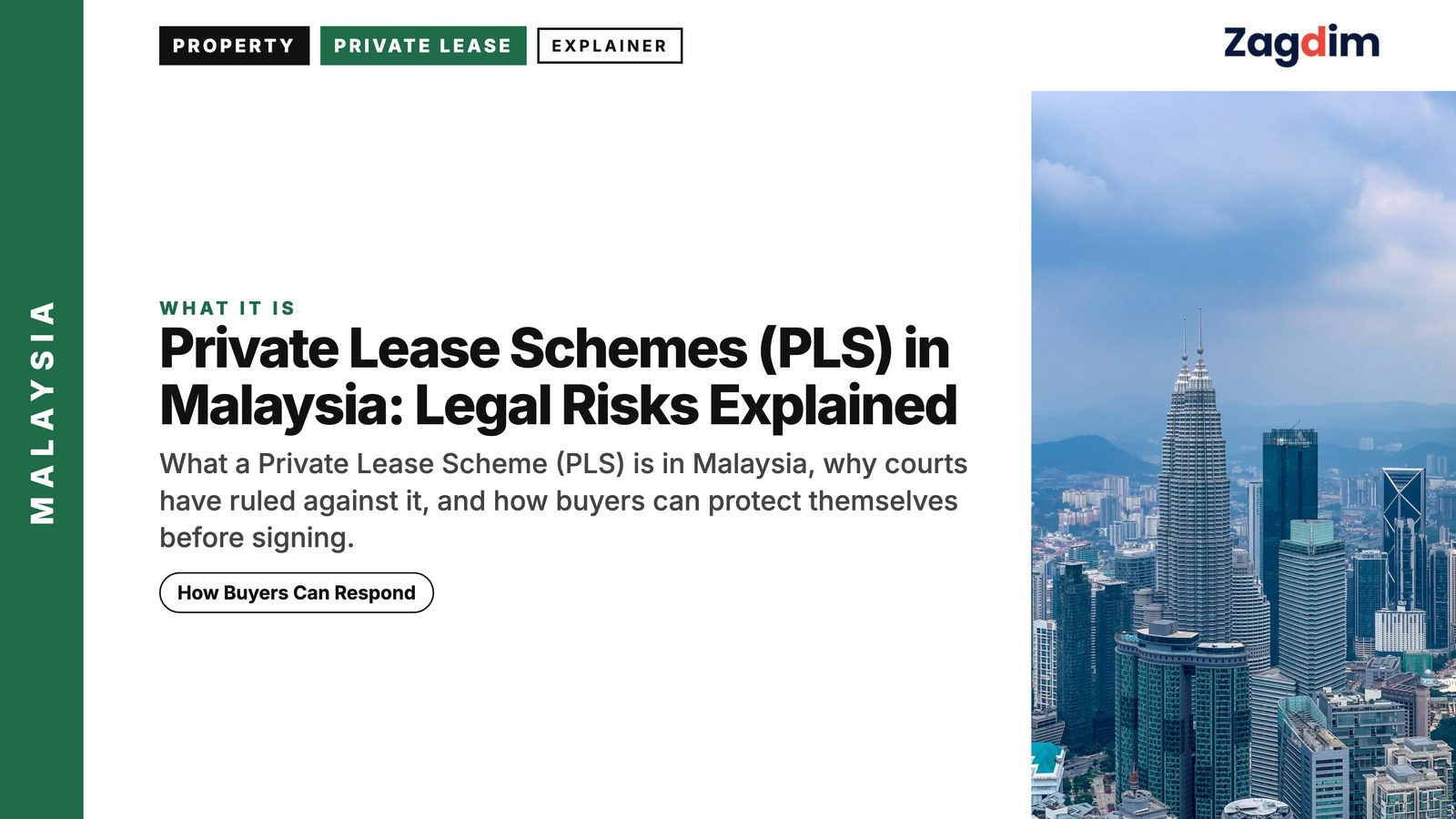
The Private Lease Scheme (PLS) was first introduced in 2012 by Iskandar Investment Berhad, and has since become a new transaction model in Malaysia’s property market. Instead of a traditional transfer of ownership, this model offers a long-term lease — the buyer can obtain a leasehold right of up to 99 years, but actual ownership of the property remains with the developer.
Under a PLS, the buyer is only a sub-lessee, holding rights based on a lease contract rather than legal title. This means the buyer cannot freely sell or rent out the property the way a traditional title holder can, and cannot take part in decisions on property management, such as voting for the management committee of the building. These restrictions significantly reduce the property’s autonomy and appeal as an investment.
PLS and Its Conflict With the Legal Framework
A PLS carries considerable legal uncertainty in how it operates, particularly because it is not fully compatible with Malaysia’s National Land Code and Strata Titles Act. A series of legal issues stand in the way of protecting a buyer’s rights:
- No strata title rights Under a PLS, the buyer cannot obtain a strata title, which not only strips them of the right to take part in property management, it may also breach the Strata Management Act 2013.
- Transaction restrictions PLS contracts require the developer’s consent before a buyer can sell or rent out the property, restricting their ability to act freely in the market.
- A warning from the courts In a 2020 case, the court ruled that the PLS model violated the Housing Development (Control and Licensing) Act 1966, and declared the relevant purchase contracts void. This ruling raised broader questions about the legality of PLS and had a significant effect on market confidence.
An important 2020 case involved a Private Lease Scheme (PLS) that breached the Housing Development (Control and Licensing) Act 1966. The case is Loh Tina & 6 Ors v Kemuning Setia Sdn Bhd & 5 Ors (and Another Appeal) [2020] 7 CLJ 720. In this case, the court made the following key rulings:
- The court ruled that the PLS breached the Housing Development (Control and Licensing) Act, the Housing Development (Control and Licensing) Regulations 1989, the National Land Code 1965 and the Strata Titles Act 1985.
- The court ordered the lease assignment to be cancelled, and instead ordered title to be transferred to the purchasers.
- Court of Appeal judge Lee Sweng Seng held that compliance with section 11(1) of the Housing Developers (Control and Licensing) Regulations 1989 is mandatory. Any deviation from the prescribed contract terms is unlawful and renders the transaction void.
- The court emphasized that the main purpose of the Housing Development (Control and Licensing) Act is to protect ordinary purchasers from unscrupulous developers. Any departure from the prescribed contract must be treated as unlawful.
- The court posed a key question: “Who would want a leasehold interest when the law entitles them to a freehold interest?” — highlighting the conflict between PLS and the legal framework.
This case makes clear that the PLS model is incompatible with the existing legal framework and infringes on purchasers’ rights. The court’s ruling underscored the importance of protecting purchasers’ interests, and reaffirmed the legislative intent behind the Housing Development (Control and Licensing) Act.
How Buyers Can Respond: Reducing the Risk
To avoid losses in a PLS transaction, experts offer the following advice:
- Understand the contract terms thoroughly Buyers should carefully review the ownership-related clauses in the contract, to confirm whether they are buying full ownership or only a leasehold right.
- Seek professional help Hire a lawyer or agent familiar with local law to help interpret the contract details and protect your own interests.
- Confirm the legal documents are complete Before signing, verify whether you will be able to obtain a strata title, and understand the renewal conditions and restrictions of the leasehold right.
- Consider a traditional ownership model instead If the legal risk is too high, consider choosing a title-transfer model instead, to ensure the property’s long-term security and stable value.
Outlook and Policy Recommendations: The Future of PLS Legality
The Private Lease Scheme offers innovative flexibility in how a transaction is structured, but its insufficient legal protection remains a major obstacle. Going forward, the Malaysian government should improve the relevant legal framework to give PLS buyers clearer protection of their rights. At the same time, strengthening public education would raise buyers’ awareness and vigilance about the PLS model, helping avoid misunderstandings and disputes caused by an information gap.
For buyers, fully understanding the legal implications of a PLS and making a careful decision is the first step in protecting their own interests. Until the relevant policy is further developed, choosing a traditional ownership model may be the safer investment choice.
Key warning: in a Private Lease Scheme, the absence of title is not just a matter of paperwork — it is a serious challenge to a buyer’s financial security and legal protection.
Have a question about this guide? Leave a comment below, or ask Zagdim directly.
Your first stop for international property and global living.
Research and insights. Know what’s changing. Understand what matters.