





























Three Key Points From This Article
- If you are planning to move to Thailand, retire there long-term, work remotely, or stay on a long-term visa, the healthcare system and health insurance are basic questions you need to understand before you go. Thailand’s healthcare quality has a solid reputation within the region, but whether a foreigner can use public healthcare, and whether they can afford private hospital costs, actually depends on their status, visa, employment situation, and insurance arrangements.
- This article focuses on three things: whether foreigners can use Thailand’s universal healthcare scheme, the practical differences between public and private hospitals in cost and experience, and how different types of long-term residents should arrange their health insurance. For anyone planning a long stay, this is not just a question of convenience — it is part of your overall relocation cost and risk management.
- One point worth particular attention: while Thai healthcare costs are generally lower than in some Western countries, hospitalization, surgery, or emergency care at a private hospital can still be a significant expense. Without insurance, or with insufficient coverage, a single medical event could disrupt your long-term budget, and could even affect your future visa and residence arrangements.
Who Planning a Long Stay in Thailand Should Pay Particular Attention to the Healthcare System?
Foreigners Planning to Move or Retire to Thailand
Many people first consider Thailand because of its relatively manageable cost of living, comfortable climate, wide choice of cities, and a regionally respected standard of healthcare. But once life shifts from “short-term travel” to “long-term residence,” the questions become much more practical: where do you go for everyday medical care? Can you use public hospitals? Will private hospitals be too expensive? Is there insurance to cover a serious illness?
Thailand’s medical tourism sector is well developed, and Bangkok, Chiang Mai, Pattaya and similar cities all have private hospitals commonly used by foreigners. But long-term residents cannot just look at “how good is the care” — they also need to look at their own ability to pay for it reliably. For retirees, those on a fixed income, or anyone planning to relocate long-term, this should be planned before the move, not after.
Foreign Employees Already Working in Thailand, or About to Be Hired by a Local Company
If you are employed by a Thai company and legally contribute to social security, your starting point for healthcare coverage is different from that of a typical retiree or digital nomad. Thailand’s Social Security Scheme (SSS) provides employees with basic medical services at designated hospitals, and foreign employees who meet the conditions can generally be included as well.
But it is important to understand that having social security does not mean all your medical costs can be freely reimbursed, nor does it mean you can freely choose a high-end private hospital. In many cases, social security corresponds to a designated or contracted hospital, and the group medical insurance provided by an employer may also have coverage limits, ward-type restrictions, and exclusions. Foreign employees should therefore look closely at whether the coverage their employer provides is actually sufficient.
People Applying for a Retirement Visa, an LTR Visa, or Another Long-Term Visa
For those planning to stay in Thailand on a retirement visa, an LTR Visa, or another long-term visa, health insurance is often not just a lifestyle consideration — it can also be part of the visa conditions. Some visa categories require applicants to hold health insurance of a certain amount, or to provide sufficient proof of financial means showing they can cover medical costs while in Thailand.
Readers in this group therefore need to look at “visa conditions” and “medical risk” together. Getting the visa approved is not the end of the process — you also need to consider: is the insurance policy’s term long enough? Will you still need to provide a policy at renewal? Will premiums rise significantly as you get older? If the insurance is not renewed in the future, do you have enough cash flow to cover medical costs on your own?
How Is Thailand’s Healthcare System Structured, and What Can Foreigners Actually Use?
Public Healthcare: UCS, SSS, and Basic Coverage for Residents
Thailand’s Universal Coverage Scheme (UCS) is a publicly funded healthcare system supported by government tax revenue, mainly aimed at letting eligible residents access essential medical services at low cost, or close to free. UCS covers outpatient care, hospitalization, emergency care, chronic disease management, and preventive health services, and is administered by the National Health Security Office (NHSO).
However, the point foreigners most often misunderstand is that UCS is not a system that a foreign resident can automatically use simply by moving to Thailand. It is designed mainly for Thai citizens, and foreigners generally will not automatically be covered by this universal healthcare scheme unless they hold a specific status or fall within a specific policy target group.
In practice, a more realistic public healthcare entry point for foreigners is joining the Social Security Scheme (SSS) through employment. If a foreigner is legally employed in Thailand, with the employer legally contributing to social security, they can generally use basic medical services at a designated hospital. This is an important healthcare foundation for foreign employees working in Thailand.
Private Healthcare: Better Service, English-Friendly, but More Expensive
Private hospitals in Thailand are the healthcare setting most familiar to many foreigners. Private hospitals in Bangkok, Chiang Mai, Pattaya, Phuket and similar cities generally have newer equipment, a more comfortable environment, and medical staff with relatively better English ability. For a foreigner who has just arrived in Thailand, is not fluent in Thai, or wants to complete checkups, diagnosis, and treatment arrangements quickly, private hospitals are noticeably more convenient.
But that convenience comes with a higher medical cost. While Thailand’s private healthcare costs may not be the highest by international comparison, a single hospitalization, surgery, or emergency visit can still be a substantial sum for an individual. Some private hospitals may also require patients to provide insurance information, a credit card pre-authorization, or an upfront payment as security before admission or treatment.
So, for foreign long-term residents, a private hospital can work well as your main choice of care, but only on the condition that you have sufficient insurance or a medical reserve fund. If you rely entirely on paying out of pocket, the risk increases significantly once a more serious medical event occurs.
Foreigners and Thailand’s Universal Healthcare: Don’t Simply Assume “Living in Thailand Means You’re Covered”
In recent years, the Thai government has discussed and advanced some expansion of healthcare coverage for non-citizens, for example bringing certain undocumented individuals, vulnerable groups, or long-term non-Thai residents into specific medical support schemes. This shows that, at the policy level, Thailand is indeed paying attention to healthcare accessibility for non-citizens.
But for most ordinary foreign long-term residents, this kind of policy should still not be understood as meaning “all foreigners can use Thailand’s universal healthcare scheme.” Whether you can actually access public healthcare still depends on your status, registration, employment situation, regional policy, and how it is actually implemented.
A safer way to think about it is:
If you are legally employed in Thailand, first check whether you have SSS coverage;
If you are on a retirement visa, an LTR visa, a digital-nomad arrangement, or another non-employment long-term status, you should assume you will mainly rely on private health insurance and out-of-pocket payment, rather than on UCS.
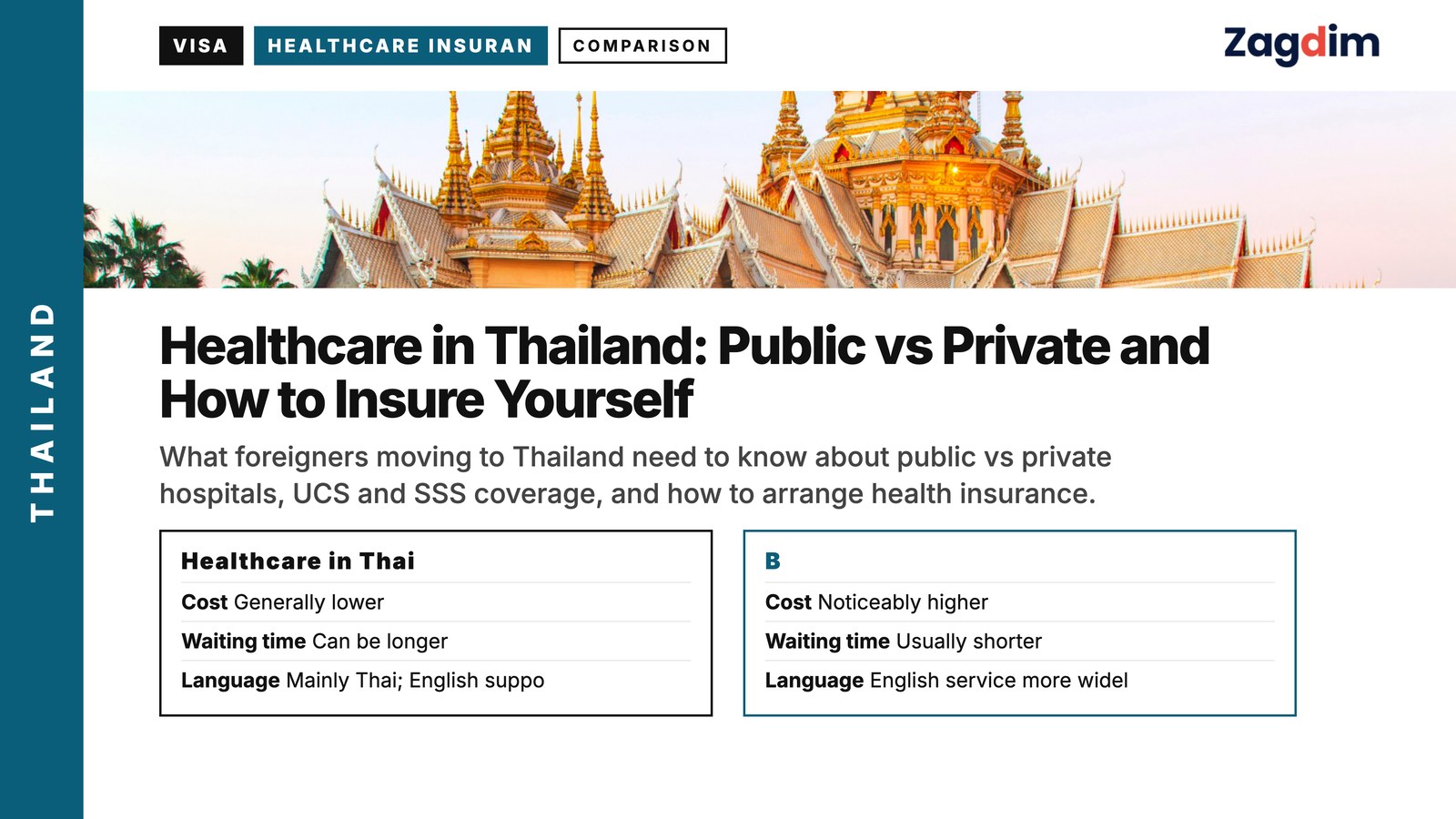
What Are the Practical Differences Between Public and Private Hospitals?
| Item | Public Hospital | Private Hospital |
|---|---|---|
| Cost | Generally lower | Noticeably higher |
| Waiting time | Can be longer | Usually shorter |
| Language | Mainly Thai; English support not always sufficient | English service more widely available |
| Quality of care | Doctors’ professional standard is not lower, but resources are tighter | Equipment, service and processes generally more complete |
| Best suited for | Basic care, SSS-designated hospitals, cost control | Foreigners, those needing English communication, fast checkups, or more privacy-sensitive care |
| Main risk | Waiting time, language barriers, crowded environment | Higher cost, needs insurance or a sufficient budget to support it |
In short, the advantage of public hospitals is lower cost, which is an important safety net especially for those enrolled in social security. But foreigners may run into language barriers, wait times, and unfamiliar processes.
Private hospitals better match most foreigners’ expectations for service, language, and efficiency, but at a noticeably higher cost. If you plan to live in Thailand long-term and expect to rely mainly on the private healthcare system, health insurance is essentially not optional — it is a necessary part of your long-term planning.
How Should Foreigners in Thailand Arrange Healthcare and Health Insurance?
Step One: Confirm Your Status and Starting Point for Healthcare Coverage
Different types of foreign residents have access to different healthcare resources in Thailand. Before you go, you can take stock using the following:
| Status Type | Possible Healthcare Coverage | What to Watch For |
|---|---|---|
| Foreign employee at a Thai company | May be enrolled in SSS, and have company group medical insurance | Confirm the designated hospital, coverage amount, and exclusions |
| Retirement visa or LTR long-term resident | Mostly relies on private insurance and out-of-pocket payment | Watch visa insurance requirements, renewal age, and premiums |
| Digital nomad, remote worker | Usually no local public healthcare coverage | Consider international health insurance or long-stay travel insurance |
| Short-term traveler | Can use public or private hospitals, but mostly out-of-pocket | Do not confuse travel insurance with government traveler coverage |
What you really need to establish first is: are you already covered by some form of public healthcare? If not, treat private insurance as your primary coverage, rather than something to sort out only when you need it.
Step Two: Don’t Just Compare Premiums — Check Whether the Coverage Actually Suits Life in Thailand
Many people, when choosing health insurance, look only at the annual premium. But for someone living in Thailand long-term, the following points matter more:
- Does it cover hospitalization and surgery?
- Does it cover private hospitals?
- Can you pay the hospital directly, or do you have to pay out of pocket first and claim afterward?
- Is there a deductible?
- Is there an annual coverage cap?
- Are pre-existing conditions excluded?
- Can the policy be renewed as you get older?
- Does this policy meet the requirements when you renew your visa?
This matters especially for retirees or older long-term residents — you cannot just look at the first year’s premium. What matters more is whether you will still be able to buy coverage in the years ahead, whether you can afford the renewal premiums, and whether the policy will still be valid once a chronic or serious illness develops.
Step Three: Insurance Arrangements Can Differ by Type of Foreign Resident
Employees: Social Security + Company Insurance + Supplementary Insurance
If you are employed by a Thai company, start by confirming your SSS-designated hospital and the details of your company’s group insurance. If the company insurance has a low coverage limit, or you are used to using private hospitals, consider adding supplementary private health insurance.
Retirees or LTR Long-Term Residents: Private Health Insurance Is Central
Retirees and LTR long-term residents generally do not automatically have access to Thailand’s public healthcare, so private health insurance becomes the central arrangement. Beyond meeting visa requirements, you also need to consider how medical costs and premiums will change as you get older.
Digital Nomads: Don’t Rely Only on Travel Insurance
If you spend several months a year in Thailand but are not formally employed by a Thai company and do not hold long-term resident status, ordinary travel insurance may not be sufficient. This group is better served by researching medium- to long-term international health insurance, particularly a plan that works across countries and covers hospitalization and emergency care.
Short-Term Travelers and Government Health Coverage: A Reference Point, Not a Full Solution
In recent years, the Thai government has introduced traveler protection schemes such as Thailand Traveller Safety (TTS), providing limited accident medical and death benefit coverage for travelers entering the country legally. These arrangements are mainly designed to give travelers a basic safety net, while also reducing the burden that unpaid medical bills place on the healthcare system.
However, this kind of government coverage is not comprehensive health insurance. It typically has a coverage cap, a limited period of applicability, restrictions on the type of incident covered, and exclusion clauses, and it does not cover all illnesses, chronic conditions, hospitalization, or long-term treatment needs.
So, if you are only traveling short-term, TTS or a similar scheme can be treated as an extra layer of protection. But if you plan to live in Thailand long-term, travel back and forth frequently, or eventually move to a retirement or long-term visa, you should not treat it as your main healthcare arrangement.
Common Misunderstandings and Long-Stay Risks
Misunderstanding One: “Thai Healthcare Is Cheap, So I Don’t Need Insurance”
Thai healthcare costs are indeed lower than in some Western countries, but that does not mean there is no risk. Minor illnesses or a routine outpatient visit may not be a big burden, but hospitalization, surgery, cancer treatment, cardiovascular disease, or a serious accident can still generate a large bill. For a retiree or a long-term resident on a fixed income, a single major medical event is enough to affect their financial security.
Misunderstanding Two: “Once I Move to Thailand, I Can Use Universal Healthcare”
UCS is aimed mainly at Thai citizens and specific policy target groups; ordinary foreigners generally do not become automatically covered simply by living in Thailand long-term. Even though the government has moved in recent years to expand some coverage for non-citizens, whether it actually applies still depends on individual status and local implementation.
Misunderstanding Three: “Having Company Insurance Is Always Enough”
Company group medical insurance genuinely helps, but it typically comes with coverage limits, a designated hospital, a ward-class limit, or exclusions. If you want to use a higher-end private hospital, or are concerned about the cost of a serious illness, company insurance may not be enough on its own. The safest approach is to look at social security, company insurance, and personal supplementary insurance together.
Misunderstanding Four: “Traveler Coverage Can Replace Health Insurance”
TTS or other traveler-protection schemes are generally only a limited supplementary layer, and are not suitable as a replacement for comprehensive health insurance. Long-term residents, remote workers, and retirees in particular need insurance arrangements that can actually handle hospitalization, surgery, and major medical expenses.
Misunderstanding Five: “Visa and Health Insurance Can Be Handled Separately”
For many long-term visas, health insurance and visa conditions are directly linked. If your insurance lapses partway through, has insufficient coverage, or you cannot provide compliant documents at renewal, this can affect your subsequent residence arrangements. Visa planning and insurance planning should therefore be handled together.
Three Typical Scenarios: How Should Different Long-Term Residents Plan?
Scenario One: A Foreign Professional Employed by a Thai Company
Suppose a foreign professional is employed by a company in Bangkok and plans to work in Thailand long-term. The company contributes to social security on their behalf and also provides basic group medical insurance.
In this situation, they should first confirm three things:
First, which hospital is designated under their SSS;
Second, whether the company insurance covers private hospitals, hospitalization, and surgery;
Third, whether the coverage amount is sufficient to handle a more serious medical event.
If the company insurance is only basic coverage, and they usually prefer to use private hospitals, it would be prudent to buy supplementary private health insurance on their own.
Scenario Two: A Long-Term Resident on a Retirement Visa or LTR Visa
Suppose a retiree plans to live in Thailand long-term on a retirement visa or an LTR visa, with income mainly from a pension, investment returns, or overseas assets. What they most need to focus on is not just whether they need to provide health insurance when applying for the visa, but their ability to afford medical care over the next 5, 10, or more years.
People in this position generally cannot rely on Thailand’s UCS as their main coverage, so private health insurance and a medical reserve fund become the core of their planning. One point to watch carefully: premiums may rise as they get older, and some policies may also restrict coverage for pre-existing conditions. If they plan to rely only on cash reserves to cover medical risk, they need to be sure they can actually absorb the cost of a large hospitalization or long-term treatment.
Scenario Three: A Remote Worker or Digital Nomad Traveling to Thailand Frequently
Suppose a remote worker spends several months each year in Bangkok or Chiang Mai, but is not formally employed in Thailand and does not necessarily hold a long-term resident visa. They may be used to using a private hospital for checkups, consultations, or minor unexpected illnesses.
What this group most easily overlooks is that their stay is longer than a typical traveler’s, yet they do not fall under an employee or public-healthcare coverage category. Relying only on short-term travel insurance may not cover an extended stay, a chronic condition, or more complex medical needs. A more suitable direction is usually to look into international health insurance, or an insurance plan designed for long-term travelers.
FAQ: Healthcare System and Insurance Planning for Foreigners in Thailand
Q1: Can foreigners use Thailand’s universal healthcare scheme, UCS?
Generally, Thailand’s Universal Coverage Scheme is aimed mainly at Thai citizens. Foreigners are not automatically covered simply by living in Thailand long-term, unless they hold a specific policy status or fall within a specific group covered by an expanded government scheme. Most foreign long-term residents still need to rely on social security, private health insurance, or paying out of pocket.
Q2: If a foreigner in Thailand has a work visa, does that guarantee free public healthcare?
Not necessarily. What matters is not simply whether you hold a work visa, but whether you are legally employed and enrolled in the Social Security Scheme. If you are enrolled in SSS, you can generally use basic medical services at a designated hospital. But this does not mean you can freely use any private hospital, nor that all your medical costs will be covered.
Q3: If I only want to use private hospitals, will it be very expensive?
Costs at Thai private hospitals are generally higher than at public hospitals, but may still be lower than in some Western countries. Even so, hospitalization, surgery, or emergency treatment can still be a large expense for an individual. If you plan to rely on the private healthcare system long-term, it is advisable to arrange sufficient health insurance rather than relying entirely on paying out of pocket.
Q4: Is the medical coverage the Thai government provides to travelers sufficient?
Traveler coverage should generally be treated as supplementary, not as comprehensive health insurance. These schemes typically have a coverage cap, specific conditions, and a limited period of applicability, and are aimed mainly at specific incidents or emergencies — they are not suitable as a long-term resident’s primary healthcare coverage. insurancebusinessmag
Q5: If I apply for a retirement visa or an LTR visa, do I have to buy health insurance?
Some long-term visas require applicants to provide health insurance meeting a specified standard, or to provide proof of financial means as an alternative. The specific conditions vary by visa category and the latest official policy. Even where proof of financial means can be used as an alternative in some cases, health insurance remains an important way for most long-term residents to reduce long-term risk.
Q6: What happens if I get seriously ill in Thailand without health insurance?
A foreigner without health insurance can still receive treatment in Thailand, but the cost generally has to be paid out of pocket. Public hospitals are cheaper but may involve waiting times and language issues; private hospitals are more convenient but more expensive, and may require upfront payment or proof of ability to pay. For a long-term resident, going without insurance for an extended period increases both financial pressure and policy risk.
For questions about a Thai visa, long-term stay, or entry status, ask Zagdim.
*Disclaimer*
*This article draws on official announcements, policy explanations, and information from professional organizations between 2023 and 2026, to summarize Thailand’s healthcare system, the differences between public and private hospitals, and health insurance and long-stay risk for foreigners in Thailand. The content is for general information and educational purposes only, and does not constitute legal, tax, financial, insurance, or medical advice, and does not guarantee the outcome of any visa application, insurance underwriting, or medical treatment.*
*Thailand’s visa, health insurance, and public healthcare policies may change based on government regulations, hospital standards, and insurer terms. Before making a decision about relocation, insurance, a visa, or medical care, readers should rely on the latest information from the Thai government, relevant medical institutions, insurers, and qualified professionals.*
Have a question about this guide? Leave a comment below, or ask Zagdim directly.
Your first stop for international property and global living.
Research and insights. Know what’s changing. Understand what matters.
Sources
- Ministry of Public Health – Universal Health Coverage Scheme Policy
- National Health Security Office – Thailand UHC & UCS Overview
- Royal Thai Embassy Washington DC – Thailand Extends Health Coverage to Non-Citizens
- Ministry of Tourism and Sports – Thailand Traveller Safety (TTS) Overview
- Allianz Care – Guide Healthcare in Thailand
- AXA Global Healthcare – Thailand Health & Medical Insurance for Foreign Expats
- Expat Financial – Thailand Healthcare System for Expatriates
- Siam Legal – LTR Visa Thailand Requirements & Benefits
- Luma Health – LTR Visa Thailand Health Insurance Guidelines
- Thailand TV News – Thailand Boosts Tourism with Medical Coverage for Visitors
- The Nation Thailand – Thailand Plans Mandatory Health Insurance for Tourists
If you are considering a Thailand retirement visa, ask Zagdim about the Non-O/O-A application options, financial and insurance document requirements, and filing support.