
































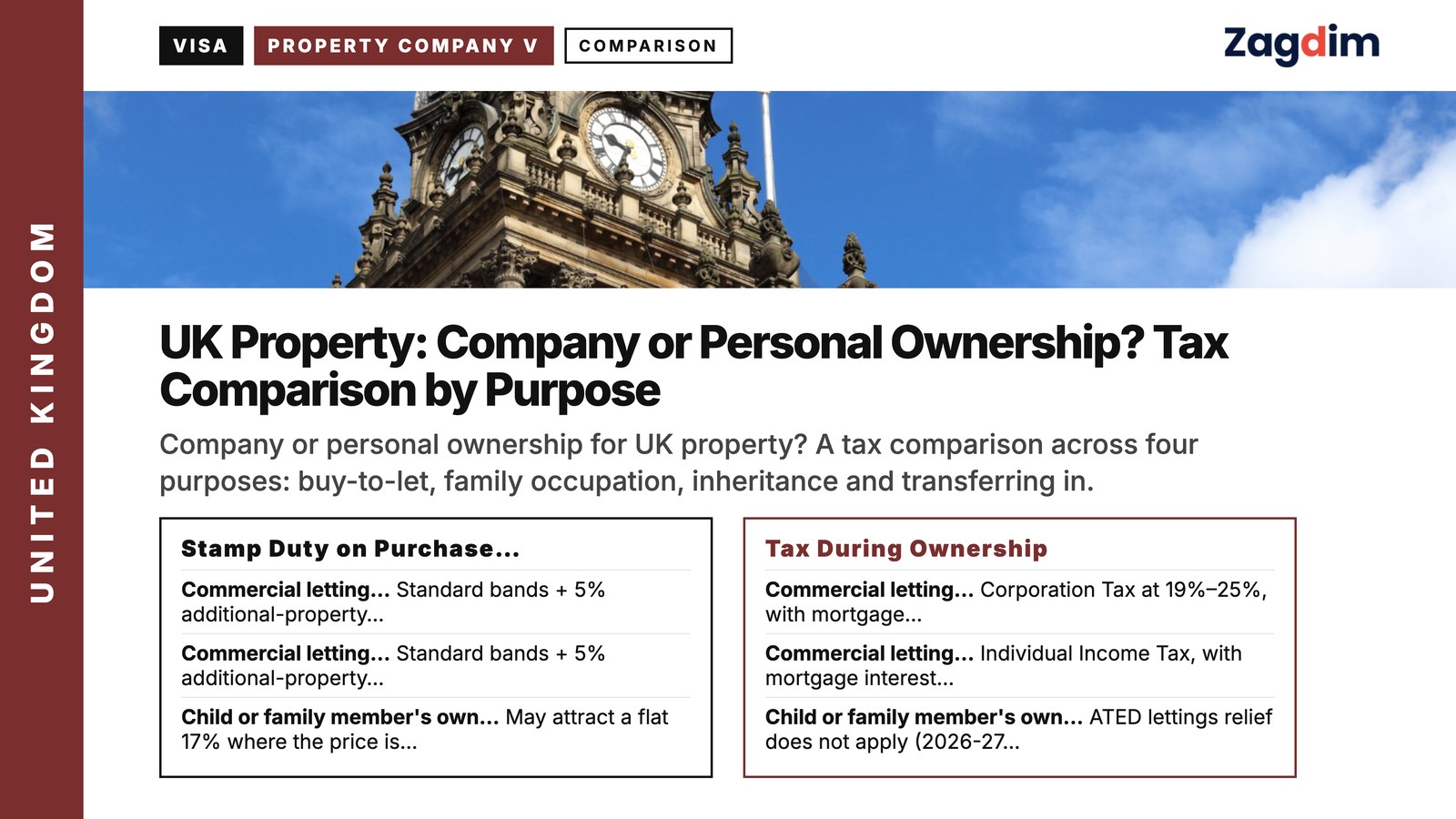
Search “buying UK property through a company” and the most common answer you’ll find is “holding through a company saves tax.” That’s true for some buyers, and the exact opposite for others — because how the UK tax system treats “a company holding a residential property” depends on the property’s purpose. Commercial letting, a family member living in it rent-free (or at a discount), inheritance planning, and moving a property you already own into a company all follow four different tax paths. And once you choose how to hold the property, the Stamp Duty is locked in at the moment of purchase — correcting that choice later can cost tens of thousands of pounds.
UK Property by Purpose: Company vs. Personal Tax Comparison
For a buy-to-let investment, holding through a company (an SPV, or special-purpose vehicle) is one of the mainstream options; buying for a child or family member to live in is, for most buyers, not favourable held through a company; where inheritance planning is the main goal, the structure needed differs from a standard SPV; and moving a property you already own into a company triggers a tax charge on the transfer itself, so the cost needs to be worked out first. Here is how the mechanics compare:
| Purpose | Stamp Duty on Purchase (England/NI) | Tax During Ownership | Sale/Transfer Route |
|---|---|---|---|
| Commercial letting (company-held) | Standard bands + 5% additional-property surcharge + 2% non-resident surcharge | Corporation Tax at 19%–25%, with mortgage interest fully deductible; ATED lettings relief can be claimed (still must be reported) | Company sells and pays Corporation Tax, or the company’s shares are sold instead |
| Commercial letting (personally held) | Standard bands + 5% additional-property surcharge + 2% non-resident surcharge | Individual Income Tax, with mortgage interest relief capped at the 20% tax-credit rate | Non-residents must report Capital Gains Tax within 60 days of completion |
| Child or family member’s own home (company-held) | May attract a flat **17%** where the price is above £500,000 | ATED lettings relief does not apply (2026-27 annual charge starts from £4,600); small-profits rate eligibility may be affected | Same company route as above |
| Transferring an owned property into a company | The company side pays Stamp Duty again under the company purchase rules | Taxed under company-holding rules once transferred in | The individual side is treated as a disposal — non-residents must report Capital Gains Tax within 60 days of completion |
Data current as of August 2026; rates and thresholds are subject to the latest official UK publications.
If you want to map out the risks of a self-occupation, inheritance or transfer scenario in detail, ask Zagdim and we can help with an initial comparison.
Buy-to-Let Investment: Three Places Company and Personal Ownership Differ
First, mortgage interest. For an individual holding a residential rental property, financing cost has not been deductible from rental income since 2020 — only a basic-rate 20% tax credit is available; a company can deduct interest as a business expense in full. The higher the gearing and the higher the individual’s tax band, the bigger this gap becomes.
Second, the rate structure. An individual’s rental profit is taxed at their personal Income Tax band; a company’s profit is taxed under Corporation Tax — for the 2026/27 tax year, the small-profits rate of 19% applies up to £50,000 of profit and the main rate of 25% applies above £250,000, with marginal relief in between. Note that the small-profits rate has an eligibility condition: the property must be let on a commercial basis to an unconnected third party (see below).
Third, the exit route. An individual (non-resident) selling must report and pay Capital Gains Tax within 60 days of completion; a company selling the property is taxed within its Corporation Tax return, and there is also room to sell the company’s shares instead. The two routes produce different tax outcomes, and which is more suitable depends on how long you intend to hold the property.
Both routes attract the same Stamp Duty on the way in: the standard bands, the 5% surcharge for owning more than one home, and the 2% non-resident surcharge, and these can all stack.
A Child or Family Member Living in It: The Triple Cost of Company Ownership
This is the most common misconception. A company buying a single residential property above £500,000, where it is not for a qualifying letting business or similar use, can be charged Stamp Duty at a flat 17% — not banded, but 17% of the whole price. A qualifying commercial letting business can be exempted onto the standard bands, but the exemption carries a 3-year condition period, and if a connected person moves in during that period, the exemption is withdrawn and the tax is reclaimed — even if that family member pays market-rate rent.
The holding period carries its own cost too: ATED (the Annual Tax on Enveloped Dwellings, charged on a company holding a residential property worth over £500,000) has a lettings relief that does not apply where a connected person occupies the property, and for 2026-27 the charge starts from £4,600 depending on the property’s value band; letting to a connected person also does not count as “commercial letting to an unconnected third party,” so small-profits-rate eligibility can be affected, with profit potentially taxed at the 25% main rate instead.
In other words, “buying through a company so your child has somewhere to live while studying” can end up more expensive than personal ownership at both the buying stage and the holding stage. In this situation, it is worth getting an ownership-structure assessment done before deciding.
Inheritance and Transferring an Owned Property: Two Often-Overlooked Points
Inheritance planning: a property-letting business is, for tax purposes, an investment activity rather than a trade. Selling shares in the company does not qualify for Business Asset Disposal Relief, and the Inheritance Tax Business Relief also does not apply to a company mainly engaged in letting investment property. Where inheritance is the main purpose, the structure needed is different from a standard SPV and needs to be planned separately.
By contrast, for an individual holding UK property in their own name, the estate benefits from the standard Inheritance Tax nil-rate band of £325,000, with 40% Inheritance Tax charged above that threshold, handled through the will in the normal way — a more straightforward, if less tax-efficient, route for a single property.
Transferring an owned property: moving a property you personally own into your own company is treated, for tax purposes, as a “sale plus purchase” — the individual side is treated as a disposal, and a non-resident must report Capital Gains Tax within 60 days of completion; the company side pays Stamp Duty again under the company purchase rules. Whether this is worthwhile requires adding up the immediate cost on both sides plus the ongoing annual tax difference afterward — it may well not be worth it.
Every situation is different — if you have a similar question, ask Zagdim and we will help you work through it.
What Happens to Company Profit After Tax: The Dividend Layer
A further point worth understanding for the company route: after a company pays Corporation Tax on its profit, if that profit is then distributed to the shareholder as a dividend, the shareholder also pays personal dividend tax on it at their own rate — 10.75% basic rate, 35.75% higher rate, or 39.35% additional rate, from April 2026. This second layer of tax at the shareholder level is why the “lower company tax rate” advantage doesn’t automatically translate into “money in your pocket is taxed less overall” — the comparison has to include what happens once profit actually leaves the company, not just the Corporation Tax rate on its own.
There is a mirror-image point on the personal side: an individual selling a property that has genuinely been their own home, rather than a rental investment, may qualify for Private Residence Relief, which can reduce or remove the Capital Gains Tax otherwise due on sale — a relief that has no equivalent for a company-held property, since a company cannot have a “main residence.”
Setting Up and Running a Company: The Ongoing Cost Side of the Comparison
Buying personally is operationally simpler: a mortgage application based on personal income and credit history, then instructing a solicitor once an offer is accepted, with no separate corporate structure to set up. Buying through a company means first incorporating a limited company (registration, a business bank account, and a bookkeeping setup), deciding its share structure, and then having the company itself go through the purchase — which brings recurring annual costs on top, such as company accounts and tax filings (a UK property-holding company’s specific annual Companies House and HMRC obligations are covered in the related article on SPV annual filing obligations). Company-held borrowing also tends to come with tighter terms than an individual mortgage — a smaller pool of lenders, and often a personal guarantee required from the director.
Frequently Asked Questions About Holding UK Property
Q: Is a company always better for a buy-to-let investment?
Not necessarily. A company has the advantage on interest deductibility and rate structure, but carries an extra layer of filing cost; a buyer in a lower personal tax band, without borrowing, or planning a short holding period may find personal ownership simpler. It depends on your personal tax position and long-term plans — compare the mechanics above, then consult an independent tax professional.
Q: If my child pays market-rate rent, is company ownership then fine?
No. Where a connected person (such a shareholder’s child) moves in, even paying market-rate rent, ATED’s lettings relief still does not apply, and the Stamp Duty letting-business exemption is still withdrawn and reclaimed within the 3-year window. Paying “proper rent” does not fix the underlying connected-person issue.
Q: I’ve personally held a property for a few years — is it worth transferring it into a company now?
You need to add up three numbers: the Capital Gains Tax on the individual side (a non-resident reports within 60 days), the Stamp Duty on the company side, and the ongoing annual tax difference after the transfer. For a property with a large gain and high borrowing, the cost of transferring can outweigh several years’ worth of the ongoing tax saving — get an assessment done first.
Company ownership versus personal ownership has never really been a “which one saves more tax” multiple-choice question — it’s a matching problem between purpose, tax band and holding period. Work out the tax path for your particular purpose before buying, and choose a structure that fits your own stage of life; after that, the annual filing becomes routine. Want to work out which category your situation falls into? Ask Zagdim and let us know your situation.
Disclaimer
This article is a general summary of information (current as of August 2026) and does not constitute legal, tax or investment advice. The tax outcome of any ownership structure depends on individual circumstances, and rates and rules may be updated — please rely on the latest official UK publications, and consult a qualified tax professional before any significant arrangement.
Have a question about this guide? Leave a comment below, or ask Zagdim directly.
Your first stop for international property and global living.
Research and insights. Know what’s changing. Understand what matters.
Sources
- HMRC – Corporation Tax Rates and Reliefs
- HMRC – Restricting Finance Cost Relief for Individual Landlords
- GOV.UK – Stamp Duty Land Tax: Residential Property Rates
- GOV.UK – Stamp Duty Land Tax: Corporate Bodies
- HMRC – Annual Tax on Enveloped Dwellings: the Basics
- HMRC – Capital Gains Tax for Non-Residents: UK Residential Property
- legislation.gov.uk – Corporation Tax Act 2010 s.18N
- GOV.UK – Business Asset Disposal Relief