
































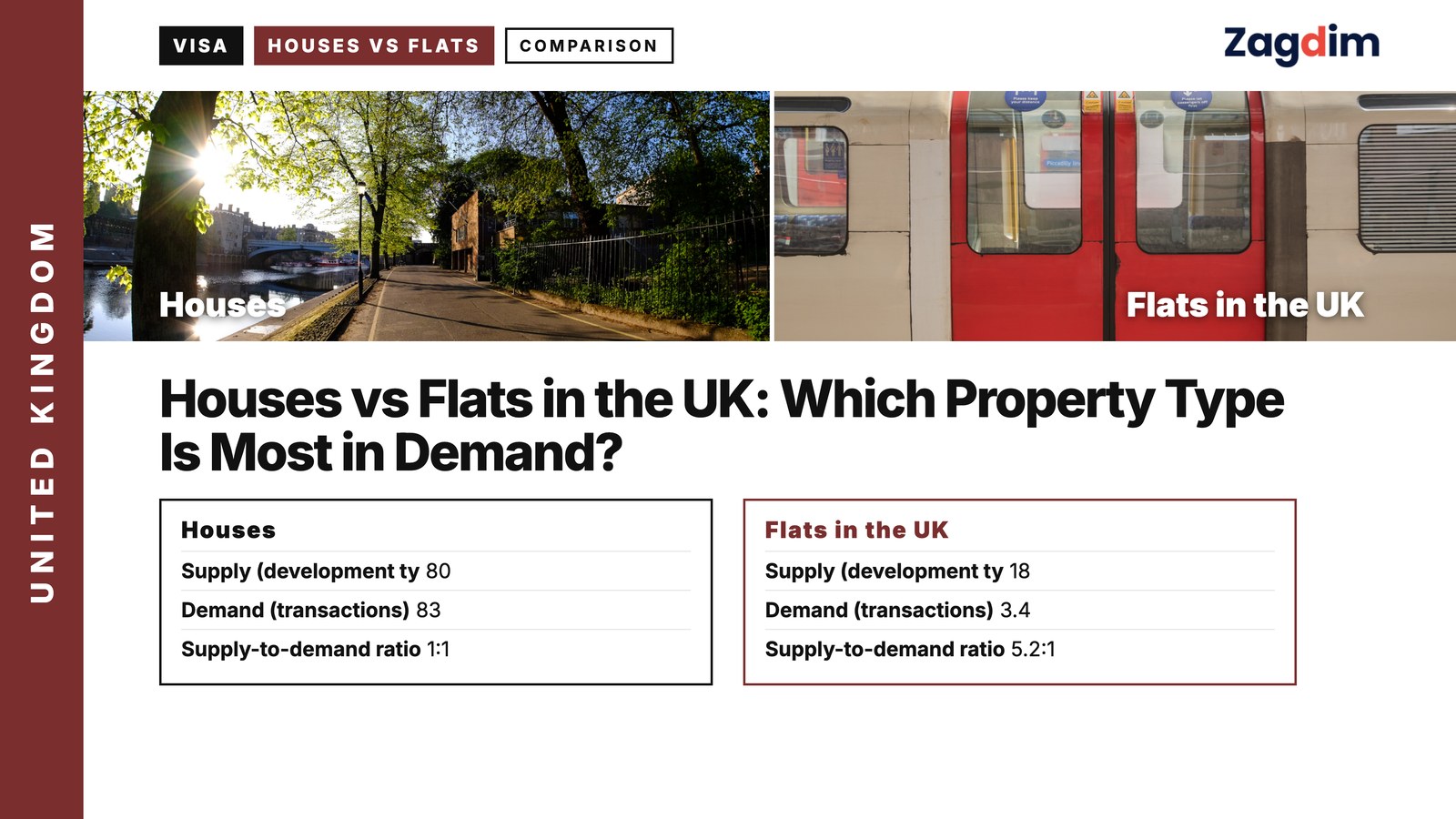
When investing in UK property, many buyers first look at one-bedroom flats, largely because the entry price is lower and they tend to be relatively easy to let, while for their own use, buyers tend to lean toward houses — on the view that houses are what British people like living in most. The data does in fact back this up: according to the Ministry of Housing, Communities and Local Government, 83% of people in the UK lived in a house as of 2018.
This 8-to-2 split shows up not just in current living patterns but historically as well. Government statistics show that between 1991 and 2018, the private supply ratio of houses to flats stayed close to 8:2. Although the flat share briefly rose to about 4 in 10 between 2002 and 2008, it later reverted to around the 8:2 level, which suggests UK housing supply policy has consistently favored, or tilted toward, houses as the dominant property type.
This tilt largely comes from the UK’s strict urban planning system (height limits, plot-ratio caps). Getting UK planning permission means going through a strict set of procedures, including pre-application consultation, public notice of the project, and planning committee review. Local planning authorities first assess whether a development fits national and local planning policy, then apply an environmental impact assessment, and weigh whether the project supports local economic development, before deciding whether to approve it — and changing the use of green-belt land is particularly difficult — all of which lengthens approval times. Looking at approval timelines, before 2011 the average residential project took 44 weeks to get planning permission, 41% of projects took over a year, and 6% took nearly three years. So land supply, within the wider planning policy framework, has already been constrained to some extent. Large housing-estate projects, with their added complexity — scale, layout, site selection, design, external appearance, landscaping, and other factors — take even longer. The clearest example is Li Ka-shing’s 2005 purchase of a London site for £100 million, which was not approved for construction until 2020 — a 15-year wait. So the fact that houses make up the largest share of housing stock is, in large part, a function of UK policy direction.
What the Transaction Data Shows
Simply looking at current figures makes it hard to analyze or judge the market properly, so a further breakdown is needed to spot genuine opportunities — this time looking at demand through actual transactions. According to HM Land Registry (HMLR), total secondhand transactions in the UK came to about 830,000 in 2019. Houses (including detached and semi-detached) accounted for about 690,000, or 83% of the total, while flats accounted for 140,000, or 17%. Houses and flats show roughly the same 8-to-2 split in transactions as in supply. Breaking flats down further by number of bedrooms reveals something interesting: of the 140,000 flat transactions, one- to two-bedroom flats accounted for 28,000, while flats of three bedrooms or more accounted for about 110,000 — meaning three-bedroom-plus flats made up nearly 80% of secondhand flat transactions.
| House | Flat (1–2 bed) | Flat (3+ bed) | |
|---|---|---|---|
| **Supply (development type)** | 80 | 18 | 2 |
| **Demand (transactions)** | 83 | 3.4 | 13.6 |
| **Supply-to-demand ratio** | 1:1 | 5.2:1 | 1:6.8 |
Three-bedroom-plus flats are undersupplied relative to demand — developers have never made this segment their main focus. When planning a new project, developers tend to favor studios or one-bedroom units, because the price per square foot for these is generally more than 20% higher than for three-bedroom units. Look closely at recent new-build launches and you’ll see three-bedroom supply is very limited, generally under 10%. Putting the (supply, transaction) numbers together roughly, houses sit at a relatively balanced 1:1 supply-to-demand ratio, while flats of three bedrooms or more sit at 6.8:1 — meaning one unit of supply faces 6.8 units of demand — compared with 5.2:1 for one- to two-bedroom flats. In other words, three-bedroom-plus flats clearly show the strongest demand relative to supply of any category.
This unbalanced demand for three-bedroom flats is closely tied to the UK’s historical housing supply structure. Before the 1980s, UK housing was largely provided by the government; after Margaret Thatcher took office, supply shifted to the market and the government stepped back, and supply growth slowed. Today, 74% of occupied properties were built before 1980, meaning more than 70% of properties are 40 years old or older. As properties age, they tend to deteriorate, which naturally makes managed, maintained flats more attractive by comparison. On top of that, the UK’s birth rate has been falling, and average household size fell from 5 people per household in 1980 to 2.3 in 2020, which directly affects how many bedrooms buyers actually need. Taken together, these factors have produced the current mismatch between supply and demand for three-bedroom flats.
The analysis above is only a rough, high-level framework — assessing any specific purchase properly requires understanding the area, its demographics, and its transport links.
For an assessment of a specific property or area, ask Zagdim.
Have a question about this guide? Leave a comment below, or ask Zagdim directly.
Your first stop for international property and global living.
Research and insights. Know what’s changing. Understand what matters.