
































In 2022, sales of new-build property in London grew 11%, a sign of strong demand. Yet amid inflation and rate rises, the outlook for the housing market has been full of uncertainty and speculation. CBRE has released a report using forward-looking data on planning, approvals, and construction starts to help buyers see where London’s new-build market is heading, and find some certainty amid the uncertainty.
Key findings:
- In 2022, approvals for new-build property in central London hit a record low
- In 2022, applications for new-build property in London hit a 10-year low
- New “Build to Rent” supply in London hit a record high, deepening the shortage of homes available to buy for owner-occupation
- New-build supply in London, especially in the city center, will stay tight for years to come
- With new-build supply scarce, regeneration projects in well-located, well-connected areas are more sought after than ever
London’s Long-Standing Supply Shortage Deepened Further in 2022
CBRE’s analysis of planning applications, approvals, and construction starts for new London developments found that the scale of new-build supply kept shrinking in 2022. The number of planning applications submitted came to just 25,147, down 28% year-on-year and 50% below the 2014 peak. The number of approved projects was 32,743, down 3% year-on-year. Completed construction came to 19,967 projects, down 11% year-on-year.
The total number of planning applications and approvals submitted in 2022 was the lowest in nearly 10 years, aside from 2020, which was affected by the pandemic. The shortage of supply is even more severe in London’s prime central areas — Kensington & Chelsea and Westminster — than in other areas.
Overseas buyers favor well-connected, high-quality-of-life properties in prime central locations. Last year, both prices and transaction volumes for new-build property in these areas rose sharply.
But over the past five years, annual planning applications, approvals, and construction starts for new-build property in these prime areas fell by 62%, 81%, and 56% respectively compared with the previous five years. In 2022, total planning applications and approvals for new-build property in prime central areas hit a record low.
New “Build to Rent” supply hit a record high, deepening the shortage of homes for owner-occupation
After a detailed look at the types of new projects being built, CBRE found another trend deepening the supply shortage: the share of new-build homes that are Build to Rent (BTR) has grown for a third straight year. In 2022, 35% of London’s private housing was BTR, the highest share on record — up from just 6% a decade earlier.
BTR transaction volume and construction starts also hit record highs in 2022. A record 7,198 BTR homes were sold in 2022, and BTR construction starts also reached a four-year high. In effect, a growing share of new-build homes are being built for rental, leaving fewer available to buy for owner-occupation.
Because of the pandemic, tenants have become more focused on personal space and amenities, and BTR homes are typically designed and built with these preferences in mind, so they tend to meet tenant expectations better than traditional private housing.
Buyers Are Shifting Toward Smaller Units
With mortgage rates elevated and the government’s Help to Buy scheme scrapped, buyers’ affordable budget has fallen, and they are leaning more toward smaller units such as studios and one-bedroom flats.
Help to Buy let buyers put down just a 5% deposit and receive an interest-free government loan for 20% of the property’s value (up to 40% in London) for five years.
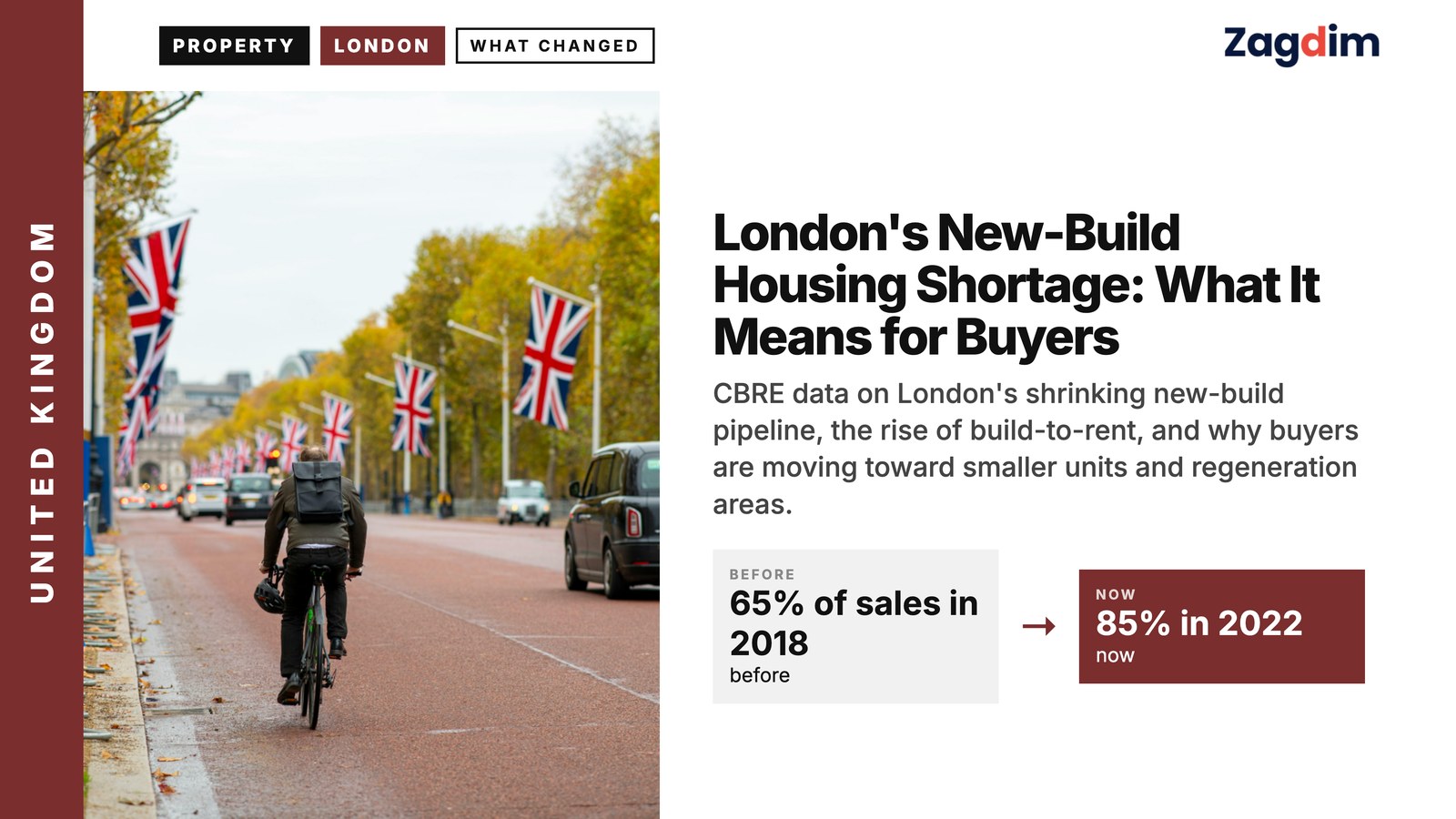
While Help to Buy was in effect, it let buyers use a smaller deposit to buy a larger home. Before the scheme ended in October 2022, larger units made up a growing share of purchases each year — one- and two-bedroom purchases rose from 65% of sales in 2018 to 85% in 2022, while studio sales fell from 12% in 2018 to just 2% in 2022. Since Help to Buy ended, CBRE has found that more buyers, constrained by budget, are being pushed toward smaller units.
London’s New-Build Supply Will Stay Tight
Last year, elevated mortgage rates added further uncertainty to the market, and developers grew more cautious about starting new projects. Making matters worse, the previous Conservative government scrapped its target of building 300,000 homes a year late last year, and some previously planned projects were put on hold.
Generally, it takes 3 to 5 years from construction start to completion, and longer still if counted from the start of the planning application. Looking at forward-looking development indicators such as planning applications and approvals, which fell 28% and 3% respectively, London’s new-build supply looks set to stay tight for years to come.
Prime Central London: New-Build Supply and Demand Remain Out of Balance
In the same vein, new-build construction starts in Prime Central London (PCL) have stayed low since 2018, and supply over the next five years will remain limited. Last year’s record-low planning applications and approvals — both forward-looking indicators — point to central London’s new-build shortage persisting for a long time to come.
And because PCL’s current new-build inventory is already limited, future supply will only get tighter. PCL currently has just 416 completed, unsold new-build flats, accounting for around 70% of annual sales. With so few new projects coming through, it’s effectively a case of selling off what little inventory is left.
PCL’s high-quality, highly convenient new-build properties attract large numbers of overseas buyers taking advantage of current exchange-rate gaps. Many well-capitalized overseas buyers pay in cash outright, unaffected by mortgage rates. In the fourth quarter of 2022, overseas buyers accounted for more than a third of PCL transactions.
With supply scarce and demand strong, prices for new-build property in prime locations are likely to keep climbing.
*Prime Central London — Fulham’s New Build Project*
One Property Type Stands Out in London’s New-Build Sales
CBRE has long found that a property’s surroundings are one of buyers’ top considerations, which is why carefully planned urban regeneration areas have become buyers’ first choice. Property prices in regeneration areas (covering redevelopment, refurbishment, or upgrade projects) have on average outpaced their borough’s overall price growth by 2.2 percentage points a year, and by as much as 5.8 percentage points in the best cases.
Urban regeneration was one of CBRE’s five key sales themes for 2022. These regeneration areas offer a good environment and strong community amenities, and with new-build supply scarce in these districts, buyers need to move quickly.
Canary Wharf, a well-known regeneration area, is one of London’s most popular places to live. Three of CBRE’s twelve best-selling developments of 2022 were in Canary Wharf. Buyers choose properties there for the convenience of living, working, and socializing that the area offers.
Even though some companies have recently shifted to hybrid working, easy access to central London remains a major consideration for buyers. In 2022’s sales, the effect of new transport infrastructure driving regional regeneration was very clear. The Elizabeth line has stations at Abbey Wood, West Ealing, and Slough, and new developments in all three locations have benefited.
CBRE Overseas Property Weekly
Have a question about this guide? Leave a comment below, or ask Zagdim directly.
Your first stop for international property and global living.
Research and insights. Know what’s changing. Understand what matters.