

































This article is part of Zagdim’s UK property series. It sets out what UK letting agents (businesses that help landlords manage a rental property) typically cover under three common service tiers, and the points worth writing into the management agreement itself. It is written for anyone who owns rental property in the UK, is considering buying one, or is planning a move there, including owners living outside the UK.
Throughout this article, we use the same example: a landlord living outside the UK who owns one rental flat in Scotland and one in England.
What’s the Difference Between the Three Letting Service Levels?
Start with one agent’s example to see how the tiers compare. In this example, the service scope builds up in layers: Rent Collection includes everything in Let Only, and Full Management includes everything in Rent Collection. This is only one agent’s approach, though, and should not be treated as a single definition used across the UK.
Below is what Lettings Waltham Forest (LWF), the letting agent run by the London Borough of Waltham Forest, states on its website, checked November 2, 2026:
| Service | What LWF’s Website States |
|---|---|
| **Let Only** | Finding a suitable tenant and preparing tenancy documents |
| **Rent Collection** | Everything in Let Only, plus collecting rent monthly and chasing arrears |
| **Full Management** | Everything in Rent Collection, plus managing upkeep, repairs and quarterly inspections |
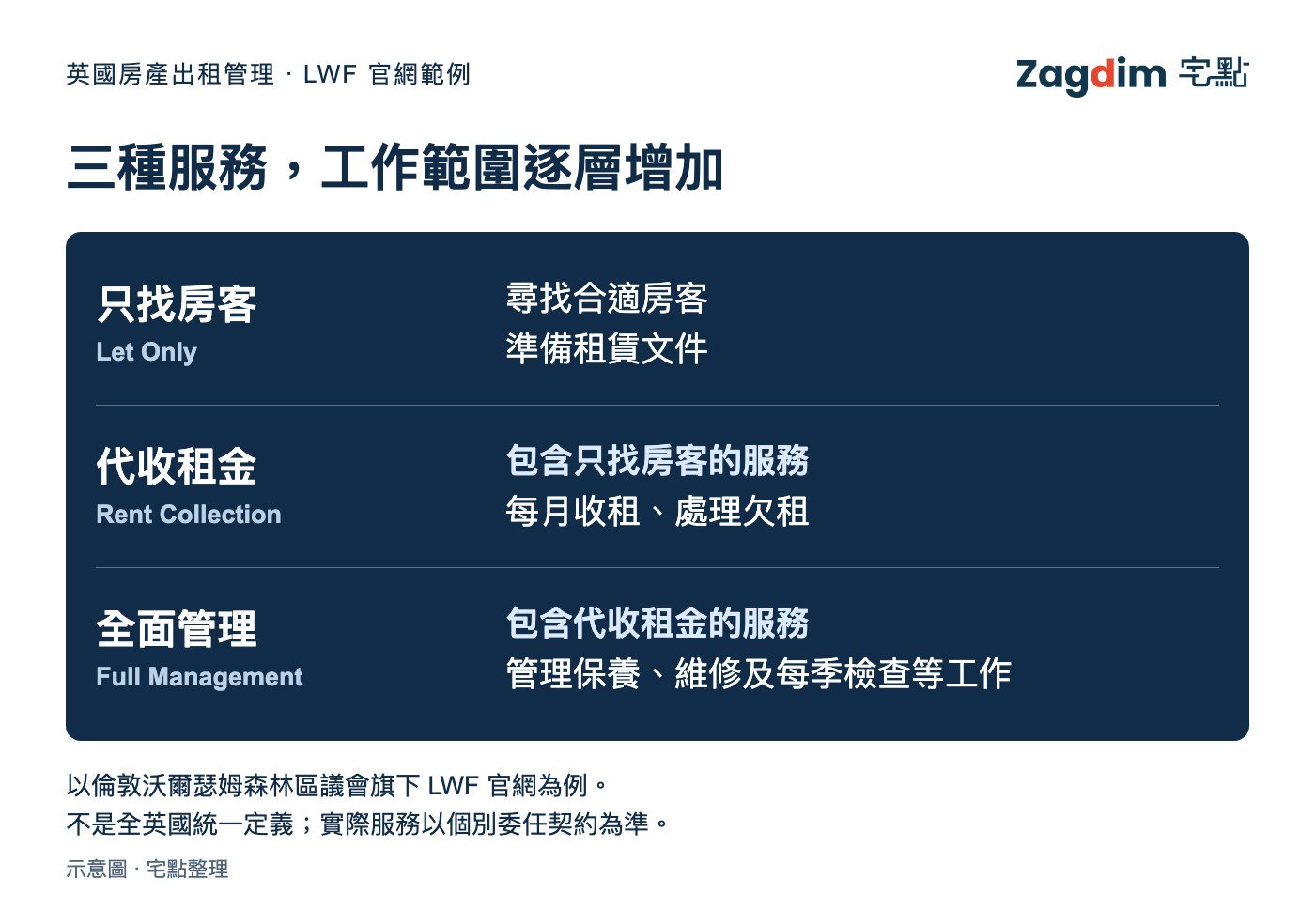
For example, if the landlord only wants someone to find a tenant and prepare the documents, that maps to Let Only in this example. If the landlord also wants someone to collect rent monthly and chase arrears, that maps to Rent Collection.
What any individual agent actually does still depends on the management agreement (the contract between the landlord and the agent, setting out what the agent will do). For a broader look at how letting management, repairs, compliance and tenant relations divide up, see “How should an overseas owner of UK property arrange letting management, repairs, compliance and tenant relations” (internal Zagdim article).
Does the Agent Check Tenant Eligibility?
This depends on which agent is used. Whether an agent runs eligibility checks, and which checks, needs to be confirmed agent by agent.
In LWF’s case, before offering the property to an applicant, it runs a full credit check on all applicants and checks references from previous or current landlords and employers.
Two things should not be assumed, though:
- Do not assume every UK agent provides the same level of checks.
- Do not assume that running checks guarantees there will be no arrears later.
So before signing, it is worth confirming what the agent actually checks against what the landlord expects.
What Should Be Written Clearly Into the Management Agreement?
Get the scope clear before signing. The following five points are worth confirming and writing into the agreement.
- Services provided: what the agent will do. In Scotland, this must be agreed with the landlord.
- Service standards and response times: the minimum standard of service, and the target times for the agent to respond to and act on landlord and tenant requests. The Scottish code states that this should be covered, though the target times are not a single statutory deadline.
- Scope of repair authority: how much the agent can decide on its own, such as a spending threshold for instructing repairs or buying replacement items, and the circumstances where the agent can act without asking the landlord first, such as emergency repairs. This part must be written in plain language.
- Fees: management fees and service charges (including tax) and how they can be adjusted, set out in writing.
- Variation or termination: how the agreement can be changed or ended, the fees that apply and the circumstances, set out clearly; termination fees and related terms must not be excessive or unreasonable.
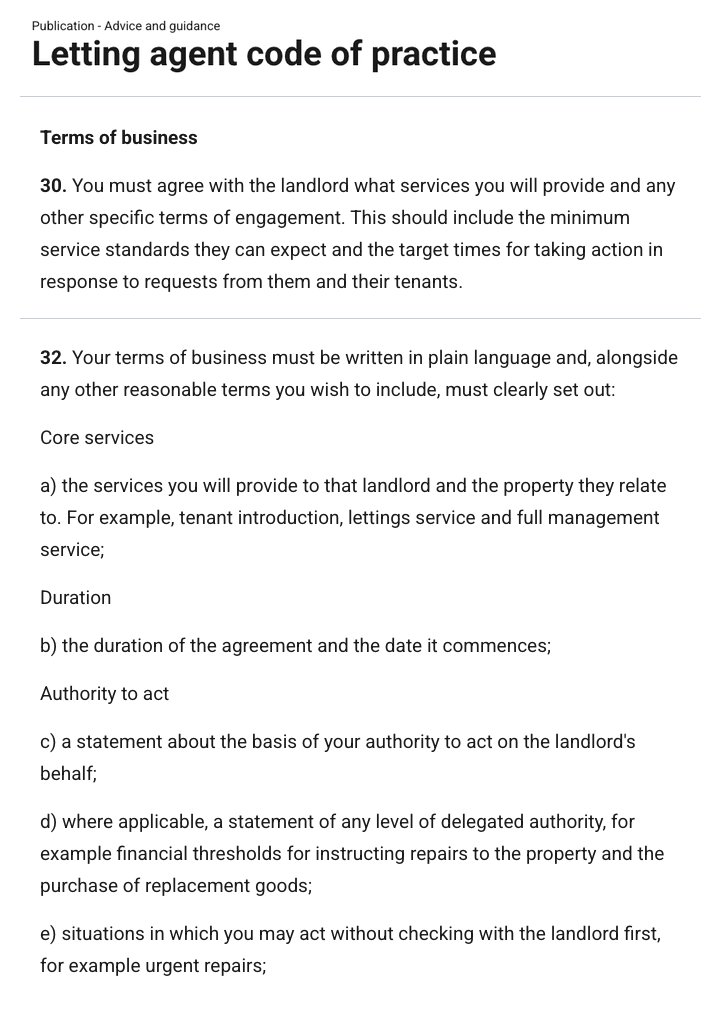
For example, when signing the agreement for the Scottish flat, the landlord can ask the agent to specify a spending threshold for repairs, and which situations do not require asking the landlord first.
These points are drawn from Scotland’s Letting Agent Code of Practice (a document governing how letting agents in Scotland operate). Landlords elsewhere can use this as a checklist when signing, but it is not a rule that applies in their area.
Who Handles Emergency Repairs When You’re Overseas?
The answer depends on the service scope. Who deals with a burst pipe at night depends on whether the agent’s service includes emergency and out-of-hours incidents; it should not be assumed that every Full Management package covers this.
Scotland’s approach is as follows:
- Written notification procedures: if the agent provides repair management directly on the landlord’s behalf, it must have an appropriate written procedure for reporting problems. The code states this should include target timeframes for both routine and emergency repairs.
- Emergency arrangements: where this falls within the service scope, the agent must have procedures for emergency incidents and contractor access (contractors being the businesses that carry out the repair work).
- Out-of-hours incidents: this is also only covered if it falls within the service scope.
- Delays to repairs and maintenance: the agent must explain delays and the reasons to the relevant landlord, tenant, or both, as soon as possible.
Before signing, an overseas landlord should confirm whether emergency arrangements and out-of-hours incidents are included in the service scope. For example, if the Scottish flat’s agreement does not include out-of-hours incidents in the service scope, it should not be assumed that incidents during those hours are covered.
Which Statutory Duties Can Be Delegated to the Agent, and Which Remain the Landlord’s?
Appointing an agent does not hand over all legal responsibility. Full Management does not release the landlord from every statutory duty; what can be delegated to the agent depends on the nation and the specific duty. The following points differ by nation:
| Nation | Area | Rule |
|---|---|---|
| England | Gas safety | The Health and Safety Executive (HSE) requires that where gas work is handled through a managing agent, the management agreement must clearly specify who is responsible for maintenance, safety checks and record-keeping. Where the agreement assigns this to the agent, the same gas safety duties that apply to the landlord apply to the agent; having an agent does not mean all duties transfer automatically. |
| England | Right to Rent checks (confirming a tenant’s right to rent in the UK) | A landlord can appoint an agent to carry out these checks. Where an agent accepts this responsibility, it should be recorded in a written agreement clearly stating whether the agent is responsible for the initial check and any necessary follow-up checks. Once responsibility has been transferred in writing, civil penalty liability sits with that agent, and cannot be transferred on to anyone other than that named agent. A verbal appointment or a general management agreement does not count as completing the transfer. |
| England | New rental property registration | This registration will only apply once rolled out by future phases, and should not be treated as already in force. The landlord needs to initiate the registration and is responsible for meeting the requirements. Once a property reference number has been obtained and the property is occupied, the landlord can delegate providing tenancy and health and safety information to the agent, but the landlord must still ensure the property record is completed within 28 days of registration. In cases such as death, incapacity or certain repossession restrictions, a third party can register or update the record; unless that third party has become the legal landlord, registration responsibility remains with the landlord. |
| Wales | Landlord registration | In principle, the landlord must register directly with Rent Smart Wales (the body overseeing letting management in Wales). There are exceptions for Power of Attorney (a formal authorization document) and Executors (people responsible for administering a deceased person’s estate); details should be checked against the official FAQ. |
| Wales | Management licence | A landlord who does not take part in arranging tenancies or managing the rental property does not need this management licence, but must appoint a licensed agent; appointing an agent does not remove the landlord’s registration requirement. |
| Scotland | Registration, repair standards and deposits | Even when using an agent, the landlord remains legally responsible for landlord registration, the statutory repair standard for the property, and the rules on taking, protecting and returning deposits. |
| Northern Ireland | Gas safety | Even when using an agent, the landlord retains overall responsibility. |
For example, if the landlord wants to delegate the gas safety check for the England flat to the agent, the management agreement needs to clearly specify who is responsible; for the Scotland flat, deposit rules remain the landlord’s legal responsibility even with an agent in place.
For more on compliance points to check before letting, see “What UK landlord compliance rules apply: gas safety, EPC, deposit protection and Right to Rent” (internal Zagdim article).
What Can You Do If You’re Unhappy With the Agent’s Service?
This depends on which nation the property is in. In England or Wales, a service complaint that cannot be resolved directly with the agent can be escalated to a redress scheme, which letting and property management agents in those areas are required to join.
Two further rules are also worth noting:
- Scotland: operating as a letting agent without registering is a criminal offense.
- England: letting or property management agents operating in the private rental market who hold client funds (money belonging to clients) must join a client money protection scheme. This protection is separate from tenancy deposit protection or rent-arrears insurance.
How Are Keys, Documents and Rent Handed Over When Switching Agents?
This section covers Scotland’s approach specifically. In Scotland, the agent must set out handover arrangements in writing. When a letting agent’s appointment ends, the agent must confirm in writing:
- the date the appointment ends
- any outstanding payments between the parties
- the arrangements and timescale for handing over keys, certificates and necessary documents
Unless otherwise agreed, the agent should automatically return any money due to the landlord when the final account is settled, after deducting any outstanding debts. For example, if the landlord switches agents for the Scottish flat, this list can be used to confirm what the handover should cover.
For more on the practical details of managing from abroad, see “How can an overseas owner manage UK rental property: tenants, repairs, tax and agent communication” (internal Zagdim article).
Frequently Asked Questions
Can a landlord accept an offer above the advertised rent? No. For lettings covered by England’s reform, landlords must not encourage bidding wars, and must not accept an offer above the advertised rent. A tenant volunteering a higher rent is not automatically an exception.
How long does a landlord have to respond to a tenant’s request to keep a pet? 28 days, and the response must be in writing. This applies under England’s assured periodic tenancy (a residential tenancy type under the new system): once the landlord receives a written request describing the pet, they must respond in writing within 28 days, and must not refuse without a fair reason.
- If the landlord asks for more information: the deadline becomes whichever is later: the time remaining on the original 28 days, or 7 days after the extra information is provided.
- If the tenant does not respond to a request for more information: the landlord can stop processing the request.
- Leasehold properties (where there is a superior title holder above the property): permission from the freeholder (the holder of the permanent title) may be required first.
Under England’s new lettings on an assured periodic tenancy, how much rent can be taken in advance?
- Before the agreement is signed: the landlord or agent must not accept, request or encourage any rent payment.
- Between signing and the start of the tenancy: for monthly rent, usually no more than one month in advance; for weekly rent, usually no more than 28 days’ worth.
- Exceptions: tenancies arranged by a local authority because the tenant is legally homeless, and social or supported housing (housing that comes with support services), have separate exceptions.
Glossary
- Letting agent: a business that helps a landlord manage letting-related matters.
- Let Only: based on the LWF website example, finding a suitable tenant and preparing tenancy documents.
- Rent Collection: based on the LWF website example, everything in Let Only plus monthly rent collection and chasing arrears.
- Full Management: based on the LWF website example, everything in Rent Collection plus managing upkeep, repairs and quarterly inspections.
- Client money protection scheme: a scheme that letting or property management agents in England’s private rental market must join when they hold client funds.
Data Notes
- Data was checked on November 2, 2026.
- The three service tiers described in this article are drawn from the Lettings Waltham Forest (LWF) website, run by the London Borough of Waltham Forest, as one agent’s example. This is not a single definition used across the UK, and any individual agent’s actual services still depend on its own agreement.
- LWF also has an undated PDF that describes rent collection and deposit responsibilities differently. This article relies only on what the website states and this should not be treated as confirmed contract content.
- The conclusions on Scotland’s Letting Agent Code of Practice are drawn from the code published by the Scottish Government, and should not be applied directly to England, Wales or Northern Ireland.
- The section on England’s new rental property registration is based on current official guidance; it will apply once rolled out in future phases and is not yet in force.
Need help with this? Talk to the Zagdim reader desk
Compares what UK letting agents typically cover at each service tier, and flags which legal duties stay with the landlord regardless of which tier is chosen.
Message the Zagdim reader desk on WhatsApp Message the Zagdim reader desk on LINE
Have a question about this guide? Leave a comment below, or ask Zagdim directly.
Your first stop for international property and global living.
Research and insights. Know what’s changing. Understand what matters.
Sources
- London Borough of Waltham Forest Council – Letting your property to keyworkers
- Scottish Government – Engaging landlords: Letting agent code of practice
- Scottish Government – Management and maintenance: Letting agent code of practice
- UK Government, Ministry of Housing, Communities and Local Government – Protecting clients’ money if you’re a property agent
- UK Government, Ministry of Housing, Communities and Local Government – Registering with a redress scheme as a property agent
- Scottish Government – Renting from a letting agent as a private tenant
- UK Health and Safety Executive – Gas safety: landlords and letting agents
- UK Home Office – Landlord’s guide to right to rent checks: 1 October 2026
- Rent Smart Wales / Cardiff Council – Landlord Registration
- Rent Smart Wales / Cardiff Council – Landlord and Agent Licensing
- Northern Ireland Executive / Health and Safety Executive for Northern Ireland – Domestic gas installation and health and safety
- Ministry of Housing, Communities and Local Government – Register your rental property service: guidance for landlords
- Ministry of Housing, Communities and Local Government – Assured periodic tenancies: a guide for tenants: Rent in advance and deposits
- Ministry of Housing, Communities and Local Government – Renters’ Rights Act: an overview for landlords
- Ministry of Housing, Communities and Local Government – Assured periodic tenancies: a guide for landlords: If a tenant wants a pet to live with them
Important Notice
This article is general information and does not constitute tax or legal advice for any individual case. Data was checked on November 2, 2026. UK rules may be updated; please follow the current guidance published by the relevant authorities, and consult a qualified professional for individual cases.