
































This article is part of Zagdim’s UK property series. It sets out the safety, registration, deposit and tenant-identity compliance requirements for letting a UK property, drawn from official sources. It is written for anyone who owns rental property in the UK, is considering buying one, or is planning a move there, including owners living outside the UK.
The UK has four jurisdictions (think of them as four regions, each with its own set of rules): England, Wales, Scotland and Northern Ireland. The rules differ across them, so this article is organized region by region based on official material. Appointing an overseas agent (a company or person who handles letting matters on the landlord’s behalf) does not automatically transfer every statutory duty; for a broader look at how letting management, repairs, compliance and tenant relations divide up, see “How should an overseas owner of UK property arrange letting management, repairs, compliance and tenant relations” (internal Zagdim article).
**Example**: Consider a landlord living outside the UK who owns a rented flat in London. The flat has gas appliances supplied by the landlord, and the landlord has also appointed an agent to help manage it. Wherever this article marks a passage “Example,” it first assumes this flat falls within the scope of that particular rule; it is only applying the rule to a situation, not drawing a conclusion about any specific case.
Gas Safety: Who Is Responsible, and How Often?
Start with the check frequency. Landlords must arrange an annual gas safety check, covering gas appliances and flues (the ducts that vent combustion fumes) that the landlord has supplied.
Under guidance from the UK Health and Safety Executive (HSE), this requirement applies to anyone letting their own property on a tenancy or licence (another arrangement that allows someone to live in a property) of less than 7 years, who meets this rule’s definition of landlord:
- New appliances or flues: a new gas appliance or flue supplied by the landlord needs a safety check completed by a Gas Safe Registered engineer within 12 months of installation, then annually after that.
- Record-keeping: records must be kept for 2 years.
- Given to the tenant: the completed check must be given to an existing tenant within 28 days of completion; a new tenant must receive it before moving in.
Can the check be done early? Yes, there is no need to wait until the exact due date. Per HSE’s explanation, the 2018 amendment to the gas safety rules allows the annual appliance or flue check to be carried out up to 2 months before the original due date, while keeping that original due date, as though it had been completed exactly 12 months after the previous check. In other words, doing it early does not bring the next due date forward.
Does appointing an agent transfer the responsibility? Not automatically. HSE requires the management agreement to clearly specify who is responsible for maintenance, safety checks and record-keeping; where the agreement assigns this to the agent, the same gas safety duties that apply to the landlord then apply to the agent. Simply having an agent does not mean all duties transfer automatically, so the division of responsibility needs to be written into the management agreement.
What if the tenant won’t allow access? The landlord cannot force entry. Arrangements for entry for a gas check or repair should be written into the tenancy agreement, but the landlord must not force their way in. If a tenant blocks a gas check, HSE inspectors look for at least 3 attempts, but how this is handled still depends on the individual circumstances, and it is ultimately the courts that decide whether reasonable steps were taken. Three attempts is not a fixed safe-harbor threshold.
Is Northern Ireland the same? Check the local official guidance; HSE’s statement about agent liability cannot be applied directly. Northern Ireland’s official gas guidance sets out:
- Landlord-supplied appliances and flues must be checked for safety every year.
- Maintenance and checks must be carried out by Gas Safe registered installers.
- Records are kept for 2 years; an existing tenant receives them within 28 days of completion, a new tenant before moving in.
- Even where an agent is used, the landlord remains fully responsible overall.
**Example**: The landlord needs to arrange the annual gas safety check, keep records for 2 years, and give the existing tenant a copy within 28 days of completion. If the landlord wants the agent to take this on, the management agreement needs to spell out who is responsible for maintenance, safety checks and records.
What Is the Minimum EPC Rating?
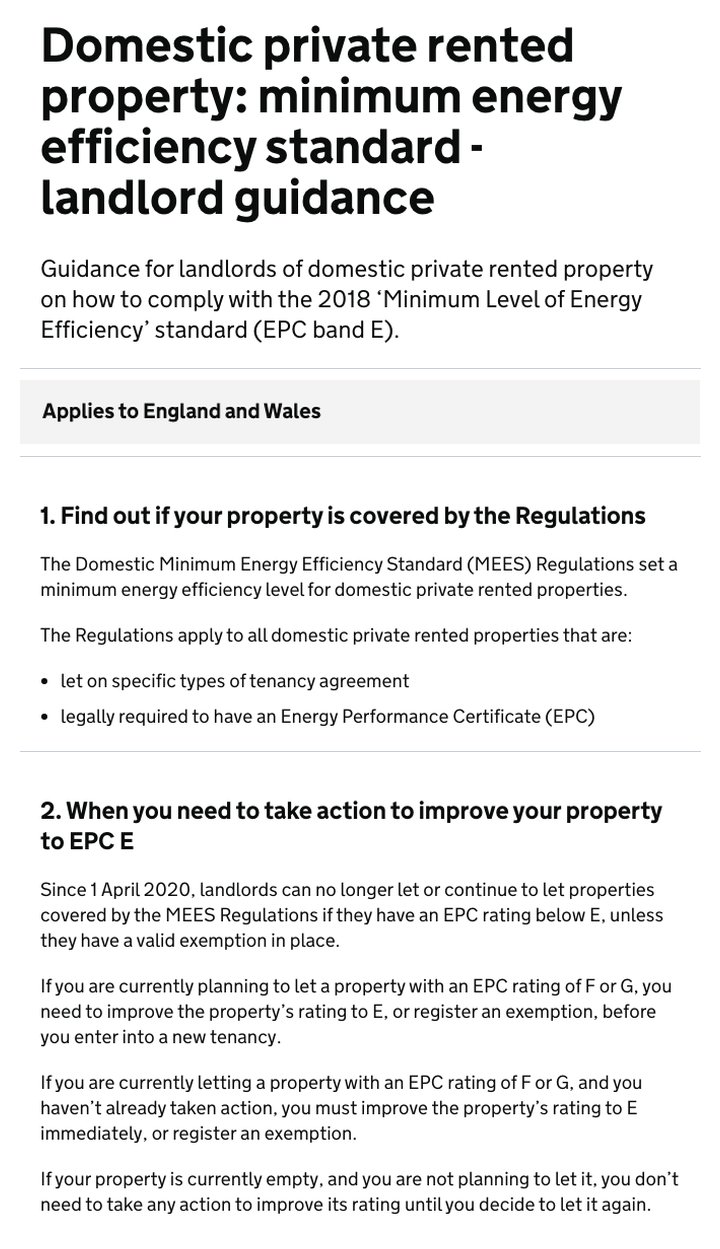
This depends on where the property is. In England and Wales, domestic private rented properties covered by the Minimum Energy Efficiency Standards (MEES, think of it as a pass mark for a rented home’s energy efficiency) must have an Energy Performance Certificate (EPC, a certificate showing a home’s energy efficiency rating) of at least band E; this rule is not UK-wide.
Since April 1, 2020, a domestic private rented property covered by MEES with an EPC below E must not be let, or continue to be let, unless a valid exemption applies (meeting the conditions to be excused from this rule). Coverage is:
- The tenancy is an assured tenancy, a regulated tenancy, or a domestic agricultural tenancy (all legal tenancy categories).
- The property is legally required to have an EPC.
If the property doesn’t reach band E, that doesn’t always mean an expensive overhaul. Per England and Wales’s MEES guidance (checked November 2, 2026), the cost cap for energy-efficiency improvements is £3,500 (including VAT):
| Situation | What to Do |
|---|---|
| Can’t reach band E within £3,500 | Complete the improvements possible within the cap, and register an “all improvements made” exemption |
| Third-party funding fully covers the improvements needed to reach band E | The cap doesn’t apply to this funding |
Note that spending up to £3,500 doesn’t automatically grant the exemption; the landlord still needs to meet the conditions and complete the registration.
Scotland’s delivery rules are different:
- New tenant: the letting EPC must be provided free of charge.
- Existing tenant renewing: there’s no need to provide it again.
- Certificate expiry: when the original 10-year validity period expires, there’s no need to redo it just because it has expired, unless the property is being sold or let to a new tenant.
This Scottish rule only addresses delivery and expiry renewal; it should not be read as meaning Scotland also has England and Wales’s band-E requirement.
**Example**: If the landlord’s flat has an EPC below band E, it cannot be let, or continue to be let, without a valid exemption. Even if the improvement cost reaches £3,500, the landlord still needs to meet the conditions and complete the registration.
Deposit Protection: Are the Rules the Same Everywhere?
Deposit rules need to be checked region by region. England, Wales, Scotland and Northern Ireland’s deposit rules cannot be applied interchangeably, because the caps, deadlines and calculation methods can all differ.
Here is how the four regions’ main rules compare:
| Item | England | Wales | Scotland | Northern Ireland |
|---|---|---|---|---|
| Deposit cap | For tenancies covered by the Tenant Fees Act 2019: annual rent under £50,000, up to 5 weeks’ rent; annual rent of £50,000 or more, up to 6 weeks’ rent | See source material | Up to 2 months’ rent | Up to 1 month’s rent |
| Protection deadline | For an assured periodic tenancy (APT): deposited into a government-approved scheme within 30 days of receipt | Scheme requirements fulfilled and protection information provided within 30 days | An approved scheme is required in most cases; deposited within 30 working days of the tenancy start | Deposited into an approved scheme within 28 days of receipt |
| Information-delivery deadline | Prescribed information given within 30 days of receiving the deposit | Within the same 30 days | Statutory information provided within the same 30 working days | Written information provided within 35 days of the tenant paying the deposit |
APT is a tenancy with no end date that rolls on, typically month to month. England’s weekly rent figure is calculated as the annual rent divided by 52.
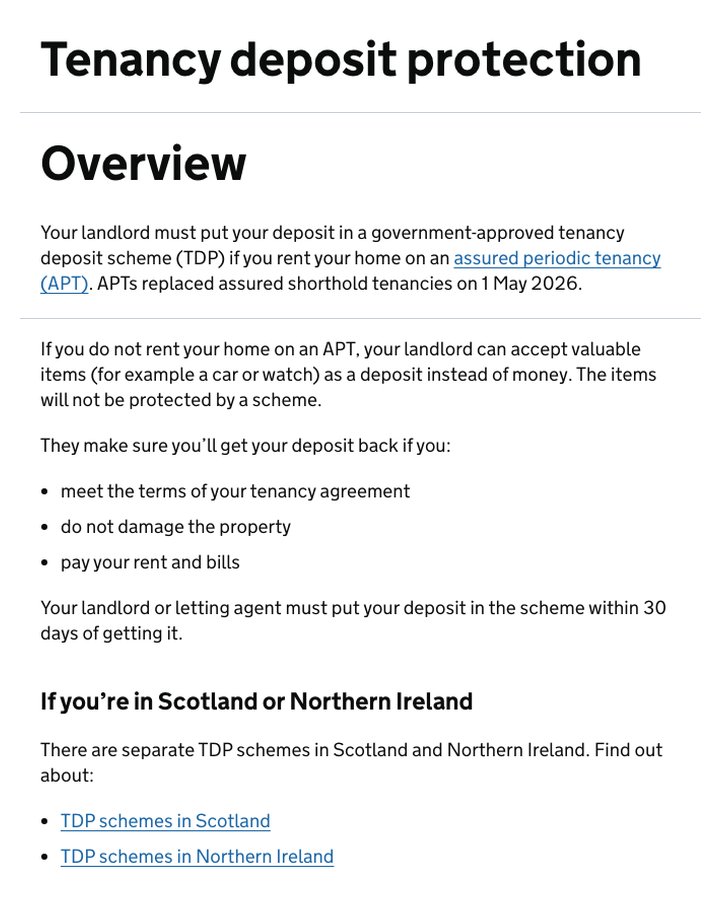
The cap and the deadline are not the only things to watch. For an England letting under a tenancy deposit protection scheme (TDP, a government-approved scheme for protecting deposits), once the landlord and tenant agree on the amount to be returned, the landlord must repay it within 10 days; if a dispute remains, the deposit stays protected within the scheme until it is resolved.
Four points to note for Scotland:
- The deadline is 30 working days, not 30 calendar days.
- If the tenancy ends under specific provisions of the Private Housing (Tenancies) (Scotland) Act 2016, and the landlord fully refunds the deposit within 30 working days of the tenancy start, the deposit requirements and information-delivery requirement do not apply.
- Where the deposit is agreed to be paid in installments, the 30 working days run from the day the landlord receives that particular installment.
- The landlord cannot use the deposit to replace items damaged or worn through normal wear and tear (natural wear from everyday use).
Wales: a tenant with an occupation contract (Wales’s term for a tenancy agreement) who paid their deposit after April 6, 2007, needs the landlord to place the deposit into a government-approved scheme; whether a deposit paid earlier needs protection depends on the fixed-term tenancy and any subsequent renewal.
Northern Ireland: deposits paid on or after April 1, 2013, must be protected. Overseas landlords have a specific requirement too: a landlord living outside Northern Ireland who takes a deposit for a Northern Ireland private tenancy must still comply with the local rules, and must give the scheme administrator protecting the deposit a Northern Ireland contact address.
Deposit compliance also affects the landlord’s later right to repossess the property. Where England’s new assured tenancy took a deposit, most repossession grounds require one of the following to be met first:
- Deposit protection, scheme requirements and the statutory information delivery have already been met.
- The deposit has been fully returned, or returned per the agreed deductions.
- Any case the tenant has brought over deposit compliance has been decided, settled or withdrawn.
Two antisocial-behaviour repossession grounds are not subject to this set of restrictions; a non-monetary deposit (an item held instead of money) still needs to be returned before repossession can proceed under any ground. For what happens when a tenant falls behind on rent or damages the property, see “What should a UK landlord do about rent arrears or property damage? Risks and procedures” (internal Zagdim article).
**Example**: If the landlord’s flat is an APT with annual rent under £50,000, the deposit cap is 5 weeks’ rent. Within 30 days of receiving the deposit, the landlord must place it into a government-approved scheme, and must also tell the tenant the prescribed information. Depositing the money alone is not enough.
Right to Rent: Who Gets Checked, and When?
The point of this check is treating everyone the same way. For residential tenancies covered by England’s Right to Rent Scheme (a system confirming whether an occupant has the right to rent locally), the landlord or agent must check, before the tenancy starts, every adult occupant who will treat the property as their only or main home, regardless of nationality; adult means 18 or over.
This is not only about checking foreign nationals, and it does not apply across the whole UK. Some arrangements are excluded under official guidance; not every residential letting is covered by the scheme.
Where an occupant’s right to rent is time-limited, there are also rules on check timing and record-keeping:
- Initial check: to establish a statutory excuse (the legal protection a landlord gains by checking as required), the initial check must not be carried out earlier than 28 calendar days before the tenancy agreement is signed.
- Keeping evidence: the check evidence and dates must be kept throughout the tenancy and for at least 1 year after it ends.
- Follow-up check: while the occupant continues living there, a follow-up check must be completed before the statutory excuse expires.
A landlord can appoint an agent to do this, but transferring the liability has conditions:
- Where an agent accepts the checking responsibility, it should be recorded in a written agreement.
- The written arrangement should clearly state whether the agent is responsible for the initial check and any necessary follow-up checks.
- Once the responsibility has been transferred in writing, the related civil penalty liability sits with that agent, and cannot be transferred on again to anyone other than that named agent.
To avoid discrimination, the official recommendation is to apply the same check to everyone. England landlords carrying out Right to Rent checks must not discriminate; Home Office guidance states that the best way to avoid discrimination is to apply the same check procedure to every adult occupant intending to move in, without distinguishing by nationality, ethnicity, appearance, accent or assumed immigration status.
**Example**: When the landlord finds a new tenant, they must check, before the tenancy starts, every adult occupant who will treat the flat as their only or main home, regardless of nationality. If the agent is to take on the checking responsibility, this needs to be recorded in a written agreement.
Beyond These Four, What Else Must Landlords Comply With?
The list isn’t finished yet. Beyond gas safety, EPC, deposit protection and Right to Rent, landlords also need to look at electrical safety, alarms, registration, licensing and advertising rules, and the requirements differ by region. The rest of this section is organized by topic.
Electrical Safety (EICR): How Often?
The check cycle is mostly built around 5 years. In England and Northern Ireland, fixed electrical installations must be inspected and tested by a qualified person at least every 5 years; in Wales, electrical installations are generally checked every 5 years.
| Jurisdiction | Check Cycle | Report Delivery | Other Conditions |
|---|---|---|---|
| England (rented homes covered by the electrical safety rules) | Fixed installations inspected and tested by a qualified person at least every 5 years | Given to an existing tenant within 28 days of inspection; a new tenant receives it before moving in; a local council must receive it within 7 days of a request | If the report calls for repair or further investigation, this must be completed within 28 days, or any shorter period the report specifies |
| Wales (occupation contracts under the fitness for human habitation (FFHH) rules, tenancy under 7 years) | Generally every 5 years; where the prior EICR recommends a shorter period, that period applies | The current EICR must be provided within 14 days of occupation starting; if the inspection happens after move-in, within 14 days of that inspection | Written confirmation of any investigation or repair work must be delivered within 14 days of move-in; for work carried out after move-in, within 14 days of the landlord receiving the confirmation |
| Northern Ireland (private tenancies) | Fixed installations inspected and tested by a qualified person at least every 5 years | — | Applies to new tenancies from April 1, 2025; existing tenancies before that date had to comply by December 1, 2025 at the latest, and this transition deadline has now passed |
The report obtained in England is commonly known as the Electrical Installation Condition Report (EICR, essentially an electrical inspection report), and it lists the next inspection date. The guidance lists exclusions including, but not limited to, the following two:
- Living with the landlord or the landlord’s family.
- A long lease granting more than 7 years’ right of occupation. However, if the agreement allows either party to end it before the 7-year point from the start of the tenancy, it does not count as granting more than 7 years’ occupation; the statutory “long lease” has its own separate definition.
In Northern Ireland, a house in multiple occupation (HMO) remains covered by the HMO licensing regime; appointing an agent does not remove the landlord’s ultimate compliance responsibility.
Where Must Smoke and Carbon Monoxide Alarms Be Installed?
Alarms also need to be checked region by region. England and Wales have different installation requirements; there is no single UK-wide rule.
- England: under the rules effective from October 1, 2022, a covered landlord must install at least 1 smoke alarm on every storey of the property that has a room used as living accommodation; a room used as living accommodation with a fixed combustion appliance needs a carbon monoxide alarm, except where the appliance is a gas cooker. Once notified of, and having confirmed, a faulty alarm, the landlord must repair or replace it.
- England, new tenancies: for a new tenancy covered by this rule, the landlord, or someone acting for them, must ensure every required alarm is in working order on the day the tenancy starts. Having installed one previously, or testing it on a different date, does not count as having carried out this day-of check.
- Wales: the FFHH rules require a mains-wired smoke alarm on every floor that is interlinked with every other mains-wired smoke alarm; additional battery-powered alarms do not need to be interlinked. A room containing a gas, oil or solid-fuel appliance needs a carbon monoxide alarm; England’s gas-cooker exclusion cannot be assumed to carry over here.
Do Landlords Need to Register or Get a Licence?
The answer depends on the jurisdiction. Landlords in Wales and Northern Ireland need to register; England will roll out region-by-region registration starting December 15, 2026.
- Wales registration: since November 23, 2015, a landlord letting private property on a residential tenancy in Wales must register with Rent Smart Wales. In principle, the direct landlord completes the registration themselves; Power of Attorney and Executors are two exceptions, with the specific conditions set out in the official FAQ. Registration is valid for 5 years and must be renewed on expiry.
- Wales licence: a landlord who does not take part in arranging the tenancy or managing the rented property does not need a management licence, but must appoint a licensed agent; this does not exempt the landlord from registering. This licence is valid for 5 years from the date it is issued.
- Northern Ireland: the landlord obligations guidance states that a landlord must join the Landlord Registration Scheme, and must provide the Tenancy Information Notice to the tenant free of charge within 28 days of the tenancy starting.
- England: based on the official guidance available as of the check date, private landlords, and rented properties already occupied by a tenant on an assured or regulated tenancy, will register by region starting December 15, 2026, with each region given a 3-month window. West Midlands runs December 15, 2026 to March 14, 2027; London runs July 15, 2027 to October 14, 2027; other regions follow the official schedule. The rollout runs through November 14, 2027, and only covers properties already let, or let during that window; supported exempt accommodation (a type of housing with support services attached) has a statutory exclusion; requiring a vacant property to register before it can be advertised is still a future measure.
**Example**: If the landlord’s flat is already let, London’s registration window runs from July 15, 2027 to October 14, 2027.
HMOs and Local Licensing: What to Watch For?
Licensing cannot be judged by headcount alone. The actual requirement depends on the local area’s rules, so it needs to be confirmed against the specific address.
- HMO permission: a landlord in England or Wales planning to let a property as an HMO needs to confirm with the local council whether a licence is required; even a smaller property with fewer occupants may still need a licence depending on local area rules.
- Selective licensing: an English local authority can designate all or part of its area as a selective licensing zone, requiring rented properties within that zone to hold a licence. In principle, a private rented property within the zone (including one let under a licence to occupy) needs a licence, except where a designated statutory exemption applies, or the property is already required to hold an HMO licence. So letting to a single family, or not being classed as an HMO, doesn’t on its own mean a licence isn’t needed; the designated area, exemptions and effective dates need to be checked against the actual address.
**Example**: Even if the landlord only lets the flat to a single family, this alone doesn’t mean a licence isn’t required; it needs to be confirmed against the actual address.
What Does England’s 2026 Rental Reform Require?
This reform affects tenancies, documents and advertising all at once. From May 1, 2026, England’s Renters’ Rights Act reform, covering private assured tenancies, brings several new requirements:
- Tenancy conversion: the main rental reform takes effect May 1, 2026. An existing assured shorthold tenancy (AST, the previous tenancy type) generally converts to an APT on this date; new tenancies also use the APT, rolling on month to month, with tenancy agreements unable to specify an end date. Where an old-style repossession notice was validly served before May 1, 2026, the tenancy only converts to an APT once that notice lapses, or the related court proceedings conclude.
- Documents for existing tenancies: in general, an existing agreement with a written record does not need to be replaced by a new tenancy, but the tenant must be given the Renters’ Rights Act Information Sheet by May 31, 2026; for a wholly oral agreement, written information covering the main tenancy terms must be given by the same date. This general deadline has already passed as of the check date. Where an old-style repossession notice was validly served before May 1, 2026, and the tenancy later converts to an APT because the notice lapsed or the court proceedings concluded without possession being granted, and there is a full or partial written record of the terms, the information sheet deadline becomes 1 month from the notice lapsing or the proceedings concluding.
- Documents for new tenancies: for a new APT, the landlord must give the prescribed written information on the main terms before the tenancy is signed, or agreed to even orally. This information can be included in the written tenancy or provided separately; failing to provide it can carry a fine of up to £7,000, and this cannot be avoided simply by using an oral agreement.
- How the information sheet must be delivered: for an existing tenancy that needs the 2026 information sheet, the landlord must give every named tenant the exact PDF published on the official website, delivered by post, hand delivery, or as an electronic attachment; sending only a web link to the PDF does not count as valid delivery. Where a managing agent is involved, the agent also has a delivery duty even if the landlord has already delivered it; a lodger (someone living inside the landlord’s own home) is not covered by this information sheet requirement.
- Rent in advance: for a new letting on an APT, the landlord or agent must not accept, request or encourage any rent payment before both parties have signed the agreement. During the pre-tenancy period between signing and the tenancy starting, monthly rent is generally capped at 1 month in advance, and weekly rent is generally capped at 28 days’ worth. There are separate exceptions where a local authority arranges the tenancy because the tenant is legally homeless, and for social housing or supported housing (housing that comes with support services); a holding deposit (money paid to reserve a property) and a tenancy deposit are different systems.
- Advertising and offers: a letting advertisement must display the asking rent (a “to let” board is a separate matter, but this doesn’t mean a higher rent can be accepted); a landlord must not encourage a bidding war, and must not accept an offer above the advertised rent.
- No discrimination: a landlord or agent must not block access to information, viewings or signing because a tenant has children or receives benefits. The exceptions are limited to: existing insurance with a restrictive clause from before May 1, 2026, up until it is renewed or ends; and a restriction on children living there that meets a legitimate aim and is proportionate (the restriction must have a genuine reason and go no further than necessary) — this latter exception cannot be used against someone receiving benefits. Affordability can be assessed fairly, but benefit income and similar must be given equal weight, and a discriminatory income test cannot be used to exclude applicants.
Using an Agent in Scotland: What Is the Landlord Still Responsible For?
The main responsibility stays with the landlord. Even where a Scottish landlord uses an agent, they remain legally responsible for landlord registration, the property’s statutory repair standard, and the rules on taking, protecting and returning deposits. Operating as a letting agent in Scotland without registering is a criminal offence.
A Scottish private landlord is legally responsible for the property meeting the safe-letting standard, even when using an agent. The property must meet both the repairing standard (the legal standard of repair a home must meet) and the tolerable standard (the basic threshold for being fit to live in); if the property falls short, repairs are required, and otherwise a tenant can bring a case to the relevant housing tribunal.
In addition, from October 6, 2026, housing covered by the Right to Repair Scheme or the repairing standard, where the landlord is responsible for the repair, is subject to clear deadlines for dealing with damp or mould:
| Step | Deadline |
|---|---|
| Investigation | Within 10 working days of becoming aware of damp or mould, carried out by a competent person |
| Written summary | Delivered within 3 working days of the investigation ending |
| Start of work | If substantial damp or mould is confirmed, work must start within 5 working days of the investigation ending |
| Completion | A private landlord must complete the work as soon as reasonably practicable; the 20-working-day completion deadline that applies to social landlords does not apply here |
Where circumstances outside the landlord’s control prevent a deadline from being met, the landlord must tell the tenant which duty has not been met, the reason, and a new deadline, and must take reasonable steps to limit the harm where practicable; where another regulation requires faster action, that shorter deadline still applies. A landlord expecting to be away for a long period should arrange for someone to act on their behalf; being overseas is not automatically an exception.
Is Wales’s Fitness-for-Habitation Duty Only at Move-In?
No. Wales’s fitness requirement applies throughout the tenancy, not only at handover. The Renting Homes (Wales) Act 2016 applies to occupation contracts of under 7 years, and requires the landlord to ensure the home is fit for human habitation both when the occupation contract begins and throughout the contract period; the assessment takes into account the 29 matters and circumstances set out in Wales’s 2022 fitness regulations.
Which Bodies Will You Deal With?
Which body you deal with depends on the topic and the jurisdiction. The table below lists the main bodies referred to in this article.
| Body | Relevance to This Article | When You’ll Encounter It |
|---|---|---|
| UK Health and Safety Executive (HSE) | Publishes landlord and letting agent gas safety guidance | Confirming gas check duties, or if a tenant blocks a gas check |
| UK Department for Energy Security and Net Zero | Publishes the MEES landlord guidance | Checking the minimum EPC rating and improvement exemptions |
| UK Home Office | Publishes the Right to Rent checks landlord guidance | Checking England’s Right to Rent requirements |
| Rent Smart Wales | Handles Wales landlord registration, and explains landlord and agent licensing | Letting a property in Wales, registering as a landlord, or appointing a licensed agent |
| Local council | Confirms whether an HMO licence is needed; in England, may request the electrical safety report | Planning to let an HMO, or when the local council asks for the report |
Living Abroad: How Do You Confirm Your Property Is Compliant?
Start by checking these four points, since they determine which compliance requirements apply:
- Which jurisdiction the property is in
- The property type
- The tenancy type
- The tenant composition
If planning to delegate all or part of this to an agent, it’s worth clarifying each compliance responsibility in writing before signing, and confirming that the agent holds a valid local qualification to practise. For more on the types of management companies and how to choose between them, see “What do UK letting agents do? Comparing Let-only, Rent Collection and Full Management” (internal Zagdim article); for day-to-day management and communication from overseas, see “How to manage a UK rental property from abroad: tenants, repairs, tax and agent communication” (internal Zagdim article).
Frequently Asked Questions
If you use a management company, does all compliance responsibility transfer to them? No. Per HSE guidance, gas work can be assigned to an agent through the management agreement, and England’s Right to Rent check responsibility can also be transferred to an agent in writing, but this doesn’t mean every duty transfers; a Scottish landlord, even using an agent, remains legally responsible for landlord registration, the statutory repair standard, and the deposit rules.
If the EPC is below band E, does that mean the property can’t be let at all? In principle, yes, unless there’s a valid exemption. This refers to England and Wales rented homes covered by MEES: an EPC below band E generally means the property must not be let, or continue to be let. If improvements can’t reach band E within £3,500 (including VAT), completing what’s possible within that cap and registering can qualify for an exemption; where third-party funding fully covers reaching band E, the cap doesn’t apply to that funding.
Is depositing the money into a protection scheme enough on its own? No. Taking England as an example, besides depositing the money into an approved scheme within 30 days of receiving it, the landlord also needs to tell the tenant, within that same 30 days, the deposit amount, how it’s protected, the scheme’s contact details and other prescribed information.
Glossary
- Assured Periodic Tenancy (APT): the tenancy type adopted from May 1, 2026 for private assured tenancies covered by England’s Renters’ Rights Act reform; the tenancy agreement cannot specify an end date, and rolls on a monthly (or similar) basis.
- Minimum Energy Efficiency Standards (MEES): the minimum EPC rating requirement set for covered private rented homes in England and Wales, currently band E.
- Right to Rent Scheme: England’s system requiring a landlord or agent to check the adult occupants of a covered tenancy before it starts.
- House in Multiple Occupation (HMO): a type of letting in England and Wales where the landlord must check with the local council whether a licence is required.
Data Notes
- This article’s data was checked on November 2, 2026.
- The four-nation comparisons in this article are Zagdim’s own compilation from each jurisdiction’s official guidance and legislation, and are not an official UK-wide comparison published by any government body. For Scotland’s deposit information deadline specifically, the government’s overview page states “30 days,” while this article follows the wording of the underlying regulation, “30 working days.”
- England’s region-by-region registration scheme, starting December 2026, had not yet begun as of the check date; the requirement to register a vacant property before advertising it is still a future measure. The general deadline for the existing-tenancy information sheet has already passed as of the check date, and is included here for reference and for transitional cases only.
- This article does not cover: Wales’s deposit cap; the deposit and normal-wear-and-tear rules in England, Wales and Northern Ireland; the minimum EPC rating in Scotland and Northern Ireland; Scotland’s electrical inspection rules; or the alarm requirements in Scotland and Northern Ireland. This does not mean no such rules exist locally.
- Legal provisions referred to in the text:
- Scotland’s deposit exception: a tenancy ended under sections 48 or 50 of the Private Housing (Tenancies) (Scotland) Act 2016.
- England’s old-style repossession notices: the old Section 8 or Section 21 notices.
- England’s antisocial-behaviour repossession grounds not subject to the deposit restriction: Grounds 7A and 14.
- England’s selective licensing HMO licence: Housing Act 2004, Part 2.
- Wales’s fitness-for-habitation duty: Renting Homes (Wales) Act 2016, Part 4, Section 91.
Need help with this? Talk to the Zagdim reader desk
Walks through the UK’s landlord statutory compliance rules, nation by nation, from gas safety and EPC to deposit protection and Right to Rent.
Message the Zagdim reader desk on WhatsApp Message the Zagdim reader desk on LINE
Have a question about this guide? Leave a comment below, or ask Zagdim directly.
Your first stop for international property and global living.
Research and insights. Know what’s changing. Understand what matters.
Sources
- UK Health and Safety Executive – Gas safety – landlords and letting agents – HSE
- UK Department for Energy Security and Net Zero – Domestic private rented property: minimum energy efficiency standard – landlord guidance – GOV.UK
- UK Government / Ministry of Housing, Communities and Local Government – Tenancy deposit protection: Overview – GOV.UK
- UK Government / Ministry of Housing, Communities and Local Government – Tenancy deposit protection: Information landlords must give tenants – GOV.UK
- UK Parliament / The National Archives – Tenant Fees Act 2019 (Schedule 1, paragraph 2(3)-(4))
- Welsh Government – Deposits: guidance for tenants | GOV.WALES
- Scottish Government – Taking a deposit as a private landlord – mygov.scot
- Scottish Parliament / The National Archives – The Tenancy Deposit Schemes (Scotland) Regulations 2011 (regulation 3(1) and (1A))
- Northern Ireland Executive / Department for Communities – Tenancy Deposit Scheme – information for tenants | nidirect
- UK Home Office – Landlord’s guide to right to rent checks: 1 October 2026 (accessible) – GOV.UK
- UK Ministry of Housing, Communities and Local Government – Electrical safety standards in the private and social rented sectors: guidance – GOV.UK
- UK Ministry of Housing, Communities and Local Government – Smoke and Carbon Monoxide Alarm (Amendment) Regulations 2022: guidance for landlords and tenants – GOV.UK
- UK Government / Local Councils – House in multiple occupation licence – GOV.UK
- Rent Smart Wales / Cardiff Council – Landlord Registration – Rent Smart Wales
- Rent Smart Wales / Cardiff Council – Landlord and Agent Licensing – Rent Smart Wales
- Northern Ireland Executive / Department for Communities – Landlord and tenant obligations | nidirect
- UK Ministry of Housing, Communities and Local Government – Renters’ Rights Act: an overview for landlords – GOV.UK
- Scottish Government – Buildings for let – Energy Performance Certificates: guide – gov.scot
- [Welsh Government – Fitness of homes for human habitation: guidance for landlords [HTML] | GOV.WALES](https://www.gov.wales/fitness-homes-human-habitation-guidance-landlords-html)
- Scottish Government – Repairs and maintenance as a private landlord – mygov.scot
- Scottish Government – Renting from a letting agent as a private tenant – mygov.scot
- Northern Ireland Executive / Health and Safety Executive for Northern Ireland – Domestic gas installation and health and safety | nidirect
- Ministry of Housing, Communities and Local Government – Register your rental property service: guidance for landlords – GOV.UK
- Scottish Government – 2. Scope – Awaab’s Law: guidance for landlords in Scotland – gov.scot
- Northern Ireland Department for Communities – The Electrical Safety Standards for Private Tenancies Regulations (Northern Ireland) 2024 | Department for Communities
- Ministry of Housing, Communities and Local Government – Assured periodic tenancies: a guide for tenants: Rent in advance and deposits – GOV.UK
- Ministry of Housing, Communities and Local Government – Rental discrimination under the Renters’ Rights Act 2025
- Ministry of Housing, Communities and Local Government – Repossessing your privately rented property after 1 May 2026 – GOV.UK
- Ministry of Housing, Communities and Local Government – Assured periodic tenancies: a guide for landlords: Written information you need to give to your tenant – GOV.UK
- Ministry of Housing, Communities and Local Government – The Renters’ Rights Act Information Sheet 2026 – GOV.UK
- Ministry of Housing, Communities and Local Government – Selective licensing in the private rented sector: a guide for local authorities – GOV.UK
Important Notice
This article is general information and does not constitute tax or legal advice for any individual case. Data was checked on November 2, 2026. UK rules may be updated; please follow the current guidance published by the relevant authorities, and consult a qualified professional for your individual situation.