

































This article is part of Zagdim’s wiki series on UK property. It covers the rules for service charges, ground rent, and building management that affect leasehold flats, focusing on England and Wales, with the differences in Scotland and Northern Ireland explained separately. It is written for readers who already own property in the UK, are considering buying there, or are planning to move to the UK, wherever they are currently living.
If you’ve bought a leasehold flat, your holding costs include more than the mortgage and property tax – there’s also the service charge, ground rent, and building-management-related fees. For how overseas landlords typically divide up rental management duties and compliance obligations, see the main wiki article “How Overseas Landlords Manage Letting, Repairs, Compliance, and Tenant Relations After Buying UK Property.”
Before starting, it helps to know three common terms and roles:
- Leasehold: you own the right to a long lease, and there’s also a landlord sitting above that lease.
- Leaseholder: the person who has bought this long lease – in other words, the flat’s owner.
- Superior landlord: the landlord positioned above you in the lease. This is not the same as a tenant you let the flat to, and it isn’t your own landlord identity when you’re the one letting it out.
Consider an overseas owner who bought a leasehold flat in England and plans to let it out. The paragraphs marked “Example” below are hypothetical scenarios used only to illustrate how the rules work.
What Does the Service Charge Cover, and Can You Ask to See Receipts?
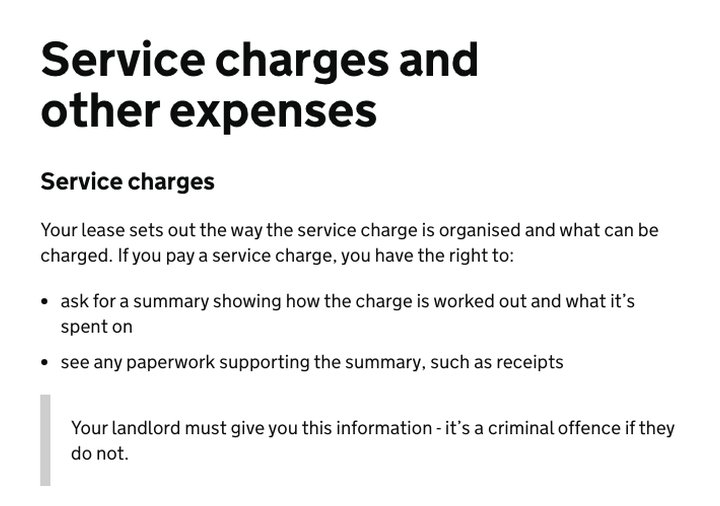
This question has two parts: what’s included, and whether you can request receipts. In England and Wales, what a service charge covers depends on the lease, and whoever pays the service charge has the right to ask to see receipts.
The service charge (service charge) is a cost arranged and collected according to the lease. What’s covered and how it’s arranged is set out in the lease, so charges aren’t the same from one flat to another.
If you have questions about the amount, you can request:
- A summary of how the service charge was calculated and what it was spent on
- Receipts or other documents supporting that summary
Not getting an immediate response doesn’t automatically count as a criminal offence. Under UK law, failing to meet the relevant statutory duty without reasonable excuse may amount to a criminal offence – legally known as a summary offence. This offence provision doesn’t apply to local authorities in Wales, or to registered social landlords (landlords registered to provide social housing). The statutory form and time limit for making this kind of request need to be confirmed separately.
Do You Have to Pay Whatever the Service Charge Demands, and What If It’s Unreasonable?
The amount of the service charge is legally limited. You don’t automatically have to pay whatever is charged, but a dispute doesn’t mean you can simply stop paying either.
Legal limits on the amount
In England and Wales, service charges covered by this law are subject to the following limits:
- General costs: only costs reasonably incurred can be charged.
- Services or works: the quality must also be reasonable, so the amount that can be charged is limited accordingly.
- Charges collected in advance: the amount can’t exceed what’s reasonable either. Once the actual cost is known, the charge must still be adjusted as necessary – through a refund, a reduction, a later charge, or some other method.
Major works: you have a right to be consulted
Individual leaseholders have a right to be consulted – that is, a chance to have a say on the building’s running and repair costs – whenever either of the following applies:
- The individual leaseholder’s share of a planned project’s works cost is more than £250
- Works or services running for more than 12 months cost the individual leaseholder more than £100 a year
This process is called a Section 20 consultation. Both thresholds are based on what an individual leaseholder has to pay, not the total cost of the works for the whole building. The right to be consulted also doesn’t give any single owner an absolute veto.
For qualifying works or long-term agreements that this process covers, the service charge contribution is legally restricted unless the consultation requirements have been met, or the appropriate tribunal (or appeal body) has granted a dispensation under the law. The tribunal is the body that handles this kind of dispute and rules on it; a dispensation is an exemption granted under the law. This doesn’t mean that skipping consultation automatically waives the whole charge for the works – whether the tribunal grants a dispensation also depends on the individual case.
If you think the charge is unreasonable, you can dispute it
Under official guidance for England and Wales, if you think a charge is unreasonable, the standard of work is poor, or you don’t believe you should have to pay, you may be able to bring a dispute to the tribunal. You cannot apply under this guidance if:
- You’ve already agreed to pay
- The dispute is already being handled elsewhere, such as by a court
- The charge is a fixed charge
This doesn’t mean a fixed service charge has no other remedy available, and simply having paid doesn’t automatically mean you’ve legally agreed to the charge either – each case needs to be checked against the lease and the applicable law. If you stop paying a charge you’re legally liable for, the landlord can sue.
Does the Insurance in My Service Charge Cover the Furniture I Rent Out?
Start by checking what this insurance actually covers. No – the insurance included in the service charge is buildings insurance, and it doesn’t cover the contents inside your flat.
For leasehold property in England and Wales, the superior landlord is usually responsible for buildings insurance, and the premium is usually included in the service charge. Leaseholders can request a summary of the policy, and if they think the charge is unreasonable, they can also bring a dispute to the tribunal.
If you’re the landlord letting out your flat, you can’t treat the building’s buildings insurance as a comprehensive policy covering your furniture, loss of rent, or landlord liability – those need to be arranged separately.
Example: the furniture the owner placed in the flat for letting counts as contents, and isn’t covered under this buildings insurance.
What Is a Reserve or Sinking Fund, and Do You Get It Back When You Move?
This is money paid in advance toward building maintenance. In England and Wales, amounts already paid in generally can’t be reclaimed, including when you move out.
Leasehold properties may require payments into a reserve or sinking fund, used to cover sudden maintenance such as replacing a roof.
That said, not every lease has this kind of fund, and not every situation rules out a refund either – you need to check your own lease.
Does Every Flat Have Ground Rent, and What’s the Difference Between Older and Newer Leases?
The key factor for ground rent is the lease, not how old the building is. Not every flat requires a cash ground rent payment – it depends on when the lease was granted, its type, and its terms.
Ground rent (ground rent) is a payment made to the landlord under the terms of the lease, within a leasehold arrangement. “Granted” refers to when this lease was first created, not the date you completed your purchase of the flat.
Here are the basic rules for England and Wales:
| Lease situation | How ground rent is treated |
|---|---|
| Older leases granted before 30 June 2022 | If the lease specifies ground rent, it’s still payable, but only once the landlord has issued a formal written demand |
| Most new long residential leases granted from 30 June 2022 onward | Ground rent is capped at one peppercorn per year |
| New regulated retirement-home leases | The same cap applies from 1 April 2023 |
| Leases bought from another leaseholder on or after 30 June 2022 | If the lease specifies ground rent, it’s still payable |
“One peppercorn a year” means ground rent can’t be collected in cash, and no separate administration fee can be charged for handling it either.
Two more points to note for older leases: the landlord can claim up to six years of unpaid ground rent in arrears, and the rent can only be increased with consent or where the lease allows it.
The new rules don’t apply to every new lease – the following situations need special attention:
- Statutory exceptions: community-led housing, certain financial products, legally defined business leases, and statutory lease extensions, among others, have separate exceptions.
- Contracts exchanged before the relevant date: if a binding contract to grant the lease (not including an option or a right of first refusal) was exchanged before the relevant date, the new rules don’t apply even if the lease itself is granted later. This date is usually 30 June 2022, or 1 April 2023 for retirement housing.
- Voluntary or non-statutory lease extensions: these can keep the original ground rent for the remaining term.
- Shared ownership leases: the landlord’s share of rent is treated separately; the peppercorn cap only applies to the leaseholder’s own share.
Example: even if the owner bought the flat after 30 June 2022, if the lease itself was granted before that date and specifies ground rent, it’s still payable.
The UK Ministry of Housing, Communities and Local Government’s 2026 ground rent policy statement says the government has also published a draft for parliamentary scrutiny ahead of legislation, intends to implement the proposal through primary legislation (law made by Parliament), and is targeting 2028 for implementation, subject to that process. This is only a proposal and a conditional target date stated in a policy document – it should not be treated as already in effect, is not guaranteed to take effect by 2028, and shouldn’t be used as a reason to stop paying ground rent under an existing lease.
Will the Building’s Managing Agent Find Me Tenants or Handle Letting?
First, separate these two kinds of agents. No, you shouldn’t expect that – in England and Wales, a building’s managing agent and the letting agent for your individual flat are two different things.
The superior landlord can appoint a managing agent to handle:
- Arranging services, repairs, improvements, and insurance
- Day-to-day management of the building or estate
A building’s service charge also isn’t the same as a full letting-management fee. If you need help handling the letting of your own unit, you’ll need to find a separate letting management company – for the types of services available, see “What Do UK Letting Management Companies Do? Comparing Let-Only, Rent Collection, and Full Management.”
If the Management Company’s Service Is Poor, Can You Replace It or Take Over Yourself?
There is a system for this, but it comes with a threshold. In England and Wales, qualifying leaseholders can take over part of the landlord’s management responsibilities, but a single owner can’t decide this alone.
This system is called the Right to Manage (RTM). It doesn’t require proving mismanagement; once leaseholders take over, they can manage the building themselves or pay to appoint a managing agent.
Basic qualifying thresholds include:
- The building consists of flats
- At least two-thirds of the flats were originally granted as leaseholds with a term of more than 21 years
- At least 50% of the internal floor area is residential
- At least half of the flats have joined the RTM company before the takeover
There’s also an exception: if the landlord or an adult family member has used one of the flats as their only or main home for at least 12 months, and the building wasn’t originally built as flats and has no more than 4 flats in total, the takeover can’t go ahead.
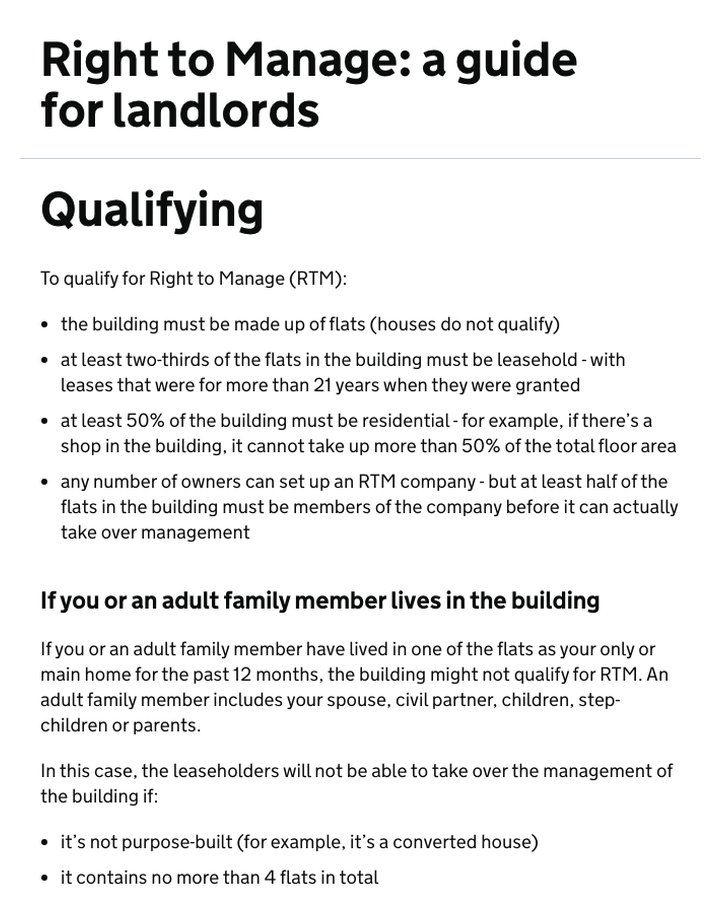
This covers only the basic eligibility conditions, not the full application process.
Example: if the owner is unhappy with the management company, they still can’t decide alone to take over – at least half of the flats need to join the RTM company, and the other conditions need to be met too.
Do the Rules Differ Across the UK?
First, confirm which part of the UK the property is in. The answer is no – the service charge, ground rent, and RTM rules covered above apply to England and Wales, and can’t be applied directly across the whole UK.
- Scotland: property factors (people or firms who help manage property) must register, and applicants go through a competency assessment. If an owner believes a factor has breached the code of conduct or failed in their duties, they can complain to Scotland’s First-tier Tribunal for Scotland Housing and Property Chamber, but must first give the factor written notice and a chance to resolve it. This system is different from the leasehold or RTM system in England.
- Northern Ireland: owners can apply to the Land Registry to buy out their ground rent, but owners of flats and apartments cannot use this buy-out arrangement.
Does Building Safety Protection Affect My Holding Costs?
This needs checking in two steps – the building, then the lease. First check whether both meet England’s protection conditions; even where they qualify, that doesn’t mean all remedial work is free.
Step 1: Is the building a “relevant building”?
The building needs to be a self-contained building, or a self-contained part of a building, containing at least 2 dwellings, and at least 11 metres high or at least 5 storeys.
However, meeting the height threshold doesn’t automatically grant all protections. The following buildings or parts are excluded:
- Where a right of first refusal or a compulsory acquisition order for a named leaseholder has already been exercised
- Where a collective enfranchisement (collective purchase) right has already been exercised
- Where the freehold (ownership not limited by a lease term) is, under the rules, leaseholder-owned
- Land held under commonhold (an ownership form jointly held by residents)
Step 2: Is the lease a “qualifying lease”?
It must meet all of the following conditions at the same time:
- It’s located in a relevant building that meets Step 1
- It’s a single-dwelling long lease with a term of more than 21 years
- The leaseholder is liable for the service charge
- The lease was granted before 14 February 2022
- As of 14 February 2022, the dwelling was the leaseholder’s only or main home, or the leaseholder owned no more than 3 dwellings in total across the UK
In addition, where there are superior and inferior leases on the same date, the superior lease doesn’t qualify. This protection only covers relevant buildings in England – it doesn’t extend to properties in Wales, Scotland, or Northern Ireland.
Eligibility is determined by the status on 14 February 2022, and automatically carries over to whoever later buys this lease. A lease that qualified on that date stays protected after a sale; a lease that didn’t qualify on that date doesn’t gain qualification just because it’s sold either.
Example: even if the current owner bought this lease later from someone else, what matters is still the status on 14 February 2022, not the status when the owner bought it.
Do You Need to Check the Lease Before Short-Term Letting, Keeping Pets, or Renovating?
These decisions can all be restricted by the lease. Yes, you need to check first – official leasehold guidance for England and Wales notes that many leases require permission before you can:
- Sublet short-term through platforms such as Airbnb
- Carry out renovations
- Keep pets
Some leases also prohibit running a business from the property. These restrictions aren’t the same across every lease, and even where a lease doesn’t prohibit something, that doesn’t mean mortgage conditions or local permits are automatically satisfied – those still need to be checked separately.
Example: if the owner wants to list the flat on Airbnb for short-term letting, they’d need to first check whether the lease requires permission, then separately confirm the mortgage and local permit requirements.
Frequently Asked Questions
Can I just stop paying the service charge in protest?
If you think it’s unreasonable, you may be able to bring a dispute to the tribunal, but if you stop paying a charge you’re legally liable for, the landlord can sue.
If I buy a resale flat in 2026, does that mean there’s no ground rent?
No. The new zero-ground-rent rule only applies to leases newly granted from 30 June 2022 onward. Buying a resale flat on an older lease can still mean paying ground rent.
Can Scotland use the Right to Manage system?
Not directly. The RTM described in this article is a system for England and Wales. Scotland has its own registration and complaints system for property factors.
Above what cost for major works does an owner have the right to be consulted?
In England and Wales, individual leaseholders have the right to be consulted when planned works cost them more than £250, or when works or services running for more than 12 months cost them more than £100 a year.
If I buy a resale flat, is building safety protection eligibility recalculated?
No. In England, protection eligibility is determined by the status as of 14 February 2022, and transfers with the lease – it isn’t recalculated when the flat is resold.
Glossary
- Service charge: a cost arranged and collected according to the lease; what can be charged is set out in the lease, and buildings insurance premiums are usually included.
- Ground rent: a payment made to the landlord under the terms of the lease within a leasehold arrangement; for new long residential leases covered by the Leasehold Reform (Ground Rent) Act 2022, ground rent is capped at one peppercorn per year.
- Managing agent: a firm appointed by the superior landlord to arrange services, repairs, improvements, and insurance, and to handle the day-to-day management of the building or estate.
- Section 20 consultation: the consultation process in England and Wales for planned works, or works and services running for more than 12 months, once an individual leaseholder’s chargeable amount reaches the threshold.
- Right to Manage (RTM): a system in England and Wales that lets qualifying leaseholders take over part of the landlord’s management responsibilities.
Source Notes
This article was fact-checked on 2 November 2026.
- Service charge: the reasonableness of cost and quality, advance-payment adjustments, Section 20 consultation, and penalties are drawn from the Landlord and Tenant Act 1985 and official guidance. The reasonableness of cost and quality is set out under section 19(1); advance payment and adjustment under section 19(2); consultation requirements and contribution limits under section 20 and sections 20(6)-(7). The statutory duties referred to in this article are sections 21-23, the offence provision is section 25, and excluded parties are listed under section 25(3). The statutory form and time limit for service charge information requests are outside the scope of this article.
- Ground rent: the old and new rules and exceptions are compiled from the Leasehold Reform (Ground Rent) Act 2022 and official user guidance; that guidance is aimed at England, and cases in Wales need to be checked separately against local implementation guidance. The 2028 ground rent reform is compiled from the 2026 policy statement, and is a proposal with a conditional target date – the timing of legislation and implementation isn’t yet confirmed.
- Building safety protection: eligibility is determined under section 117 of the Building Safety Act 2022 and official guidance; height and storey measurement, and the definition of “leaseholder-owned,” follow separate implementing rules.
- Scotland and Northern Ireland: this article only summarizes the property factor system and the ground rent buy-out; it doesn’t represent the complete local rules.
Need help with this? Talk to the Zagdim reader desk
If you are deciding which route fits you, or which authority to deal with, the Zagdim reader desk can arrange a suitable specialist for your situation. The first consultation is free.
Message the Zagdim reader desk on WhatsApp Message the Zagdim reader desk on LINE
Have a question about this guide? Leave a comment below, or ask Zagdim directly.
Your first stop for international property and global living.
Research and insights. Know what’s changing. Understand what matters.
Sources
- UK Government
- Ministry of Housing, Communities and Local Government – Leasehold property: Service charges and other expenses
- UK Ministry of Housing, Communities and Local Government – How to lease
- UK Parliament
- The National Archives – Landlord and Tenant Act 1985 (sections 19(1) and 19(2))
- UK Parliament
- The National Archives – Landlord and Tenant Act 1985 (section 20(1))
- UK Ministry of Housing, Communities and Local Government – Leasehold Reform (Ground Rent) Act 2022
- UK Ministry of Housing, Communities and Local Government – Addressing unregulated and unaffordable ground rent: Policy statement
- UK Government
- Ministry of Housing, Communities and Local Government – Leasehold property: Right to Manage and management disputes
- UK Government
- Ministry of Housing, Communities and Local Government – Right to Manage: a guide for landlords: Qualifying
- UK Ministry of Housing, Communities and Local Government – Qualifying date, qualifying lease and extent
- UK Parliament
- The National Archives – Building Safety Act 2022, section 117
- Ministry of Housing, Communities and Local Government – Leasehold Reform (Ground Rent) Act 2022: Guidance for leaseholders, landlords and managing agents
- Scottish Government – Property factor registration
- Northern Ireland Executive
- Land & Property Services – Buying out your ground rent
Important Notice
This article is a general information summary and does not constitute tax or legal advice for any individual case. The information was fact-checked on 2 November 2026. UK rules may be updated – please check current official guidance from the relevant authority, and consult a qualified professional for your own situation.