

































This article is part of Zagdim’s wiki series on the UK. It sets out the repairs, compliance, tax and agent-coordination questions that come up for owners who live outside the UK and rent out property there, whether they already own in the UK, are considering buying, or are planning a move to the UK.
For the overall picture of how overseas owners should arrange letting management, repairs, compliance and tenant relations across the different stages of owning UK property, see Zagdim’s main guide on that topic.
For example, Mr. Lin, who lives outside the UK, owns one rental flat in London and one in Edinburgh, both managed by letting agents. Mr. Lin is a fictional example used only to show how these rules apply in practice, and he comes up again later in this article.
What to Confirm When Choosing an Agent From Abroad
When you live abroad, a great deal depends on your agent (the company or person handling letting and management for you). At a minimum, confirm these five things when choosing one:
- Scope of service
- Response time commitments
- Repair authorization limits
- Whether out-of-hours emergency cover is included
- Client money protection
The Scotland-specific rules below come from Scotland’s own code of practice; they are not UK-wide rules.
What Should a Scottish Agent’s Terms of Service Cover?
Start with what the contract says. A Scottish letting agent must agree with the landlord on the services provided and the terms of engagement (the conditions under which the agent is appointed to act). Under Scotland’s Letting Agent Code of Practice, this should include minimum service standards and target times for responding to landlords and tenants.
These are target times, not a single statutory deadline. In other words, “full management” is not a fixed standard package. You need to see in the contract exactly which tasks the agent is responsible for and how quickly it commits to respond.
How Should Repair Authorization Limits Be Set?
The point is to put the boundaries in writing. A Scottish letting agent’s terms of engagement must set out, in plain language, the extent of its authority, including:
- The monetary threshold for instructing repairs or buying replacement items
- The circumstances in which the agent can act without asking the landlord first, such as emergency repairs
When you live abroad, it’s worth putting the line between small repairs and emergency action directly into the contract. For example, Mr. Lin could specify in the terms of engagement for his Edinburgh flat exactly how much the agent can spend without asking first, and which emergencies don’t require checking with him beforehand.
Is After-Hours Emergency Repair Cover Included?
That depends on the scope of service. In Scotland, out-of-hours cover is included only if it is part of the agreed scope, not in every full-management package.
Scottish agents also have these additional requirements:
- Written reporting procedure: if an agent provides repair management directly on behalf of the landlord, it must have an appropriate written procedure for handling reports.
- Target timescales: the code says this procedure should include target timescales for both routine and emergency repairs.
- Emergency procedures: where emergency arrangements are part of the scope of service, there must also be procedures for emergencies and for contractors to access the property.
Does an English Agent Need Client Money Protection?
This depends on whether the agent holds client money, that is, money held on a client’s behalf. In England’s private rented sector, a letting or property management agent that holds client money must join a client money protection scheme. This scheme is separate from tenancy deposit protection and rent-guarantee insurance.
Repairs and Access When You’re Not There
Start by establishing where the property is and what kind of tenancy applies. A landlord or agent needs to give notice before entering, major repairs that require the tenant to move out should be agreed in writing in advance, and Scotland has separate timescales for damp and mould. The rules differ by nation and tenancy type, so this needs to be worked out before instructing an agent.
How Much Notice Is Required Before Entry?
This depends on nation and tenancy type. A Scottish private residential tenancy (a type of private tenancy used in Scotland) requires at least 48 hours’ notice for an agent visit.
| Situation | Notice Required | Other Conditions |
|---|---|---|
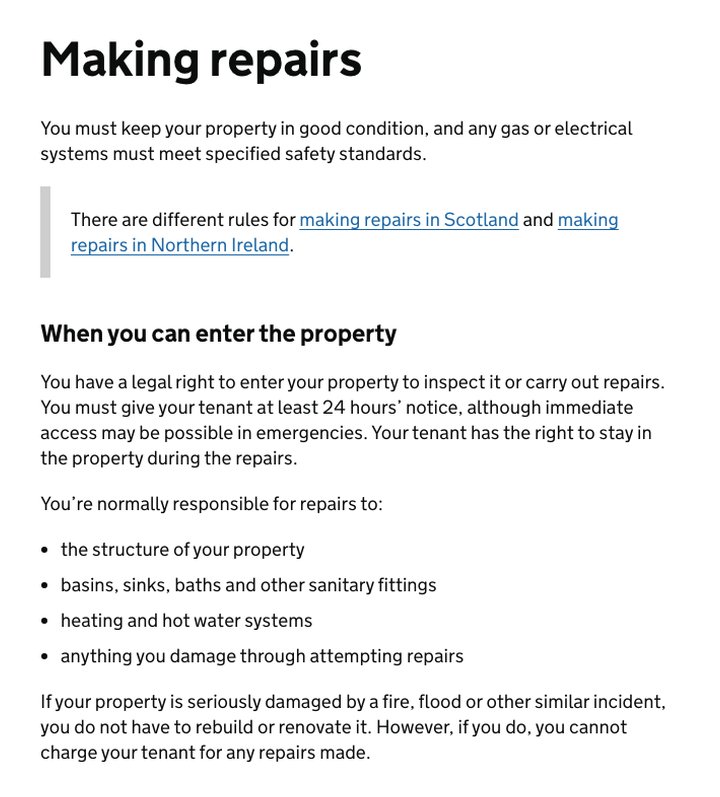
| Entry by the landlord to inspect or carry out repairs, as described in UK government repairs guidance | At least 24 hours’ notice to the tenant | May be able to enter immediately in an emergency |
| Entry for a condition check under the repairing obligation implied into English tenancies | 24 hours’ written notice to the occupier | Must be at a reasonable time of day; anyone entering on the landlord’s behalf needs the landlord’s written authorization |
| Agent visit under a Scottish tenancy (general) | Reasonable notice with a stated reason, at least 24 hours | Unless otherwise agreed with the tenant, entry must be at a reasonable time with the tenant present |
| Agent visit under a Scottish private residential tenancy | Reasonable notice with a stated reason, at least 48 hours | Exceptions apply in an emergency or where notice would defeat the purpose of entry; unless otherwise agreed, entry must be at a reasonable time with the tenant present |
An implied term is one that is not written into the tenancy but is nonetheless treated as part of it in law. A few other points to note:
- In the English situation above, verbal notice alone does not satisfy this legal requirement.
- In Scotland, if a tenant refuses, neither the agent, the landlord nor a third party has the right to enter using a retained key without a warrant (a formal document authorizing entry).
- Scotland and Northern Ireland have separate repair rules. England’s 24-hour rule does not transfer directly to a Scottish private residential tenancy, and Wales’s occupation contract (the Welsh equivalent of a tenancy) needs to be checked separately too.
Which Repairs Are Usually the Landlord’s Responsibility?
UK government repairs guidance lists several categories. Landlords are usually responsible for:
- The structure of the property
- Sanitary fittings such as basins, sinks and baths
- Heating and hot water systems
- Damage caused by the landlord’s own repair attempts
Scotland and Northern Ireland have their own separate rules; see Zagdim’s main guide on managing, maintaining and complying with UK rental property as an overseas owner for the overall breakdown.
How Quickly Must Damp and Mould Be Addressed in Scotland?
Scotland has had clear timescales since October 6, 2026. Where the Right to Repair Scheme or the Repairing Standard (the maintenance standard for rented housing) applies, and the repair is the landlord’s responsibility, the following timeline applies:
| Step | Timescale |
|---|---|
| Investigation by a competent person | Within 10 working days of learning of damp or mould |
| Written summary issued | Within 3 working days of the investigation ending |
| Work starts, once substantial damp or mould is confirmed | Within 5 working days of the investigation ending |
The 5 working days here is when work must start, not when it must be finished. A private landlord in Scotland must complete the work as soon as reasonably practicable, and cannot use the 20-working-day completion period that applies to social landlords (landlords providing social housing).
- If circumstances beyond the landlord’s control make the deadline impossible to meet, the landlord must say which obligation hasn’t been met, why, and the new timescale, and must take reasonable mitigating steps (to reduce harm in the meantime) where practicable.
- Where another regulation sets a shorter deadline, the shorter one still applies.
- Living abroad is not automatically an exception. If you expect to be away for a long period, you should arrange for someone to act on your behalf. For example, if these rules apply to Mr. Lin’s Edinburgh flat, living outside the UK does not exempt him.
What Happens If Major Repairs Require the Tenant to Move Out?
This needs to be agreed in advance. Under UK government repairs guidance, a landlord can ask a tenant to move out temporarily during major repair work, but the length of the work, the tenant’s right to return, and details of alternative accommodation should be agreed in writing beforehand.
The tenant has the right to remain in the property during the works. This does not mean the landlord can end the tenancy or take back the property on their own. Scotland and Northern Ireland have their own separate repair rules.
How Should an Agent Report on Repair Progress?
Scotland has clear requirements for how this should be reported. Scottish agents need to do three things:
- Explain the plan: tell the tenant what repair action is intended and the likely timescale.
- Explain delays: where repairs or maintenance are delayed, explain the delay and the reason to the landlord, the tenant, or both, as soon as possible.
- Record issues: if carrying out a routine visit or inspection, record any issues found and notify the tenant and landlord as appropriate.
Which Compliance Duties Can’t Be Delegated to an Agent?
Some responsibilities don’t disappear just because you’ve appointed an agent. Even with an agent in place, the landlord remains responsible for:
- Scotland’s Repairing Standard: a private landlord is legally responsible for the property meeting this standard, agent or no agent. If it falls short, it must be fixed, or the tenant can take the case to the Housing and Property Chamber (the tribunal that hears housing disputes).
- Northern Ireland electrical safety: the electrical safety rules for private tenancies state that appointing an agent does not remove the landlord’s ultimate compliance responsibility. HMOs (houses in multiple occupation) are handled separately under the HMO licensing regime.
- England’s upcoming rental registration: covered below.
The full set of compliance requirements and deadlines is covered in Zagdim’s guide on which letting compliance rules UK landlords must follow, covering gas safety, EPC, deposit protection and Right to Rent.
What If a Tenant Refuses Access for a Gas Safety Check?
Even here, forcing entry isn’t an option. A landlord must not force entry; access arrangements should be written into the tenancy agreement in advance.
Inspectors from the UK’s Health and Safety Executive (HSE) look for at least three attempted visits, but what counts as reasonable still depends on the individual case, and it is ultimately for a court to decide whether reasonable steps were taken. Three attempts alone do not automatically clear a landlord.
Does a Welsh Landlord Who Doesn’t Self-Manage Need a Licensed Agent?
This depends on whether the landlord is involved in managing the property. The answer is yes: in Wales, a landlord who is not involved in arranging contracts or managing the rental property does not need a management license personally, but must appoint a licensed agent. The license is valid for five years from the date it is issued.
This does not mean appointing an agent removes the landlord’s own registration obligation.
When Does England’s New Rental Registration Start?
This will roll out region by region. As of November 2, 2026, according to official guidance, private landlords in England with properties let under an assured or regulated tenancy (tenancy types used in England) will need to register in phases starting December 15, 2026, with a three-month registration window for each region.
| Region | Registration Window |
|---|---|
| West Midlands | December 15, 2026 to March 14, 2027 |
| London | July 15, 2027 to October 14, 2027 |
| All other regions | Per the official schedule |
The rollout period covers:
- Through November 14, 2027, only properties already let, or let during that period, are covered.
- Supported exempt accommodation (a category of housing that comes with support services) has a statutory exclusion.
- A requirement to register an empty property before advertising it is a future measure, not yet in force.
Once the phased rollout applies, responsibilities break down like this:
- Landlord: must initiate registration and is responsible for meeting the requirements.
- Agent: once a property reference has been obtained and the property is occupied, the landlord can delegate providing tenancy and health-and-safety information to the agent, but the landlord still needs to make sure the property record is completed within 28 days of registration.
- Third party: in cases such as death, incapacity, or certain repossession-related restrictions, a third party may register or update the record. Unless that third party has become the legal landlord, the landlord retains the registration responsibility.
Fees:
- The annual service fee is £65 per property, with no VAT (the UK’s value-added tax) charged.
- There’s no extra charge for a landlord registering and updating records themselves.
- The first fee during the rollout period is prorated, excluding days before November 15, 2027, so £65 is not a fixed first-year amount for every landlord.
For example, if Mr. Lin’s London flat falls under this registration requirement, his registration window would be July 15 to October 14, 2027. Even if he uses an agent to provide the information, he still needs to make sure the property record is completed within 28 days of registration.
Can England’s Information Sheet Just Be Sent as a Link?
Official guidance is clear on delivery method. No: sending only a link to the PDF does not count as valid delivery.
In England, for existing tenancies that must receive the 2026 information sheet, the exact PDF provided on the government website must be given to every named tenant on the tenancy (tenants listed by name on the agreement).
- Delivery methods: post, handing over a paper copy in person, or email attachment are all acceptable.
- Agent’s responsibility: where a managing agent is in place, the agent also has a delivery obligation, even if the landlord has already delivered it.
- Excluded: lodgers are not covered by this information-sheet requirement.
What Should Overseas Landlords Know About Tax and Rent?
Rent paid to overseas landlords may have tax withheld before it reaches you. If there’s a letting agent, the agent withholds; if there’s no agent and the tenant pays more than £100 a week in rent, the tenant withholds.
To receive rent in full, you need approval from HM Revenue and Customs (HMRC, the UK’s tax authority), and you still need to report the rental income through Self Assessment (a system for calculating and reporting your own income tax).
Are You a Non-Resident Landlord?
This depends on how much of the year you spend abroad. HMRC’s rental guidance classifies anyone who lives abroad for 6 months or more a year as a non-resident landlord, even if you remain a UK tax resident.
This classification is specific to the Non-resident Landlords Scheme (NRLS); it’s not the same as the statutory test for tax residence, and it isn’t based on nationality. For example, if Mr. Lin lives abroad for 6 months or more a year, he would be classified as a non-resident landlord regardless of his nationality.
Who Withholds Tax, and How Much?
This depends on whether rent passes through an agent. Where there’s an agent, the agent handles it; without one, it depends on whether weekly rent exceeds £100.
| Situation | Who Handles It | Rule |
|---|---|---|
| An agent operating under the NRLS | The agent | Applies regardless of the rent amount, even at £100 a week or below |
| No letting agent, and the tenant pays the overseas landlord directly more than £100 a week | The tenant | Withholds tax from the rent payment |
| No letting agent, and weekly rent is £100 or below | Generally no need to operate the scheme | Unless HMRC instructs otherwise |
Unless told otherwise, an agent must calculate the tax owed each quarter and pay it to HMRC within 30 days of the end of the quarter. The calculation applies the basic rate of Income Tax to the rental income, after deducting allowable expenses.
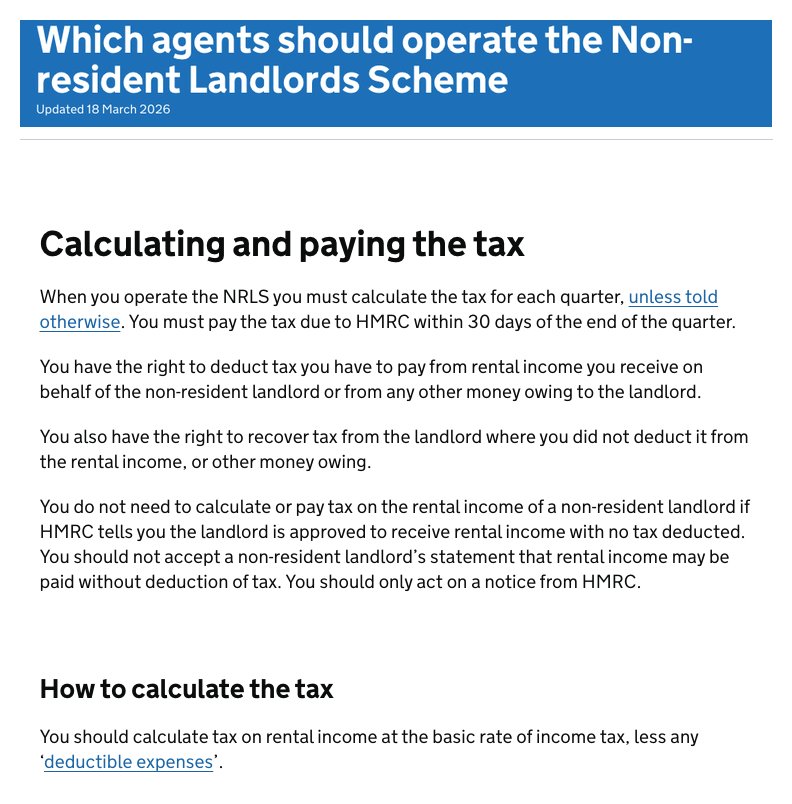
The amount withheld this way isn’t necessarily the landlord’s final Income Tax bill. If the landlord has already been approved by HMRC to receive rent in full, HMRC will notify the agent or tenant not to withhold.
Does Approval to Receive Rent in Full Mean It’s Tax-Free?
These are two separate things. Approval to receive rent gross does not mean tax-free; it simply means the agent or tenant doesn’t withhold up front, and the landlord still has to report the rental income through Self Assessment.
An overseas individual landlord who wants to receive UK rent in full, reporting it via Self Assessment instead, must file form NRL1i and get HMRC approval. Anyone whose tax affairs aren’t up to date, such as outstanding returns or tax owed, won’t be approved.
For example, once Mr. Lin’s NRL1i is approved, the agent will stop withholding tax up front, but Mr. Lin still needs to report the rental income through Self Assessment.
Which Expenses Can Be Deducted?
This needs to be looked at in two separate stages. The expenses an agent can deduct when calculating withholding, and the expenses a landlord can ultimately deduct on their tax return, cover different ground and shouldn’t be confused.
| Stage | Can Be Deducted | Cannot Be Deducted |
|---|---|---|
| Agent’s withholding calculation | Qualifying expenses the agent itself pays, or pays on the agent’s instruction | Expenses the landlord pays directly (even if the agent knows the details); expenses incurred but not yet paid that quarter |
| Landlord’s final tax return | Qualifying day-to-day expenses of the rental business | Capital expenditure (for example, buying the property, or renovation beyond normal wear-and-tear repair), which doesn’t count as a deductible day-to-day expense |
See Zagdim’s main guide on managing, maintaining and complying with UK rental property as an overseas owner for the full list of items.
How Is Mortgage Interest Treated?
Start by establishing whether you pay tax as a company or as an individual. A company paying Corporation Tax can deduct mortgage interest on the property as an allowable expense; an individual landlord paying Income Tax cannot deduct it the same way, but that doesn’t mean there’s no relief at all.
Under HMRC’s current guidance, an individual landlord’s tax reduction is the lowest of the following three figures, multiplied by the basic rate of tax (20% as of November 2, 2026):
- Finance costs not already deducted (the cost of borrowing to buy or run the rental business), including any carried forward
- Property business profits
- Adjusted total income above the personal allowance
This relief cannot create a tax refund. Qualifying finance costs that aren’t fully used can be carried forward, meaning saved for use in a later year.
How Do You File?
HMRC is clear about how this must be filed. Under HMRC’s guidance on overseas rental income, landlords must file through Self Assessment unless HMRC tells them it isn’t required.
- Cannot use: HMRC’s online service.
- Can use: post, commercial software, or professional help such as an accountant.
- Must complete: the residence section and the property section, using paper forms SA109 and SA105 respectively.
Do Overseas Landlords Need to Use Making Tax Digital?
This depends on income and any exemptions (circumstances that remove the requirement). An individual landlord or sole trader (someone running a business on their own, without a company) who needs to file Self Assessment, has self-employment or property income, and has qualifying income above the relevant threshold with no exemption, must use Making Tax Digital (MTD, digital tax reporting) for Income Tax.
| Tax Year | Qualifying Income | Start Date |
|---|---|---|
| 2024/25 | Over £50,000 | April 6, 2026 |
| 2025/26 | Over £30,000 | April 6, 2027 |
| 2026/27 | Over £20,000 | April 6, 2028 |
Whether this applies needs checking against qualifying income and individual exemptions; it isn’t based on after-tax rent alone. Here’s how it relates to form SA109:
- Already filed SA109 with your 2024/25 Self Assessment: automatically exempt from MTD for 2026/27, no separate application to HMRC needed.
- Didn’t file SA109 for 2024/25, but reasonably expect to need to file it for 2025/26 or 2026/27: you need to apply for an exemption. Not being a UK tax resident is only one of the reasons SA109 might be required.
- Qualifying income over £30,000 in 2025/26: in principle, MTD applies from 2027/28, though other exemptions still need to be checked.
Will Property Income Tax Rates Change in 2027/28?
There are two separate sets of figures here, and they need to be kept apart. The rates already written into law are 22%, 42% and 47%; a separate official proposal would raise these to 24%, 44% and 49%, but that proposal has not yet been enacted.
| Source | Basic Rate | Higher Rate | Additional Rate | Status |
|---|---|---|---|---|
| Finance Act 2026 | 22% | 42% | 47% | Enacted as of November 2, 2026; this is the statutory rate for future years, not the current rate for 2026/27 |
| Budget 2026 official proposal | 24% | 44% | 49% | To be legislated through Finance Bill 2026-27, targeted to take effect from April 6, 2027 in England, Wales and Northern Ireland; not yet enacted |
This proposal should not be treated as already in effect, and it does not mean the enacted provision has already been changed. Scotland and Wales can set their own property income tax rates under their existing devolved income tax powers.
None of these are Corporation Tax rates, and none can simply be multiplied against gross rent. NRLS withholding and final Income Tax liability are two separate calculations.
What Are the Requirements for an Address for Service?
Living abroad, the question of an address needs sorting out too. A landlord to whom the relevant legal requirement applies must give the tenant, by notice, an address in England or Wales for serving notices (delivering formal documents) on the landlord, including legal notices.
- Doesn’t mean hiring a management company: this requirement does not mean the landlord must hire a letting management company.
- Effect of not providing an address: until the address is provided, rent, service charges or administration charges that would otherwise be due are treated as not yet due.
- Northern Ireland deposits: a landlord based outside Northern Ireland who takes a deposit for a private tenancy in Northern Ireland must give the scheme administrator protecting the deposit a Northern Ireland contact address. This does not substitute for the address-for-service requirement that applies elsewhere.
See Zagdim’s main guide on managing, maintaining and complying with UK rental property as an overseas owner for more detail.
How Do You Handle Rent Arrears or Damage From Abroad?
Procedures for arrears and damage differ by nation. An overseas landlord first needs to confirm what records the agent has kept, and needs to understand that repossessing a property and recovering money owed are two separate things. The full procedure is covered in Zagdim’s guide on what to do if a tenant won’t pay rent or a property is damaged, covering risks and procedures for UK landlords.
What Should Happen First With Rent Arrears in Scotland?
Scotland has clear requirements for handling arrears. A private landlord must contact the tenant as soon as possible and provide:
- Details of the arrears and when they fell due
- Information about the tenancy’s rent
- The process for ending the tenancy
- Sources of help
The landlord must also make reasonable efforts to agree a payment plan for the arrears and future rent. The tribunal will expect evidence that pre-action protocols (steps required before a case goes to a hearing) were followed.
A Scottish agent should follow its written procedure, or its agreement with the landlord, to give written notice of late rent. In managing arrears, the agent must be able to show it took all reasonable steps to recover rent owed to the landlord that hasn’t been paid. This doesn’t mean the agent guarantees recovery.
Does Repossession Mean You Get the Arrears Back?
These are two separate things. Repossessing the property doesn’t mean recovering the arrears: when an English county court bailiff (the court officer who carries out enforcement) executes a repossession, that doesn’t recover rent arrears or damage compensation on your behalf.
A judge can attach a money judgment to a repossession order, stating an amount the tenant owes you, such as arrears, but the bailiff won’t collect that money for you. Guidance states that recovering money requires a separate money claim (a formal process for demanding payment); if you don’t know the tenant’s address, a tracing service may be needed.
For example, even if a bailiff executes repossession of Mr. Lin’s London flat, the arrears are not automatically recovered as a result.
How Should Damage at Move-Out Be Documented?
Documentation should start from move-in. In Scotland, agents have written obligations at both move-in and move-out:
- At move-in: if a letting agent is responsible for the move-in check, it must produce an inventory (a list of the property’s contents, their condition, and the property’s condition) unless the landlord has agreed otherwise in writing; this can include photographs. Where an inventory and condition report is made, both the agent and the tenant need to sign to confirm it’s accurate.
- At move-out: where a check finds damage, the letting agent must give the tenant clear written information about the damage and the proposed cost of repair, which can be supported by photographs, and should refer to the move-in inventory and condition report where one exists.
A proposed repair cost here doesn’t mean the tenant has already agreed to it, that a deposit can automatically be withheld, or that a court will necessarily award that amount.
What to Check When Switching Agents
When changing agents, dates, money and documents all need to be accounted for clearly. When a Scottish letting agent’s appointment ends, the agent must confirm in writing:
- The date the agency stops
- Any money still outstanding between the parties
- Arrangements and timescales for handing over keys, certificates and necessary documents
Unless otherwise agreed, money due to the landlord should be returned automatically as part of final billing, net of any outstanding amounts owed. Before switching agents, get these items and timescales confirmed.
If asked by the landlord, a Scottish agent must also disclose in writing any commission, fees, rebates, other payments or benefits received from contractors or third parties it has appointed, as well as any financial or other interest the agent itself holds.
Frequently Asked Questions
Can an agent enter to carry out repairs without notice while I’m abroad? No. The tenant must be notified first, and entry can’t be forced. In England, a condition check under the written-notice requirement needs 24 hours’ written notice; a Scottish private residential tenancy agent visit needs at least 48 hours, with exceptions for emergencies.
If I don’t provide an address in England or Wales, does the tenant never have to pay rent? No. Until a landlord covered by this legal requirement provides the address, amounts like rent are treated as not yet due, but the debt isn’t permanently waived. This effect also doesn’t apply while a receiver or manager appointed by a court or tribunal, with duties that include collecting such payments, remains in place.
Does approval for NRL1i make UK rental income tax-free? No. Once NRL1i is approved by HMRC, the agent or tenant simply stops withholding tax up front. You still need to report the rent through Self Assessment.
If a Scottish property is under full management, do I not need to worry about safety? No. A private landlord in Scotland is legally responsible for meeting the Repairing Standard, agent or no agent. If the property falls short, it must be fixed, or the tenant can take the case to the Housing and Property Chamber.
Key Terms
- Non-resident landlord: HMRC’s rental-guidance classification for anyone who lives abroad for 6 months or more a year; it is not the statutory test for tax residence.
- Client money protection scheme: the scheme that an agent holding client money in England’s private rented sector must join.
- Making Tax Digital (MTD): the system that an individual landlord or sole trader who must file Self Assessment, and whose qualifying income is above the relevant threshold with no exemption, must use.
A Note on Sources and Scope
This article was checked on November 2, 2026. The agent-vetting points for overseas landlords are drawn together from Scotland’s Letting Agent Code of Practice and England’s client money protection rules; officials have not published them as a single combined list, and Scotland’s code does not represent the rules in other nations. England’s future rental registration and fees are future requirements that had been announced as of the check date but are not yet fully in force; the first-year fee during the rollout is calculated by official formula based on the registration date, and this article does not attempt that calculation. On the 2027/28 property income tax rates, the enacted rate and the Budget proposal are presented side by side; the proposal has not yet been legislated, and the final outcome depends on Finance Bill 2026-27.
This article refers to the following legal provisions:
- England’s 24-hour written notice for a condition check: Landlord and Tenant Act 1985, section 11(6).
- The address-for-service requirement and rent and other charges being treated as not yet due: Landlord and Tenant Act 1987, section 48.
- The property income tax rates enacted for 2027/28: Finance Act 2026, section 7.
Need help with this? Talk to the Zagdim reader desk
If you are deciding which route fits you, or which authority to deal with, the Zagdim reader desk can arrange a suitable specialist for your situation. The first consultation is free.
Message the Zagdim reader desk on WhatsApp Message the Zagdim reader desk on LINE
Have a question about this guide? Leave a comment below, or ask Zagdim directly.
Your first stop for international property and global living.
Research and insights. Know what’s changing. Understand what matters.
Sources
- UK Government
- Ministry of Housing, Communities and Local Government – Renting out your property: Making repairs
- UK Parliament
- National Archives – Landlord and Tenant Act 1987 (section 48)
- Scottish Government – Engaging landlords – Letting agent code of practice
- Scottish Government – Management and maintenance – Letting agent code of practice
- UK Government
- Ministry of Housing, Communities and Local Government – Protecting clients’ money if you’re a property agent
- Scottish Government – Awaab’s Law: guidance for landlords in Scotland
- Scottish Government – Repairs and maintenance as a private landlord
- Northern Ireland Department for Communities – The Electrical Safety Standards for Private Tenancies Regulations (Northern Ireland) 2024
- UK Health and Safety Executive – Gas safety: landlords and letting agents
- Rent Smart Wales
- Cardiff Council – Landlord and Agent Licensing
- UK Ministry of Housing, Communities and Local Government – Register your rental property service: guidance for landlords
- UK Ministry of Housing, Communities and Local Government – The Renters’ Rights Act Information Sheet 2026
- HM Revenue & Customs – Tax on your UK income if you live abroad: Rental income
- HM Revenue & Customs – Which agents should operate the Non-resident Landlords Scheme
- HM Revenue & Customs – What the Non-resident Landlords Scheme is
- HM Revenue & Customs – Renting out your property: Paying tax and National Insurance
- HM Revenue & Customs – Tax relief for residential landlords: how it’s worked out
- HM Revenue & Customs – Find out if and when you need to use Making Tax Digital for Income Tax
- HM Revenue & Customs – Find out if you can get an exemption from Making Tax Digital for Income Tax
- UK Parliament
- National Archives – Finance Act 2026, section 7
- HM Revenue & Customs
- HM Treasury – Budget 2026 — Overview of tax legislation and rates (OOTLAR)
- Northern Ireland Executive
- Department for Communities – Tenancy Deposit Scheme: information for tenants
- Scottish Government – Dealing with rent arrears as a private landlord
- Ministry of Housing, Communities and Local Government
- HM Courts and Tribunals Service – Repossessing your privately rented property after 1 May 2026
- UK Parliament
- National Archives – The Letting Agent Code of Practice (Scotland) Regulations 2016
Important Notice
This article is a general information summary and does not constitute tax or legal advice for any individual case. It was checked on November 2, 2026. UK rules may be updated; check current official guidance from the relevant authorities, and take advice from a qualified professional for your own situation.