

































If you already own rental property in the United Kingdom, are considering buying one, or are thinking about moving to the UK yourself, and you currently live somewhere else in the world, this article maps out the overall picture of what owning and letting a UK property involves once you are not living there day to day: letting management, repair duties, legal compliance, leasehold holding costs and tenant relations.
Letting rules are not fully unified across England, Scotland, Wales and Northern Ireland. This article sets out the overall picture first; the detailed points each link out to their own companion articles.
What Should You Check Before Letting a UK Property From Overseas?
Before letting out a UK property while living overseas, confirm mortgage consent, lease restrictions, which part of the UK the property is in, and your non-resident landlord tax status, so you do not run into trouble with the rules later.
At minimum, you should confirm:
- If the property has a mortgage, you need the mortgage lender’s consent first.
- If it is a leasehold flat, check the lease for restrictions first. Many leases require permission before subletting short-term through services such as Airbnb, before making alterations, or before keeping pets, and some leases ban running a business from the property.
- Which part of the UK the property is in (England, Scotland, Wales or Northern Ireland), because compliance and repossession procedures differ between them.
If you live overseas for six months or more each year, HM Revenue and Customs (HMRC) will classify you as a non-resident landlord. This applies even if you remain a UK tax resident for other purposes; it is a rental income tax classification, not a statutory tax residence test.
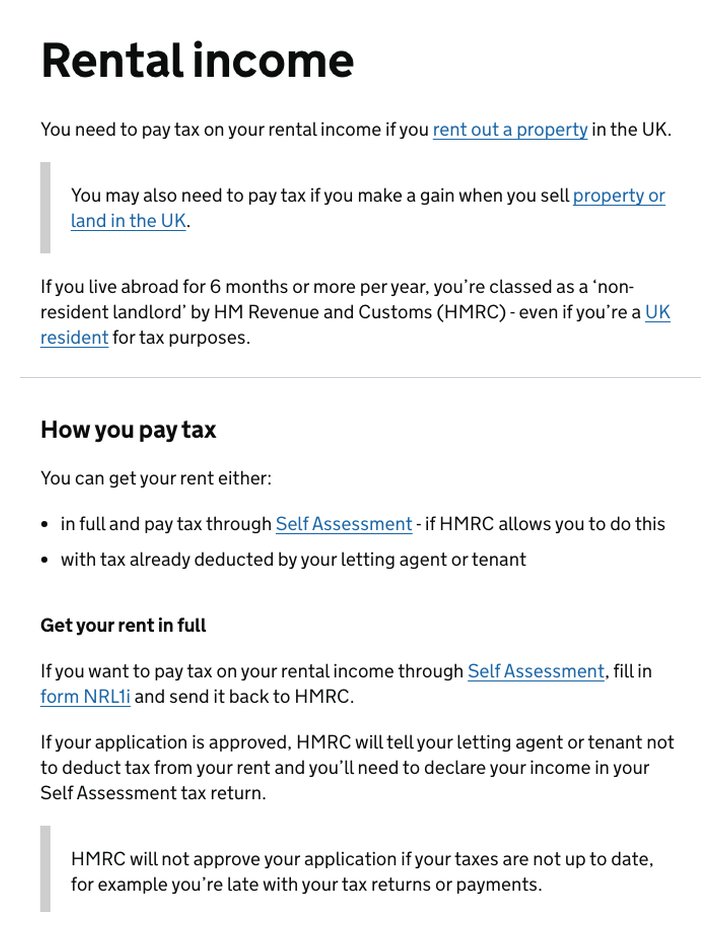
On tax, an overseas individual landlord who wants to receive rent in full and self-report it through Self Assessment needs to file form NRL1i and get HMRC’s approval. Once approved, HMRC will tell the agent or tenant not to withhold tax, but you still have to declare the rental income. Approval will not be granted if you have outstanding tax returns or tax due.
If you have no letting agent and the tenant pays you more than 100 British pounds a week directly, the tenant must withhold tax from the rent, unless HMRC has already approved you to receive rent in full and notified the tenant accordingly. Under the Non-resident Landlords Scheme (NRLS), a tenant paying 100 pounds a week or less with no agent involved generally does not need to operate the scheme, unless HMRC instructs otherwise; where there is an agent, the scheme applies regardless of the rent amount.
For more on letting management and compliance, see our companion articles, “What Do UK Letting Management Companies Do? Comparing Let-Only, Rent Collection and Full Management” and “What UK Landlord Compliance Must You Meet? Gas Safety, EPC, Deposit Protection and Right to Rent.”
How Can You Divide Up Letting Management: DIY or Agent?
Managing a UK rental property does not have to be entirely hands on. Depending on your time, language and distance from the property, you can choose different levels of service, from simply finding a tenant to collecting rent to full management.
The table below is one example, taken from the website of Lettings Waltham Forest (LWF), the letting agency run by the London Borough of Waltham Forest council (checked November 2, 2026):
| Service | What LWF’s Website Says It Covers |
|---|---|
| **Let Only** | Finding a suitable tenant and preparing tenancy documents |
| **Rent Collection** | Includes Let Only, plus monthly rent collection and handling rent arrears |
| **Full Management** | Includes Rent Collection, plus managing maintenance, repairs and quarterly inspections |
This is just one agency’s example, not a UK-wide standard definition; what you actually get depends on the agency contract you sign. For a comparison of the three service levels and who each suits, see our companion article “What Do UK Letting Management Companies Do? Comparing Let-Only, Rent Collection and Full Management.”
One thing worth noting: handing the property to an agent does not transfer all of a landlord’s legal responsibilities. In Scotland, for example, even when using an agent, the landlord remains legally responsible for landlord registration, meeting the property’s legal repairing standard, and the rules on taking, protecting and returning deposits. Operating as a letting agent in Scotland without registering is a criminal offense. Similarly, private landlords in Scotland are legally responsible for making sure the property meets a safe letting standard, even when an agent is used.
If you are considering using an agent, it is worth setting out clearly in the contract:
- The amount and circumstances under which the agent can carry out repairs (for example, emergency repairs) without checking with you first. Under the Scottish letting agent code of practice, the terms of engagement with a letting agent in Scotland must set out, in plain language, the scope of authority given, such as the monetary threshold for instructing repairs or buying replacement items, and the circumstances in which the agent can act without first asking the landlord.
- Whether out-of-hours emergencies are covered. Under the Scottish code, if an agent manages repairs directly on the landlord’s behalf, it must have a proper written reporting procedure in place; where emergency arrangements are part of the service, it must also have procedures for emergencies and contractor access, and out-of-hours incidents are only covered if that part of the service was included.
- Whether the agent holds client money. In England’s private rented sector, a letting or property management agent that holds client money must belong to a client money protection scheme; this is a separate protection from tenancy deposit protection or rent arrears insurance.
What Compliance Must You Meet Before and After Letting?
Across the UK, landlords face a range of safety, registration and documentation requirements. Letting a property is not just a matter of handing over the keys, and breaching these requirements can mean fines or being unable to recover the property.
The list below sets out compliance items commonly required in England (Scotland, Wales and Northern Ireland have their own separate rules):
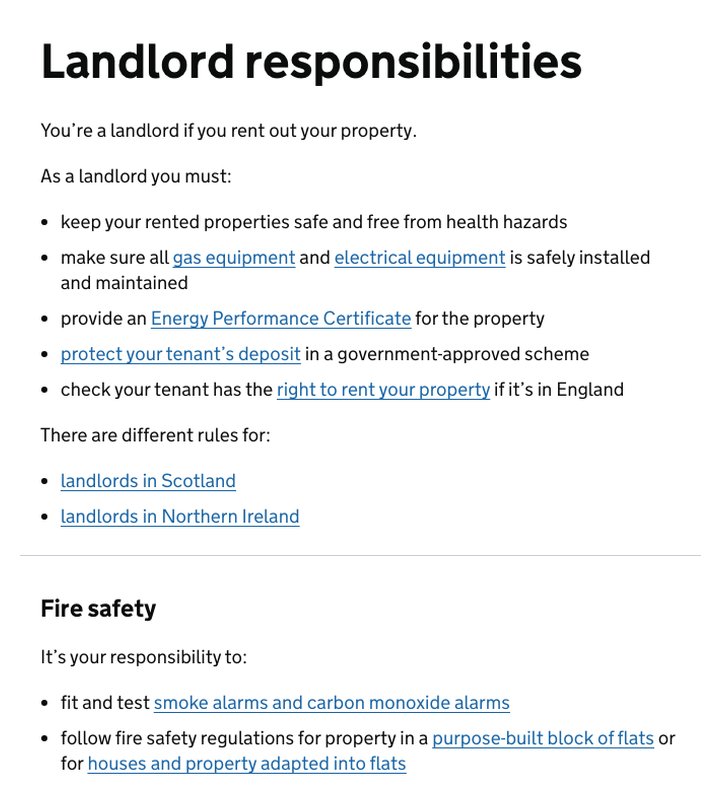
- Gas safety: Under the Health and Safety Executive’s (HSE) gas safety guidance, a landlord letting a property on a tenancy of less than seven years, or under a licence to occupy, who meets the rule’s definition of a landlord, must have any gas appliance or flue they provide checked by a Gas Safe Registered engineer within 12 months of installation and annually thereafter. Records must be kept for two years, provided to an existing tenant within 28 days of the check, and given to a new tenant before they move in.
- Energy Performance Certificate (EPC): In England and Wales, since April 1, 2020, residential private rented properties covered by the Minimum Energy Efficiency Standards (MEES) cannot start or continue to be let if the EPC rating is below band E, unless a valid exemption applies.
- Deposit protection: In England, deposits for an assured periodic tenancy (APT) must be placed by the landlord or letting agent into a government-approved tenancy deposit protection (TDP) scheme within 30 days of receipt. The APT replaces the assured shorthold tenancy (AST) from May 1, 2026, with transitional arrangements described below.
- Right to Rent checks: For residential tenancies covered by England’s scheme, the landlord or agent must check every adult occupant for whom the property will be their only or main home, regardless of nationality, before the tenancy starts; “adult” means 18 or over. Some arrangements are excluded under official guidance, and not every residential letting is covered by the scheme.
- Electrical safety: For rented homes covered by England’s electrical safety rules, fixed electrical installations must be inspected and tested by a qualified person at least every five years, producing what is commonly called an Electrical Installation Condition Report (EICR), which must state the date of the next inspection. Exclusions set out in the guidance include tenants who share accommodation with the landlord or their family, and long leases granting occupation for more than seven years; a lease is not treated as granting occupation for more than seven years if either party can end it before the seven-year mark.
- Smoke and carbon monoxide alarms: Under England’s alarm requirements effective from October 1, 2022, landlords covered by the rules must have at least one smoke alarm on every storey of the property with a room used as living accommodation, and a carbon monoxide alarm in any room used as living accommodation with a fixed combustion appliance, except gas cookers.
On top of this, in England and Wales, if you plan to let to multiple unrelated tenants, check with your local council whether you need a house in multiple occupation (HMO) licence. Even a small property with few occupants may still need a licence depending on local rules.
Local authorities in England can also designate a whole district or part of one as a selective licensing area. Within such an area, private rented properties generally need a licence, except for properties with a specified statutory exemption or those already required to hold an HMO licence under Part 2 of the Housing Act 2004. Letting to a single household or not being an HMO does not by itself mean a licence is unnecessary; you need to check the actual address.
Registration requirements also differ by nation:
- Wales: Since November 23, 2015, landlords letting private residential property must register with Rent Smart Wales. Registration lasts five years and must be renewed when it expires. This is generally done directly by the landlord; powers of attorney and executors are among the exceptions, with details set out in the official FAQ. If you do not take part in arranging contracts or managing the let property yourself, you do not need a licence to manage, but you must appoint a licensed agent; appointing an agent does not remove the landlord’s own registration requirement.
- Northern Ireland: Landlords must join the Landlord Registration Scheme and provide tenants with a Tenancy Information Notice, free of charge, within 28 days of the start of the tenancy.
- England: Based on official guidance available as of the check date, a new private rented sector registration scheme will be rolled out region by region from December 15, 2026, with each region given a three-month window; London’s window, for example, runs from July 15 to October 14, 2027. The rollout period runs until November 14, 2027, and covers only properties already let, or let during that period; supported exempt accommodation has a statutory exclusion.
The new England registration carries an annual service fee of 65 British pounds per property, with no VAT charged; during the rollout period the first fee is prorated and does not count days before November 15, 2027, so 65 pounds is not a fixed first-year amount for every landlord. The landlord must start the registration and remains responsible for meeting the requirements; once the property has a registration number and is occupied, an agent can be asked to provide tenancy and health and safety information, but the landlord must still ensure the record is completed within 28 days of registration. Death, incapacity and certain repossession-related situations allow a third party to register or update the record.
For compliance details and the latest changes, see our companion article “What UK Landlord Compliance Must You Meet? Gas Safety, EPC, Deposit Protection and Right to Rent.”
Who Is Responsible for Repairs and Access to the Property?
Under UK government repair guidance, a landlord is generally responsible for the property’s structure, sanitary fittings such as basins, sinks and baths, heating and hot water systems, and any damage caused by their own attempted repairs; Scotland and Northern Ireland have their own separate rules. By contrast, damage caused by the tenant, their family or friends is the tenant’s responsibility to fix or pay for, though normal wear and tear should not be treated as tenant-caused damage.
Under UK government repair guidance, a landlord must give the tenant at least 24 hours’ notice before entering to inspect or carry out repairs, except in an emergency, when entry without notice may be possible; the tenant has the right to remain living in the property during repairs. Entry to inspect condition under the implied term in Section 11(6) of the Landlord and Tenant Act 1985 must take place at a reasonable time of day, with at least 24 hours’ written notice given to the occupier, and anyone entering on the landlord’s behalf must have the landlord’s written authorization.
This Section 11(6) rule applies only to English tenancies where the landlord’s repairing obligation is an implied term; Scotland and Northern Ireland have their own repair rules, and Wales occupation contracts need to be checked separately. A right of entry also does not mean a right to force entry.
If major repairs are needed, a landlord can ask the tenant to move out temporarily during the works, but should agree in advance, in writing, on the length of the works, the tenant’s right to return and the arrangements for alternative accommodation; Scotland and Northern Ireland have their own separate rules.
A few nation-specific points to watch for:
- Scotland: From October 6, 2026, for housing covered by the Right to Repair Scheme or the Repairing Standard where the landlord is responsible for the repair, a competent person must investigate within 10 working days of becoming aware of damp or mould, and a written summary must be provided within three working days of the investigation ending. Where the investigation confirms substantial damp or mould, work must start within five working days of the investigation ending. Private landlords must comply as soon as reasonably practicable; where other legislation requires a faster timescale, the shorter deadline applies. Where circumstances beyond the landlord’s control prevent compliance, the landlord must inform the tenant of which duty cannot be met, the reason, and the new timescale, and take reasonable steps to mitigate harm where practicable.
- Wales: Under the Renting Homes (Wales) Act 2016, for occupation contracts of less than seven years, the landlord must ensure the home is fit for human habitation (FFHH) both at the start of, and throughout, the contract; this is assessed against the 29 matters and circumstances set out in the 2022 Welsh fitness regulations.
- Northern Ireland: Fixed electrical installations in private tenancies must be inspected and tested by a qualified person at least every five years. This applies to new tenancies from April 1, 2025, with existing tenancies required to comply by December 1, 2025, at the latest. HMOs remain covered by the separate HMO licensing system, and appointing an agent does not remove the landlord’s ultimate compliance responsibility.
If you live overseas, it is worth setting out clearly in your agent contract the threshold for repair authorization, the emergency procedure and the out-of-hours arrangements. In Scotland, an expected long absence should be planned for in advance rather than assumed to be an automatic exception. For practical arrangements, see our companion article “How Do You Manage a UK Rental Property From Overseas? Tenants, Repairs, Tax and Agent Communication.”
How Do Service Charges, Ground Rent and Building Management Affect Holding Costs?
If you have bought a leasehold flat, your holding costs include more than the mortgage and tax. They can also include service charges, ground rent and building management related fees.
For leasehold property in England and Wales, how the service charge is arranged and which items can be charged is set out in the lease. Those who pay the service charge have the right to request a summary of costs and how the money was used, and to inspect the receipts and other documents supporting that summary. Failing to meet the statutory duties under Sections 21 to 23 without reasonable excuse can be a summary offense under Section 25 of the Landlord and Tenant Act 1985; Section 25(3) separately excludes local authorities in Wales and registered social landlords.
The freeholder can appoint a managing agent to arrange services, repairs, improvements and insurance, and to handle day-to-day management of the building or estate; this is separate from any letting agent you hire yourself, and the service charge is not a letting management fee. Buildings insurance is typically the freeholder’s responsibility, with the premium usually included in the service charge, but the insurance only covers the building itself, not the contents, furniture or loss of rent.
Leasehold property may also require payments into a reserve or sinking fund, to cover unexpected major repairs such as roof replacement. These payments are generally not refundable, including when you move out.
On ground rent, for leases granted in England and Wales before June 30, 2022, ground rent only becomes payable once the landlord makes a formal written demand; the landlord can claim up to six years of unpaid ground rent in arrears, and can only increase it where agreed or allowed under the lease. Even if you buy an existing lease from another leaseholder on or after June 30, 2022, you still have to pay ground rent if the lease provides for it; the new rules only apply to leases newly granted from that date.
New long residential leases also cannot be judged purely by the grant date: where a binding contract to grant the lease was exchanged before the relevant commencement date, the new rules do not apply even if the lease itself is granted later. This commencement date is generally June 30, 2022, or April 1, 2023, for retirement homes; voluntary lease extensions and shared ownership arrangements have their own separate exceptions.
If major works are planned for the building, leaseholders in England and Wales have the right to be consulted, under what is known as a Section 20 consultation, where an individual leaseholder’s share of planned works costs more than 250 British pounds, or where ongoing works and services lasting more than 12 months cost more than 100 pounds a year. This does not give an individual owner an absolute veto.
Separately, England’s building safety protections only apply to a qualifying lease within a relevant building. Under Section 117 of the Building Safety Act 2022, a relevant building must contain at least two dwellings and be at least 11 metres tall or have at least five storeys, with several further exclusions.
A qualifying lease must be for a single dwelling, have a term of more than 21 years, require the leaseholder to pay a service charge, and have been granted before February 14, 2022. On that date, the dwelling must have been the leaseholder’s only or main home, or the leaseholder must have owned no more than three dwellings in total across the UK; if there was a superior and an inferior lease on that date, the superior lease does not qualify. The protection does not cover property in Wales, Scotland or Northern Ireland, and qualifying does not mean every repair is free.
For details on leasehold holding costs, see our companion article “How Do Service Charges, Ground Rent and Management Companies Affect UK Holding Costs?”
What Are the Rules on Tenant Relations, Rent Increases and Repossession?
England’s main letting reforms under the Renters’ Rights Act took effect from May 1, 2026. For private assured tenancies covered by the reform, both rent increases and repossession now follow a statutory process. Scotland and Northern Ireland have their own separate procedures.
Tenancy Type and Rent Increases
For private assured tenancies covered by England’s reform, existing ASTs generally converted to APTs on May 1, 2026, and new tenancies are also APTs, rolling on a periodic basis such as monthly, with no fixed end date allowed in the tenancy agreement. Cases where a Section 8 or 21 notice had already been validly served before May 1, 2026, only convert to an APT once the notice expires or the related court process concludes.
For rent increases, an England APT landlord must use Form 4A and give at least two months’ notice, under what is known as the Section 13 process, even if the tenant has already agreed to the increase informally. Rent cannot be increased within the first year of a tenancy, and after that, each increase must be at least a year after the previous one took effect; a tenant can challenge an increase that is above the open market rent.
What New Rules Apply at Marketing and Signing?
For new England APT lettings, the landlord or agent cannot accept, request or encourage payment of rent before both parties have signed the agreement. Between signing and the start of the tenancy, monthly rent is generally capped at one month in advance, and weekly rent at 28 days in advance. Exceptions apply to tenancies arranged by a local authority for a tenant who is statutorily homeless, and to social or supported housing. Advertisements must display an asking rent (a separate rule applies to “to let” boards), landlords cannot encourage bidding, and cannot accept an offer above the advertised rent.
On discrimination, landlords and their agents in England cannot block access to information, viewings or signing because a prospective tenant has children or receives benefits. They can carry out fair affordability checks, but must give equal weight to income from benefits. Exceptions are limited to existing insurance policies with restrictive terms taken out before May 1, 2026, until renewal or termination, and restrictions on children living in the property that serve a legitimate aim and are proportionate; the latter cannot be used against benefit recipients.
On pets, an England APT tenant can make a written request to keep a pet, with a description of the animal, and the landlord cannot refuse without a fair reason, and must respond in writing within 28 days. If further information is requested, the final response deadline is either the remainder of the original 28 days or seven days after the extra information is provided, whichever is later; leasehold properties may require the freeholder’s consent first.
In addition, under the new England APT system, the landlord must give the tenant prescribed written information about the main terms before the tenancy is signed, or otherwise agreed to orally. Failing to provide this can carry a fine of up to 7,000 British pounds.
What If a Tenant Falls Behind on Rent or Damages the Property?
From May 1, 2026, private assured tenancies in England covered by the reform can no longer be repossessed using Section 21 of the Housing Act 1988; repossession must instead follow a Section 8 notice ending the tenancy. Cases where notice was already served before May 1, 2026, and tenancies not covered by the reform, follow separate guidance.
Common grounds and procedures for repossession include:
- Rent arrears (Ground 8): For tenants paying monthly, arrears must reach at least three months; for those paying weekly or fortnightly, at least 13 weeks, and both the date the notice is served and the date of the hearing must meet the threshold. If the arrears are paid off or fall below the threshold before the hearing, this ground cannot be used to evict. Arrears caused only by not yet receiving the housing element of Universal Credit the tenant is entitled to are excluded from the calculation. The notice period is four weeks, after which a landlord can apply to court for repossession.
- Deterioration of the property (Ground 13): Where the tenant has let the property’s condition deteriorate, this is a discretionary ground decided by the court; the landlord must give two weeks’ notice before applying to court for a possession order. Normal wear and tear does not meet this ground.
- Sale or moving in: If a landlord repossesses because they need to sell or move into the property, this ground cannot be used to evict a tenant within the first 12 months of the tenancy; even after 12 months, the notice and court process must still be followed.
For cases covered by England’s reform, the landlord must serve a Section 8 notice citing the ground for repossession and give the correct notice period. If the tenant does not leave once the notice expires, the landlord must apply to court for a possession order to recover the property. Evicting a tenant without giving the legally required notice, by changing the locks, or without a court order, can amount to illegal eviction; harassing or attempting to remove a tenant outside the correct process is a criminal offense.
A few further points worth noting:
- Deposit compliance is a precondition for most repossession grounds. Where a deposit has been taken under England’s new system for assured tenancies, most grounds require that the deposit has been protected and the scheme requirements and statutory information met, or that the deposit has been returned in full or with agreed deductions, or that any dispute over the deposit’s compliance has been decided, settled or withdrawn. Anti-social behavior Grounds 7A and 14 are not subject to this restriction, and for a non-money deposit, the items must still be returned before any ground can be used to obtain repossession.
- After using Ground 1 or 1A, re-letting or re-advertising the property within the 12-month restriction period can result in a fine of up to 40,000 British pounds in place of prosecution, unless the landlord has taken all reasonable steps to avoid this or an exception applies.
- A tenant who believes the landlord has committed a specified offense, or where the landlord has already been convicted of one, can apply to the First-tier Tribunal for a rent repayment order (RRO). If the tribunal finds the offense proven, it may order the rent to be repaid. The 2026 reforms raised the maximum from one year’s rent to two years’, but this does not apply to offenses committed before May 1, 2026; where a continuing offense specified in the legislation spans that date, the period before it still does not count.
- The County Court fee for a property repossession claim is 415 British pounds (per the fee schedule updated October 26, 2026), not including legal costs, enforcement or other fees.
Scotland and Northern Ireland follow their own separate procedures:
- Scotland: Facing rent arrears, a landlord must contact the tenant as soon as reasonably possible, provide details such as an arrears statement, and make a reasonable effort to agree a payment plan. The tribunal will expect evidence that pre-action protocols were followed.
- Northern Ireland: A landlord’s Notice to Quit must be in writing, with at least four weeks’ notice for a tenancy of 12 months or less, at least eight weeks for one over 12 months but not more than 10 years, and at least 12 weeks for one over 10 years. If the tenant refuses to leave, repossession can only be obtained through the courts.
For full details of tenant risk and procedures, see our companion article “What to Do If a Tenant Stops Paying Rent or Damages the Property: UK Landlord Risks and Procedures.”
What Expenses Can You Deduct From Rental Income for Tax?
Taxable profit from letting residential property can be reduced by qualifying day-to-day expenses, such as letting agent fees, accountancy fees, buildings and contents insurance, repairs and maintenance (excluding improvements), ground rent and service charges. Capital expenditure, such as buying the property or renovation that goes beyond restoring normal wear and tear, does not count as a deductible day-to-day expense.
On mortgage interest, a company paying Corporation Tax can deduct mortgage interest on the property as an expense; an individual landlord paying Income Tax cannot deduct it in the same way. That said, an individual residential landlord is not entirely without relief for finance costs. Under HMRC’s current guidance, the tax reduction is calculated by taking the lowest of three figures: unrelieved finance costs (including any carried forward), the property business’s profits, and the total income exceeding the personal allowance that is subject to tax, then multiplying that lowest figure by the basic rate (currently 20 percent, per the relevant guidance page). This cannot create a tax refund, and unused finance costs that meet the rules can be carried forward.
On future tax rates, as of November 2, 2026, Section 7 of the Finance Act 2026 has set the basic, higher and additional rates of property income tax for the 2027/28 tax year at 22, 42 and 47 percent; these are the statutory rates for a future tax year, not the rates currently in force for 2026/27.
Separately, the official Budget 2026 proposal plans to legislate, through the Finance Bill 2026-27, to raise the 2027/28 property income tax rates to 24, 44 and 49 percent, targeted to take effect from April 6, 2027 across England, Wales and Northern Ireland; this remains a proposal awaiting legislation. The Scottish and Welsh governments can set their own property income tax rates under their existing income tax powers; none of these rates can simply be multiplied against total rent to calculate tax owed.
Reporting requirements are also changing. An individual landlord required to file Self Assessment, with property income, whose qualifying income exceeds the relevant threshold and who has no exemption, must use Making Tax Digital for Income Tax (MTD):
| Qualifying Income | Start Date |
|---|---|
| Over 50,000 British pounds in 2024/25 | April 6, 2026 |
| Over 30,000 British pounds in 2025/26 | April 6, 2027 |
| Over 20,000 British pounds in 2026/27 | April 6, 2028 |
If you already filed an SA109 with your 2024/25 Self Assessment, you are automatically exempt from MTD for 2026/27, with no need for a separate application to HMRC; being a non-UK tax resident is just one of the reasons an SA109 is required. If you did not file an SA109 for 2024/25 but reasonably expect to need to file one for 2025/26 or 2026/27, you must apply for an exemption. Those with qualifying income over 30,000 pounds in 2025/26 will generally need to use MTD from 2027/28 onward; other exemptions still need to be confirmed individually.
How Do You Handle a Service Address While Living Overseas?
Landlords living overseas need to pay attention to the service address rules in England and Wales, and the contact address requirement for deposits in Northern Ireland.
In England and Wales, a landlord covered by Section 48 of the Landlord and Tenant Act 1987 must give the tenant, by notice, an address in England or Wales where the tenant can serve notices, including notices in legal proceedings. This does not mean you have to hire a letting management company.
In Northern Ireland, a landlord living outside Northern Ireland who takes a private tenancy deposit there still has to follow the local rules, including providing a Northern Ireland contact address to the scheme administrator protecting the deposit.
For more on tax, agent communication and remote management for overseas landlords, see our companion article “How Do You Manage a UK Rental Property From Overseas? Tenants, Repairs, Tax and Agent Communication.”
Which Institutions Will You Deal With?
When letting a UK property, you will come across institutions and schemes including HMRC, your local council, the Home Office’s right to rent check requirements, and government-approved deposit protection schemes.
| Institution or Scheme | What It Does for Landlords | When You Will Encounter It |
|---|---|---|
| **HM Revenue and Customs (HMRC)** | Classifies non-resident landlords; approves receiving rent in full | When applying for NRL1i, or filing Self Assessment for rental income |
| **Local council** | Confirms whether an HMO licence is needed | When letting an HMO in England or Wales |
| **Home Office** | Issues landlord guidance on right to rent checks | When checking adult occupants before a tenancy starts in England |
| **Tenancy deposit protection (TDP) scheme** | Protects deposits for England’s APT | Within 30 days of receiving a deposit |
Frequently Asked Questions
My UK property still has a mortgage. Can I let it out directly?
No. If the property you plan to let has a mortgage, you must first get the mortgage lender’s consent.
What is the current minimum EPC rating needed to let a property?
For residential private rented properties covered by the MEES rules in England and Wales, an Energy Performance Certificate (EPC) rating below band E means the property cannot start or continue to be let, unless a valid exemption applies.
How many days after receiving a deposit do I have to protect it?
In England, a deposit for an assured periodic tenancy (APT) must be placed by the landlord or letting agent into a government-approved deposit protection scheme within 30 days of receiving it.
If a tenant is three months behind on rent, can I evict them right away?
No. In England, the Ground 8 rent arrears ground requires meeting the arrears threshold, the correct notice period and the court process, and both the date the notice is served and the hearing date must meet the threshold. Changing the locks or evicting without a court order can amount to illegal eviction.
Does the insurance included in the service charge cover tenants’ furniture?
No. Buildings insurance on a leasehold property does not cover the contents, furniture or loss of rent; the premium is typically included in the service charge.
Key Terms
- Assured periodic tenancy (APT): The tenancy type used from May 1, 2026, for private assured tenancies covered by England’s reform. It rolls on a periodic basis, such as monthly, with no fixed end date.
- Service charge: A charge collected under the lease for leasehold property; how it is arranged and which items can be charged is set out in the lease.
- Ground rent: A payment made under the lease to the landlord of a leasehold property. The newer rules apply to leases newly granted from June 30, 2022, with older leases and exceptions handled separately.
- Non-resident landlord: Under HMRC’s rental income guidance, someone who lives overseas for six months or more each year, even if they remain a UK tax resident for other purposes.
Notes on This Article
This article’s facts were checked as of November 2, 2026.
England’s new private rented sector registration is an announced but not yet fully implemented future measure; the proposed 2027/28 property income tax rates of 24, 44 and 49 percent remain a legislative proposal, and the final version of the Finance Bill should be tracked.
The items recommended for an agent contract are a preparedness checklist drawn from Scotland’s letting agent code of practice, England’s client money rules and the LWF service example; these are not written by the official sources as a single UK-wide list. LWF’s undated PDF records rent collection and deposit responsibilities differently in places; this article relies only on its website content.
This article does not cover the entry rules for Wales occupation contracts, the application deadlines and recoverable rent period for rent repayment orders, or the specific categories excluded from Right to Rent. Scotland, Wales and Northern Ireland each have their own separate rules; this article only sets out verified key points, not a complete list for each nation.
Building safety protections, HMO licensing and selective licensing all depend on the specific address and individual circumstances, and cannot be determined from height or occupant numbers alone.
Need help with this? Talk to the Zagdim reader desk
If you own a UK rental property from overseas, Zagdim’s reader desk can help line up a specialist for letting management, compliance or tenant issues.
Message the Zagdim reader desk on WhatsApp Message the Zagdim reader desk on LINE
Have a question about this guide? Leave a comment below, or ask Zagdim directly.
Your first stop for international property and global living.
Research and insights. Know what’s changing. Understand what matters.
Sources
- UK Government / Ministry of Housing, Communities and Local Government – Renting out your property: Landlord responsibilities – GOV.UK
- UK Government / Ministry of Housing, Communities and Local Government – Renting out your property: Making repairs – GOV.UK
- UK Parliament / The National Archives – Landlord and Tenant Act 1987 (Section 48(1))
- London Borough of Waltham Forest – Letting your property to keyworkers | London Borough of Waltham Forest
- Scottish Government – Engaging landlords – Letting agent code of practice – gov.scot
- UK Government / Ministry of Housing, Communities and Local Government – Protecting clients’ money if you’re a property agent – GOV.UK
- Scottish Government – Renting from a letting agent as a private tenant – mygov.scot
- Scottish Government – Management and maintenance – Letting agent code of practice – gov.scot
- UK Health and Safety Executive (HSE) – Gas safety: landlords and letting agents – HSE
- UK Department for Energy Security and Net Zero – Domestic private rented property: minimum energy efficiency standard: landlord guidance – GOV.UK
- UK Government / Ministry of Housing, Communities and Local Government – Tenancy deposit protection: Overview – GOV.UK
- Northern Ireland Executive / Department for Communities – Tenancy Deposit Scheme: information for tenants | nidirect
- UK Home Office – Landlord’s guide to right to rent checks: 1 October 2026 (accessible) – GOV.UK
- UK Ministry of Housing, Communities and Local Government – Electrical safety standards in the private and social rented sectors: guidance – GOV.UK
- UK Ministry of Housing, Communities and Local Government – Smoke and Carbon Monoxide Alarm (Amendment) Regulations 2022: guidance for landlords and tenants – GOV.UK
- UK Government / Local Council – House in multiple occupation licence – GOV.UK
- Rent Smart Wales / Cardiff Council – Landlord Registration – Rent Smart Wales
- Rent Smart Wales / Cardiff Council – Landlord and Agent Licensing – Rent Smart Wales
- Northern Ireland Executive / Department for Communities – Landlord and tenant obligations | nidirect
- UK Ministry of Housing, Communities and Local Government – Renters’ Rights Act: an overview for landlords – GOV.UK
- HM Revenue and Customs – Tax on your UK income if you live abroad: Rental income – GOV.UK
- HM Revenue and Customs – Renting out your property: Paying tax and National Insurance – GOV.UK
- UK Government / Ministry of Housing, Communities and Local Government – Leasehold property: Service charges and other expenses – GOV.UK
- UK Ministry of Housing, Communities and Local Government – How to lease – GOV.UK
- UK Ministry of Housing, Communities and Local Government – Qualifying date, qualifying lease and extent – GOV.UK
- UK Ministry of Housing, Communities and Local Government / HM Courts and Tribunals Service – Repossessing your privately rented property after 1 May 2026 – GOV.UK
- UK Ministry of Housing, Communities and Local Government – Grounds for possession: guidance for landlords and letting agents – GOV.UK
- UK Government / Ministry of Housing, Communities and Local Government – Private renting for tenants: evictions in England: Harassment and illegal evictions – GOV.UK
- UK Government / Ministry of Housing, Communities and Local Government – Private renting: Your rights and responsibilities – GOV.UK
- HM Courts and Tribunals Service – Civil court fees (EX50) – GOV.UK
- Scottish Government – Dealing with rent arrears as a private landlord – mygov.scot
- Northern Ireland Executive / Department for Communities – Protection against eviction | nidirect
- [Welsh Government – Fitness of homes for human habitation: guidance for landlords [HTML] | GOV.WALES](https://www.gov.wales/fitness-homes-human-habitation-guidance-landlords-html)
- Scottish Government – Repairs and maintenance as a private landlord – mygov.scot
- Ministry of Housing, Communities and Local Government – Register your rental property service: guidance for landlords – GOV.UK
- Scottish Government – Scope – Awaab’s Law: guidance for landlords in Scotland – gov.scot
- Northern Ireland Department for Communities – The Electrical Safety Standards for Private Tenancies Regulations (Northern Ireland) 2024 | Department for Communities
- Ministry of Housing, Communities and Local Government – Assured periodic tenancies: a guide for tenants: Rent in advance and deposits – GOV.UK
- Ministry of Housing, Communities and Local Government – Rental discrimination under the Renters’ Rights Act 2025
- Ministry of Housing, Communities and Local Government – Assured periodic tenancies: a guide for landlords: If a tenant wants a pet to live with them
- Ministry of Housing, Communities and Local Government – Enforcement measures for landlords: Renters’ Rights Act 2025
- HM Revenue & Customs – What the Non-resident Landlords Scheme is – GOV.UK
- HM Revenue & Customs – Tax relief for residential landlords: how it’s worked out – GOV.UK
- HM Revenue & Customs – Find out if and when you need to use Making Tax Digital for Income Tax – GOV.UK
- HM Revenue & Customs – Find out if you can get an exemption from Making Tax Digital for Income Tax – GOV.UK
- UK Parliament / The National Archives – Building Safety Act 2022, section 117 (Meaning of relevant building)
- Ministry of Housing, Communities and Local Government – Leasehold Reform (Ground Rent) Act 2022: Guidance for leaseholders, landlords and managing agents – GOV.UK
- Ministry of Housing, Communities and Local Government – Assured periodic tenancies: a guide for landlords: Written information you need to give to your tenant – GOV.UK
- Ministry of Housing, Communities and Local Government – Selective licensing in the private rented sector: a guide for local authorities – GOV.UK
- UK Parliament / The National Archives – Finance Act 2026, section 7 – Property rates of income tax for tax year 2027-28
- HM Revenue & Customs / HM Treasury – Budget 2026 – Overview of tax legislation and rates (OOTLAR)
Important Disclaimer
This article is a general information summary and does not constitute tax or legal advice for any individual case. The facts were checked as of November 2, 2026. UK rules may be updated; always check the current published guidance from the relevant authorities, and consult a qualified professional for your specific situation.