































Private Lending vs Bank Loans in the UK: A Flexible Option for Overseas Buyers?
In today’s UK mortgage market, being unable to get a mortgage is no longer a rare individual case for overseas buyers — it has become widespread. Even a non-UK-national investor with stable income and a solid asset background may be turned down by mainstream banks simply for lacking a local credit history, having income sourced overseas, or being unable to promptly provide documentation that meets a bank’s standards. In this environment, private lending has become an option that can’t be ignored.
Over the past year in particular, high UK interest rates have pushed several banks to tighten underwriting and lower loan-to-value ratios, forcing many international buyers under time pressure toward private lenders, whose process is faster and more flexible. Although private lending rates are usually higher than a traditional bank’s, requirements on documents, identity or income structure are more lenient, making it a strategic choice for some high-net-worth individuals or international student families.
So, what are the core differences between private lending and bank loans, and which suits your purchase plan better? This article walks through rate, eligibility and risk, using real examples and practical tips to help you avoid common pitfalls and make a smarter funding choice.
Who this is for: non-UK-national investors planning to borrow to buy a property.
Before reading, it helps to first consider whether your issue is really a funding-efficiency problem, or a lending-eligibility problem.
Who Suits UK Private Lending, and Who Should Choose a Traditional Bank?
Choosing a lending route is never as simple as comparing rates. For non-local residents in particular, whether you can successfully get a mortgage often comes down to your identity, income structure, and the actual purpose of the purchase. Below are three angles to help you quickly work out which type of applicant suits private lending, and which suits a bank loan.
1. Identity Background: What Kind of “Non-Resident” Are You?
In the UK property market, banks tend to flag the following three types of overseas buyer as “higher risk”:
- No UK residency status: such as short-term visa holders, or those without Indefinite Leave to Remain (ILR)
- Income mainly sourced overseas: difficult to provide UK tax records or proof of fixed income
- No UK credit history: first-time buyers, or families who have just relocated to the UK
In these cases, banks often require an extra deposit or third-party guarantee, which slows underwriting and can lead to outright rejection.
2. Different Purchase Purposes Call for Different Logic
- Owner-occupied use (such as a self-use flat): most banks favor this use; if you can show local income and a sufficient deposit, a bank loan will generally be more favorable.
- Investment use (buy-to-let): for applicants with no UK income, banks scrutinize more strictly, and the Rental Coverage Ratio needs to clear a higher threshold.
- Flexible asset allocation: if the purchase is purely for capital deployment or as a short-term transitional asset, most banks won’t accept this purpose, leaving more room for private lending.
3. Scenario Comparison: Who Suits Private Lending?
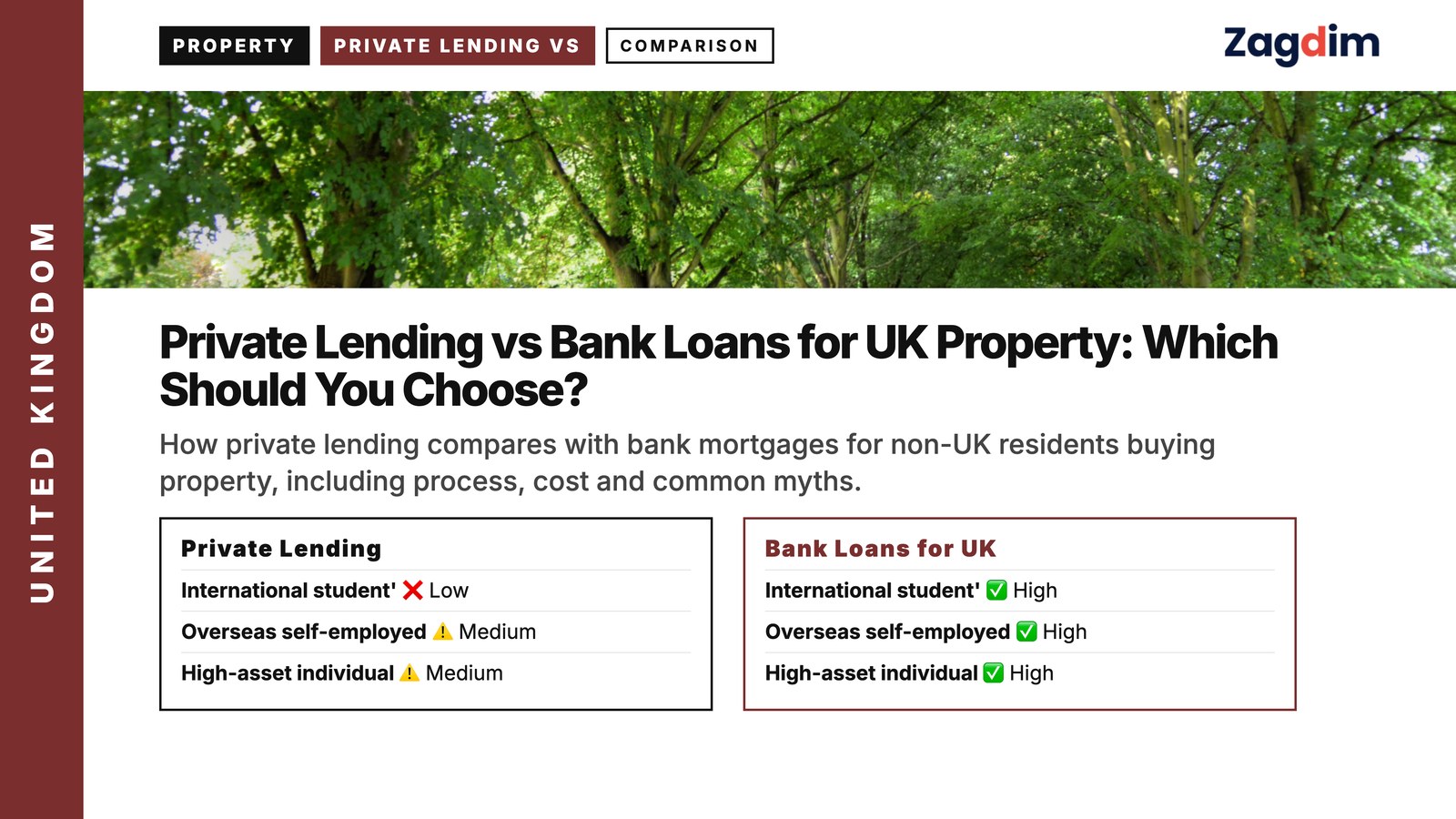
| Application Scenario | Bank Loan Fit | Private Lending Fit | Notes |
|---|---|---|---|
| International student’s parent buying a property | ❌ Low | ✅ High | Struggles to show local income; banks often decline |
| Overseas self-employed / entrepreneur | ⚠️ Medium | ✅ High | Volatile income; strict bank scrutiny |
| High-asset individual allocation | ⚠️ Medium | ✅ High | Sufficient assets but unwilling to commit to the traditional lending process |
| Someone with a UK employment contract | ✅ High | ⚠️ Medium | Banks prefer local income and employment proof |
| Long-term buy-to-let investor | ✅ High | ⚠️ Medium | A bank loan is more cost-effective if rental coverage requirements are met |
If you’re trying to work out which category you fall into, it helps to first clarify your budget and identity status — this will strongly shape which direction suits you. If you’d like help thinking it through, ask Zagdim.
Application Process: Bank vs Private Lending
Once you decide to buy in the UK using borrowed funds, the first real step is entering the application process. Whether you choose a traditional bank or a private lender, the basic steps overlap, but the details and speed differ significantly. Below is a breakdown of both processes to help you plan your timeline and spot the risk points in advance.
1. Bank Loan Process (for a Non-Local Resident)
Step 1: Choose a lending bank and product — generally recommended to use a professional broker to screen products suited to non-resident applicants, alongside an experienced property solicitor for the rest of the process.
Step 2: Provide income and identity evidence — including passport, visa page, tax documents, and proof of overseas income; some documents need certified translation, along with bank statements or accounting records.
Step 3: The bank carries out valuation and underwriting — the bank commissions an independent surveyor to value the property on site, and checks the borrower’s asset background and liabilities.
Step 4: The bank issues the mortgage offer and legal process begins — once approved, the bank issues the mortgage offer, and both parties’ solicitors begin handling the contract, title, and mortgage registration.
Step 5: Drawdown and completion — once all legal steps are complete, the bank releases funds to the solicitor’s account, completing the transaction and title registration.
This usually takes 6–10 weeks; the process is transparent but the documentation requirements are extensive.
2. Private Lending Process: Fast and Flexible, but Costlier
Compared with a bank loan, private lending works more like a commercial agreement — its underwriting standard and speed depend entirely on the lender’s own risk framework and cost of capital.
- Short approval time: some lenders can give initial approval within 3–7 days
- Flexible documentation: little fixed format; overseas asset evidence or trust documents can be accepted as security
- Higher rate and fees: typical annual rates of 6%–10%, plus one-off costs such as a setup fee and valuation fee
Private lending isn’t right for everyone, but for those who need to complete quickly or have been turned down by a bank, it’s a viable — though carefully-considered — alternative route.
FAQ
Q1. Can non-UK residents apply for a UK home loan?
A: Yes. Different banks vary widely in their requirements for non-residents, generally requiring proof of overseas income, a passport and visa copy, and possibly a higher deposit (typically 30%–40%). If bank criteria can’t be met, private lending is also worth considering as an alternative.
Q2. Is a private loan’s rate always higher?
A: In most cases, yes. Private lending rates typically fall in the 6%–10% range or higher, depending on the risk and security involved. But its advantage is faster approval and more lenient documentation, which still makes it useful for buyers a bank can’t accommodate.
Q3. I’m an international student’s parent — can I buy a property for my child and apply for a mortgage?
A: Yes. Many parents buy under a buy-to-let structure and let it out, while it’s actually intended as housing for their child. Because banks treat this scenario as higher risk, it’s worth seeking a broker experienced in non-resident mortgages, or considering private lending depending on the situation.
Q4. Is private lending riskier or subject to more legal risk?
A: As long as you choose a compliant lender and have a solicitor handle the contract terms, private lending is not the same as a “loan shark.” That said, pay particular attention to how interest is calculated, penalty clauses, and the repayment deadline, to avoid disputes later.
Q5. Can I repay early during the loan term?
A: Most bank and private lending products allow early repayment, but usually charge an Early Repayment Charge at a set rate. Confirm the relevant terms before signing to understand your repayment flexibility.
Q6. How long does a UK mortgage typically take to process?
A: A bank loan typically takes 6–10 weeks, depending on underwriting and valuation. Private lending can complete within 1–2 weeks, depending on the lender’s funding arrangement and whether documents are complete.
If your documentation or circumstances are unusual and you’re not sure how they’ll affect your application, ask Zagdim and we’ll help you work out the right direction.
Common Myths and Risk Warnings When Choosing a Loan
Choosing a lending route when buying in the UK can look, on the surface, like simply comparing rates — but in practice, many buyers overlook cost structure and legal risk, which often means their capital is used less efficiently than expected. Below are several common myths and risk points worth knowing, to help you avoid hidden costs and the wrong choice.
1. Private lending ≠ subprime lending: flexible structure doesn’t mean extreme risk
Many people hear “private lending” and think of high risk, black-market money, or even the 2008 subprime mortgage crisis. In reality, the UK’s private lending market today has become considerably more regulated and institutionalized, particularly in high-asset investment circles and development projects, where bridge loans and variable-rate products are now well established.
✅ Tip: rather than judging by the lender’s name, focus on the contract terms and repayment risk.
2. Rate isn’t the only cost — compare the “total cost”
Bank loans generally have a lower headline annual rate (currently mostly 4%–6%), but the process still involves valuation fees, legal fees, a setup fee, and potentially an Early Repayment Charge. Private lending varies more on these items — some lenders set a higher setup fee or additional administrative costs, which can push the actual total burden well above initial expectations.
✅ Watch for: some private lending terms hide late-payment interest or penalty clauses.
➡️ It’s worth having an internationally experienced lending adviser and solicitor review the contract terms in advance.
3. The key reason overseas applicants get rejected: documents and tax structure don’t line up
Many buyers are clearly able to repay, yet still fail bank underwriting. The key is that banks look at verifiable UK income/tax records, not total assets or overseas wealth. So if you’re self-employed, your income is mainly company-based, or you’re based in a low-tax jurisdiction, you can easily be treated as higher risk and declined.
➡️ The solution isn’t to force your way through the bank process, but to choose a lending structure that matches your own circumstances.
If your terms look complicated or the costs keep changing and you’re not sure how to decide, ask Zagdim and we can help break the situation down first.
Conclusion
When buying in the UK, whether for your own use or as an investment, the real question in choosing a lending route isn’t just the rate — it’s how well the overall financing matches your identity and circumstances. For some overseas buyers, a traditional bank loan can be hard to use because of strict underwriting and a long process; private lending, while fast and flexible, comes with a higher rate and potential hidden costs. This isn’t a simple “which is better” choice — it depends on your funding rhythm, transaction timeline and risk tolerance.
If you’re at the evaluation stage and want to know which type of loan best fits your identity and budget, now is a good time to clarify your strategy. Fill in the contact form below, and a professional can help assess your circumstances and match you with the right option, building a solid foundation for your UK property purchase.
Have a question about this guide? Leave a comment below, or ask Zagdim directly.
Your first stop for international property and global living.
Research and insights. Know what’s changing. Understand what matters.
Sources
- Bank of England – *Financial Stability Report (June 2024)*
- IMF – *Global Financial Stability Report (April 2024)*
- OECD – *The Rise of Private Credit Markets (2024)*
- Advias – *Private Bank Mortgage Loans vs Traditional Bank Mortgages*
- Wise – *Mortgage for Foreigners in the UK*
- HSBC – *Mortgages for Non-UK Residents*
- Moneyfacts – *Best UK Residential Mortgage Rates This Week*
- Sprive – *Mortgage Requirements in the UK*
- MHC – *Private Credit: The Risks and Rewards*
- Halifax Intermediaries – *UK Lending Criteria Guide*
This article draws mainly on official financial-institution reports and UK market-platform information from 2023–2024, cross-checked using Perplexity AI. It is for reference only; actual lending terms and legal liability should follow each institution’s latest published guidance.