






























Zagdim Overseas
Subscribe
  • Home
  • Real Estate & Economic News
    • All
    • Japan Market News
    • Other Market News
    • Thailand Market News
    • UK Market News
    • Vietnam Market News
    Singapore's Immigration & Checkpoints Authority (ICA) Commissioner at an official signing ceremony, with the Singapore state crest and national flag in the background

    Singapore Confirms Citizenship Age Threshold and Re-Entry Permit Conditions for PRs

    Matthew Pennycook, Minister of State at the UK's Ministry of Housing, Communities and Local Government, meets with housing-reform stakeholders as the department confirms mandatory property agent licensing and leasehold fee caps

    UK Government Confirms Property Agent Licensing and Leasehold Fee Caps

    A vacant undeveloped residential block in Victoria, Australia, with a developed suburb visible in the distance, illustrating the ATO land-banking enforcement case

    Foreign Investor Fined $508,000 as ATO Tightens Grip on Australian Land Banking

    Facade of Spain's Congreso de los Diputados in Madrid, where lawmakers vote Friday on whether the new housing decree survives

    Spain Approves New Housing Rules, but a Friday Vote Could Undo Them

    A DHS official speaks at the USCIS Headquarters groundbreaking ceremony

    USCIS More Than Doubles EB-5 Investor Visa Fees from 30 November

    The Eccles Building, headquarters of the U.S. Federal Reserve Board in Washington, DC, which released the draft stablecoin reserve and redemption rules

    Fed Proposes Detailed Stablecoin Reserve and Redemption Rules Under GENIUS Act

    Trending Tags

  • Zagdim Insights
    • All
    • Market Trends Overview
    • Policy Interpretation
    • Zagdim Insights
    Automated immigration gates at Suvarnabhumi Airport

    Thailand’s Suvarnabhumi Auto Gates Expand to 33 Nationalities: Full List, Eligibility and TDAC Guide

    1960 archive photo of Queen Sirikit at a gala concert in The Hague, with Bank of Thailand specimens of the THB100 and THB500 commemorative notes

    Thailand’s commemorative banknotes return in October: where to exchange the THB100 and THB500 notes

    Bangkok Aerial — Chao Phraya dusk, illustrating Thailand Joins Global Minimum Tax Information Exchange: What Businesses and Individuals Need to Know

    Thailand joins the global minimum tax information exchange: which businesses need to pay attention, and are individuals affected?

    A 2025 file photo of Australian Home Affairs Minister Tony Burke at a meeting, alongside Zagdim’s analysis title on Australia’s migration reforms.

    Australia announces migration reforms targeting student families, visa switching and longer stays

    China’s Entry-Exit Agency Rules: What Your Business Needs to Prepare. Paper folders labelled Deadlines, Documents and Partners, with a calendar, Chinese gateway and flight route. AI-generated illustration.

    China’s New Entry-Exit Agency Rules: What Your Business Needs to Prepare

    City of London skyline at sunset, illustrating UK New-Build Rules in 2026: Safety Levy, Staircases and the New EPC

    Three UK New-Build Thresholds for 2026: The Building Safety Levy, Second Staircases and the New EPC

    Zagdim Research cover: investigator setting up cameras in an empty Japanese apartment - Japan Prices Death Into Its Housing Market, and Buyers Have Begun to Bite

    Japan Prices Death Into Its Housing Market — and Buyers Have Begun to Bite

    Thailand to Cancel 60-Day Visa Exemption: What Long-Stay Options Are Available for Foreigners?

    Thailand to Cancel 60-Day Visa Exemption: What Long-Stay Options Are Available for Foreigners?

    Thailand Cabinet Approves Cancellation of 60-Day Visa Exemption for 93 Countries; Official Effective Date Still Pending Royal Gazette Publication

    Thailand Cabinet Approves Cancellation of 60-Day Visa Exemption for 93 Countries; Official Effective Date Still Pending Royal Gazette Publication

    • Zagdim Insights
    • Market Trends Overview
    • Policy Interpretation
  • Global Reports
    Zagdim Featured CBRE Thailand Mid-Year Outlook 2026

    CBRE Thailand Mid-Year Outlook: What Is Changing Across Six Real Estate Sectors?

    More Firms, a Busier First Half, a Softer Q2: What Vietnam’s Property Data Show, and Where ‘Repositioning’ Is a Reading

    More Firms, a Busier First Half, a Softer Q2: What Vietnam’s Property Data Show, and Where ‘Repositioning’ Is a Reading

    The Headline Number and the Real One: Reading UK Home Values After Inflation

    The Headline Number and the Real One: Reading UK Home Values After Inflation

    Tokyo’s Property Boom: How to Read AMRO’s ‘Warning, Not a Crisis’

    Tokyo’s Property Boom: How to Read AMRO’s ‘Warning, Not a Crisis’

    A Soft Summer for US Housing: What the Data Show, and Where ‘Hurting’ Is CNBC’s Word

    A Soft Summer for US Housing: What the Data Show, and Where ‘Hurting’ Is CNBC’s Word

    Malaysia’s Property Market Is Getting Choosier — What \”Selective\” Does and Doesn’t Say

    Malaysia’s Property Market Is Getting Choosier — What \”Selective\” Does and Doesn’t Say

    72% at the Top: What Mainland Buyer-Share Data Say About Hong Kong Property — and What They Don’t

    72% at the Top: What Mainland Buyer-Share Data Say About Hong Kong Property — and What They Don’t

    Hong Kong Home Prices Are Up ~10% This Year — but Can the Rebound Last Without Local Owners?

    Hong Kong Home Prices Are Up ~10% This Year — but Can the Rebound Last Without Local Owners?

    193 Deals in Dubai, 94 in Hong Kong: Reading a Super-Prime Quarter Without Calling It a Cycle

    193 Deals in Dubai, 94 in Hong Kong: Reading a Super-Prime Quarter Without Calling It a Cycle

  • Buying & Immigration Guide
    • All
    • Expat Lifestyle Guide
    • International Property Buying Guide
    • Overseas Leasing & Long-Term Stay
    • Real Estate Law & Taxation
    • Relocation, Immigration & Visa
    Five things a first-time overseas buyer must settle before buying in London: entry (SDLT and the two surcharges), financing (interest relief capped at 20%), holding (NRLS and letting compliance), title (leasehold and building safety), exit (NRCGT and your treaty position)

    Is London property worth buying? Five things a first-time overseas buyer must settle first

    Night — Dotonbori canal at night with neon signs, illustrating Japan's 2026 Condominium Law Reform: What Overseas Owners Need to Know

    Japan’s Revised Condominium Ownership Act (2026): What Overseas Owners Need to Know About Voting Rights, Resolutions, and the New Domestic Manager Requirement

    Before You Buy Property in Vietnam: Eligible Assets, Prohibited Categories, and How Land Rights Actually Work for Overseas Buyers

    Before You Buy Property in Vietnam: Eligible Assets, Prohibited Categories, and How Land Rights Actually Work for Overseas Buyers

    Buying Property in London: Key Risks to Check Before You Exchange — Leasehold, Service Charges, Off-Plan Deposits, and Contracts

    Buying Property in London: Key Risks to Check Before You Exchange — Leasehold, Service Charges, Off-Plan Deposits, and Contracts

    Opening a UK Bank Account as an Overseas Resident: Identity, Address, and What to Check Before You Apply

    Opening a UK Bank Account as an Overseas Resident: Identity, Address, and What to Check Before You Apply

    Street lamp under a tree, illustrating Residential Mortgages for Foreign Buyers in the UK: What Lenders Check

    UK Residential Mortgage Readiness for Overseas Buyers: What Lenders Check on Income, Status, and Deposit

    How should overseas owners manage and rent out property in Japan after purchase?

    How should overseas owners manage and rent out property in Japan after purchase?

    The retirees who no longer want to renew their Thai visa every year

    The retirees who no longer want to renew their Thai visa every year

    Same retirement age, different Thailand residence choices: Retirement O, LTR, and Thailand Privilege

    Same retirement age, different Thailand residence choices: Retirement O, LTR, and Thailand Privilege

    Trending Tags

  • About
    • Ask Questions
    • Zagdim Research
    • Contact Us — LINE / WhatsApp
  • 中文 EN
No Result
View All Result
Zagdim
  • Home
  • Real Estate & Economic News
    • All
    • Japan Market News
    • Other Market News
    • Thailand Market News
    • UK Market News
    • Vietnam Market News
    Singapore's Immigration & Checkpoints Authority (ICA) Commissioner at an official signing ceremony, with the Singapore state crest and national flag in the background

    Singapore Confirms Citizenship Age Threshold and Re-Entry Permit Conditions for PRs

    Matthew Pennycook, Minister of State at the UK's Ministry of Housing, Communities and Local Government, meets with housing-reform stakeholders as the department confirms mandatory property agent licensing and leasehold fee caps

    UK Government Confirms Property Agent Licensing and Leasehold Fee Caps

    A vacant undeveloped residential block in Victoria, Australia, with a developed suburb visible in the distance, illustrating the ATO land-banking enforcement case

    Foreign Investor Fined $508,000 as ATO Tightens Grip on Australian Land Banking

    Facade of Spain's Congreso de los Diputados in Madrid, where lawmakers vote Friday on whether the new housing decree survives

    Spain Approves New Housing Rules, but a Friday Vote Could Undo Them

    A DHS official speaks at the USCIS Headquarters groundbreaking ceremony

    USCIS More Than Doubles EB-5 Investor Visa Fees from 30 November

    The Eccles Building, headquarters of the U.S. Federal Reserve Board in Washington, DC, which released the draft stablecoin reserve and redemption rules

    Fed Proposes Detailed Stablecoin Reserve and Redemption Rules Under GENIUS Act

    Trending Tags

  • Zagdim Insights
    • All
    • Market Trends Overview
    • Policy Interpretation
    • Zagdim Insights
    Automated immigration gates at Suvarnabhumi Airport

    Thailand’s Suvarnabhumi Auto Gates Expand to 33 Nationalities: Full List, Eligibility and TDAC Guide

    1960 archive photo of Queen Sirikit at a gala concert in The Hague, with Bank of Thailand specimens of the THB100 and THB500 commemorative notes

    Thailand’s commemorative banknotes return in October: where to exchange the THB100 and THB500 notes

    Bangkok Aerial — Chao Phraya dusk, illustrating Thailand Joins Global Minimum Tax Information Exchange: What Businesses and Individuals Need to Know

    Thailand joins the global minimum tax information exchange: which businesses need to pay attention, and are individuals affected?

    A 2025 file photo of Australian Home Affairs Minister Tony Burke at a meeting, alongside Zagdim’s analysis title on Australia’s migration reforms.

    Australia announces migration reforms targeting student families, visa switching and longer stays

    China’s Entry-Exit Agency Rules: What Your Business Needs to Prepare. Paper folders labelled Deadlines, Documents and Partners, with a calendar, Chinese gateway and flight route. AI-generated illustration.

    China’s New Entry-Exit Agency Rules: What Your Business Needs to Prepare

    City of London skyline at sunset, illustrating UK New-Build Rules in 2026: Safety Levy, Staircases and the New EPC

    Three UK New-Build Thresholds for 2026: The Building Safety Levy, Second Staircases and the New EPC

    Zagdim Research cover: investigator setting up cameras in an empty Japanese apartment - Japan Prices Death Into Its Housing Market, and Buyers Have Begun to Bite

    Japan Prices Death Into Its Housing Market — and Buyers Have Begun to Bite

    Thailand to Cancel 60-Day Visa Exemption: What Long-Stay Options Are Available for Foreigners?

    Thailand to Cancel 60-Day Visa Exemption: What Long-Stay Options Are Available for Foreigners?

    Thailand Cabinet Approves Cancellation of 60-Day Visa Exemption for 93 Countries; Official Effective Date Still Pending Royal Gazette Publication

    Thailand Cabinet Approves Cancellation of 60-Day Visa Exemption for 93 Countries; Official Effective Date Still Pending Royal Gazette Publication

    • Zagdim Insights
    • Market Trends Overview
    • Policy Interpretation
  • Global Reports
    Zagdim Featured CBRE Thailand Mid-Year Outlook 2026

    CBRE Thailand Mid-Year Outlook: What Is Changing Across Six Real Estate Sectors?

    More Firms, a Busier First Half, a Softer Q2: What Vietnam’s Property Data Show, and Where ‘Repositioning’ Is a Reading

    More Firms, a Busier First Half, a Softer Q2: What Vietnam’s Property Data Show, and Where ‘Repositioning’ Is a Reading

    The Headline Number and the Real One: Reading UK Home Values After Inflation

    The Headline Number and the Real One: Reading UK Home Values After Inflation

    Tokyo’s Property Boom: How to Read AMRO’s ‘Warning, Not a Crisis’

    Tokyo’s Property Boom: How to Read AMRO’s ‘Warning, Not a Crisis’

    A Soft Summer for US Housing: What the Data Show, and Where ‘Hurting’ Is CNBC’s Word

    A Soft Summer for US Housing: What the Data Show, and Where ‘Hurting’ Is CNBC’s Word

    Malaysia’s Property Market Is Getting Choosier — What \”Selective\” Does and Doesn’t Say

    Malaysia’s Property Market Is Getting Choosier — What \”Selective\” Does and Doesn’t Say

    72% at the Top: What Mainland Buyer-Share Data Say About Hong Kong Property — and What They Don’t

    72% at the Top: What Mainland Buyer-Share Data Say About Hong Kong Property — and What They Don’t

    Hong Kong Home Prices Are Up ~10% This Year — but Can the Rebound Last Without Local Owners?

    Hong Kong Home Prices Are Up ~10% This Year — but Can the Rebound Last Without Local Owners?

    193 Deals in Dubai, 94 in Hong Kong: Reading a Super-Prime Quarter Without Calling It a Cycle

    193 Deals in Dubai, 94 in Hong Kong: Reading a Super-Prime Quarter Without Calling It a Cycle

  • Buying & Immigration Guide
    • All
    • Expat Lifestyle Guide
    • International Property Buying Guide
    • Overseas Leasing & Long-Term Stay
    • Real Estate Law & Taxation
    • Relocation, Immigration & Visa
    Five things a first-time overseas buyer must settle before buying in London: entry (SDLT and the two surcharges), financing (interest relief capped at 20%), holding (NRLS and letting compliance), title (leasehold and building safety), exit (NRCGT and your treaty position)

    Is London property worth buying? Five things a first-time overseas buyer must settle first

    Night — Dotonbori canal at night with neon signs, illustrating Japan's 2026 Condominium Law Reform: What Overseas Owners Need to Know

    Japan’s Revised Condominium Ownership Act (2026): What Overseas Owners Need to Know About Voting Rights, Resolutions, and the New Domestic Manager Requirement

    Before You Buy Property in Vietnam: Eligible Assets, Prohibited Categories, and How Land Rights Actually Work for Overseas Buyers

    Before You Buy Property in Vietnam: Eligible Assets, Prohibited Categories, and How Land Rights Actually Work for Overseas Buyers

    Buying Property in London: Key Risks to Check Before You Exchange — Leasehold, Service Charges, Off-Plan Deposits, and Contracts

    Buying Property in London: Key Risks to Check Before You Exchange — Leasehold, Service Charges, Off-Plan Deposits, and Contracts

    Opening a UK Bank Account as an Overseas Resident: Identity, Address, and What to Check Before You Apply

    Opening a UK Bank Account as an Overseas Resident: Identity, Address, and What to Check Before You Apply

    Street lamp under a tree, illustrating Residential Mortgages for Foreign Buyers in the UK: What Lenders Check

    UK Residential Mortgage Readiness for Overseas Buyers: What Lenders Check on Income, Status, and Deposit

    How should overseas owners manage and rent out property in Japan after purchase?

    How should overseas owners manage and rent out property in Japan after purchase?

    The retirees who no longer want to renew their Thai visa every year

    The retirees who no longer want to renew their Thai visa every year

    Same retirement age, different Thailand residence choices: Retirement O, LTR, and Thailand Privilege

    Same retirement age, different Thailand residence choices: Retirement O, LTR, and Thailand Privilege

    Trending Tags

  • About
    • Ask Questions
    • Zagdim Research
    • Contact Us — LINE / WhatsApp
  • 中文 EN
No Result
View All Result
Zagdim
No Result
View All Result

How to Set Up a Company in Vietnam as a Foreigner

Home Vietnam
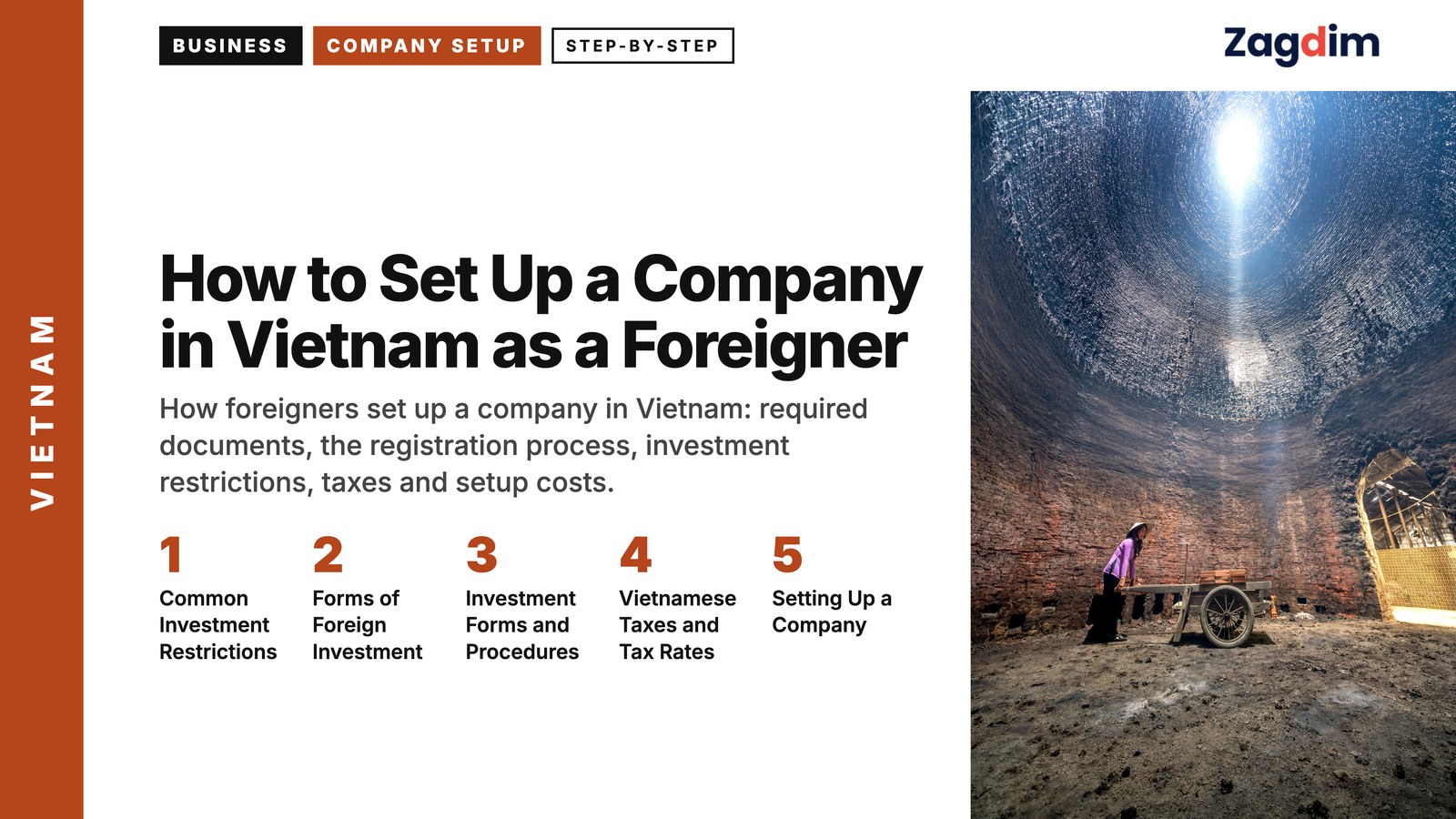
Interior — Interior of brick kiln with worker below, illustrating How to Set Up a Company in Vietnam as a Foreigner

Image: Zagdim

September 29, 2026
in Vietnam
Reading Time: 12 mins read
Tags: Company & Business

Introduction

Vietnam has become one of Southeast Asia’s most closely watched destinations for foreign entrepreneurs looking to build a business. But because of legal and cultural differences, setting up a company in Vietnam as a foreigner still comes with real challenges. Understanding Vietnam’s business environment is key to operating successfully there.

Vietnam’s economic transformation is part of the context. Following two decades of war and economic hardship through the late 1970s and 1980s, the Vietnamese government launched its Đổi Mới (“renovation”) reform and opening-up policy in 1986. More than three decades on, Vietnam has moved from being one of the world’s poorest countries to a middle-income economy, and is now recognized as one of the fastest-growing and most dynamic economies in Asia — and one of the largest recipients of foreign direct investment in the region. According to a global survey of the best countries for expats to live in, Vietnam ranked 18th worldwide; on that survey’s investment-environment dimension specifically, Vietnam scored particularly highly, which is a major reason the country now draws so many new arrivals. Vietnam’s government has also stepped up infrastructure investment and rolled out a number of special incentive policies, making the country a top destination for foreign investors.

Common Investment Restrictions

In practice, foreign capital in Vietnam still faces some restrictions worth noting in advance:

Restrictions on foreign ownership. Vietnam’s current Investment Law is Law No. 61/2020/QH14, effective 1 January 2021. Its Appendix IV lists conditional business lines for foreign investors (widely reported at roughly 220-230 sectors after later trims), some specific to sectors like trading, distribution and logistics services. The list and its conditions are published on Vietnam’s national business registration portal.

Companies operating in a conditional business line must fully meet the applicable conditions (such as minimum capital, foreign-shareholding limits, facility and staffing requirements, and operating licenses). Failure to meet these requirements can result in government penalties and an order to cease operations.

Restrictions by industry. Some industries require separate approval from different ministries — for example, banking requires approval from the State Bank of Vietnam, while education, construction and real estate require approval from other relevant ministries. Different provinces may also offer different incentives to encourage investment.

In recent years, Vietnam’s government has prioritized foreign investment in the following directions:

  • Projects that apply “high, new and clean technology,” use a high proportion of domestically produced materials and components, show a high ratio of domestic R&D spending, and commit to technology transfer and on-the-job training
  • Joint ventures or co-production arrangements between foreign and domestic enterprises
  • Multinational companies with a global brand and strong competitiveness, and foreign companies engaged in supporting industries

Forms of Foreign Investment

Foreign investors in Vietnam can invest either directly or indirectly.

Direct Investment Indirect Investment
Establishing a new legal entity as a limited liability company (LLC) or a joint-stock company (JSC) Buying shares, stocks, bonds and other securities traded on the stock exchange
Investing through a contractual agreement Investing through a securities investment fund
Signing a business cooperation contract with a local or other foreign investor Investing through another financial intermediary
Signing a public-private partnership contract with a Vietnamese government body —
Investing by acquiring shares or capital in an existing entity —

Investment Forms and Procedures

The procedure differs depending on the form of investment. The statutory timeframes below refer to government processing time only, and do not include the time needed to prepare documents or any practical delays.

Investment Form Procedure Licensing Authority Statutory Timeframe Notes
Establishing a legal entity (1) Apply for an Investment Registration Certificate Provincial Department of Planning and Investment / Investment Registration Division; Special Zone Management Board 15 days Where the investment project has a major economic or social impact, it must first receive in-principle approval from the National Assembly, the Prime Minister or the provincial People’s Committee before the Investment Registration Certificate can be issued
Establishing a legal entity (2) Apply for an Enterprise Registration Certificate Provincial Department of Planning and Investment / Investment Registration Division 3 working days —
Business cooperation contract (1) Apply for an Investment Registration Certificate Provincial Department of Planning and Investment / Investment Registration Division; Special Zone Management Board 15 days Same major-impact approval rule as above applies
Business cooperation contract (2) Apply for a Business Registration Certificate with the foreign investment office Provincial Department of Planning and Investment / Investment Registration Division 15 days —
Public-private partnership contract (1) Approve the investment proposal Ministry of Planning and Investment and provincial People’s Committees 30 days —
Public-private partnership contract (2) Feasibility assessment National Appraisal Council, or an assessor appointed by the provincial People’s Committee chair 30–90 days —
Public-private partnership contract (3) Apply for an Investment Registration Certificate Ministry of Planning and Investment or provincial People’s Committees 25 days —
Public-private partnership contract (4) Apply for an Enterprise Registration Certificate Provincial Department of Planning and Investment or provincial People’s Committees 3 working days —
Investment via share or capital subscription (1) Apply for approval to purchase shares or capital Provincial Department of Planning and Investment / Investment Registration Division 15 working days Applies where: (1) the target company’s business line is a conditional sector for foreign investors, or (2) the transfer would raise the target company’s foreign ownership above 51%
Investment via share or capital subscription (2) Apply to update shareholder/member information Provincial Department of Planning and Investment / Investment Registration Division 3 working days —
Investment via share or capital subscription (3) Apply to update investor information Provincial Department of Planning and Investment / Investment Registration Division 3 working days —

Vietnamese Taxes and Tax Rates

Foreign investors in Vietnam face tax obligations regardless of which business structure they choose. There are four common taxes to be aware of:

  • Corporate income tax: applies to any organization operating a business in Vietnam that earns taxable income. Exemptions are available, and certain expenses can be deducted from taxable income. The standard rate is 20%; preferential rates of 17%, 15% and 10% apply in some cases; other rates (such as for oil and gas operators) run from 32% to 50%.
  • Value-added tax (VAT): levied on the value added at each stage of the production and distribution chain, with four rate tiers:
    • *Exempt*: applies to, among others, 26 categories including certain agricultural products, salt products, transfer of land-use rights, life insurance, finance, healthcare, public postal and telecom services, culture-related construction work, education and training, broadcasting, publishing, mass transit, temporarily imported goods for re-export, technology transfer, and export of unprocessed natural resources.
    • *0%*: applies to exported goods and services, goods and services consumed outside Vietnam or in non-tariff zones, goods processed for export or domestic export, goods sold to duty-free shops, certain export services, construction and installation for export-processing enterprises, and air, sea and international transport services.
    • *5%*: applies to specific essential goods and services, including clean water, fertilizer, agricultural activities, agricultural products and equipment, unprocessed food seasonings, medical and educational equipment, and scientific and technical services.
    • *10%*: the standard rate.
  • Personal income tax, 5% to 35%: tax residents are taxed on worldwide income at these progressive rates, while non-residents are taxed at a flat 20% on Vietnam-sourced income.
  • Foreign Contractor Tax (FCT): a combined CIT (0.1%-10%, depending on business line) plus VAT (2%-5%) withholding on Vietnam-sourced income of foreign contractors without a Vietnamese legal entity; the calculation basis changed under Circular 20/2026/TT-BTC, effective 12 March 2026.

Companies must also submit annual audited financial statements to the relevant state authorities, including the tax authority, the planning and investment department, the statistics department and the finance department. Tax filings and audited financial statements must be submitted on time to avoid penalties, so it is worth engaging an accountant in advance to prepare the company’s books and financial statements before the audit.

Common Questions About Investing in Vietnam

Foreign Investment Projects Require Prior Approval

Although Vietnamese law provides for equal treatment between foreign and domestic investors, foreign investors must still comply with different business licensing requirements and related restrictions. The government bodies involved in foreign investment include the Ministry of Planning and Investment, the Ministry of Industry and Trade, the Ministry of Finance, the Ministry of Natural Resources and Environment, the Ministry of Construction, and the State Bank of Vietnam. People’s Committees, industrial-zone management boards and provincial economic zones are the main bodies responsible for registering foreign investment.

Vietnam currently maintains a number of restrictions on foreign investors, mainly covering: limits on foreign ownership ratios; industry restrictions; specific investment requirements; geographic restrictions; and requirements on the qualifications of local partners. Depending on the industry, scale and impact of the investment project, registration may require approval from the National Assembly, the Prime Minister or a provincial People’s Committee.

Restrictions on Industry Access

Under the new Investment Law, Vietnam takes a “negative list” approach to foreign investment: for industries not on the negative list, foreign investors receive the same treatment as Vietnamese investors. As a result, both foreign and domestic private entities have the right to establish and own businesses in Vietnam and to legally operate in areas not subject to government restriction on foreign investment — although Vietnam still retains a considerable number of industry-specific restrictions for foreign investors. Investing in a particular restricted industry requires the relevant regulator’s approval — for example, telecoms investment may require an assessment from the Ministry of Information and Communications, and power-sector investment may require an assessment from the Ministry of Industry and Trade.

Vietnam’s National Security Review Regime

The new Investment Law introduced a national security review regime: any investment activity that poses, or could pose, a threat to Vietnam’s national defense or security may be suspended, halted or terminated. In addition, for M&A transactions involving entities with rights over land on islands, at the border, or in coastal areas, the Investment Law adds a new prior-approval requirement to safeguard national defense and security. Because the Investment Law does not clearly define “national defense and security,” enforcement bodies retain considerable interpretive latitude in practice, so some uncertainty remains for foreign investment.

Restrictions on Foreign Investors’ Land-Use Rights

In Vietnam, land is owned by the state and the collective, so neither local citizens nor foreigners can obtain legal ownership of land. Foreigners can only obtain a Land Use Right Certificate (LURC), representing a right to use the land. The LURC obtained by a foreigner has a maximum term of 50 years, after which it may be renewed or the land reclaimed by the government. Foreigners can choose to pay land rent annually or in a single lump sum; with a lump-sum payment, the foreigner is permitted to sublease, mortgage or sell the land and the assets attached to it.

Foreign investors cannot directly acquire land. They must first establish a legal entity in Vietnam (a “project company”), which then signs a formal land lease agreement with the lessor and applies to the government for a Land Use Right Certificate. In practice, once a foreign investor identifies a suitable project site, they typically sign a memorandum or a letter of offer with the land lessor.

For foreign investors, investing in Vietnam — especially acquiring equity in a local company or carrying out a large infrastructure project — requires attention to potential land disputes, including the risk of being unable to renew a land-use right upon expiry, whether the land’s designated use (such as urban residential, industrial-park, or commercial and services land) fits the specific project, and whether the land type matches the intended investment purpose.

Foreign Exchange Considerations

Vietnam requires domestic transactions to be conducted in Vietnamese dong. Foreign exchange is tightly regulated. While the Vietnamese government does allow foreign investors to make capital contributions and remit legitimate profits and other lawful investment income through authorized foreign-exchange institutions, investors often encounter difficulties due to lengthy government approval processes — for example, being asked to provide supporting documents (audited financial statements, contracts for imported goods or services purchased from abroad, tax payment certificates, etc.), or being required to complete tax and other fiscal obligations as a precondition for remitting funds. The State Bank of Vietnam also requires foreign investors to submit a profit-remittance notice to the tax authority at least seven working days before remitting funds.

Setting Up a Company: Documents, Steps and Costs

Documents Foreigners Need to Prepare

  1. A valid passport
  2. Proof of funds: showing, via a bank account balance or savings book, that the investor holds the corresponding amount to be invested in Vietnam
  3. Office address: a property or office lease agreement in Vietnam, to register the company’s headquarters
  4. A business plan

The Basic Process for Foreigners Setting Up a Company

Setting up a company in Vietnam is not a complicated process. Following these steps helps ensure your business activities in Vietnam get off to a smooth start.

1. Decide on the business type. Before setting up a company in Vietnam, you should decide what type of business you plan to run — different business types are subject to different rules and requirements under Vietnamese law, including investment restrictions and conditions. You can choose to set up:

1) A wholly foreign-owned LLC (100% foreign-owned company in Vietnam)
2) A partly foreign-owned LLC (a Vietnam joint-venture company)

A 100% foreign-owned company is very difficult to get approved and requires meeting a number of conditions. For that reason, it is often more practical to register as a joint-venture-type company first, using a local nominee owner to set up the company before transferring it to the foreign investor once formation is complete. Ask Zagdim if you would like guidance on this route.

2. Choose a company name. Foreigners must follow Vietnam’s legal rules when choosing a company name, ensuring the name does not duplicate an existing company and is consistent with business ethics.

3. Prepare an investment plan. Setting up a company in Vietnam requires an investment plan, which should include the company’s business objectives, expected income and expenditure, and the source of investment funds. This plan is used later in the registration process.

4. Find a partner (where required). Under Vietnamese law, foreigners in certain business areas — such as financial services and education — need to partner with a local counterpart. Finding a reliable partner is critical to running the business successfully.

5. Apply for registration. Once preparation is complete, you can apply to register the company with the Vietnamese government. You will need to submit the required documents, including the company charter, investment plan, cooperation agreement (if applicable) and shareholder documentation.

6. Obtain the license. The Vietnamese government reviews the application documents and, after assessment, decides whether to issue a license. Once the license is granted, you can formally begin business operations in Vietnam.

Costs of Registering a Company in Vietnam

If you plan to register a company in Vietnam, there are a number of additional costs to consider beyond the registration cost itself, such as filing fees and office rental. While these extra costs are relatively low individually, they are still worth budgeting for.

  1. Registered capital: the minimum registered capital for a limited liability company is USD 100,000; for a joint-stock company, the minimum is USD 300,000.
  2. Company name search fee: registering a company in Vietnam requires a search to confirm the proposed name is not already registered; this fee is VND 1,000,000.
  3. Company registration fee: covers preparation of the company charter, shareholder list, and board member list, among other documents; generally around VND 5,000,000.
  4. Business license fee: obtaining the business license requires a fee, generally around VND 1,000,000.
  5. Tax registration fee: after registering the company, tax registration is required, at a cost of around VND 1,000,000.
  6. Office lease cost: after registration, the company needs to lease office premises; the rental cost varies by location and floor area.

Advantages of Buying Property Under a Company Name in Vietnam

  1. Legal and tax advantages: buying property under a company name can bring certain legal and tax benefits — for example, the company may be able to access a lower tax rate or more flexible tax arrangements.
  2. Fund management and financing: buying property under a company name allows better management and control of funds; the company can more conveniently use its own capital or bank financing to make the purchase.
  3. Asset protection: putting property under a company’s name can offer better asset protection. If you buy property under your personal name, your personal assets could be exposed if a legal dispute or other risk arises. Holding property under a company name keeps the property separate from personal assets, lowering personal risk.
  4. Succession and transfer: buying property under a company name can make succession and transfer easier. If you plan to pass the property to the next generation as a family asset, or sell it to another investor, a corporate structure can offer a simpler, more convenient process.

Summary

Registering a company in Vietnam, and buying property under that company’s name, both come with a number of advantages and potential opportunities. Registering a company allows you to operate a business in Vietnam and benefit from relevant legal and tax incentives. Buying property under a company name can offer better asset protection and management, and simplify succession and transfer procedures. As a dynamic and promising market, Vietnam offers considerable room to achieve your business goals and grow your investment. That said, it is essential to comply with local laws and regulations, and to consult a professional before making decisions, to ensure you are working from accurate information.

Related in this series:

  • Vietnam Property Law for Foreign Buyers: What You Can and Cannot Buy
  • Health Insurance for Foreigners in Vietnam: Your Options
  • Vietnam New-Build Inspection Checklist for Foreign Buyers
  • Can a Foreign Company Own Real Estate in Vietnam?

Have a question about this guide? Leave a comment below, or ask Zagdim directly.

Life abroad? Ask Zagdim.

Your first stop for international property and global living.

Research and insights. Know what’s changing. Understand what matters.

Zagdim AI
All content is researched, written, or authorized for publication by the @Zagdim Overseas team. Sharing and reposting are welcome, but please make sure to credit the source and include the original article link from this website. Any plagiarism or unauthorized use may result in legal action. For article submissions, please contact us via Facebook. Thank you for your support!

For article submissions, press release publication, or interview notices, please contact [email protected]. 

Zagdim Ask

Have a specific question about overseas living, property, visa, or practical arrangements?

Fill in your situation and key concerns through Zagdim Ask. Our team will review your message and get back to you by email where appropriate.

Submit your enquiry →

Similar Topics

Singapore's Immigration & Checkpoints Authority (ICA) Commissioner at an official signing ceremony, with the Singapore state crest and national flag in the background
News

Singapore Confirms Citizenship Age Threshold and Re-Entry Permit Conditions for PRs

October 1, 2026
Matthew Pennycook, Minister of State at the UK's Ministry of Housing, Communities and Local Government, meets with housing-reform stakeholders as the department confirms mandatory property agent licensing and leasehold fee caps
News

UK Government Confirms Property Agent Licensing and Leasehold Fee Caps

October 1, 2026
A vacant undeveloped residential block in Victoria, Australia, with a developed suburb visible in the distance, illustrating the ATO land-banking enforcement case
News

Foreign Investor Fined $508,000 as ATO Tightens Grip on Australian Land Banking

October 1, 2026
Next Post
Market — Woman selling yellow flowers at floating market, illustrating Vietnam Property Law for Foreign Buyers: What You Can and Cannot Buy

Vietnam Property Law for Foreign Buyers: What You Can and Cannot Buy

Market — Vendors on boats loaded with market produce, illustrating Vietnam Tax Residency for Foreigners: Rules and Reporting Obligations

Vietnam Tax Residency for Foreigners: Rules and Reporting Obligations

Rural — Green rice terraces on hillside near Sapa, illustrating Signing a Rental Contract in Vietnam: Terms, Deposits, Disputes

Signing a Rental Contract in Vietnam: Terms, Deposits, Disputes

Facebook Twitter Youtube

About Us

Zagdim is a global knowledge platform focused on cross-border property, relocation, lifestyle, and location-based decision-making.

We provide insights on overseas real estate, market trends, regional analysis, economic developments, and practical relocation information. Through continuous market observation and on-the-ground research, Zagdim helps readers better understand a place before deciding where to live, invest, buy property, or establish a base abroad.

We currently follow markets including the UK, Japan, Thailand, Malaysia, Germany, Australia, the UAE, Greece, Portugal, and Spain, while continuing to track emerging lifestyle, relocation, and property trends worldwide.

Category

  • Australia
  • Buying & Immigration Guide
  • Cambodia
  • Canada
  • Costa Rica
  • Dubai
  • Encyclopedia
  • Europe
  • Expat Lifestyle Guide
  • Germany
  • Global Reports Analysis
  • Hong Kong
  • Human-Picked
  • Indonesia
  • International Property Buying Guide
  • Japan
  • Japan Market News
  • Kenya
  • Living Abroad
  • Malaysia
  • Mallorca
  • Market Trends Overview
  • News
  • Other Market News
  • Overseas Leasing & Long-Term Stay
  • Philippines
  • Policy Interpretation
  • Portugal
  • Property
  • Property Law & Tax
  • Real Estate & Economic News
  • Real Estate Law & Taxation
  • Relocation, Immigration & Visa
  • Singapore
  • South Korea
  • Spain
  • Switzerland
  • Thailand
  • Thailand Market News
  • UK Market News
  • United Kingdom
  • United States
  • Vietnam
  • Vietnam Market News
  • Visa & Immigration
  • Zagdim Insights
  • Zagdim Property Insights

Email:[email protected]


Add Friends


WhatsApp
Contact Us


Wechat:Zagdim

Work with Zagdim

Put your brand inside the overseas property research process — in English and in Chinese. Reaching buyers, expats and investors across 19 markets.

View partnership packages →

©2026 Zagdim Overseas All Right Reserved

No Result
View All Result
  • Home
  • Zagdim Property Insights
    • Market Trends Overview
    • Policy Interpretation
    • Forest
    • PLACEHOLDER sub-cate for Zagdim Property Insights
  • Global Reports Analysis
    • In-Depth Project Analysis
  • Real Estate & Economic News
    • Thailand Market News
    • UK Market News
    • Germany Market News
    • Japan Market News
  • Buying & Immigration Guide
    • Expat Lifestyle Guide
    • Real Estate Law & Taxation
    • Overseas Leasing & Long-Term Stay
    • Starting a Business & Company Setup
  • Zagdim Ask
  • 中文 EN

©2026 Zagdim Overseas All Right Reserved