






























Introduction
In recent years, Vietnam has become a new hotspot for foreign capital allocation, thanks to steady economic growth, a demographic dividend and its strategic position in the region. Multinational corporations, family offices and high-net-worth investors alike are increasingly turning their attention to this emerging market, looking for long-term opportunities in real estate and infrastructure.
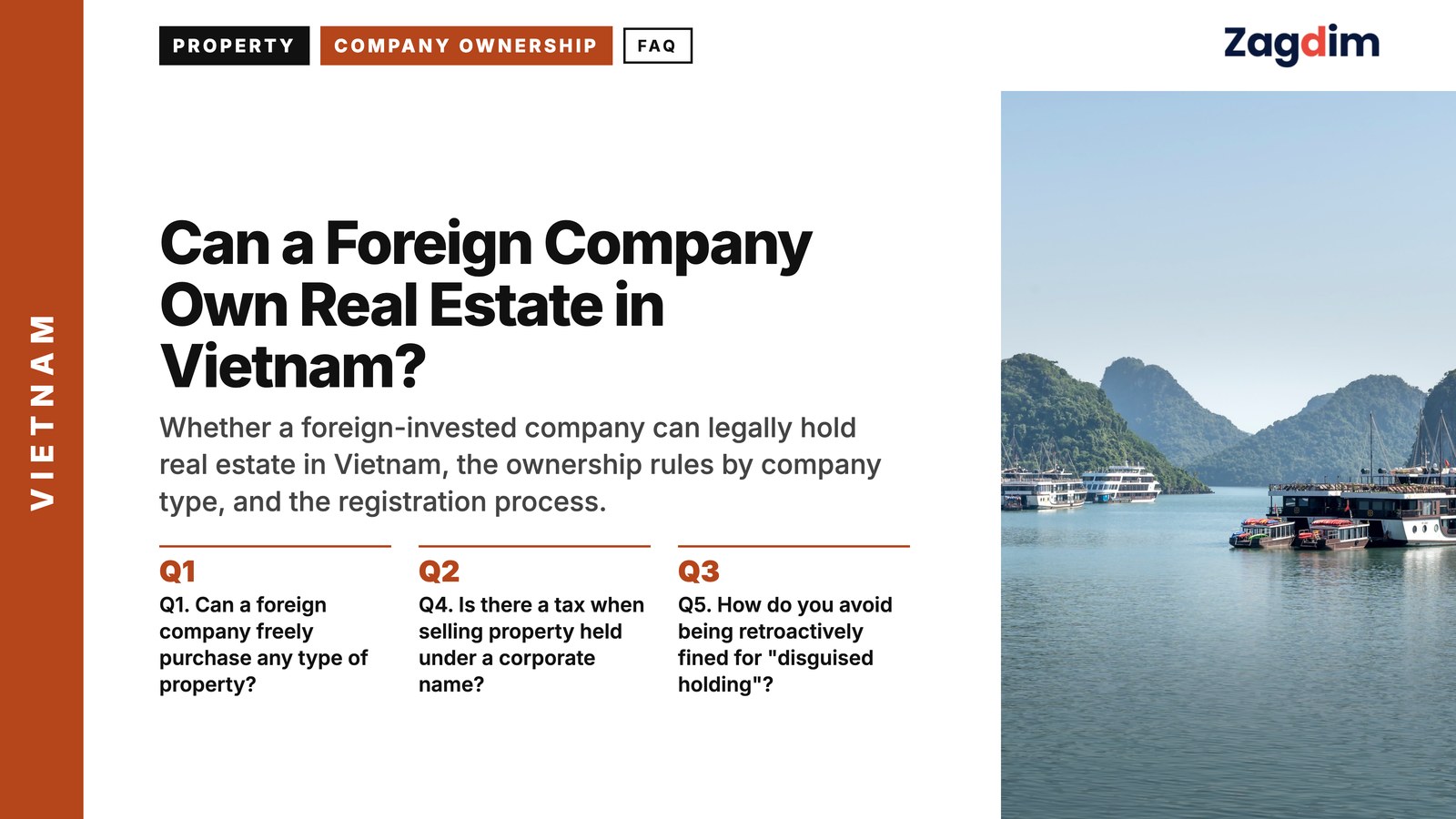
But as capital inflows accelerate, a practical question is coming into focus: can a foreign-invested company legally hold real estate in Vietnam under its own corporate name? This question is not just about compliance — it also affects future asset allocation, tax planning and exit strategy.
Who Qualifies
Before considering buying Vietnamese real estate under a corporate name, it is essential to clarify a key point first: not every foreign-invested company can directly hold real estate assets. Specific eligibility depends on the company type, ownership structure, intended use of the asset, and geographic restrictions.
1. Company Types: Foreign Legal Entity vs. Foreign Joint Venture vs. Vietnamese Local Entity
Vietnam draws a clear distinction between company types:
- Foreign legal entity (100% foreign-owned company): subject to the strictest restrictions, generally only able to purchase real estate for its own office use, and must comply with the Investment Law and the Land Law.
- Foreign joint venture: if the foreign shareholding is below 51%, conditions closer to those for a local company may apply in some cases, but case-by-case approval is still required.
- Vietnamese local entity (wholly domestically owned): free to purchase land and property without foreign-ownership conditions, though if the shareholders behind it are foreign, it may still be subject to substantive review.
Tip: the difference in property-holding rights between a 100% foreign-owned company and a joint venture is significant, so it is essential to plan the capital structure precisely from the outset, or it will directly affect your future freedom to allocate assets.
| Company Type | Property-Holding Rights | Special Restrictions |
|---|---|---|
| Foreign legal entity (100% foreign-owned) | Limited to approved uses such as own-use office space | Must pass land-use rights review; restrictions on subletting and trading |
| Foreign joint venture (foreign ownership ≤50%) | Can hold certain property types similarly to a local company | Joint-venture agreement and substantive business activity are reviewed |
| Vietnamese local entity (wholly domestic) | Free to purchase land and property | Still subject to compliance review if the real controller is foreign |
2. Use Restrictions: Own-Use Office and Specific Approved Investment Projects
Even where the company type qualifies, the permitted use of any property purchased is also tightly restricted:
- Mainly permitted as own-use office space (such as setting up a representative office or a regional headquarters)
- In specific cases, may be purchased as part of an approved investment project (such as industrial-park development or hotel operation)
- Foreign companies are prohibited from using property purchases mainly for resale or short-term leasing as a business model — violators may have their land-use rights revoked
3. Geographic Restrictions: Strategic Areas and Agricultural Land
For reasons of national defense and food security, Vietnam also sets clear geographic limits on foreign real estate purchases:
- Strategically sensitive areas (such as those near borders or military bases) are entirely off-limits to foreign ownership
- Agricultural land is, in principle, only available for lease, not purchase
- In major cities (such as Ho Chi Minh City and Hanoi), specific locations still require case-by-case approval, particularly for large residential or mixed-use developments
If you are not sure whether your current company structure meets Vietnam’s purchase conditions, it is worth getting advice first to avoid a hold-up later in the process — ask Zagdim.
The Process: General Steps for Buying Under a Corporate Name
Even where a company qualifies, buying real estate under a corporate name in Vietnam still requires following a clear, multi-layered review process. Understanding and planning for each stage helps significantly reduce procedural delays and legal risk.
Step 1: Company Formation and Registration (Business Scope Must Be Specified)
First, the foreign investor must complete company formation in Vietnam, and clearly state the business scope in the company charter and the Enterprise Registration Certificate (ERC). If real estate activity (even for own use) is not indicated, the purchase process will run into obstacles later.
Step 2: Apply for Investment Project Approval (If Required)
If the property purchase forms part of a specific investment project (such as building an office tower or setting up an industrial park), a separate Investment Registration Certificate (IRC) application and other departmental approvals are required. For some industries or locations, dual approval from both the local government and the Department of Planning and Investment (DPI) may be required.
Step 3: Sign the Purchase Contract (Subject to Foreign-Eligibility Review)
Once eligibility is confirmed, you can sign the purchase contract with the seller. This stage generally requires a lawyer’s review to ensure the contract terms comply with foreign-company purchase rules, and to avoid the title registration being rejected because of formatting or condition issues.
Step 4: Complete Title Registration (Limited to Property Within the Permitted Scope)
After signing the purchase contract, you must apply to the Ministry of Natural Resources and Environment (MONRE) for title registration (the Land Use Right Certificate, or LURC). Note that a foreign company can only register property that it is legally permitted to hold — a purchase outside that scope may not be able to obtain a certificate.
Step 5: Ongoing Management and Annual Filing
After title registration is complete, the foreign company must fulfill annual obligations including tax filing and reporting on the property’s use, and ensure that actual use matches the registered use. Any change of use, subletting or resale plan must also be reported in advance.
Tip: not every property developer is willing to sell units to a foreign company, especially in popular downtown residential projects. Confirming eligibility and communicating in advance is critical to avoid ending up with a restricted title after signing.
FAQ
Q1. Can a foreign company freely purchase any type of property?
No. A foreign company can only purchase specific-use real estate that complies with Vietnam’s Land Law, Housing Law and Real Estate Business Law — mainly limited to own-use office space or an approved investment project. General residential property, agricultural land and certain strategic areas are not open to direct purchase by foreign companies.
Q2. Does buying under a corporate name require a separate investment certificate?
It depends. If the property purchased forms part of an investment project (such as setting up an industrial base or a hotel project), an Investment Registration Certificate (IRC) is required. If it is purely for own-use office space, some regions may allow the general company-registration process instead — check the requirements with the local government.
Q3. Can residential-type property be held under a corporate name and rented out?
In principle, no. Vietnamese law does not allow a foreign company to purchase residential property purely for rental purposes, unless the company is approved to operate a real estate leasing business and meets specific industry-licensing conditions. Renting in breach of this can lead to heavy fines and revocation of land-use rights.
Q4. Is there a tax when selling property held under a corporate name?
Yes. Selling real estate held under the company’s name is subject to capital gains tax (generally around 20% of the transaction amount) and must be reported under the Tax Administration Law. International transfers also require special attention to double-taxation treaties and foreign-exchange controls.
Q5. How do you avoid being retroactively fined for “disguised holding”?
Make sure company formation, purchase and registration are fully legal, and that the actual use matches the registered use. Avoid disguised joint ventures or nominee shareholding as workarounds, and regularly update shareholder structure and operating documents to avoid being found in violation during an audit.
Q6. Can I use a subsidiary to hold multiple properties?
Yes, but each subsidiary must independently satisfy the relevant formation conditions and use restrictions. A parent company cannot use a single license to freely purchase different types of property across subsidiaries without case-by-case review — every purchase must comply with local regulations.
Q7. What happens to property under a company’s name if the company is dissolved?
On dissolution, the company must liquidate its assets according to law, including disposing of any property under its name. The property may be sold and taxes settled, with the remaining assets distributed; if it cannot be sold, it must be transferred or turned over to the state treasury under local statutory procedure. Specifics are handled under Vietnam’s Bankruptcy Law and Enterprise Law.
Points to Note
Even after a foreign company has completed registration and the purchase process, a deviation in the details can still lead to an invalid title, heavy fines or forced disposal. Here are the most common, and most easily overlooked, high-risk pitfalls:
1. “Registered in the Company’s Name” Does Not Equal “Legal Ownership”
Many foreign companies mistakenly assume that completing purchase registration under the company’s name automatically means full ownership. In fact, Vietnam’s land and property system runs on the concept of “land use rights” — a foreign company must satisfy both the Investment Law and the Land Law together to obtain genuinely legal holding status. A company purchase registration that has not gone through the proper approval process may be treated as an invalid transaction.
2. Avoid Workarounds That Sidestep Foreign-Ownership Limits (Such as a Sham Joint Venture)
To get around foreign-ownership limits, some companies use a local individual as a nominee or set up a sham joint venture to purchase property. This kind of “nominee holding” arrangement, once discovered by the authorities, can lead to title revocation, heavy fines or even criminal liability. Enforcement is becoming stricter, particularly in cities where property values are rising quickly, making this workaround increasingly risky.
3. Rules Vary Significantly Between Cities (Ho Chi Minh City vs. Hanoi vs. Haiphong)
Approval details and restriction levels for foreign real estate purchases differ across Vietnam:
- Ho Chi Minh City: the most active core-area property market, with the strictest approval standards, particularly detailed scrutiny of residential use.
- Hanoi: somewhat more open toward commercial land and office space, but still requires case-by-case reporting.
- Haiphong and other industrial cities: relatively favorable toward industrial land and logistics facility investment, but still conservative on residential use.
Holding rules vary by city in the details — getting ahead of the regulations early reduces future risk. Still looking for clear direction on your situation? Ask Zagdim.
Summary
Buying real estate under a corporate name in Vietnam is undoubtedly one of the key strategies for asset allocation, tax optimization and international structuring. But the path is not simple — from company formation and use approval to title registration and ongoing management, every step is bound by strict rules and use restrictions. If you are considering holding Vietnamese property under a foreign company’s name, it is best to start from your own circumstances and long-term asset goals, and work with a professional team to plan the structure and process best suited to you, so you can achieve compliance, security and flexibility at the same time.
If you would like to learn more about which property structure suits you, fill out the contact form below and a specialist can help you analyze it in depth.
Have a question about this guide? Leave a comment below, or ask Zagdim directly.
Your first stop for international property and global living.
Research and insights. Know what’s changing. Understand what matters.
Sources
- Freshfields — Vietnam Land Law 2024: Key Changes from M&A/Foreign Investment Perspectives
- Allen & Gledhill — VNKH Clarifies Rules on Foreign Ownership and Raising Capital in New Law on Residential Housing
- Vietnam Investment Review — Clarifying Rules on Foreign Property Ownership
- Vietnam Briefing — Vietnam Housing Law Draft Decree Guidelines on Foreign Property Ownership
- Bross & Partners — Updates on New Regulations of Real Estates
- PwC Vietnam — Amended Law 2024 Summary
- Baker McKenzie — Vietnam Real Estate Legal Updates 2024