




























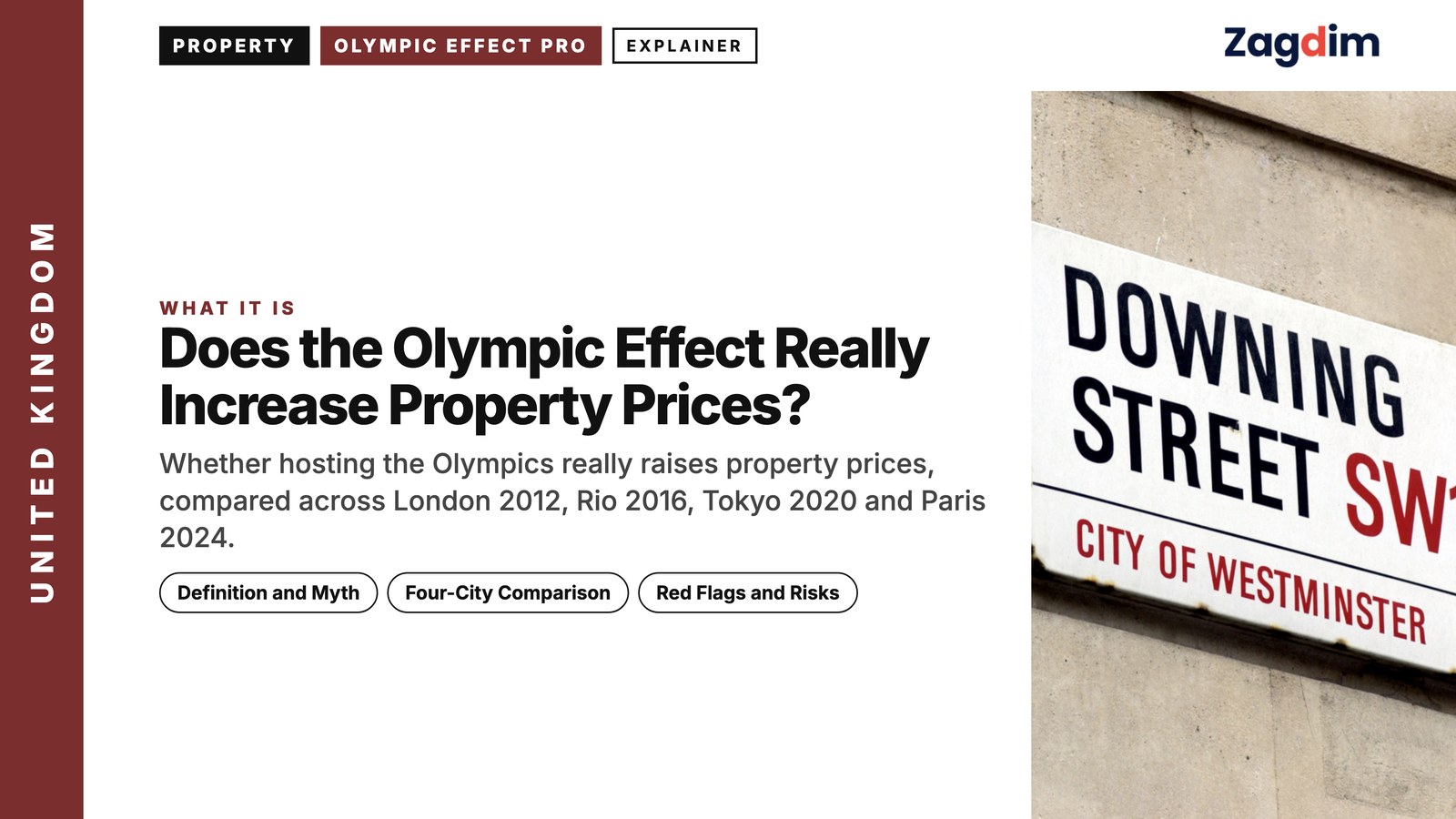
Does Winning an Olympic Bid Mean Property-Price Growth?
When a city successfully wins the right to host the Olympics, the same topic always resurfaces in real-estate investment circles: “Will prices here go up?” This phenomenon is called the “Olympic effect” — a logic of anticipated appreciation built on large-scale infrastructure, urban regeneration and global media exposure. It is not just short-term speculation around a real-estate hotspot; it also carries the imagination of a city’s future: new subway lines, new venues, new communities — everything seems to catalyze the possibility of turning an asset into cash.
But is this effect a general rule, or a local story that only holds under specific conditions? Does the Olympics bring lasting urban dividends, or only a brief illusion of capital? To really understand this “Olympics × property prices” city game, we need to go back to the real data and institutional design of past host cities and take it apart from there.
Let’s look at four key cities — London, Rio, Tokyo and Paris — and the very different “Olympic effects” each of them experienced.
Definition and Myth: Is the Olympic Effect a Driver of Appreciation, or a Housing-Market Illusion?
From an urban-planning perspective, the Olympics genuinely brings three kinds of asset upside: first, infrastructure, such as new subway lines and reworked roads and ports; second, media exposure, which introduces the city to global capital afresh; and third, city rebranding, packaging older areas as the start of a “new vision of living.”
But not every area benefits equally. Historical experience shows that only areas with a long-term development plan, located at transport hubs and within a reasonable commute of the main Olympic venues, are likely to see sustainable appreciation. For example, London’s Stratford took off because it connects to Crossrail, while Tokyo Bay’s Harumi Flag has had its resale potential limited by being a transport island.
So why is the “Olympic effect” so often overhyped? It comes from the convergence of three narrative forces: the international-stage feel amplified by the media, short-term speculative sentiment in the property market, and the vision of prosperity that local governments create, wittingly or not. Once the news of a successful bid breaks, many investors rush in, trying to “cash in on the future” ahead of time — yet real asset growth is usually unrelated to the opening ceremony date, and instead depends on what the city has left behind once the games are over.
Four-City Comparison: One Olympics, Four Different Fates
A. London 2012: Urban Renewal Transformed the East End
Before the Olympics, London’s Stratford was seen as synonymous with old industrial decline and social disadvantage. But starting from the successful 2005 bid announcement, government and private capital launched large-scale redevelopment. By 2015, property prices in the Stratford area had grown more than 70% compared with 2005, while neighboring areas such as Hackney Wick recorded an increase of over 200%.
This turnaround came from three forces: the Olympic Village being converted into a residential community (East Village), Crossrail joining to significantly shorten commute times, and the economic pull of the Westfield shopping centre and the Here East digital campus. This model has been hailed as a successful example of “public planning × private capital,” and it moved East London from the margins into a new hub for young professionals and creative communities.
B. Rio de Janeiro 2016: Unfinished Projects and Social Division
By contrast, Rio’s story is a cautionary tale. Before the opening ceremony, Rio had attracted heavy investment betting on port-area redevelopment and infrastructure projects, but economic recession and political corruption quickly shattered that dream. More than half of the Olympic infrastructure was not completed on schedule, resale of the athletes’ village fell short, and property prices fell sharply between 2015 and 2017. Worse still was the social rupture: over 22,000 households were forced to relocate from Olympic development areas, including the historic community of Vila Autódromo, which was demolished entirely. In the end, what the Olympics left behind was not glory but a site of double failure — overbuilding combined with social displacement.
C. Tokyo 2020 (held in 2021): Pandemic and Early Exhaustion
Tokyo’s property prices did see a rise after the successful bid. From 2013 to 2016, prices for condominiums in central Tokyo rose a cumulative 20–27%, with prime areas such as Minato and Chuo wards most stimulated by the Olympic narrative. However, this rise had already peaked by 2016, after which the market entered a period of stagnation and weakened noticeably under pandemic pressure in 2020. Harumi Flag (the athletes’ village) generated plenty of buzz, but its high actual selling price excluded middle-income buyers, and poor transport connections limited resale and rental returns. It could be said that the “Olympic effect” in Tokyo was not a failure to materialize — rather, it was cashed in by the market too early, so that financial liquidity ended up displacing the Olympic theme.
D. Paris 2024: Political Slogans Ahead of Market Reaction
The French government promoted the slogan “Olympics × urban equality,” treating the 2024 Games as an opportunity to transform impoverished areas of the outer ring, such as Saint-Denis. However, from 2020 to 2023 property prices in the area did not show significant surges — instead coming under pressure from inflation, higher interest rates and France’s strict rent-control policy. While the Grand Paris Express will bring structural change to the commuter belt, its real upside is only expected to emerge gradually after 2030, disconnected from the Olympic timeline. Redevelopment of the Olympic Village into housing has also progressed slowly, and social division issues remain, leaving investors largely on the sidelines. Paris’s case is a reminder: the Olympics does not automatically rewrite the property-price curve — institutional design and confidence are the dominant forces.
Four-City Olympic Effect Comparison: Property Prices × Infrastructure × Social Impact
| City / Host Year | Property Price Performance | Infrastructure Completion | Urban Transformation and Social Impact |
|---|---|---|---|
| London 2012 | Stratford +104%, Hackney Wick +202% (2005–2015) | High completion (Crossrail, Olympic Village converted to housing, shopping centre) | Successful transformation: East London de-industrialized into a creative/middle-class community; Here East drove tech-sector employment |
| Rio 2016 | Fell before reaching its peak; only 6% of the athletes’ village was sold (2016–2018) | About half unfinished; Javelin venue disused, port area left incomplete | Large-scale displacement (22,000 households), social rupture, both prices and infrastructure left in disrepair |
| Tokyo 2020 | Up 27% from 2013–2016, then flat and slightly down after 2020 | High completion (Harumi Flag, rail upgrades) | Early exhaustion of expectations; resale is difficult; price effect absorbed by low interest rates and the pandemic |
| Paris 2024 | No significant rise before the opening (2020–2023); the 93 département remains depressed | Metro construction ongoing (Grand Paris Express) | Slow conversion of the Olympic Village; the 93 département remains a pocket of poverty; protests and rent pressure continue |
Who Actually Saw Gains, and Who Just Saw Excitement?
| Indicator | London | Rio | Tokyo | Paris |
|---|---|---|---|---|
| Price growth | ✅ Strong | ❌ Fell | ⚠ Priced in early | ❌ Flat |
| Infrastructure completion | ✅ Fully completed | ❌ Partly unfinished | ✅ High completion | ⚠ Not yet complete |
| Successful area transformation | ✅ Clear | ❌ Failed | ⚠ Limited | ⚠ Delayed |
| Social controversy and displacement | ⚠ Minor | ❌ Severe | ⚠ Prices too high | ⚠ Unresolved |
| Investor returns | ✅ Visible | ❌ Setback | ⚠ High cost | ❓ Unknown |
Breaking Down the Factors: What Conditions Produce a “Real Olympic Premium”?
Not every Olympics drives up housing prices, and cities that do produce a genuine “Olympic premium” tend to share the following four key conditions. These factors don’t all need to be present, but missing even one often reduces the so-called Olympic effect to little more than a slogan and media buzz.
Key Condition and Success-Case Comparison Table
| Condition Type | Key Element | Success Case | Failure Case |
|---|---|---|---|
| Infrastructure completion rate | High completion of Olympic venues plus city transport, benefiting non-venue areas too | London’s Crossrail | Half of Rio’s metro left unfinished |
| Scale of redevelopment | Large-scale urban restructuring, not isolated spot upgrades | Stratford’s urban transformation | Slow transformation of Paris’s 93 département |
| Level of private-sector participation | Private capital actively invested in housing, retail and supporting infrastructure | The East Village model | Rio relying entirely on government borrowing |
| Timing of the cycle | Capital and confidence flow in 3–5 years after a successful bid | Tokyo 2013–2016 | Paris 2020–2023 |
Supplementary Explanation: How Do the Four Conditions Work?
- Infrastructure completion rate: it’s not about building fast, but building completely. If the Olympics only produces a stadium without completing the supporting transport and community facilities on time, the venue can instead become an “isolated ghost town.” London’s on-schedule delivery of Crossrail connected the East End with the City and the airport, and value naturally followed.
- Scale of redevelopment: only spreading from point to area creates spillover effects. Appreciation confined to the area right around a venue is limited; the real “Olympic dividend” comes from comprehensive urban restructuring — Stratford wasn’t just renovated, it was rebuilt into a whole new stretch of commerce, housing, schools and parks, giving rise to an entirely new community.
- Private-sector participation: money only flows in when the market believes in it. If development relies entirely on public budgets, it is often disrupted by changes in government or fiscal tightening; when private companies are willing to invest in shopping centres, office buildings and long-term rental communities, that signals the area has potential to be sustained over the long run.
- Timing: most of the gains happen “before the opening ceremony.” In most cities, the period of price growth has historically been concentrated in the 3–5 years after a successful Olympic bid — the golden window when confidence and capital flow in most densely. By the time the opening year arrives, the market has often already priced in too much.
Red Flags and Risks: When Does the “Olympic Effect” Become an Asset Landmine?
The Olympics isn’t just a stage — it can also be an illusion. When expectations overheat and execution falls short, the “Olympic effect” can flip from an asset upside into a bubble risk. The following are situations past cities have already fallen into, and they should serve as clear warning signs for future investors.
Three Common Traps
- Venue area turns into a ghost town: demand misjudged, investment misplaced. Over-concentration around Olympic venues, ignoring the reality of “who will actually live here once the games are over.” Case in point: Athens 2004 and Rio 2016 — the athletes’ villages saw high vacancy, unable to attract families or businesses, eventually becoming empty “mosquito buildings” and security dead zones.
- Infrastructure delays or failures: transport dividends turn to vapor. Big promises are made when marketing the games, but subways, high-speed rail or airports get delayed or even cancelled, leaving the anticipated appreciation “with nowhere to go.” Case in point: Paris’s Grand Paris Express is still under construction, but most stations will not open before the Olympics — leaving the outskirts of the athletes’ village still hard to reach by transport, with investment value yet to materialize.
- Overheated expectations plus market speculation: the highest number of buyers get left holding the bag at the top. Right after a successful bid, over-speculation causes many investors to buy in at high prices, only to find the Olympics did not bring the expected rent and price gains, leaving them stuck. Case in point: Tokyo’s Harumi Flag — sales were highly competitive, but once residents actually moved in, prices flattened, unit costs and maintenance fees were too high, and rental yields were low, hurting resale liquidity.
Deeper Structural Risks
- Does the Olympics bring inclusion, or exclusion? If redevelopment ignores existing residents, causing displacement or rising rent pressure, the resulting social tension can drag down confidence in the housing market instead. Example: more than 22,000 households were displaced in Rio, and both the housing market and public safety subsequently worsened.
- Does the area instead get “labeled”? Some cities chose to locate the Olympic village in disadvantaged areas hoping to reverse their image, only to deepen social tension because of uneven resource distribution. Example: Paris’s Saint-Denis in the 93 département — it became a focal point for policing and protest, with property prices instead held down.
One-Line Summary:
The real risk isn’t that the Olympics failed to bring benefits — it’s that you bet on an imagined future at the wrong time, in the wrong place, at the wrong price.
Investment Playbook: How Should You Follow an Olympic City?
The Olympics can genuinely bring transformative change to a city, but that change doesn’t mean you can profit by buying any property, at any time, in any location. Truly smart investors think this way:
Four Investment Principles
- Don’t look at the venue itself — look at the residential zone within a 30-minute commute. Areas with genuine livability, rental demand and appreciation potential are usually not right next to the venue, but rather secondary-core areas within a 30-minute commute of extended infrastructure. London’s Stratford and Tokyo’s Kachidoki, for example, both fall into this beneficiary category.
- Avoid short-term hotspots; focus on neighborhoods with a “sustainable redevelopment” plan. Some locations get over-hyped before the opening ceremony but cool off quickly without long-term infrastructure and urban-renewal support behind them. By contrast, neighborhoods included in official urban planning, with school-district improvements and expanding job opportunities, tend to have more resilient appreciation.
- Check whether the city was already in an “upward cycle” to begin with. The Olympics cannot reverse a city’s long-term structural trend. Cities such as Paris and Tokyo already had strong economic and population growth trends before their bids, which is why they were able to capture the Olympic dividend; by contrast, Brazil and Greece hosted the Olympics while fiscally fragile, which only added to their burden.
- Remember: the “Olympic effect” does not equal a price guarantee. Investors must distinguish whether a location represents “one-off speculative upside” or “a long-term dividend driving structural transformation.” The former cools off as soon as it heats up; only the latter is worth holding for 5–10 years.
Summary Recommendation
The Olympic locations truly worth following are usually not the ones the media hypes the most, but rather the areas where infrastructure has actually been delivered and where supporting facilities and social function grow in step with it.
If your goal is steady investment rather than short-term speculation, then instead of asking “where will prices rise because of the Olympics,” it is better to first ask: “Is this city already heading in the right direction?”
Have a question about this guide? Leave a comment below, or ask Zagdim directly.
Your first stop for international property and global living.
Research and insights. Know what’s changing. Understand what matters.
Sources
- Greater London Authority — Housing Delivery Plan 2020–2025
- Office for National Statistics — House Price Statistics for Small Areas (2012–2022)
- Tokyo Metropolitan Government — Sustainability Plan for Tokyo 2020
- Lloyds Banking Group — Olympic Boroughs House Price Growth Report
- BBC News — London 2012: Affordable Homes and Legacy Shortfalls
- Savills Japan — Tokyo Condominium Market Review
- Here East — 10-Year Impact Report
- Real Estate Economic Institute — Tokyo Condominium Transaction Trends 2013–2023
- IOC — Official Legacy Reports of Rio 2016 and Tokyo 2020
- CoStar — London Olympics 10 Years On: Property and Planning Review
*Disclosure: All statistics and analysis in this article are drawn from official reports and public real-estate market data from 2012 to 2024, cross-checked across sources. Data sources include official bodies, real-estate research firms and international media from the UK, Brazil, Japan and France, provided for general investment reference only and not investment advice.*