




























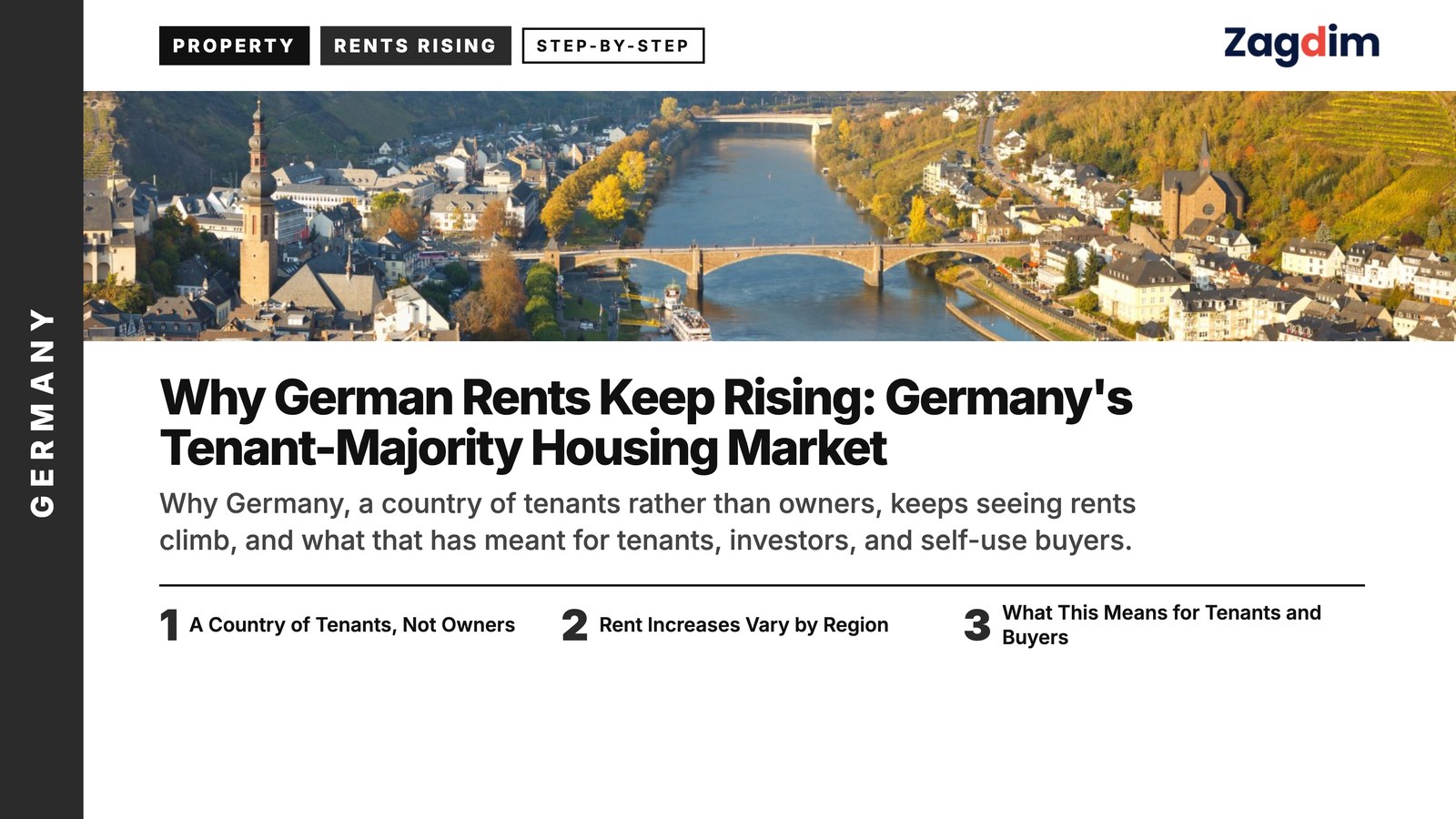
Germany’s economic media and political institutions have been full of striking headlines: rents on residential property rose 5-10% in a single month, and the trend was not over. Why does this subject matter so much to Germany’s property market?
A Country of Tenants, Not Owners
Germany is one of the few countries in the world — perhaps the only one — with a tenant market rather than an owner market. Germany’s homeownership rate is among the lowest in Europe and the world. More than 70% of Germans live as tenants, and not briefly: often for the long term, or their entire lives. This has historical roots, alongside a genuinely held view among some Germans that owning property is riskier and more expensive than renting. Strict lending rules at mortgage banks and low equity ratios are also part of the reason.
Tenants’ legal position is very strong, and the scope for raising rent or changing lease terms is limited. Every rent increase touches many households’ budgets at once and reaches into politics. Rent changes affect the German government quickly, and will show up at the next election. Politicians are accordingly very cautious on this subject, and mostly side with tenants — whether or not that is the rational position.
A Supply Shortfall a Decade in the Making
In the past, the residential property market was in balance. Over the past 10 to 12 years, the number of newly built apartments has kept falling. New construction rules, more bureaucracy, more environmental rules, new carbon-emissions regulations, and new financing rules have all made it more complicated and difficult to build new homes or renovate old buildings. For private owners, investing the right way has become an increasing challenge. Private investors have taken the opportunity to buy German property, seeing an opportunity in a demand-heavy market. At the same time, Germany is estimated to need 1 million new apartments.
The German government wanted 400,000 new apartments built in 2022 — in practice, 250,000-280,000 were actually completed. The shortage is worsening, and is not expected to change for the foreseeable future. All political protest on the subject has been ignored, because planning and approval decisions rest with regional governments, not the federal government. Seventeen parties would need to reach consensus.
Rent Increases Vary by Region
The result of all this is that rent prices keep rising, with the market pricing everything in. It is worth noting that the size of the increase varies by region and city.
In major German cities such as Munich, Hamburg, and Berlin, rent growth has run at 5-7%. That suggests rent prices are approaching a limit, since tenant income cannot adapt quickly enough to keep up with higher rents.
In areas with a population between 20,000 and 250,000, rent prices have risen 7-10%. Surprisingly, even areas where rents had been stable and low — such as Brandenburg and Saarland — are now seeing broad, across-the-board rent increases too.
If housing policy does not change fundamentally, this trend will continue for years to come. But that kind of fundamental change is, in practice, unlikely to happen in the political decision-making process. Those in power should remember the story of the Gordian knot.
What This Means for Tenants and Buyers
For tenants, the outlook is fairly uncertain. Despite good legal protection under German law, the actual state of the property market will push them toward accepting higher rents, since average rents are rising too.
But for investors and self-use buyers, this is a good time. Interest rates have risen from around 1% to the current 3%. Still, viewed against a 20-year fixed-rate term, that is an acceptable level. At the same time, Germany’s actual inflation rate of around 10% is worth factoring in — on its own, that is reason enough to consider investing in German property. The short- and medium-term outlook is very good, and the long-term outlook is positive as well.
Have a question about this guide? Leave a comment below, or ask Zagdim directly.
Your first stop for international property and global living.
Research and insights. Know what’s changing. Understand what matters.