

































Further reading: How to negotiate a rent reduction when renewing in Dubai
A Dubai Landlord Has Two Legal Routes: A Statutory Ground During the Lease, or 12 Months’ Notice After It
When renting in Dubai, a landlord who wants you out after the lease expires must, under Article 25(2) as amended by Law No. 33 of 2008, rely on one of four statutory grounds and give at least 12 months’ notice through a Notary Public or by registered mail. During the lease itself, Article 7 of Law No. 26 of 2007 allows termination only by mutual consent or in accordance with the law.
The question resurfaced in October 2026. On 12 October 2026, the UAE daily Khaleej Times re-shared on X a legal Q&A column on whether a landlord who wants to sell can make a tenant move out. The column, answered by Dubai-based lawyer Ashish Mehta, was first published on 20 September 2026 and updated on 25 September. The reader’s landlord had suddenly announced a sale and asked them to leave, and they wanted to know how much notice was required and whether they could be made to go before the lease ended.
A sale is only one of the reasons a landlord might give. This guide widens the lens to the three situations people renting in Dubai meet most often — renewal, non-renewal at expiry, and a notice to vacate during the lease — and sets out which rule applies, how much notice is required, how notice must be served, and where to go if you cannot agree.
Key Points
- Who needs to take note: foreign employees renting in Dubai, long-term residents and families whose lease is coming up for renewal, and tenants who have just received a notice to vacate or a rent increase and want to know whether it is lawful.
- The dividing line when renting in Dubai is “during the lease” versus “after expiry”: during the lease a landlord can only seek eviction on statutory breach-type grounds; after expiry there are four grounds only, with 12 months’ notice.
- In both cases the notice must be served through a Notary Public or by registered mail; WhatsApp, email or a message passed on by an agent are not methods the law names.
- If you cannot agree, the formal route is the Rental Disputes Center (RDC) under the Dubai Land Department — and the lease must be registered with RERA (Ejari) for a dispute to be heard.
Renting in Dubai: Notice Periods at a Glance for Renewal, Non-Renewal and Mid-Lease Eviction
The table sets the three situations side by side. Each row rests on a different provision, listed in the last column.
| Situation | What the landlord can do | Time limit | Service method | Legal basis |
|---|---|---|---|---|
| Renewal: landlord raises no objection | Lease renews on the same terms | For the original term or one year, whichever is shorter | — | Law No. 26 of 2007, Article 6 |
| Renewal: landlord wants a rent increase or new terms | Notify the tenant of the proposed changes | No less than 90 days before expiry, unless otherwise agreed | Not specified | Article 14 as amended in 2008 |
| Non-renewal: repossession after expiry | Only for demolition, major repairs, own use or sale | At least 12 months before the eviction date | Notary Public or registered mail | Article 25(2) as amended in 2008 |
| During the lease: unpaid rent | Seek eviction after notice | Rent still unpaid 30 days after notice | Notary Public or registered mail | Article 25(1) as amended in 2008 |
| During the lease: tenant fails to meet legal or contractual obligations | Seek eviction after notice | Still unremedied 30 days after notice | Notary Public or registered mail | Article 25(1) as amended in 2008 |
| During the lease: other statutory cases | For example, subletting without written consent or illegal use | As set out in each sub-clause | Notary Public or registered mail | Article 25(1) as amended in 2008 |
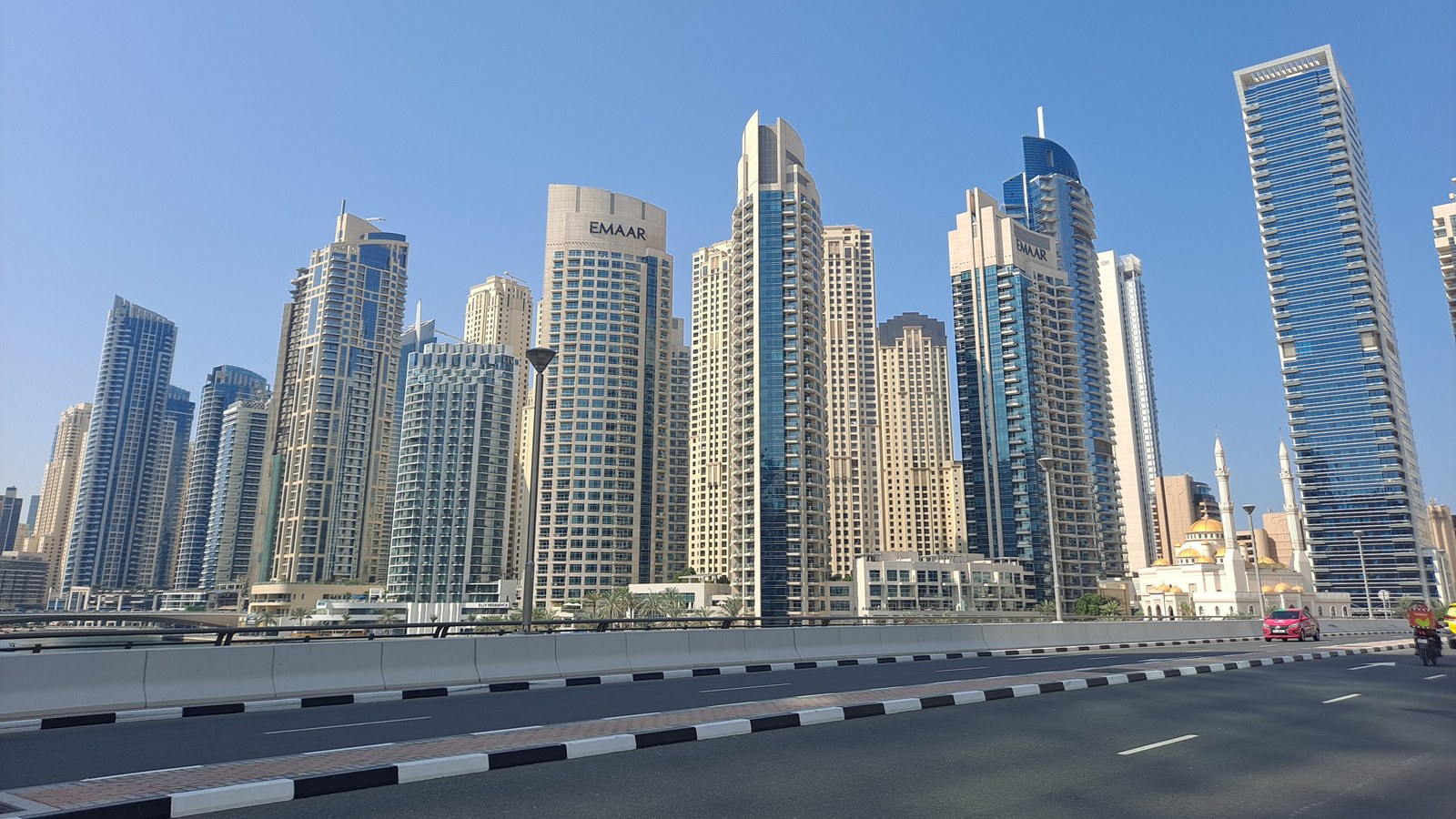
Situation One: Renewing a Dubai Lease — Silence Means Renewal, and a Rent Increase Needs 90 Days’ Notice
Renewal has a default that is easy to miss. Under Article 6 of Law No. 26 of 2007, if the lease expires, the tenant stays on and the landlord raises no objection, the lease renews on the same terms for the original term or one year, whichever is shorter.
A landlord who wants to raise the rent or change other terms at renewal must, under Article 14 as amended in 2008, notify the tenant no less than 90 days before the lease expires, unless the parties agreed otherwise. If they cannot agree, Article 13 leaves it to the tribunal to set a fair rent using the criteria in Article 9 — a failed rent negotiation is not itself one of the grounds for eviction in Article 25.
The maximum increase is set separately by Decree No. 43 of 2013, in five bands depending on how far your current rent sits below the average for similar properties: within 10% below means no increase, and the top band is 20%. The average is taken from the Dubai Rental Index approved by RERA, and the rules also cover special development zones and free zones. Zagdim’s earlier guide, “Dubai Landlord Selling the Flat? Your 12-Month Notice and Tenant Rights Explained“, sets out all five bands in a table.
Situation Two: When a Dubai Lease Expires and the Landlord Will Not Renew — Four Grounds and 12 Months’ Notice
Many tenants assume a landlord can simply decline to renew. Dubai law does not say that. Article 25(2) uses the words “only if”: the grounds for repossession after expiry are an exhaustive list, and all four below come from Article 25(2) as amended by Law No. 33 of 2008:
| Ground | Condition attached |
|---|---|
| Demolition and reconstruction, or new construction that prevents use of the property | Landlord must hold the competent authority’s permits |
| Restoration or comprehensive maintenance that cannot be carried out with the tenant in occupation | Requires a technical report issued or certified by Dubai Municipality |
| The landlord or a first-degree relative wants to live there | Landlord must prove they own no other suitable property |
| The landlord wants to sell the property | No further condition in the text |
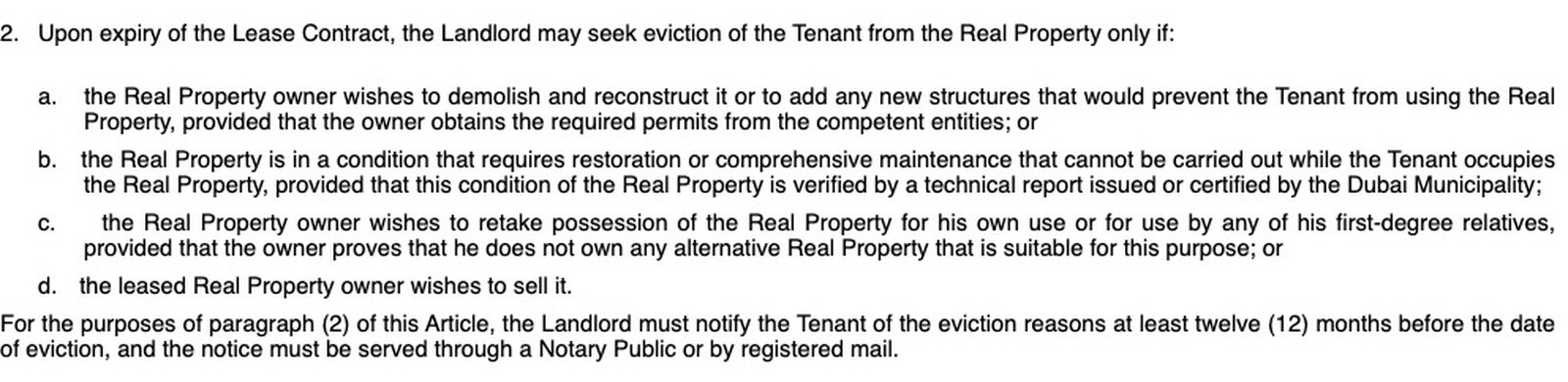
All four grounds share one notice rule: the landlord must give the reasons at least 12 months before the eviction date, served through a Notary Public or by registered mail. “I just don’t want to renew” or “I can get more rent from someone else” are not on the list.
Two related rules are worth keeping in mind. First, under the amended Article 26, if a landlord repossesses for own use, they may not let the property to a third party for at least 2 years for residential property, or 3 years for non-residential property, from the date of repossession; otherwise the tenant may ask the tribunal for fair compensation. Second, if the landlord sells during the lease, Article 28 of Law No. 26 of 2007 means the buyer takes over the existing lease, provided it has a fixed term, and you can stay until it ends.
Situation Three: A Notice to Vacate While Renting in Dubai Mid-Lease — Only Statutory Cases Count
If your lease has not yet ended and the landlord wants you out, start with Article 7: neither party may terminate unilaterally during the term; termination is only by mutual consent or in accordance with the law. “In accordance with the law” means the cases in Article 25(1) as amended in 2008, which uses the words “only in the following cases”:
- The tenant fails to pay rent within 30 days of being notified
- The tenant sublets without the landlord’s written consent
- The property is used for illegal purposes, or in breach of public order or morals
- A commercial property is left vacant without valid reason for 30 consecutive days, or 90 non-consecutive days in a year
- The tenant’s alterations endanger the property’s safety beyond restoration, or the tenant causes damage deliberately or through gross negligence
- The property is used for a purpose other than the agreed one, or in breach of planning, building or land-use rules
- The property is at risk of collapse, supported by a technical report issued or certified by Dubai Municipality
- The tenant fails to meet obligations under the law or the lease within 30 days of being notified
- The competent government authority requires demolition and reconstruction for urban development
This list contains neither “the landlord wants to sell” nor “the landlord wants to move in” — both appear only in Article 25(2), which applies after expiry. The final paragraph of Article 25(1) likewise requires the landlord’s notice to be served through a Notary Public or by registered mail.
Received a Notice to Vacate in Dubai? Run These Four Checks First
Before agreeing to a moving date, work through the following:
- During the lease or after expiry? Check the start and end dates in your lease. Article 25(1) applies during the term and Article 25(2) after expiry, and the lists of grounds differ.
- Is the reason on the list? During the lease it must match a case in Article 25(1); after expiry it must be one of demolition, major repairs, own use or sale.
- Is there enough time? For repossession after expiry, check that at least 12 months separate the notice from the date you are asked to leave; for unpaid rent or unmet obligations, the period is 30 days from notice.
- Was it served properly? The law names a Notary Public or registered mail. The Khaleej Times column adds that notarised notices can be delivered through Tableegh Legal Notification Services Company.
Also confirm the lease is registered with RERA (Ejari): under Article 4 of Law No. 26 of 2007, the judicial and government authorities will not hear disputes over an unregistered lease. Keep messages, payment records and original notices.
If one of the four checks fails, the landlord’s demand is not automatically void — what a defect in service or timing means legally is decided case by case — but that is exactly when it is worth consulting a lawyer or approaching the RDC.
If You Cannot Agree While Renting in Dubai: The Rental Disputes Center (RDC)
The body that handles landlord–tenant disputes in Dubai is the Rental Disputes Center (RDC), part of the Dubai Land Department. The e-services listed on the RDC website include a Dispute Lawsuit for Amicable Settlement, ordinary lawsuits, execution, and provisional and summary orders, alongside digital services such as case tracking and a virtual court.
According to a Khaleej Times report on 10 October 2026, the RDC said 2,350 cases were concluded by amicable settlement between January and the end of September 2026, with a combined value of Dh401 million and an average of six days per case. That average covers only cases that settled; it does not mean every rental dispute in Dubai is resolved within that time.
Filing a case requires a fee; the amount and procedure follow the RDC’s latest published rules.
Four Common Misconceptions About Renting in Dubai
Misconception 1: “When the lease ends, the landlord can just refuse to renew”
Why it is incomplete: Article 25(2) limits repossession after expiry to four grounds and requires 12 months’ notice through a Notary Public or registered mail; and where the landlord raises no objection, Article 6 renews the lease automatically.
Practical tip: If you are told the lease will not be renewed, ask which ground applies and whether the notice has run for 12 months.
Misconception 2: “The landlord gave me two months — that’s what we agreed”
Why it is incomplete: The 12-month notice for repossession after expiry is set by law, not something a landlord can shorten unilaterally. A separate early-termination agreement signed by both sides is a mutual termination under Article 7, on whatever terms the parties agree.
Practical tip: Before signing anything to leave early, make sure compensation, the deposit and the move-out date are all written down.
Misconception 3: “If we can’t agree on the rent, the landlord can make me leave”
Why it is incomplete: A rent change at renewal requires 90 days’ notice under Article 14; if the parties disagree, the tribunal sets a fair rent under Article 13. A rent increase is not itself a ground for eviction under Article 25.
Practical tip: Compare your rent with the average for similar properties on the Dubai Rental Index, then check whether the increase exceeds the caps in Decree No. 43 of 2013.
Misconception 4: “Dubai’s rules apply across the UAE”
Why it is incomplete: Every law cited here is a Dubai law. Abu Dhabi, Sharjah and the other emirates have their own tenancy rules.
Practical tip: If you move to another emirate, check the local notice periods and grounds again.
Renting in Dubai: Three Situations Foreign Workers and Long-Term Residents Often Face
Scenario 1: An expat engineer with three months left gets a WhatsApp saying the lease won’t be renewed and to leave within two months
Background: A one-year lease; the landlord messages that they will take the flat back for own use at expiry and asks the tenant to move out within two months.
The problem: Own use is a ground under Article 25(2), but neither the method nor the timing matches the law.
How to handle it: Under Article 25(2), repossession for own use needs at least 12 months’ notice through a Notary Public or registered mail, and the landlord must prove they own no other suitable property. The tenant can reply in writing citing the law and keep a record of the messages.
Limits to keep in mind: If the landlord later serves a compliant notice, how the eviction date is calculated is decided case by case; agreeing to leave early or negotiating compensation is a separate, consensual arrangement.
Scenario 2: A long-term resident family receives a rent-increase notice 60 days before expiry
Background: The lease was signed two years ago and renewed each year; this time the landlord gives notice of an increase 60 days before expiry.
The problem: The notice is shorter than the 90 days in Article 14, and it is unclear whether the increase is within the caps.
How to handle it: First check whether the lease sets a different notice period; if not, Article 14 requires no less than 90 days before expiry. Compare the increase with the five bands in Decree No. 43 using the Dubai Rental Index. If there is no agreement, Article 13 leaves the fair rent to the tribunal.
Limits to keep in mind: The lease must be registered with Ejari, or the dispute cannot enter the formal process.
Scenario 3: A rent cheque bounces mid-lease and the landlord sends notice
Background: During a change of job, one rent cheque is not honoured, and the landlord sends notice by registered mail.
The problem: Unpaid rent is one of the mid-lease cases listed in Article 25(1).
How to handle it: Under Article 25(1), the landlord may seek eviction if rent is still unpaid 30 days after the tenant is notified. Pay the arrears within the 30 days and keep proof of payment.
Limits to keep in mind: A bounced cheque may carry other legal consequences outside the scope of this guide; consult a lawyer licensed in the UAE if needed.
FAQs on Being Asked to Leave When Renting in Dubai
When renting in Dubai, can my landlord make me leave before the lease ends?
As a rule, no. Article 7 of Law No. 26 of 2007 says neither landlord nor tenant may terminate a lease unilaterally during its term; it ends only by mutual consent or in accordance with the law. The lawful cases are listed in Article 25(1) as amended in 2008 — for example rent unpaid 30 days after notice, subletting without consent or illegal use. A planned sale or the landlord’s own use is not among them.
Renting in Dubai, how much notice must a landlord give if they will not renew?
Under Article 25(2) as amended in 2008, the landlord may repossess only for demolition and reconstruction, major restoration, own or first-degree-relative use, or sale, and must give the reason at least 12 months before the eviction date through a Notary Public or registered mail. If the landlord raises no objection and the tenant stays on, Article 6 renews the lease on the same terms.
How much notice does a Dubai landlord need to give for a rent increase?
Under Article 14 as amended in 2008, either party wishing to change the lease terms at renewal, including the rent, must notify the other no less than 90 days before expiry, unless otherwise agreed. The size of any increase is capped by Decree No. 43 of 2013 in five bands, from no increase up to a maximum of 20%, depending on how far the current rent sits below the average for similar properties.
My landlord told me to move out by WhatsApp or email. Does that count?
For both mid-lease and post-expiry repossession, Article 25 says notice must be served through a Notary Public or by registered mail. Messages, emails or word passed on by an agent are not methods the law names. What a defect in service means is decided case by case, but whether you send or receive a notice, keep the records and proof of delivery.
Where do I file a rental dispute in Dubai?
Dubai’s dedicated body is the Rental Disputes Center (RDC) under the Dubai Land Department, where you can file cases such as an amicable-settlement claim or an ordinary lawsuit through its website. Check first that the lease is registered with RERA (Ejari): under Article 4, the authorities will not hear disputes over an unregistered lease. Fees follow the RDC’s latest published rules.
If the flat is sold during my lease, can the new owner ask me to leave?
Not simply because they have bought it. Article 28 of Law No. 26 of 2007 says a transfer of ownership does not affect the tenant’s right to stay under the existing lease, provided it has a fixed term. The buyer steps into the landlord’s shoes; to repossess after expiry they too must give 12 months’ notice under Article 25(2) through a Notary Public or registered mail.
Questions About Renewing or Moving Out While Renting in Dubai? Ask Zagdim
If you want to work out which situation your lease falls into and what to do next, Ask Zagdim; if you need further help, Zagdim can arrange a suitable specialist for you.
Life abroad? Ask Zagdim.
Your first stop for international property and global living.
Research and insights. Know what’s changing. Understand what matters.
Newsletter for overseas updatesSubscribe →
Disclaimer
This article is general information and does not constitute legal advice. It is based on the English versions of Law No. 26 of 2007, Law No. 33 of 2008 and Decree No. 43 of 2013 published on the Dubai Legislation portal, the Rental Disputes Center website, and media reports from September and October 2026. The English versions of these laws state that the Arabic text prevails in interpretation and application. The rules described apply only in the Emirate of Dubai, and individual cases are decided by the competent authorities on their facts; where your rights are affected, consult a legal professional licensed in the UAE.
Rules are current as of October 2026; refer to the Dubai Legislation portal, the Dubai Land Department and the Rental Disputes Center for the latest updates.
References
Dubai Legislation – Law No. (26) of 2007 Regulating the Relationship between Landlords and Tenants in the Emirate of Dubai / Dubai Legislation – Law No. (33) of 2008 Amending Law No. (26) of 2007 / Dubai Legislation – Decree No. (43) of 2013 Determining Rent Increase for Real Property in the Emirate of Dubai / Rental Disputes Center – Official Website / Khaleej Times – Can your landlord in Dubai evict you to sell property? What UAE law says / Khaleej Times – Dubai tenants, landlords settle rental disputes in six days on average