































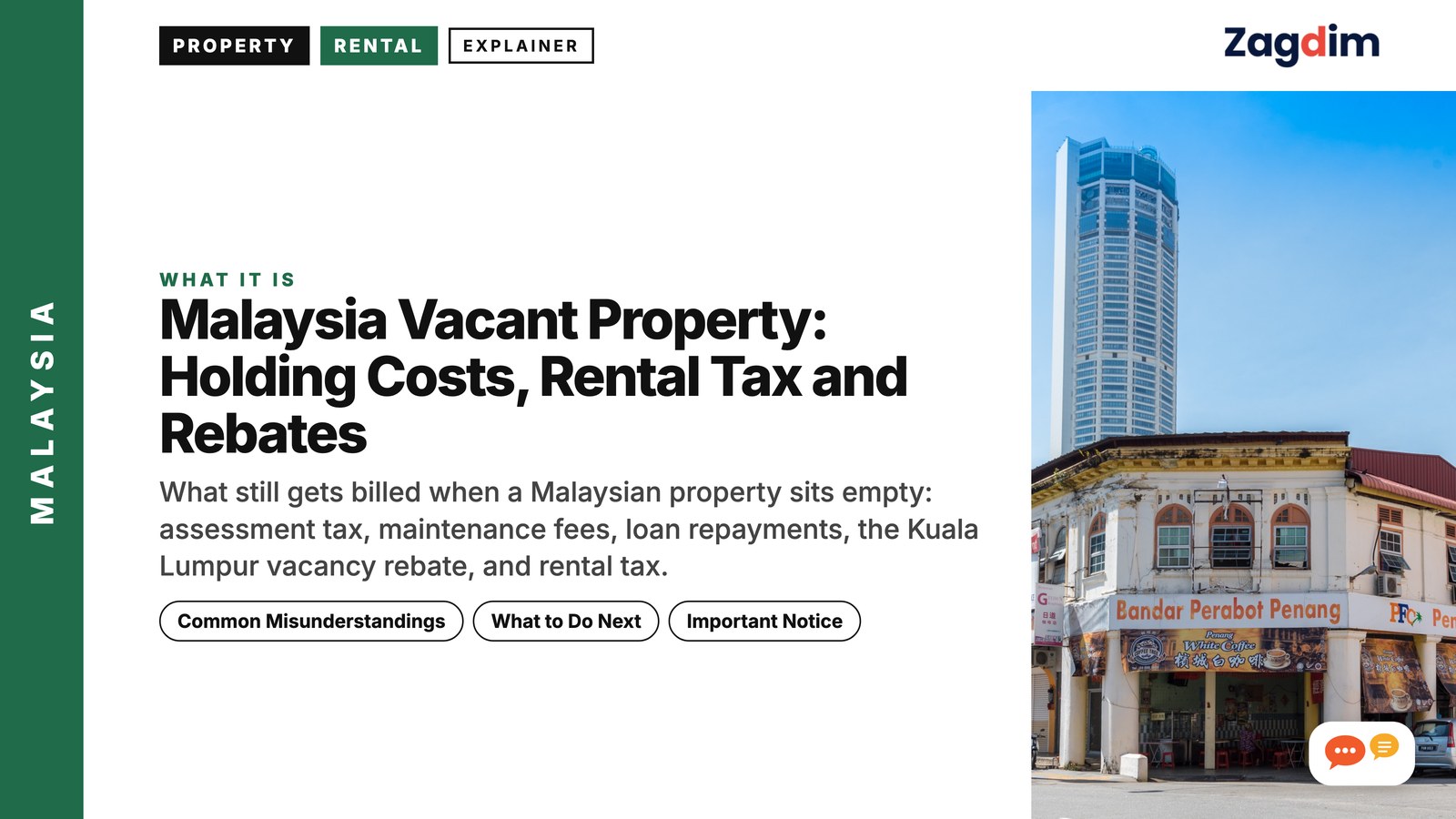
When a property in Malaysia has no tenant, the bills that used to be covered by rent do not simply stop. This article looks at what an owner of a vacant Malaysian property typically still has to pay, the assessment tax vacancy rebate available in Kuala Lumpur, how a vacancy affects the year’s rental income tax, and when vacancy-related expenses can still be deducted.
A Vacancy Means Lost Rent, Not Automatically Lower Costs
A property sitting empty does not necessarily make every expense go up, but the taxes, fees, and loan repayments that rent used to cover may now have to come out of the owner’s own pocket. The longer a unit stays vacant, the more cash an owner typically needs to set aside.
Cleaning, inspection visits, advertising for a new tenant, and repairs can also add extra costs during a vacancy. When estimating the true cost of a vacancy, an owner needs to look at both the rental income lost and the expenses that keep running.
Which Costs Usually Continue During a Vacancy
| Item | How It Is Treated During a Vacancy |
|---|---|
| Land tax (quit rent) or strata land tax | Not automatically waived just because no one is living there |
| Assessment tax | Generally still payable; any applicable rebate or relief has to be applied for separately through its own procedure |
| Management fees and sinking fund contributions | A strata owner’s payment obligations generally continue |
| Mortgage | Repayments do not pause automatically just because there is no rental income |
| Insurance | Check the policy’s renewal terms and any vacancy-related conditions |
| Utilities (water, electricity, sewerage, etc.) | Usage charges may fall, but fixed or account fees need to be confirmed against the actual service |
| Unit maintenance | Budget for inspections, leak repairs, cleaning, and equipment upkeep |
Not using the pool, gym, or security services does not mean an owner can simply stop paying management fees. If a bill looks wrong, it should be checked and resolved through the proper process rather than withheld.
Kuala Lumpur Offers an Assessment Tax Vacancy Rebate, But You Must Apply
In Kuala Lumpur, a vacant property is not automatically exempted from assessment tax. An owner can inquire with Kuala Lumpur City Hall (DBKL) about applying for the vacancy rebate or refund, known locally as *elaun kekosongan*.
The application involves the vacancy period, the property’s condition, and supporting documents. The published form requires the owner to first pay the assessment tax in full for the half-year period being claimed, then submit the rebate claim and proof of vacancy afterward through the set procedure; an owner cannot simply deduct an estimated amount from the tax bill in advance.
The form is also processed in two half-year cycles: claims covering January through June must be submitted by the stated July deadline, and claims covering July through December follow a deadline the following January. If the vacancy continues into the next cycle, a new application has to be submitted for that period. The exact dates and the current version of the form should be confirmed at the start of the vacancy, rather than only remembering the final submission deadline and missing an earlier notification or inspection step.
Whether other local authorities offer a similar rebate, and under what conditions and procedure, needs to be confirmed with the authority where the property is located. A unit kept aside for occasional personal holiday use should not be assumed to automatically qualify for a vacancy rebate either.
No Rent Collected in a Given Month Does Not Mean the Year’s Rental Tax Can Be Skipped
Simply holding a property with no rental income generally does not, by itself, create rental income tax. But ending a tenancy partway through the year only changes the period during which the property was rented; rent that already accrued before that point still has to be included in that year’s tax calculation.
Rent collected in advance, deposits withheld against unpaid rent, or other payments connected to the tenancy also need to be assessed by their actual nature. It is not enough to check whether a bank statement shows a “rent” deposit in a given month, since a refundable deposit and a deposit already applied toward rent are not the same thing.
Existing filing obligations or tax notices are also not automatically canceled just because a unit is vacant. Whether a form needs to be filed, and how to report it, should be worked out together with all of that year’s income.
Whether Vacancy Expenses Are Tax-Deductible Depends on How the Property Was Used Before and After
A property that was previously rented out and is temporarily between tenants is a different situation from a property that has never been rented, has been converted to personal use, or is simply being held for sale.
For a temporary vacancy where the property is being actively maintained as available for rent and meets the relevant conditions, some expenses may still be deductible. But having an expense does not mean all of it is deductible, and it does not mean deductions can continue indefinitely. An owner should keep records of the tenancy’s end date, advertising for a new tenant, repairs, and any change in how the property is used.
Cash flow budgeting is more straightforward: regardless of whether an expense is ultimately deductible, if a payment is due, the cash has to be set aside.
Common Misunderstandings
“If No One Is Living There, I Can Just Pay Everything Once a New Tenant Moves In.”
Payment deadlines generally continue regardless of occupancy, and waiting can allow arrears and late penalties to build up in the meantime.
“Since There Is a Vacancy Rebate, I Can Hold Off on Paying the Assessment Tax First.”
Under DBKL’s published procedure, for example, the assessment tax for the relevant period has to be paid in full first, and the rebate is then claimed afterward according to the stated requirements.
“If There Was No Tenant All Year, I Do Not Need to Worry About My Existing Tax Account.”
Filing obligations, notices, and any other rent-related payments that should be counted still need to be checked; none of this can simply be assumed to be closed out.
What to Do Next
List out every expense that has to be paid each month, then estimate the cash needed for a vacancy of three months, six months, or longer. These are only budgeting scenarios, and an owner should adjust them based on the actual leasing situation for the property and set aside a separate reserve for unexpected repairs.
FAQ
Does a vacancy automatically exempt a property from land tax and assessment tax?
No. If the location offers an eligible rebate or relief, it has to be applied for through the proper procedure.
Can the Kuala Lumpur vacancy rebate be used to directly offset an unpaid tax bill?
No, it cannot be offset automatically. The published application procedure requires the relevant half-year assessment tax to be paid in full first, before the rebate claim is submitted.
If I end a tenancy this year, does that mean there is no more rental income tax?
Not necessarily. Rent and other related payments that already accrued during the year still need to be accounted for; it is not enough to check whether new rent came in after the tenancy ended.
Important Notice
This article is based on information publicly available as of October 8, 2026, and is provided for general reference only; it does not constitute tax, legal, or financial advice. Taxes, deductions, and rebate arrangements must be confirmed against the rules of the property’s specific location, the official bill, the relevant contract, and individual circumstances.
Have a question about this guide? Leave a comment below, or ask Zagdim directly.
Your first stop for international property and global living.
Research and insights. Know what’s changing. Understand what matters.
Sources
- DBKL — Frequently Asked Questions by Department: Assessment Tax, Annual Value, and Vacancy Arrangements
- DBKL — Assessment Tax Vacancy Rebate Application Form DBKL/PBCT-01-2023
- KPKT — Handbook Pengurusan Strata 2.0
- LHDN — Public Ruling 12/2018: Income From Letting of Real Property
- Selangor Land and Mines Office — Tax Bills, Payments, and Deadlines FAQ