

































This article is part of Zagdim’s wiki series on moving to Japan with a pet, written for readers planning to relocate to Japan with a pet, or already living there with one. It covers rental and condominium restrictions, vet visits, pet insurance, and day-to-day costs.
For entry quarantine, documents and flight arrangements, see the main article, “Moving to Japan With Pets: Rabies Quarantine, Documents, Waiting Periods and Flight Arrangements.” This article only covers the costs that come up after your pet has already entered Japan.
A worked example runs through this article: Mina is moving to Yokohama with a dog. Mina is a fictional reader, used only to show how the rules apply.
Can You Keep a Pet When Renting or Buying an Apartment in Japan?
Not automatically. For a rental, it depends on the lease. For an apartment purchase, it depends on the building’s management rules, meaning the rules the building’s owners agree to follow together.
Renting: check the lease first
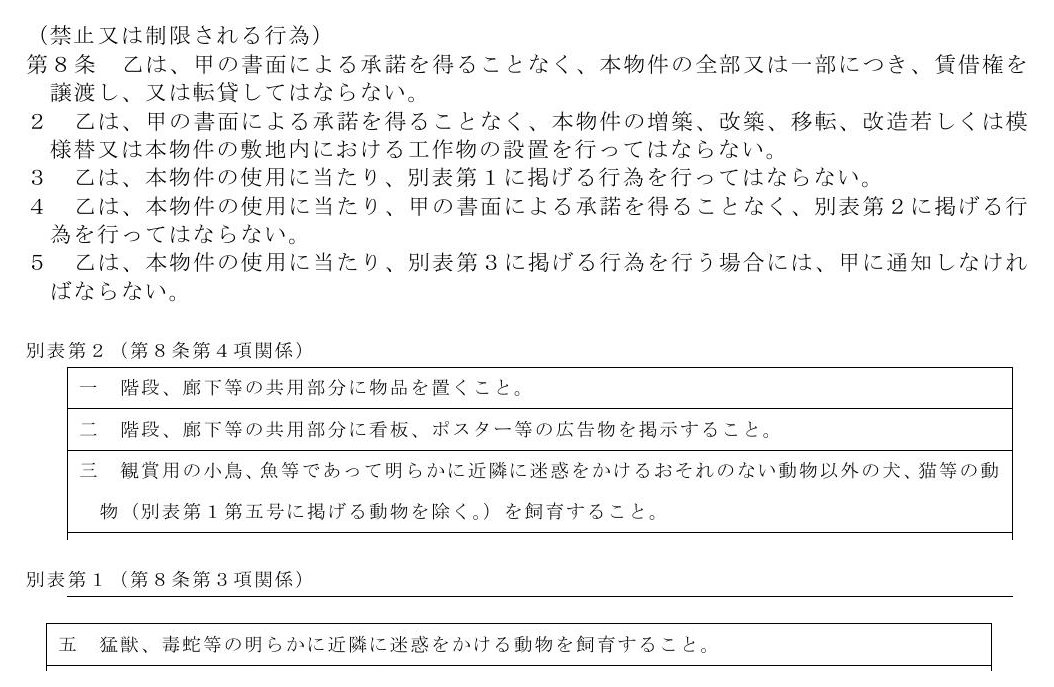
Japan’s Ministry of Land, Infrastructure, Transport and Tourism (MLIT) publishes a Standard Rental Housing Lease Agreement (賃貸住宅標準契約書), a government-drafted lease template that is not mandatory to use. The template sorts animals into three categories:
| Animal | What the template says |
|---|---|
| Dogs, cats and similar animals | Written consent from the landlord (lessor) is required first |
| Ornamental small birds, fish and similar animals clearly unlikely to disturb neighbors | Not subject to this restriction |
| Dangerous animals, venomous snakes and similar animals listed in the template’s separate schedule as clearly disturbing to neighbors | Not in the category that can be kept with consent |
Buying an apartment: check the management rules
In 2025, MLIT revised its Standard Condominium Management Rules template (マンション標準管理規約). Its commentary states that whether dogs, cats and similar animals may be kept should be decided by the building’s own management rules. If pets are allowed, the rules should also spell out:
- Which animals may be kept, and how many
- How to report or register them with the management association (the building’s governing body)
- How your own unit (the exclusively-owned section) and shared areas may be used
- How waste must be handled
- Who is responsible if damage occurs
- How violations are handled
How a no-pets clause is worded in the template
The same template also includes wording for buildings that prohibit pets outright. Both unit owners and the people who actually occupy a unit (occupants) must follow it. Under that wording, no dogs, cats or similar animals may be kept either in your own unit or in shared areas.
The template lists two exceptions:
- Small birds and ornamental fish kept only inside a cage or tank within your own unit, under the building’s usage rules
- People who use a dog legally certified in Japan as a guide, service or hearing dog
All of the above is a government template or commentary; an actual lease or an actual building’s management rules may differ. Check the real documents for the specific property before signing a lease or buying.
For example, when Mina looks at a rental, Mina should read that unit’s actual lease first. If the lease matches the template’s wording, Mina would need the landlord’s written consent before moving in.
If You Can Keep a Pet, Will You Be Charged for Repairs When You Move Out?
Possibly. Under the government template, damage caused by the pet is the tenant’s responsibility, while ordinary aging of the property is, in principle, the landlord’s responsibility.
This template comes from the restoration conditions (原状回復, literally “restoring to original condition”) attached to MLIT’s collection of rental consultation cases. Restoration is how move-out costs are divided between tenant and landlord.
| Item | Who pays |
|---|---|
| Scratches to pillars, wallpaper, etc. caused by the pet | Tenant (lessee) |
| Odor caused by the pet | Tenant (lessee) |
| Natural aging and ordinary wear from normal use | In principle, the landlord (lessor) |
There is one exception: the two parties can agree to a special clause (an additional condition written into the lease) that departs from this. As long as it does not violate the Civil Code or the Consumer Contract Act, the special clause applies instead.
So keeping a pet does not automatically mean paying for a full repaint of the unit, nor does it mean a fixed number of months’ deposit is forfeited by default. It comes down to the actual lease and the actual damage.
For example, if Mina’s lease matches the template, Mina would be responsible for the part of a scratched pillar caused by the dog. Ordinary wall aging would, in principle, be the landlord’s responsibility.
How Much Does a Vet Visit Cost in Japan?
Ask the clinic directly; it’s the most reliable way to know. The two university animal hospitals below are not national Japan-wide pricing.
Tottori University’s Agriculture Faculty Animal Medical Center states that the attending veterinarian explains the estimated examination and treatment fees. CT, MRI and endoscopy-type examinations fall into the “high-cost examination” category of tens of thousands of yen and up, and usually also require general anesthesia plus pre-anesthesia blood tests and X-rays.
Hokkaido University’s Veterinary Teaching Hospital states that because every case needs different examinations, it cannot quote a fee before the visit. The estimated examination and treatment fees are explained directly by the attending veterinarian after the examination.
This hospital’s night and holiday service has the following rules:
- You must call ahead; walk-ins are not accepted.
- A special night examination fee applies, and you should confirm it by phone.
- The service covers dogs and cats only, not exotic pets.
For other clinics’ fees and emergency arrangements, check with the clinic you plan to use. For example, if Mina’s dog became unwell in the middle of the night, Mina would need to confirm that clinic’s emergency rules first.
What Are the Conditions and Payout Limits for Pet Insurance in Japan?
All four products researched for this article list a Japan-residency requirement for the policyholder. Pet age, health status and payout caps also vary by product, so premium alone is not a fair comparison.
For Anicom, what this article found applies to online enrollment specifically. “Policyholder” below means the person who applies for and signs the policy.
For example, while Mina was still living outside Japan, Mina would not have met these residency conditions.
Enrollment conditions
| Product | Who can enroll | Pet age (at the start of coverage) |
|---|---|---|
| Anicom Insurance (“Dobutsu Kenpo Family” / どうぶつ健保ふぁみりぃ) | Online enrollment: policyholder must live in Japan and be at least 18 at the time of application | Dogs and cats no older than 7 years 11 months |
| Daiichi ipet Insurance (“Our Child” / うちの子) 70% plan | Policyholder must be an individual or corporation residing in Japan; individuals under 15 cannot apply, and those under 18 may need a legal representative’s (e.g. a parent’s) consent | Must meet the company’s age limits |
| Pet & Family Insurance (“Genki No.1 Slim” / げんきナンバーわんスリム) | Policyholder and the insured owner (the owner covered by the policy) must both live in Japan and be the same person at the time of signing | 45 days to 7 years 11 months |
| PS Insurance | Open only to individuals living in Japan; the pet must be kept as a household pet | 30 days to 8 years 11 months |
Payout method and waiting period
A waiting period (待機期間) is a span of time after coverage starts during which an illness that develops is not covered.
| Product | Payout method and waiting period |
|---|---|
| Anicom | Has 70% and 50% plans, paying only a percentage of covered treatment costs, subject to payout caps; a 30-day waiting period applies to illness in the first year |
| Daiichi ipet (70% plan) | Outpatient: capped at ¥12,000/day, up to 22 days/year. Hospitalization: capped at ¥30,000/day, up to 22 days/year. Surgery: capped at ¥150,000/procedure, up to 2/year. Annual maximum ¥1,224,000. Conditions that existed before coverage began are not covered |
| Pet & Family | 70% plan: annual maximum ¥700,000. 50% plan: annual maximum ¥500,000. Daily deductible of ¥5,000. In the first year, a general illness that develops within 30 days of the policy start date is not covered; for cancer, the window is 90 days |
| PS Insurance | — |
Example premiums
| Product | Conditions | Monthly | Annual |
|---|---|---|---|
| Anicom | — | — | — |
| Daiichi ipet | 70% plan, dog class A, age 1 | ¥3,230 | ¥37,680 |
| Pet & Family | Small dog aged 0, weight class up to 7.2 kg, 50% plan, ¥5,000 daily deductible, first-year premium | ¥1,940 | ¥20,800 |
| PS Insurance | Small dog aged 0–2 having reached 120 days, online application, credit card payment, 50% plan, without the pet memorial service rider, 1-year policy term | ¥1,430 | ¥16,480 |
These premiums are all listed rates for a specific class, age, plan and payment condition. They are not average premiums across all dogs or all policies.
More about Anicom
- The waiting period is measured from the date the illness develops. An illness that develops during the waiting period is not covered even after the waiting period ends.
- This waiting period does not apply to renewal-year contracts. It also does not apply to policyholders whose special-terms section states “waiting period does not apply.”
- Three groups must first pass online enrollment screening: those currently being treated for or observed for an illness/symptom at the time of application, those who have had a company-specified illness, and those who have had non-preventive treatment in the past 3 months.
- Dogs’ base premium is set by breed, in classes A through E.
- The base premium, in principle, increases at each renewal until the animal turns 20.
- At renewal, the premium is also adjusted up or down based on how often the policy was used.
More about Daiichi ipet
- The ¥1,224,000 annual cap cannot be freely shifted between categories. Outpatient, hospitalization and surgery each have their own separate limit.
- Health declaration is where you disclose the pet’s health status at enrollment. What you disclose may lead to denial of coverage, or to specific illnesses or body parts being excluded.
- Already holding another pet insurance policy may also make you ineligible to apply.
- The premium table above reflects the rates revised in October 2026. The revision applies to policies (including renewals) whose coverage starts on or after October 2, 2026.
How Pet & Family calculates a payout
The formula is: (eligible treatment cost − deductible) × reimbursement rate, up to the insured amount stated on the policy.
For example, if Mina had the 70% plan and the dog’s eligible outpatient cost for one day was ¥10,000, with a ¥5,000 deductible, and no other limit was reached, the calculation would be (¥10,000 − ¥5,000) × 70%, for a payout of ¥3,500.
- If the treatment cost does not exceed the deductible, nothing is paid.
- Within the annual cap, there is no separate daily payout limit or limit on the number of claims.
- Some treatment items are still excluded from coverage.
How Pet & Family’s deductible is counted
- For hospitalization, the deductible is counted by total days hospitalized; one night and two days counts as two days.
- For outpatient visits, the deductible is counted by treatment day; multiple outpatient visits on the same day count as one.
- If hospitalization and an outpatient visit happen on the same day, the deductible is not taken from that outpatient treatment cost.
- At renewal, pets aged 8 and over may instead choose a ¥10,000 deductible; those who choose it are bound by that choice.
Pet & Family’s enrollment restrictions
- Dogs and cats must be kept as household pets in Japan and should, in principle, be healthy.
- Dogs and cats previously diagnosed with or treated for a company-specified illness cannot be enrolled.
- Dogs and cats held for sale are not accepted.
- Dogs and cats used for dog fighting, competitions or similar performance purposes are not accepted.
- Dogs and cats used for police, narcotics-detection, search-and-rescue, hunting or other occupational purposes are not accepted.
- Breeding dogs and cats are not accepted, even if currently kept as pets.
- Dogs and cats that have completed a sale, and legally certified service dogs, can apply.
- For puppies under 1 year old, the weight class is estimated from a breed chart’s projected weight at age 1.
- Future products or rate revisions may still change premiums.
More about PS Insurance
- Commercial breeding or sale purposes are not insurable.
- Health declarations, among other things, may lead to denial of coverage.
- Owning property in Japan does not by itself satisfy this product’s Japan-residency requirement.
Is There an Official Statistic for Daily Pet Costs?
Yes, but it should not be used directly as a pet-keeping budget. Japan’s Ministry of Internal Affairs and Communications Statistics Bureau reported that in 2025, the average annual pet-related spending for single-person households nationwide was ¥19,278. This average includes households that had no such spending at all.
The statistic covers:
- Pet food
- Pet supplies and other items
- Veterinary clinic fees
- Other pet services (such as grooming)
It is not a statistic on pet-owning households specifically, nor on cost per dog or cat, nor a complete monthly pet-keeping cost, and it should not be divided by 12 to estimate a monthly figure for an individual pet.
For example, Mina should track actual spending rather than applying this average directly.
How Much Does Dog Registration and Microchipping Cost in Japan?
Using Yokohama City’s Naka Ward as an example, the dog registration application fee is ¥3,000, and the rabies vaccination completion tag is ¥550. Microchip registration is a separate set of fees.
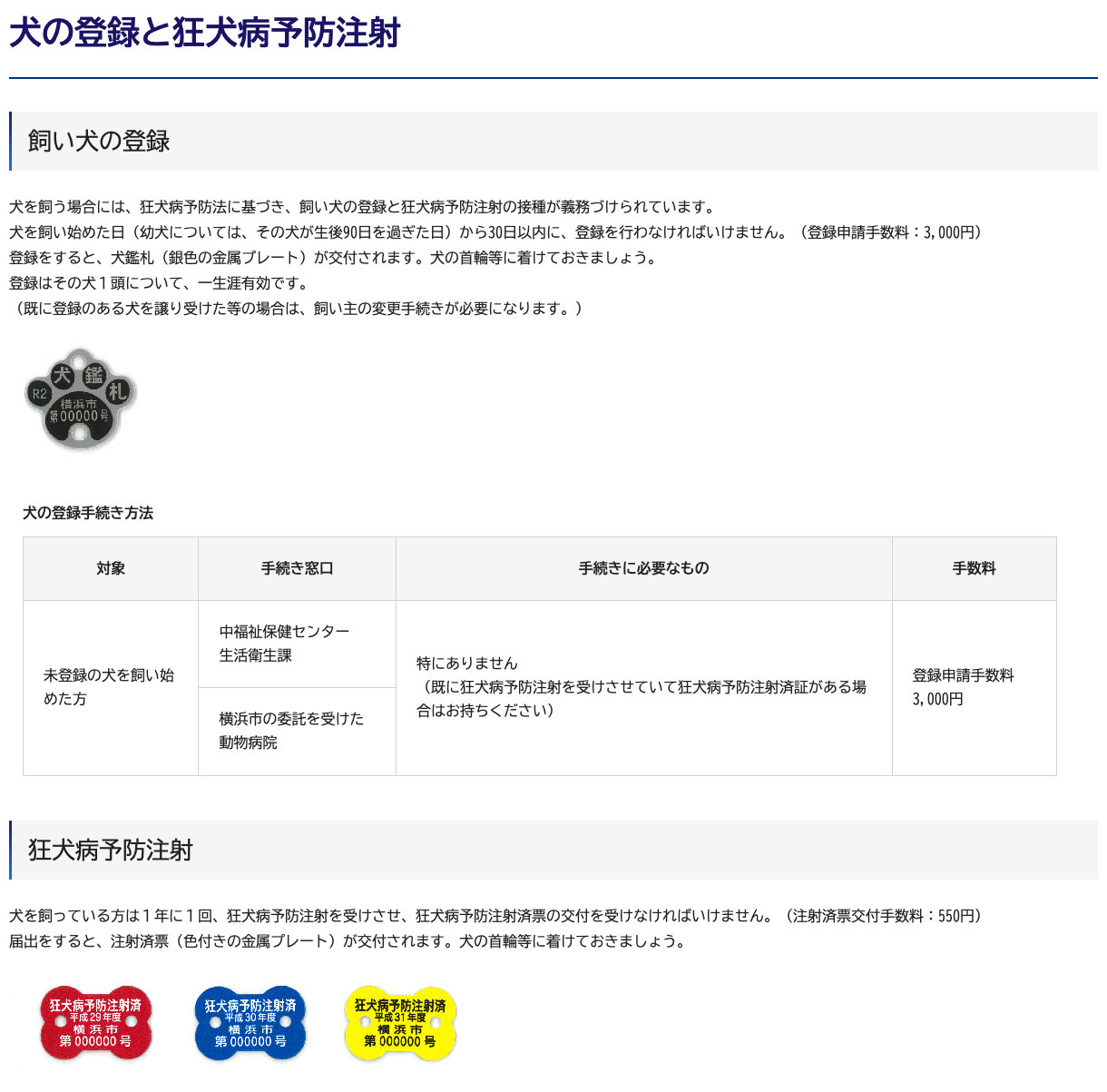
Dog registration (犬の登録) is where the owner registers the dog with their city, town or village. Dog and cat microchip information registration (犬と猫のマイクロチップ情報登録) is a separate system run by the Ministry of the Environment for registering microchip data.
| Item | Fee | Note |
|---|---|---|
| Dog registration application (Yokohama City, Naka Ward) | ¥3,000 | Valid for the dog’s lifetime per registration; not an annual fee |
| Rabies vaccination completion tag (Yokohama City, Naka Ward) | ¥550 | A rabies vaccination must be given and the tag applied for once a year; this is the tag issuance fee, not the total cost of the vaccination itself |
| New microchip information registration or ownership-change registration (Ministry of the Environment) | ¥400 online, ¥1,400 by paper form | Charged per registration, separate from the municipal dog registration fee |
| Microchip registration detail changes (Ministry of the Environment) | No charge | Required when name, address, phone number, etc. change |
For example, if Mina lives in Yokohama’s Naka Ward and needs to register the dog, the first two rows above apply. Registration itself is valid for the dog’s lifetime, but the vaccination and tag renewal happen every year.
Some municipalities (local governments) have a microchip-based exception. In Shinjuku Ward, for a new owner who has obtained proof of microchip registration:
- An ownership-change registration must still be filed.
- A separate registration visit to the ward office is not needed.
- The microchip is treated as the dog tag (鑑札); a separate dog tag is not issued.
- The rabies vaccination completion tag must still be applied for separately.
Procedures differ by municipality, so follow the rules where the pet is kept. Dog registration does not apply to cats. For registration procedures after a dog enters Japan, see the main article linked above.
Is There a Registration System for Pet Boarding If You Leave Japan Short-Term?
Yes. Pet hotels and pet sitters both fall under Japan’s registration system, though registration does not guarantee quality.
This system is called the Type 1 Animal Handling Business (第一種動物取扱業), which regulates businesses that handle animals commercially.
- Animals covered: mammals, birds and reptiles, excluding laboratory animals and livestock.
- Who must register: anyone operating an animal-boarding or similar business for profit within this scope.
- Who they register with: the prefectural governor or the mayor of a government-designated city, depending on business location and type.
- What else is required: compliance with management and facility standards.
Pet hotels fall under the boarding-business category. Pet sitters are covered by this system even if they have no animals or facilities of their own.
For example, if Mina leaves Japan short-term and needs someone to care for the dog, the fact that a business has completed registration does not mean the government is guaranteeing the service’s quality. Mina would still need to check this independently.
Frequently Asked Questions
If I keep a pet while renting, will my deposit automatically be deducted when I move out?
Not automatically. MLIT’s template assigns scratches and odor caused by the pet to the tenant, while natural aging and ordinary wear are, in principle, the landlord’s responsibility. The actual outcome still depends on the lease and any lawful special clause.
How much does a first vet visit cost in Japan?
It depends on the clinic; asking the clinic directly before the visit is the most reliable approach. Hokkaido University’s Veterinary Teaching Hospital states it cannot quote a fee before the visit, and Tottori University’s Agriculture Faculty Animal Medical Center states that the attending veterinarian explains the estimated examination and treatment fees.
Can someone living overseas buy Japanese pet insurance?
The four products researched for this article all list a Japan-residency requirement for the policyholder or applicant, with Anicom’s condition specifically covering online enrollment. Readers living outside Japan would not meet these residency conditions.
Key Terms
- Standard Rental Housing Lease Agreement: A lease template published by Japan’s Ministry of Land, Infrastructure, Transport and Tourism; not mandatory to use.
- Standard Condominium Management Rules: A condominium management-rules template revised by MLIT; the actual content depends on each building’s own management rules.
- Restoration (原状回復): The conditions, from an MLIT case-collection template, used to divide move-out costs between tenant and landlord.
- Dog registration: The registration a dog owner in Japan files with their municipality.
- Dog and cat microchip information registration: The microchip information registration system designated by the Ministry of the Environment.
- Deductible: The amount deducted from eligible treatment costs before an insurance payout is calculated.
About the Data in This Article
The facts in this article were checked as of October 31, 2026. Vet fees and insurance premiums are each a single clinic’s or specific product’s figures current as of that date. They are not nationwide Japan-wide pricing, nor are they averages across all comparable products.
The Statistics Bureau’s pet-spending figure is a per-household average for single-person households, including households with no such spending; it is not a cost figure for an individual pet.
The statement that “the four products researched for this article all list a Japan-residency requirement” is this article’s own synthesis of each company’s documents; it is not explicitly stated by any regulator, and it does not describe every pet insurance product on the market. Anicom’s condition comes from its online-enrollment page and does not cover other application channels.
Insurance terms are each company’s own contract conditions, not government regulation, and may be updated at any time. Chinese-to-English translations of product names in this article are direct translations, not official English product names.
The research for this article did not cover, and therefore does not draw conclusions about:
- A uniform nationwide vet fee schedule
- Full monthly pet-keeping costs for an average pet-owning household
- Average premiums across pet insurance products generally
- Specific boarding-service prices
This article also does not assess whether buying pet insurance is worthwhile. Anicom’s source material does not list specific premium amounts, and PS Insurance’s source material does not list payout conditions beyond the reimbursement percentage.
Dog registration and microchip procedures vary by municipality; the Yokohama and Shinjuku examples do not represent every area. Registration as an animal-handling business only means a business has completed the legally required registration; it is not a guarantee of service quality.
Have a question about this guide? Leave a comment below, or ask Zagdim directly.
Your first stop for international property and global living.
Research and insights. Know what’s changing. Understand what matters.
Sources
- Ministry of Land, Infrastructure, Transport and Tourism — Standard Rental Housing Lease Agreement
- Ministry of Land, Infrastructure, Transport and Tourism — 2025-Revised Standard Condominium Management Rules and Commentary
- Ministry of Land, Infrastructure, Transport and Tourism — Collection of Private Rental Housing Consultation Cases
- Tottori University Agriculture Faculty Animal Medical Center — On Treatment Fees
- Hokkaido University Veterinary Teaching Hospital — Frequently Asked Questions
- Hokkaido University Veterinary Teaching Hospital — Night, Weekend and Holiday Service
- Anicom Insurance — Online Enrollment Conditions
- Anicom Insurance — Premiums and Discounts
- Anicom Insurance — “Dobutsu Kenpo Family” Related Materials
- Daiichi ipet Insurance — “Our Child” Important Matters Explanation Document
- Daiichi ipet Insurance — “Our Child” Premiums
- Pet Medical Support — PS Insurance Important Matters Explanation Document
- Pet Medical Support — PS Insurance Premium Table
- Pet & Family Insurance — “Genki No.1 Slim” Coverage Details
- Pet & Family Insurance — “Genki No.1 Slim” Premiums
- Pet & Family Insurance — “Genki No.1 Slim” Important Matters Explanation Document
- Ministry of Internal Affairs and Communications Statistics Bureau — Household Survey Information
- Ministry of the Environment — Regulation of Type 1 Animal Handling Businesses
- Yokohama City, Naka Ward — Dog Registration and Rabies Prevention Vaccination
- Ministry of the Environment — Dog and Cat Microchip Information Registration Q&A
- Shinjuku Ward — About Dog Registration
Disclaimer
This article is general information and is not tax or legal advice for any individual situation. The facts were checked as of October 31, 2026. Rules in Japan may be updated; check the current announcements of the relevant authorities, and consult a qualified professional for individual cases.