
































This article is part of Zagdim’s wiki series on Vietnam. It sets out the core licenses and approvals that a foreign investor runs into when setting up a company in Vietnam, written for anyone considering opening a company, working, or living long-term in Vietnam, wherever they are based right now, including people who are not yet in Vietnam.
A foreigner opening a company in Vietnam may need to deal with the Investment Registration Certificate (Giấy chứng nhận đăng ký đầu tư, IRC), the Enterprise Registration Certificate (Giấy chứng nhận đăng ký doanh nghiệp, ERC), and industry-specific licenses, all at the same time. This article separates the IRC, the ERC, and industry restrictions so you can see at a glance who needs to apply for what, in what order, and which industries need extra attention.
Throughout the article, one example is used to illustrate how the rules apply: a foreign investor (referred to here simply as “the investor”) who plans to open a small retail store in Vietnam. Every mention of the investor is illustrative only, showing how a rule applies in practice.
How Vietnam Defines a Foreign Investor and a Foreign-Invested Company
Before setting up a company, first check whether you count as a foreign investor under Vietnamese law. This is determined by nationality, or by the law under which an organization was established, not by where you live.
- Individual: holds a foreign nationality.
- Organization: established under foreign law and carrying out investment or business activities in Vietnam.
An economic organization can be understood as an organization that is lawfully established and carries out business activities, such as a company. As soon as a foreign investor is a member or shareholder of an economic organization, that organization becomes a foreign-invested economic organization (tổ chức kinh tế có vốn đầu tư nước ngoài). For a fuller explanation, see Zagdim’s wiki article on foreign-invested companies, charter capital, and operating responsibilities before setting up an LLC in Vietnam.
Where the investor happens to live is not what determines status. If the investor holds a foreign nationality, the investor counts as a foreign investor, regardless of country of residence.
What Are the IRC and ERC, and Which Comes First?
These two documents have similar-sounding names, but they register different things. The IRC is a registration certificate for an investment project; the ERC is a registration certificate for an enterprise. There is now more than one possible order between them.
Foreign investors can now choose between two routes:
| Route | How it works | Key rule |
|---|---|---|
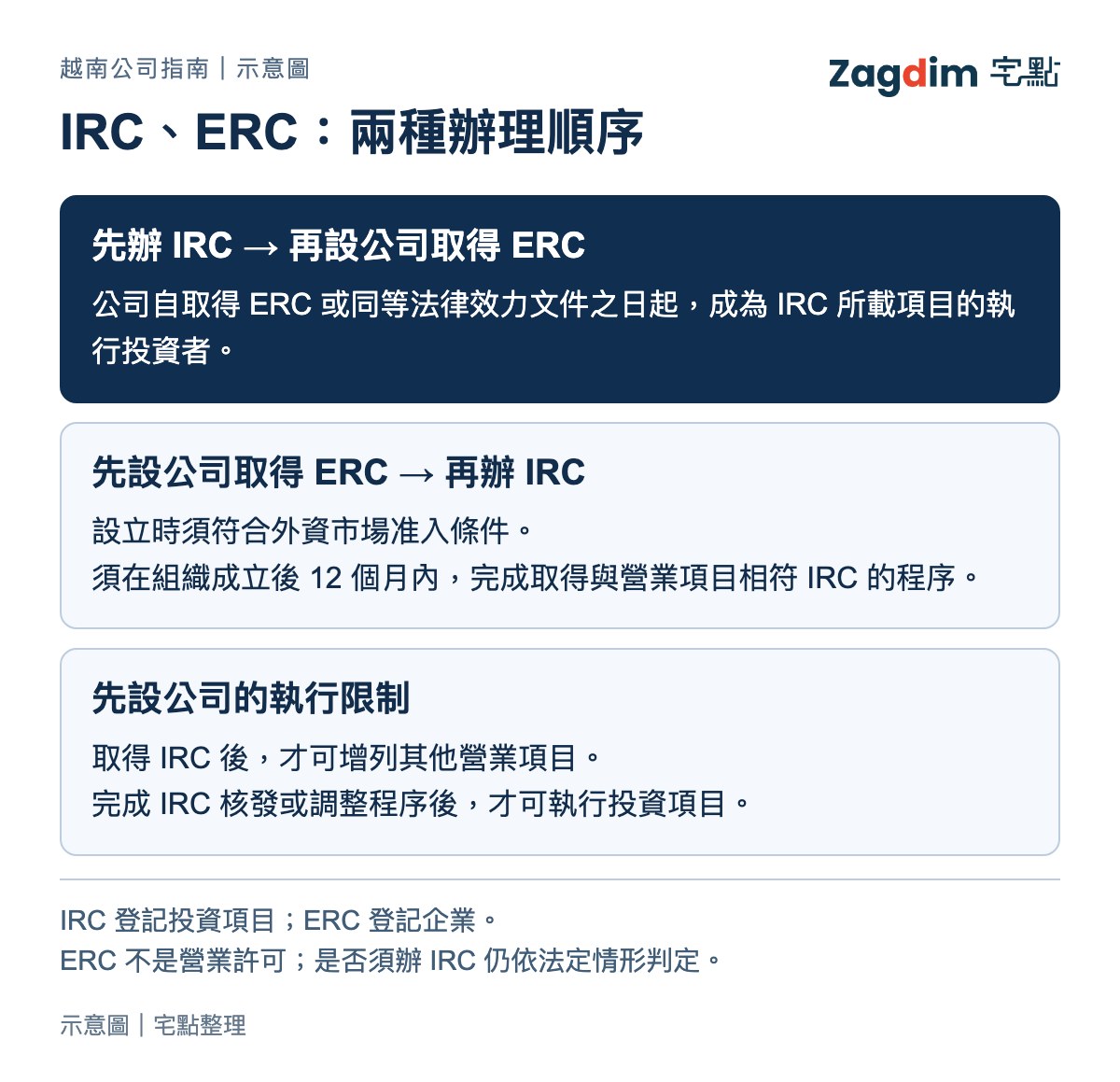
| IRC first | The IRC is issued or adjusted first, then the economic organization is established | The company becomes the entity executing the project listed on the IRC from the date it obtains the ERC or an equivalent legally effective document |
| Company first, ERC first | The economic organization is established first, then the IRC is issued or adjusted | Subject to conditions, a deadline, and restrictions, set out below |
Choosing the “company first, ERC first” route comes with four things to watch for:
- The company must meet foreign market-access conditions at the time it is set up. Market access refers to whether foreign capital can enter a given industry at all, and what conditions apply.
- The company must complete the process of obtaining an IRC that matches its registered business lines within 12 months of being established.
- Only after obtaining the IRC can the company add further business lines.
- Only after completing the IRC issuance or adjustment process can the company actually execute the investment project.
In other words, setting up the company first does not skip the IRC process, and this route comes with a deadline, business-line limits, and execution restrictions. The next section covers which projects need an IRC at all.
It is also worth noting that both single-member and multi-member limited liability companies acquire legal entity status from the date the ERC is issued, meaning the company becomes an independent legal subject. But legal entity status is not the same as holding all required industry licenses, and it is not the same as holding residency status.
In the investor’s case, if the investor sets up the company first, the company must meet foreign market-access conditions at the time of establishment, and must complete the IRC process described above within 12 months of being established.
When Is an IRC Actually Required?
An IRC is not required for every investment. Whether one is needed depends on the investor’s status, the ownership structure, and the form of investment, not simply on whether foreign capital is involved.
An IRC is required for investment projects of foreign investors, and for projects of economic organizations with any of the following structures:
- A foreign investor holds more than 50% of the charter capital (the capital amount registered for the company), or foreign individuals make up the majority of general partners in a partnership (a type of partner status within a partnership);
- One of the organizations described above holds more than 50% of the charter capital;
- Foreign investors and the organizations described above together hold more than 50% of the charter capital.
“More than 50%” here does not include exactly 50%. For example, if the investor and a business partner set up a company together and the investor holds exactly 50%, that does not count as “more than 50%.”
An IRC is not required in the following situations:
- Projects of domestic investors;
- Projects of economic organizations that do not fall under the structures above, as defined by the Investment Law (Luật Đầu tư);
- Investment made in the form of capital contribution, or the purchase of shares or a capital contribution portion.
However, not needing an IRC does not mean the obligations around foreign market access, investment policy approval (the process by which the relevant authority reviews and approves an investment project), or pre-registration before an acquisition (registering first, before a change of member or shareholder is allowed) no longer apply. These obligations each have their own separate rules. For more on how charter capital relates to actual project funding, see Zagdim’s wiki article on how much charter capital a Vietnam company should register, and its effect on banking, tax, and day-to-day operations.
Which Industries Are Closed to Foreign Capital, and Which Are Conditional?
Before settling on an industry, check whether foreign capital can operate in it at all. Foreign investors cannot enter every industry, and even where they can, full foreign ownership is not always allowed.
Foreign investors are, in principle, subject to the same market-access conditions as domestic investors, but the separate list of restrictions on foreign capital is split into two categories:
- “Not yet open for access”: industries not yet open to foreign capital.
- “Conditional access”: industries that require specific conditions to be met before foreign capital can enter.
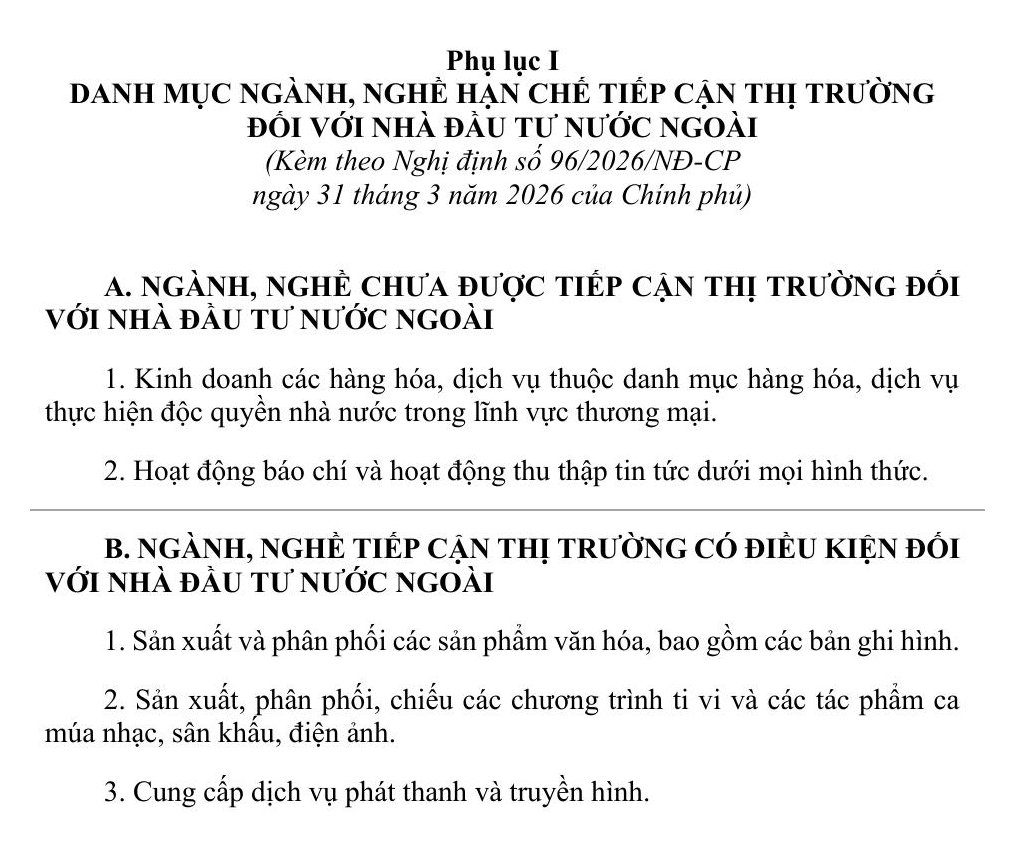
Conditions that may apply under “conditional access” can include:
- Foreign ownership ratio;
- Form of investment;
- Scope of activity;
- Investor capability;
- Business partners;
- Other conditions set by law or by an international treaty to which Vietnam is a party.
The list of market-access restrictions on foreign capital is a separate document from the list of conditional business lines that applies to all businesses, foreign or domestic, and the two need to be checked separately. The dates for the list of conditional business lines are as follows:
- The Investment Law’s list of conditional business lines: effective from July 1, 2026.
- The Law Amending and Supplementing the Investment Law (Luật sửa đổi, bổ sung một số điều của Luật Đầu tư), which replaces this list: effective from March 1, 2027.
Investment treaties, which are agreements in which Vietnam and other parties set out investment rules, can also affect market-access conditions:
- When a treaty can apply: the foreign investor falls within the scope of a given investment treaty, and that treaty’s market-access conditions are more favorable than Vietnam’s domestic law.
- When more than one treaty could apply, with different conditions: the investor must choose one treaty to apply across all of its business lines, and once chosen, must comply with that treaty’s full set of rights and obligations.
- What is not allowed: picking the most favorable condition from each of several different treaties and combining them, or assuming which treaty applies purely based on where the investor is located.
Eligibility and the specific commitments under a treaty each need to be checked separately. In the investor’s case, the question of which treaty applies cannot be settled simply by looking at where the investor happens to be based.
Does Getting an ERC Mean You Can Start Operating?
Getting an ERC is an important step, but it does not mean every procedure is complete. The answer is no: the ERC also serves as the enterprise’s tax registration certificate, but it is not a business license (giấy phép kinh doanh).
A limited liability company that obtains an ERC gains legal entity status. But if the company’s industry falls under the list of conditional business lines, or under the foreign investor’s list of conditional market-access industries, the company still needs to meet the relevant conditions as a matter of law, and must keep meeting them throughout the entire period it operates, not just once at the time of setup.
A retail outlet is one example. A foreign-invested economic organization that wants to set up a retail outlet needs a Retail Outlet Establishment License (Giấy phép lập cơ sở bán lẻ), which in principle is applied for after the company has obtained its Business License and its outlet documentation. If the first outlet is located in the same province or centrally-governed city as the company’s head office, the Business License and the license for the first outlet can be applied for at the same time.
In the investor’s case, if the investor’s company is a foreign-invested economic organization, opening the first store means following this exact sequence to confirm the order of licenses needed.
How Long Does IRC Review Take for Projects That Don’t Need Investment Policy Approval?
Processing time depends on the type of project and the state of the paperwork. For projects that do not require investment policy approval, the registration authority issues the IRC within 10 working days of receiving a valid application, but only if every applicable condition is already met.
The registration authority may consult local authorities if needed. The project must meet all of the following conditions at the same time:
- It does not fall under a prohibited industry;
- There is a site with provable usage rights;
- It complies with planning and foreign market-access rules;
- Where applicable, it also meets conditions on land investment rate per unit, labor headcount, and technology review.
In short, the 10-working-day period only applies to projects that do not need investment policy approval, where the paperwork is valid and every condition is already satisfied. It is not counted from the day you start preparing your documents.
Does Proof of Financial Capacity Have to Be Two Years of Financial Statements?
Proof of financial capacity is documentation used to demonstrate an investor’s financial resources. The answer is no: when an investor applies for investment policy approval for a project, proof of financial capacity only needs to include at least one of the following, and the most recent two years of financial statements is just one option among them:
- Financial statements from the most recent two years;
- A financial support commitment from a parent company;
- A financial support commitment from a financial institution;
- A guarantee of the investor’s financial capacity;
- Other documents that can demonstrate the investor’s financial capacity.
In other words, if the most recent two years of financial statements are not available, one of the other listed documents can be substituted instead, though acceptance of any single document is not guaranteed.
When Buying Shares in an Existing Company Directly, When Does Pre-Registration Apply?
Buying shares in an existing company can also trigger a prior procedure. When a foreign investor makes a capital contribution, or buys shares or a capital contribution portion (the portion a contributor holds within a company), pre-registration is required, before any change of member or shareholder can go through, in the following three situations:
- Increasing foreign ownership in a company that is in a conditional market-access industry;
- Causing foreign ownership, or ownership by an organization listed under the Investment Law (the specific article is noted in the sourcing section below), to go from 50% or below to above 50%, or increasing it further when it is already above 50%;
- The invested organization holds a land-use rights certificate (the document proving the right to use land) for land located on an island, in a border commune or ward special zone, in a coastal commune or ward, or in another area that affects national defense and security.
So, while buying shares or a capital contribution portion is listed as not requiring an IRC, that does not mean every change of ownership can simply go through without any prior step.
Can You Open a Capital Account and Inject Capital Before Getting the IRC?
The answer is yes, but with restrictions on what the account can be used for: when a foreign investor sets up the economic organization first and applies for the IRC afterward, that organization is allowed to open one foreign-currency capital account and/or one Vietnamese dong capital account (a bank account used to handle capital inflows and outflows) at the same licensed bank, before the IRC is issued or adjusted.
At this stage, the account can only be used for a limited set of purposes set out by law:
- Receiving charter capital and any interest earned on the account balance;
- Paying lawful costs of preparing the investment in Vietnam;
- Refunding capital to the investor or to a member enterprise (doanh nghiệp thành viên) if the IRC is ultimately not issued or adjusted.
Only after the IRC is issued or adjusted can the company open additional foreign-currency accounts, and all account activity must still comply with the rules of the State Bank of Vietnam (Ngân hàng Nhà nước Việt Nam, SBV).
It’s worth flagging that being able to open the account does not mean the investment project can be run ahead of schedule, and the costs of preparing the investment cannot be stretched to cover all day-to-day operating expenses. In the investor’s case, the company can use this account to receive its charter capital, but that does not mean it can start running the store before the proper stage.
For more on the ongoing operating responsibilities after a company is set up, see Zagdim’s wiki article on Vietnam accounting, tax, social insurance, and annual compliance obligations after incorporation.
Can Someone Else Be a Nominee Shareholder or Capital Contributor on Your Behalf?
The answer is no: under Vietnamese law, a company’s owners, shareholders, and members are not allowed to contribute capital to the enterprise on someone else’s behalf using their own name as a stand-in. Acting as a nominee means using one’s own name to contribute capital for someone else.
The Enterprise Law (Luật Doanh nghiệp) has its own separate rules governing contributed assets, which apply to all company owners, shareholders, and members.
It’s also worth clarifying that a shareholder lawfully designating an authorized representative is a different system from using a false name to conceal the real investor. A legitimate authorized representative of an organizational shareholder cannot simply be treated as equivalent to nominee capital contribution.
In short, using a nominee shareholder to get around foreign-investment conditions is not a lawful approach. In the investor’s case, even if the investor asked a friend to act as a nominee shareholder to get around foreign-investment conditions, that would equally be unlawful.
Frequently Asked Questions
Does getting an ERC mean you can start operating? Not necessarily. The ERC also serves as the enterprise’s tax registration certificate, but it is not a business license. If the business falls under a conditional business line, or a foreign investor’s conditional market-access industry, it still needs to meet the relevant conditions by law, and must keep meeting them throughout the entire period it operates.
Can a foreigner fully own any Vietnamese company? Not necessarily. Foreign investors are, in principle, subject to the same market-access conditions as domestic investors, but the separate restrictions list for foreign capital splits industries into “not yet open for access” and “conditional access.” Conditional access can carry limits such as an ownership ratio cap, and international treaties may set separate conditions as well.
Can you get the ERC first and then apply for the IRC? Yes, but with four restrictions:
- The company must meet foreign market-access conditions at the time it is set up.
- It must complete the process of obtaining an IRC matching its business lines within 12 months of being established.
- Only after obtaining the IRC can it add further business lines.
- It must complete the IRC issuance or adjustment process before it can execute the investment project.
Glossary
- Foreign investor: an individual who holds a foreign nationality, or an organization established under foreign law that carries out investment or business activities in Vietnam.
- Foreign-invested economic organization: an economic organization that has a foreign investor as a member or shareholder.
- Investment Registration Certificate (IRC): a registration certificate issued for an investment project. Whether one is required depends on the investor’s status, the ownership structure, and the form of investment.
- Enterprise Registration Certificate (ERC): a registration certificate for an enterprise, which also serves as its tax registration certificate, but is not a business license. A limited liability company obtains legal entity status from the date the ERC is issued.
Methodology and Sourcing Notes
This article’s facts were checked as of November 2, 2026. The conclusions on foreign market access, the relationship between the IRC and ERC, industry restrictions, and pre-registration before an acquisition are drawn from Vietnam’s National Assembly Investment Law and related government decrees. Some provisions, such as the restrictions on capital-account activity when a company is set up before the IRC, are not explained in plain language by the authorities; they are summarized here based on the wording of the relevant articles.
The retail outlet license discussed above is included only as an example. It is not a complete statement of every retail market-access rule or of any individual investment treaty’s commitments. This article also does not list any country-specific industry treaty commitments.
Separately, the Law Amending and Supplementing the Investment Law, Luật số 24/2026/QH16, which replaces the list of conditional business lines, takes effect March 1, 2027, with some provisions taking effect January 1, 2027. Both dates are later than this article’s check date, so these changes are not yet in force.
The provisions referenced in this article correspond to the following articles:
- Economic organization projects that do not require an IRC: Investment Law, Article 20, Clause 2.
- The organizations referred to under pre-registration before an acquisition: Investment Law, Article 20, Clause 1.
- List of conditional business lines: Investment Law, Appendix IV.
- Retail Outlet Establishment License: Decree 09/2018/ND-CP.
- Account rules following IRC issuance or adjustment: Circular 38/2026/TT-NHNN, Article 7, Clause 1 (opening additional foreign-currency accounts), and Articles 8 and 9 (account activity).
- Rules on contributed assets: Enterprise Law, Article 34, Clause 2.
Need help with this? Talk to the Zagdim reader desk
Zagdim’s reader desk can help you work out which registration route and approvals apply to your specific business plan in Vietnam.
Message the Zagdim reader desk on WhatsApp Message the Zagdim reader desk on LINE
Have a question about this guide? Leave a comment below, or ask Zagdim directly.
Your first stop for international property and global living.
Research and insights. Know what’s changing. Understand what matters.
Sources
- Quốc hội — Luật số 143/2025/QH15 luật Đầu tư (congbao.chinhphu.vn)
- Văn phòng Quốc hội — Văn bản hợp nhất số 67/VBHN-VPQH hợp nhất Luật Doanh nghiệp (congbao.chinhphu.vn)
- Chính phủ — Nghị định số 96/2026/NĐ-CP quy định chi tiết và hướng dẫn thi hành một số điều của Luật Đầu tư (congbao.chinhphu.vn)
- Chính phủ — Nghị định số 168/2025/NĐ-CP về đăng ký doanh nghiệp (congbao.chinhphu.vn)
- Chính phủ — Nghị định số 09/2018/NĐ-CP quy định chi tiết Luật thương mại và Luật Quản lý ngoại thương về hoạt động mua bán hàng hóa và các hoạt động liên quan trực tiếp đến mua bán hàng hóa của nhà đầu tư nước ngoài, tổ chức kinh tế có vốn đầu tư nước ngoài tại Việt Nam (congbao.chinhphu.vn)
- Ngân hàng Nhà nước Việt Nam — Thông tư 38/2026/TT-NHNN (congbao.chinhphu.vn)
- Chính phủ — Nghị định 296/2026/NĐ-CP (congbao.chinhphu.vn)
- Quốc hội — Luật số 24/2026/QH16 luật Sửa đổi, bổ sung một số điều của Luật Đầu tư (congbao.chinhphu.vn)
Disclaimer
This article is a general information summary and does not constitute tax or legal advice for any individual case. Information was checked as of November 2, 2026. Vietnam’s regulations may be updated; please refer to the current notices of the relevant authorities, and consult a qualified professional for your specific situation.