
































You may have heard the saying, “A home is for living in, not for speculation.” That is true enough — but once you move your life across cities, invest for the long term, or hope to preserve and pass on wealth through property, “living in it” stops being the only purpose.
In fact, a home you live in and a home you invest in have always run on different tracks. A home to live in is about location, convenience and quality of life. An investment property adds an invisible but critical line item: return. Whether it is rent landing in your account every month, potential future appreciation, or simply a hedge that protects your money’s purchasing power against inflation, all of this counts as a property’s “return.”
The real question to ask is: why are you buying?
- For someone approaching retirement, stable rental income is a form of pension.
- For someone younger, positioning early in an area with good returns is a springboard to financial freedom.
- For a family, choosing a property that can appreciate and be rented out is a way of building assets for your children’s future.
Buying a home is not just about owning a place — it is a financial decision. And behind that decision, return is what determines whether you win time and freedom.
The Three Dimensions of Property Return
Talk of “collecting rent” often stops at, “this property brings in tens of thousands a year!” But the money that actually lands in your pocket is rarely that simple.
1. Rental Yield
Rental yield is the first metric used to evaluate an investment property’s value — but do not stop at the headline number.
Gross rental yield is the most common figure, used to quickly compare the appeal of different areas. It is calculated as:
Annual rental income ÷ purchase price × 100%
For example: a unit in central Bangkok bought for THB 6,000,000, renting for THB 25,000 a month (THB 300,000 a year), has a gross rental yield of:
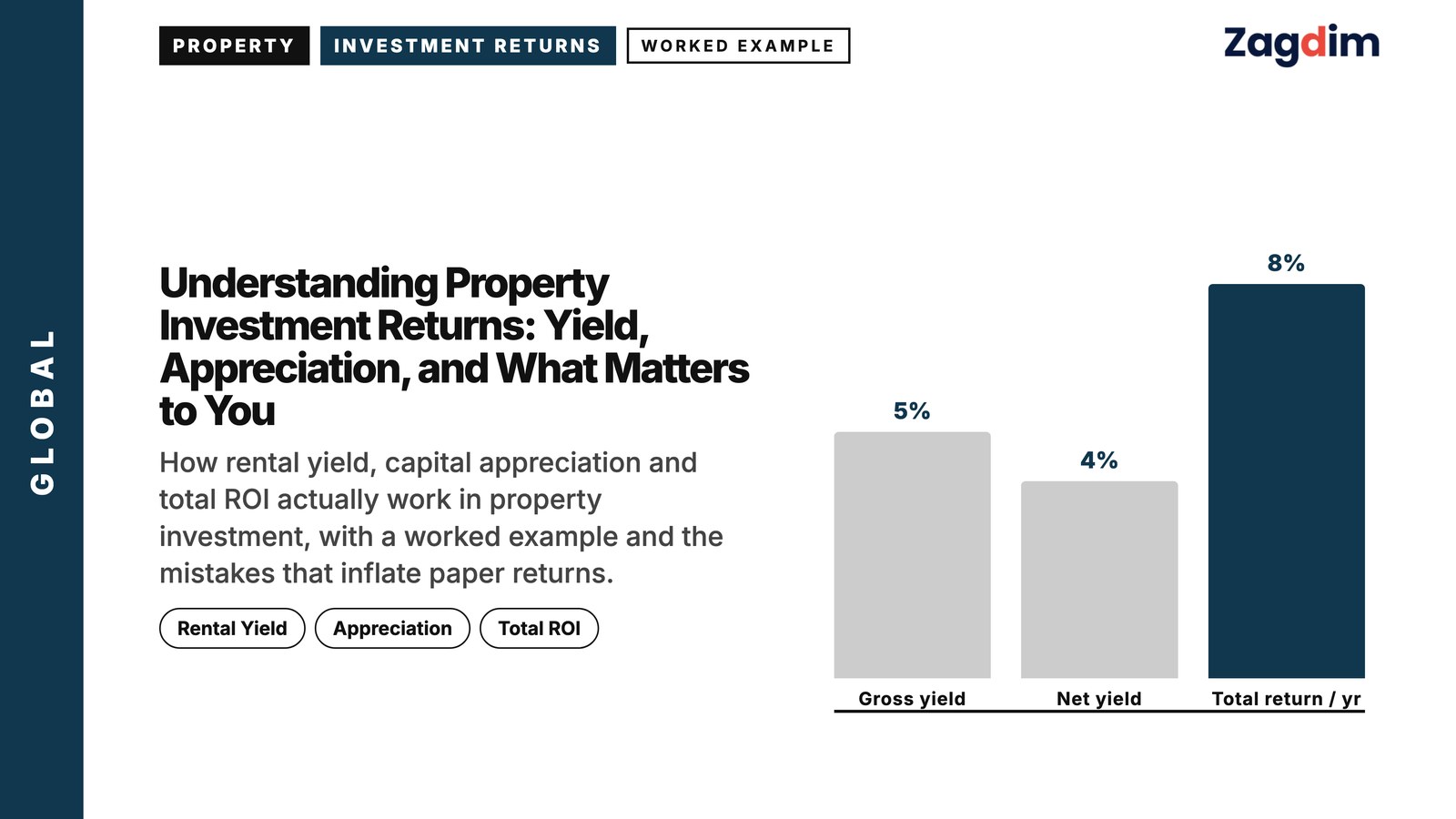
THB 300,000 ÷ THB 6,000,000 × 100% = 5%
What is actually worth your attention is net rental yield — what is left after all expenses, including:
- Management fees and a maintenance/sinking fund (roughly THB 20,000 a year)
- Local or property tax (for example, Dubai’s municipal tax is about 5% of annual rent)
- Vacancy periods (assume one month vacant a year = THB 25,000 in lost income)
- Agent commission, tenancy registration, cleaning and upkeep (averaging THB 10,000–20,000 a year)
Working through the same example:
| Item | Amount (THB) |
|---|---|
| Annual rental income | 300,000 |
| Vacancy loss (1 month) | -25,000 |
| Management and maintenance fees | -20,000 |
| Other costs (tax, registration, sundries) | -15,000 |
| Actual net annual income | **240,000** |
| Net rental yield | 240,000 ÷ 6,000,000 = **4%** |
That is the real, cash-in-hand return you can actually collect and keep every year.
A high headline rental yield often comes with heavier management demands and hidden risk. Before choosing a property, weigh it against your actual capacity to hold it, whether you have a reliable local managing agent, and how you plan to handle tax.
2. Capital Appreciation
Some buyers are not chasing rent at all — they are betting on appreciation. A property’s price movement can indeed decide the fate of your investment, but that path is rarely a straight line up.
Areas and cities that do appreciate tend to share three structural conditions:
- Infrastructure investment: new metro lines, transport hubs, major medical or education facilities (for example, London’s Old Oak Common, or areas along new high-speed rail lines)
- Population and employment growth: an influx of young residents, clusters of innovative companies (for example, Manchester, East Berlin, or Thu Duc new town in Ho Chi Minh City)
- Policy direction and planning: urban renewal programs, free economic zones, tax incentives (for example, Dubai’s free zones, or Bangkok’s Eastern Economic Corridor, EEC)
Since the pandemic, several cities or districts have seen striking, even “doubling,” appreciation:
- Dubai: an influx of wealthy residents during the pandemic saw luxury homes around Palm Jumeirah appreciate more than 100% in just three years.
- Eastern Bangkok along Bangna–Udomsuk: riding the EEC and light-rail development, some projects rose from THB 120,000/sqm to THB 180,000/sqm, a gain of more than 40%.
- London Zone 3 (areas such as Woolwich and Acton): the opening of the new Crossrail line drove gains of more than 30% within three years.
There is a trap here too. Not every location that “looks like it will appreciate” actually delivers a return. Many locations that surge in the short term — newly launched, hyped developments or high-commission overseas projects — often cool quickly after launch, and resale prices can even fall below the purchase price. Some areas also saw a rapid rise during the pandemic on the back of a tourism or short-let recovery, but without genuine structural demand behind them; once the rental market cools or policy tightens (such as restrictions on Airbnb-style lets), prices can reverse just as quickly.
Genuinely worthwhile capital appreciation is not manufactured through speculation — it comes from a city “growing” on its own. Rather than chasing the next hot spot, it is worth asking calmly:
- Will the population here actually grow?
- Will young people actually stay?
- Will the government actually put real money in?
Total Return on Investment (Total ROI)
Rent can support you, and appreciation can reward you — but what really decides whether the whole investment was worthwhile is how much you walk away with at the end.
That is what Total ROI measures: the full picture only becomes clear once you sell the property and settle all costs against all proceeds. In simple terms, the formula is:
(Sale price − Purchase price) + net rent collected while holding − all expenses, all divided by your actual capital invested
For example:
- You buy a unit in Thailand for HKD 2,000,000.
- Five years later you sell it for HKD 2,500,000, a gain of 500,000.
- Over that period you collected HKD 80,000 a year in rent, totaling 400,000, while holding costs (management fees, tax, maintenance, etc.) totaled 100,000.
- Actual proceeds: 500,000 + 400,000 − 100,000 = 800,000.
- On capital invested of 2,000,000, the total return is: 800,000 ÷ 2,000,000 = 40% over five years — an average of about 8% a year, not simply the 4% you might assume from rental yield alone.
Two important risks should not be overlooked here:
- Exit market conditions: How liquid is the local market? Will it sell easily? Who will actually buy your unit?
- Currency risk: You may buy in one currency, collect rent in the local currency, and eventually convert everything back to a third currency. Exchange rate swings along that round trip will directly rewrite your final return.
For example: if you originally bought a Thai property using Hong Kong dollars, but five years later the Thai baht has depreciated 10% against the Hong Kong dollar, all of your local-currency gains shrink by 10% automatically once converted back.
This is why genuine investors do not just ask whether rental yield is high — they think through the entire cycle, from entry to holding to exit, weighing risk and efficiency at every step.
Working Out the Return That Is Right for You
When someone tells you a property has “amazing returns” or is “guaranteed to appreciate,” the question is not “how good is it?” — it is: which kind of return do I actually need?
Everyone’s financial situation, life stage and risk tolerance differ, so there is no single standard answer for “the right return.” Consider it from a few angles:
1. Are you after rental cash flow, or long-term appreciation?
- If you want steady monthly income to support living costs or retirement plans, look at net rental yield, not speculative price gaps.
- If you have other income sources and are not in a rush to recover capital, you might instead choose an emerging area with redevelopment potential and infrastructure support.
2. How large is your budget? How long can you hold? Can you get a mortgage?
- If you have limited capital and want results within five years, you need a fast-in, fast-out, asset-light product (such as a low total-price, quick-to-let small unit).
- If you can hold for longer and have flexible capital, you can pursue mid-to-high-potential, policy-supported regional projects.
3. Domestic property vs. overseas property — it is not about which is “better,” but that the return structure is different:
| Category | Domestic Property | Overseas Property |
|---|---|---|
| Advantages | Familiar market, clear tax rules, high liquidity | Higher rent, larger price-gap potential, more policy incentives |
| Disadvantages | Lower returns, higher entry threshold | Complex regulations, currency risk, management cost |
4. Do you have a tax plan and an exit strategy?
Many people only think about “buying in” and overlook “selling out.” If you cannot resell smoothly in the future, or tax costs are too high, or double taxation is involved, even the best-looking return on paper cannot be realized.
This matters especially for overseas investment — check whether you meet local non-resident tax filing requirements, and whether you need to set up a company or apply for a tax number (such as a UK NINO or a Thai TIN).
Your ideal return is not about a headline percentage — it is about whether it matches your risk tolerance and the rhythm of your life. Rather than chasing the market’s next hot spot, calmly work out the numbers that fit you.
Common Mistakes and Reminders
Talking about return is about making a clearer-eyed choice. In the course of working with many clients, we have also seen several recurring traps — they look backed by data, but hide real risk.
1. High return does not mean low risk
Many projects advertise “6% rental yield, 50% appreciation potential.” You must ask: is that gross or net return? Does it include tax, management fees, vacancy risk? A number that looks impressive can come from a very short-term hot market or a guaranteed-rent leaseback scheme — once that scheme ends, the return can collapse back to reality.
2. Chasing the appreciation dream while ignoring cash flow
We have seen many people expect prices to double while overlooking that the property is quietly bleeding money every month. If you cannot get stable income from rent, relying on capital appreciation alone is like waiting for the weather — it might come, but can you hold out until then?
3. Ignoring currency and local tax
The most commonly overlooked cost in overseas property investment is the cost you cannot see: currency swings can wipe out 10% of your annual return in a single year, and local tax (such as Thailand’s 5% rental tax, or the UK’s capital gains tax, CGT) can eat into your profit at exit if not planned for.
4. Skipping the financial modeling and having no exit plan
Buying based only on a sales presentation, without a complete financial model, is what lets risk balloon unchecked. You should know: how many years you plan to collect rent, what your exit conditions are, and how liquid the local secondhand market is — otherwise even the highest potential may never be realized.
Investment is not about who profits fastest — it is about who can go the distance. Understanding return is not about calculating every last cent; it is about having enough clarity to know whether this investment can bring you security and choice for your future.
Summary and Next Steps
A property has never been just “a home” — it is a financial decision about money, time and life planning. It can become a lever toward financial freedom, or it can become a long-term trap. The difference lies in whether you saw the full picture of the return from the start.
Remember: every property is a financial plan, not an impulse purchase.
Rather than following someone else’s advice or chasing the market’s hottest location, ask yourself three questions first:
- Do I want monthly rental income, or long-term appreciation?
- How much capital do I really have to spare? How long can I hold it? How much risk can I bear?
- Where will I actually live in the future? Should this asset be paired with a residency or relocation plan?
Once you start letting return-based logic guide your choices — instead of following trends, chasing hot spots, or comparing headline profit numbers — things start to become clearer. You are no longer just “buying a home.” You are building a controllable capital system for your own future.
Right now may well be the point to reset your direction and plan your next move.
*Disclaimer: This article is for investment reference only and does not constitute financial or legal advice. Data may be updated as regional conditions or policies change; please confirm actual local conditions before acting.*
Have a question about this guide? Leave a comment below, or ask Zagdim directly.
Your first stop for international property and global living.
Research and insights. Know what’s changing. Understand what matters.