
































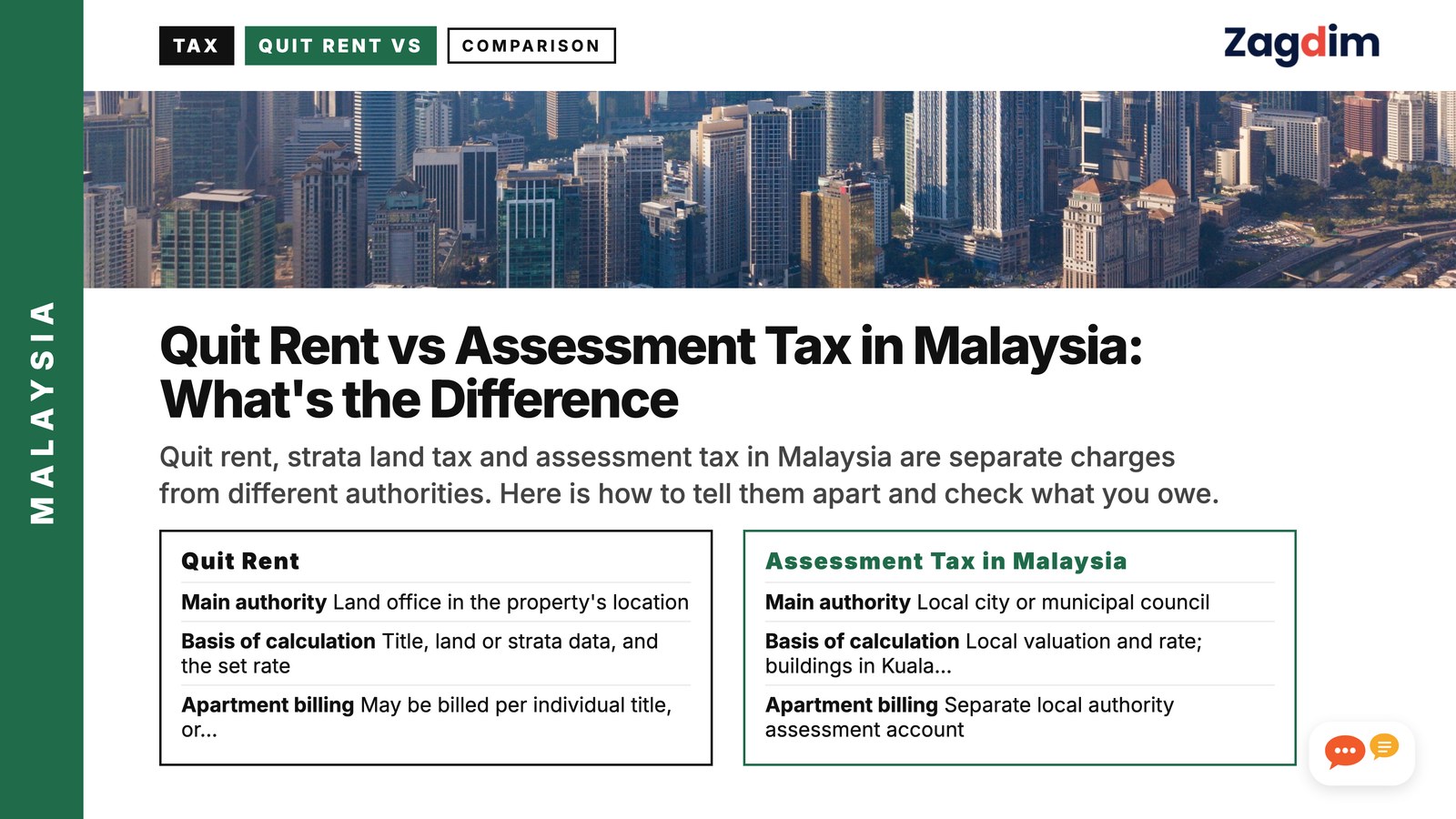
Property owners in Malaysia typically encounter two separate recurring charges: quit rent (Cukai Tanah) and assessment tax (Cukai Taksiran, also called Cukai Pintu). They are collected by different authorities, calculated differently, and paying one does not offset or replace the other. Apartment owners may also encounter strata land tax (Cukai Petak), which has its own relationship to quit rent that needs to be checked before assuming it duplicates anything. This article explains how each charge works and what to verify, using Kuala Lumpur and Selangor as the reference examples. Arrangements and fees in other states, federal territories, and East Malaysia should still be confirmed against the specific property’s location.
Quit Rent Depends on Land Title and Location
Quit rent is generally handled by the land office in the property’s location, based on land use, category, size, and the locally set rate. There is no single nationwide percentage that can be applied to a property’s market price to estimate the amount owed.
Landed homes and stratified apartments do not necessarily receive the same type of bill. When making an inquiry, owners should have the title, lot number, or tax account number ready, rather than only the development’s marketing name.
In Selangor, for example, the current year’s quit rent or strata land tax is generally required to be paid by May 31. Deadlines and any adjustments in other states should be confirmed separately.
Strata Land Tax Is Not an Additional Quit Rent Charge
For units where strata land tax has been implemented and applies, the land tax is handled under the individual strata title, replacing the original arrangement under the master title. Owners should not assume, without checking, that this means an extra land tax is being charged on top of what was already paid for the same period.
For projects still under a master title, the developer or management body may pay the quit rent first and then collect a proportional share from owners under the applicable arrangement. So not receiving an individual quit rent bill does not mean the project has no such cost.
When a property transitions to strata land tax, if a bill still shows a master-title apportionment, owners should check which year it covers, whether it is an outstanding balance from before, and what has already been paid, rather than assuming either charge can be skipped.
Assessment Tax’s Annual Value Is Not the Rent You Actually Collect
Assessment tax is collected by the local authority. For buildings in Kuala Lumpur, for example, the annual value is the estimated gross annual rental that the property could reasonably be expected to achieve, multiplied by the applicable rate.
Even an owner-occupied property can be assessed based on a reasonable assumed rental value. A tenant moving out, a temporary rent reduction, or never having rented the property out at all does not automatically bring the annual value to zero.
Different property uses may fall under different classifications and rates. The assessment category, land use, and public service charge each have their own basis, so a single label such as “residential” or “commercial title” is not enough to calculate the full amount owed.
Quit Rent / Strata Land Tax vs. Assessment Tax at a Glance
| Quit Rent / Strata Land Tax | Assessment Tax | |
|---|---|---|
| Main authority | Land office in the property’s location | Local city or municipal council |
| Basis of calculation | Title, land or strata data, and the set rate | Local valuation and rate; buildings in Kuala Lumpur use annual value |
| Apartment billing | May be billed per individual title, or apportioned under a master title | Separate local authority assessment account |
| Relationship to maintenance fees | Cannot be assumed to already be included | Paying maintenance fees does not mean assessment tax has been paid |
What to Check at Handover and When a Reassessment Notice Arrives
At handover or during a transfer, confirm the tax account number, any outstanding balance, the apportionment between buyer and seller, and who is responsible going forward, with the lawyer and the management office. A tax apportionment settled in the sale and purchase agreement does not necessarily mean the government account has already been updated to reflect it.
When a reassessment or data-change notice arrives, check the stated property use, size, annual value, and effective date. If there is an objection to raise, it should follow the procedure and deadline stated on the notice; continuing to pay the old amount without addressing the new notice is not a substitute for responding to it.
Common Misunderstandings
“My apartment doesn’t have land, so I shouldn’t need to pay any land tax.”
An apartment is still subject to a land tax arrangement, either under an individual strata title or under a master title. Owners need to check which arrangement currently applies to their project.
“Assessment tax is based on rental income, so I don’t owe anything if I have no tenant.”
For buildings in Kuala Lumpur, for example, the calculation uses the assessed annual value, not simply the rent an owner actually collects.
How to Work This Out
Collect one bill each from the land office, the local authority, and the building’s management body, and check the account number, property details, year, and balance on each. Confirm the current arrangement first, then estimate the annual holding cost going forward.
FAQ
Do I have to pay both strata land tax and quit rent?
Where strata land tax applies, it is meant to replace the original quit rent arrangement. If a bill or notice for both arrives at the same time, check which period each covers and whether either represents an outstanding balance from before.
Is assessment tax the same as a maintenance fee?
No. The local authority’s tax and the building’s common-area maintenance charge are separate items collected by different parties.
Does an owner-occupied unit still have an assessment tax annual value?
Yes, it can. For buildings in Kuala Lumpur, for example, an owner-occupied unit is still assessed using a reasonable assumed rental value, even without an actual tenant.
Disclaimer
This article is based on information available as of October 8, 2026, and is provided for general reference only. It does not constitute tax, legal, or financial advice. Tax amounts, deductions, and refund arrangements should be confirmed against the specific property’s location rules, official bills, contracts, and individual circumstances.
Sources
DBKL — Frequently asked questions by department: assessment tax, annual value, and vacancy arrangements; Petaling Land Office — Quit rent and strata land tax FAQ; Selangor Land and Mines Department — Bills, payment, and deadlines FAQ
Have a question about this guide? Leave a comment below, or ask Zagdim directly.
Your first stop for international property and global living.
Research and insights. Know what’s changing. Understand what matters.