































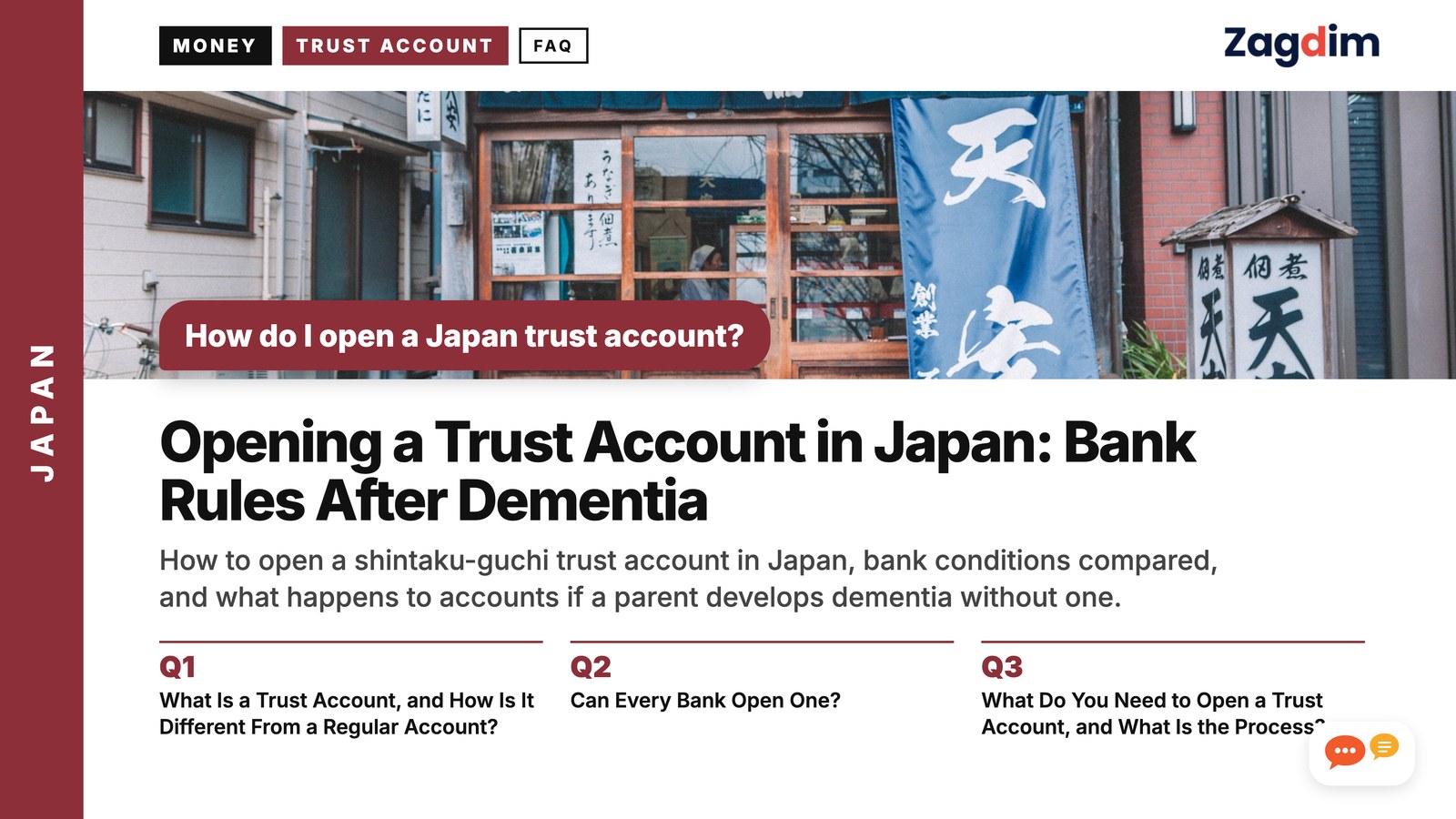
Families who own property or hold savings in Japan sometimes need to set up a trust so that a designated person can manage a parent’s assets if that parent later loses the capacity to manage them. This article looks at the practical side of doing that: how to open a trust account (shintaku-guchi kōza) at a Japanese bank, what different banks require, and what alternatives exist if a family decides not to set up a trust. It is based on official Japanese sources and the public terms published by individual financial institutions. For the basic structure of a family trust and why a parent’s bank account can be frozen after dementia sets in, see Zagdim’s main article on family trusts and dementia (linked in the “Localised” notes).
What Is a Trust Account, and How Is It Different From a Regular Account?
A trust account is a deposit account that a trustee opens to keep trust property separate from the trustee’s own money, holding only the funds that belong to the trust. The account name typically reads something like “Settlor [Name] Trustee [Name] Trust Account.” It is opened in the trustee’s name, but its use is restricted to managing the trust’s money — it is not the trustee’s personal account for everyday income and spending.
Japan’s Trust Act requires a trustee to keep trust property separate from their own property, and to keep books and report to the beneficiary. Placing the trust’s money in a dedicated account is how that separation and accounting are kept clear.
Can Every Bank Open One?
No. A report by the Research Group on Financial Law of the Japanese Bankers Association (Zenginkyo) found that financial institutions do not respond consistently: some will not open trust accounts at all, some open them but apply no special handling, and others open them and even extend financing to the trustee through that account. According to a Tokyo District Court ruling from Reiwa 3 (2021) cited in the report, banks that finance a trustee generally do so on the condition that the account is a “narrow-sense trust account” — one kept systemically separate from the trustee’s personal account. The report is the research group’s own compilation and is not a binding rule for member banks.
What Do You Need to Open a Trust Account, and What Is the Process?
Taking Sumitomo Mitsui Trust Bank’s public explanation (updated July 9, 2026) as an example, a trust account is handled through a qualified professional who drafts the trust agreement — a lawyer, judicial scrivener (shiho shoshi), administrative scrivener (gyosei shoshi), tax accountant, or certified public accountant:
- The professional first submits the draft trust agreement, a family relationship chart, and asset information to the bank.
- The bank reviews the submission and tells the professional whether an account can be opened.
- If approved, the settlor and trustee execute the trust agreement as a notarized document (kōsei shōsho).
- The trustee goes to a branch in person to open the account.
That bank’s conditions include: a deposit of generally at least 30 million yen; the trust agreement must be drawn up by the settlor and trustee themselves as a notarized document (not by proxy) — a private, non-notarized agreement cannot be used to open the account; and both the trustee and the beneficiary must reside in Japan. There is no separate fee for opening or maintaining the account. An existing ordinary deposit account cannot be repurposed to hold trust property — a new account in the trustee’s name must be opened instead. A trust agreement held jointly by co-settlors or co-trustees cannot be used to open an account, and if the trustee is a corporation, it must be a non-profit corporation.
Other financial institutions also carry out pre-review. Keiyo Bank requires review before opening and cannot open an account on the day of application; at the time of opening, the combined deposits and transactions of everyone party to the trust must reach at least 5 million yen. Nishio Shinkin Bank requires submission of the draft trust agreement, an application form, and identity documents, and states that opening the account takes time. A trust agreement can be notarized at a notary public office; the notarization fee is covered in Zagdim’s main article on family trusts.
Which Banks Offer Trust Accounts, and How Do Their Conditions Differ?
Based on the public terms of seven financial institutions as checked for this article in October 2026:
| Financial Institution | Residency Requirement | Agreement Requirement | Account Fees |
|---|---|---|---|
| Keiyo Bank | Generally individuals residing in Chiba Prefecture and neighboring areas | Not listed on the public page | Not listed on the public page |
| ORIX Bank | Generally all parties to the trust agreement reside in Japan | Drawn up by a professional such as a judicial scrivener; settlor is also the initial beneficiary | Not listed on the public page |
| Tama Shinkin Bank | Generally the settlor and trustee reside within the bank’s service area | Drawn up by a professional such as a lawyer or judicial scrivener; self-benefit trust; must be able to produce the finalized notarized agreement | Not listed on the public page |
| Sumitomo Mitsui Trust Bank | Trustee and beneficiary reside in Japan | Handled through a professional; notarized agreement executed by the parties themselves | No separate fee for opening or maintenance; deposit generally at least 30 million yen |
| Nishio Shinkin Bank | Not listed on the public page | Professional involvement required; notarized agreement; self-benefit trust; trustee must be a statutory heir of the settlor/beneficiary | Account opening: 110,000 yen (tax included); from the second year, 3,300 yen annually (tax included) |
| Awa Bank | Not listed on the public page | Trust agreement in notarized form | Not listed on the public page |
| Musashino Bank | Not listed on the public page | Full conditions not listed on the public page | Trust account setup service: 110,000 yen (tax included) |
Of the four banks that do publish a residency requirement, all require residence in Japan or within the bank’s service area as a general rule; the other three do not list a residency requirement on their public pages, and the absence of a stated requirement should not be read as meaning overseas residents can use the service. The fee comparison covers only the listed account fees — professional fees, notarization, and registration costs are billed separately. Musashino Bank also offers a separate family trust support plan (minimum 825,000 yen, or a flat 550,000 yen, tax included), which is a bank-provided service for setting up the trust structure, not a required fee for opening the account itself.
Whether a trustee who lives outside Japan can open an account needs to be confirmed individually with each financial institution; see Zagdim’s companion article on foreign nationals and non-resident settlors or trustees (linked in the “Localised” notes).
If You Don’t Set Up a Trust, Are There Alternatives at the Bank?
Some banks let a depositor designate a family member in advance to withdraw funds on their behalf, though the conditions and scope vary:
Sumitomo Mitsui Banking Corporation’s agent registration and agent cash card: according to the bank, an ordinary deposit holder can arrange in advance for an “agent registration procedure” (dairinin shimei tetsuzuki) or an “agent cash card” (dairinin kyasshu kado), allowing a designated family member to withdraw funds as an agent. The agent cash card can withdraw up to the daily ATM limit at a time; the agent registration procedure allows withdrawals over the ATM limit at the counter and can also be used to cancel a fixed-term deposit. Both must be set up at a bank branch while the account holder still has decision-making capacity; if this has not been arranged and the bank determines the account holder lacks capacity due to dementia, withdrawals from the account may become impossible.
Mitsubishi UFJ’s reservation-type agent service: according to a March 8, 2021 announcement by Mitsubishi UFJ Financial Group, an account holder can designate in advance someone to act as their agent for future transactions; after designation, the account holder continues transacting normally. Only once the account holder has difficulty transacting, and the agent submits a dedicated diagnosis document plus official documents confirming the relationship, does the agent begin transacting on the holder’s behalf. The agent is generally the spouse or a blood relative within the second degree, though other relatives or a partner can also be designated. Available transactions include yen deposit withdrawals and account closures, and the sale or cancellation of foreign-currency deposits and investment trusts, with specifics varying by group company; there is no separate fee. This reflects the 2021 announcement, so current conditions should be confirmed with the relevant branch.
Both of these arrangements cover only that bank’s deposits and other financial assets — neither extends to real estate in Japan.
What Happens If You Discover Too Late, After a Parent Has Dementia?
Under Zenginkyo’s 2021 policy considerations, if an account holder’s decision-making capacity has declined and the adult guardianship system has not been used, a family member’s ability to withdraw funds on the holder’s behalf is very limited, and banks generally require use of the adult guardianship system (details in Zagdim’s main article). This policy is guidance for member banks, not a requirement that every bank follow it identically, and outcomes may differ case by case — so whether funds can actually be accessed depends on the judgment of the bank holding the account.
Fees, requirements, and review processes vary from bank to bank.
Frequently Asked Questions
How is a trust account different from a regular deposit account? A trust account is opened in the trustee’s name, is explicitly designated as being for trust use, and holds only trust property; a regular account is for an individual’s everyday income and spending. Sumitomo Mitsui Trust Bank also states that an existing ordinary deposit account cannot be repurposed to hold trust property.
Do you need a notarized agreement to open a trust account? Among the seven banks checked for this article, Sumitomo Mitsui Trust Bank, Nishio Shinkin Bank, and Awa Bank all require the trust agreement to be in notarized form; Tama Shinkin Bank requires that the finalized notarized agreement can be produced. Sumitomo Mitsui Trust Bank states explicitly that a private, non-notarized agreement cannot be used to open the account.
Without a trust, can family members withdraw funds as an agent after a parent develops dementia? It depends on whether this was arranged in advance. Sumitomo Mitsui Banking Corporation’s agent registration procedure and agent cash card must both be set up while the account holder still has decision-making capacity. Mitsubishi UFJ’s reservation-type agent service is designated in advance and only activated later with a diagnosis document. Neither option covers real estate — only deposits.
Glossary
- Trust account (shintaku-guchi kōza): A deposit account a trustee holds exclusively for trust property, kept separate from the trustee’s own assets.
- Self-benefit trust: A trust in which the settlor and the beneficiary are the same person.
- Notarized document (kōsei shōsho): An official document prepared by a notary public.
- Adult guardianship system: A system under which a family court appoints a guardian to manage property on behalf of a person whose decision-making capacity is impaired.
- Reservation-type agent: A Mitsubishi UFJ Financial Group service in which an agent is designated in advance and activated, once the account holder has difficulty transacting, upon submission of a diagnosis document.
About This Data
The facts in this article were checked as of October 20, 2026. The conditions and fees of individual financial institutions were compiled from the seven banks’ public pages checked for this article and do not represent the practice of every bank in Japan; conditions can change at any time, so confirm with the relevant branch before opening an account. Sumitomo Mitsui Banking Corporation’s agent arrangements are drawn from a financial-planning column on the bank’s own website; Mitsubishi UFJ’s reservation-type agent service reflects a 2021 announcement; the Zenginkyo Research Group on Financial Law report is the research group’s own compilation and not a rule binding on member banks.
Have a question about this guide? Leave a comment below, or ask Zagdim directly.
Your first stop for international property and global living.
Research and insights. Know what’s changing. Understand what matters.
Sources
- e-Gov — Trust Act
- Japanese Bankers Association — Views on the Agency of Financial Transactions (February 18, 2021)
- Japanese Bankers Association — Announcement on Views Regarding Agency of Financial Transactions
- Japanese Bankers Association Research Group on Financial Law — Report, Chapter 2: Bank Transactions With Civil Trust Trustees
- Sumitomo Mitsui Trust Bank — On Opening a Trust Account for Civil Trusts
- Keiyo Bank — Family Trust
- ORIX Bank — Trust Account
- Tama Shinkin Bank — Dedicated Family Trust Account
- Nishio Shinkin Bank — Dedicated Family Trust Account
- Awa Bank — Family Trust
- Musashino Bank — Musashino Family Trust
- Sumitomo Mitsui Banking Corporation — Can You Withdraw From a Parent’s Account if It’s Frozen Due to Dementia?
- Mitsubishi UFJ Financial Group — Introduction of the “Reservation-Type Agent” Service
- Japan Federation of Notaries Public Associations — What Kinds of Notarized Documents Are There?
Important Notice
This article is a general information summary and does not constitute financial or legal advice for any individual case. Facts were checked as of October 20, 2026. Japanese regulations and financial institutions’ conditions may change; refer to each institution’s current published information, and consult a qualified professional for individual cases.