

































This article is part of Zagdim’s Vietnam wiki series. It sets out how an investment visa (ĐT), a work permit (giấy phép lao động), and a temporary residence card (thẻ tạm trú) relate to one another once a foreigner sets up a company in Vietnam. It is written for readers considering forming a company, working, or living long-term in Vietnam, wherever they are from and whether or not they are currently in the country.
Whether you can get a visa, whether you need a work permit, and whether you can apply for a residence card each have their own, independent thresholds and conditions. Think of them as three separate checkpoints: clearing one does not mean you have cleared the others. For the basic structure and responsibilities of setting up a company, see “Foreign-Owned LLCs in Vietnam: Capital and Operating Responsibilities Before You Register.”
Example (used throughout this article): Lin is a hypothetical reader, based outside Vietnam, who plans to set up a limited liability company there and work on site. Lin is a capital-contributing member with a contribution valued at VND 3 billion, and has a spouse, one child under 18, and one adult child.
Does Setting Up a Company Guarantee an Investment Visa?
Start by separating the company from the visa. The answer is no, not automatically: forming a company does not by itself grant an investment visa or a right of entry.
An investment visa is issued to a foreigner who invests in Vietnam. To apply for a visa for investment purposes, you need to meet the following conditions:
- Hold a passport or an international travel document.
- Provide documents proving, under the Investment Law, that you are investing in Vietnam.
- Not fall under any of the statutory grounds for entry refusal, that is, the situations the law lists as grounds to deny entry.
- Be invited or sponsored by an agency, organization, or individual inside Vietnam, in other words, someone or some entity in Vietnam steps forward to invite you or vouch for you; the law sets out specific exceptions to this requirement.
Which investment visa class you qualify for mainly depends on the capital contribution value of the foreign investor, or of the representative of a foreign investment organization (the person who acts on behalf of a foreign investing entity): how much that person personally contributed, not the company’s total registered charter capital. Visas are divided into four classes by contribution size, ĐT1 through ĐT4. ĐT1 and ĐT2 also have an alternative qualifying path based on the investment industry or region. Maximum terms range from 1 to 5 years.
| Visa Class | Capital Contribution Threshold | Maximum Visa Term | Alternative Qualifying Path |
|---|---|---|---|
| Investment Visa Class 1 (ĐT1) | At least VND 100 billion | 5 years | Investment in an industry or region the government has designated as investment-incentivized |
| Investment Visa Class 2 (ĐT2) | At least VND 50 billion, under VND 100 billion | 5 years | Investment in an industry the government has designated as encouraged for investment development |
| Investment Visa Class 3 (ĐT3) | At least VND 3 billion, under VND 50 billion | 3 years | None |
| Investment Visa Class 4 (ĐT4) | Under VND 3 billion | 1 year | None |
Keep three things in mind when reading this table:
- The terms shown are maximums, not terms that are guaranteed to be issued.
- Every visa class’s term must be at least 30 days shorter than the remaining validity of your passport or international travel document.
- Where an international treaty Vietnam has joined sets a different term, the treaty term applies.
For example: a foreign investor who contributes VND 50 billion to a Vietnamese company, if the other conditions are met, qualifies for the ĐT2 investment visa, with a maximum term of up to 5 years, still limited by the passport or international travel document’s remaining validity.
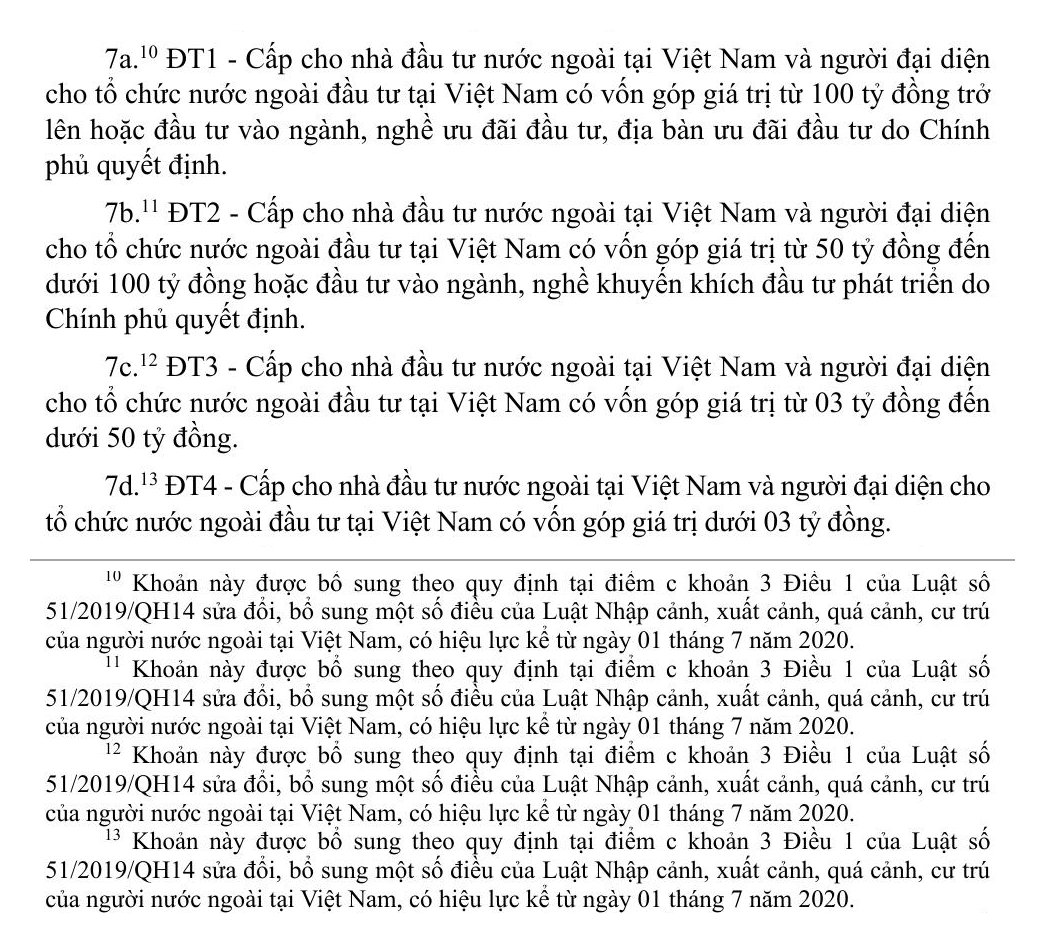
Example (Lin): A contribution value of VND 3 billion falls within the ĐT3 range. If the other conditions are met, Lin qualifies for ĐT3, with a maximum term of 3 years, likewise limited by the passport or international travel document’s remaining validity.
How Much Capital Contribution Exempts You From a Work Permit?
A work permit is the document that authorizes a foreigner to work in Vietnam. The answer: an owner of a limited liability company, or a capital-contributing member, who personally contributes at least VND 3 billion does not need a work permit.
In that case you also do not need to apply for a work-permit exemption confirmation (the document that certifies you do not need a work permit). You still need to notify the confirmation authority (the government body responsible for this) in your intended place of work, at least 3 working days before you expect to start working in Vietnam, giving the following information:
- Name, date of birth, nationality, and passport number
- Employer’s name
- Place and duration of work
In other words, contributing VND 3 billion or more exempts you from the work permit itself, not from every work-related procedure: you still need to notify the authority in advance.
If you are a foreign worker who does need a work permit, the process is as follows:
| Item | Requirement |
|---|---|
| Who files | The employer |
| When to file | Within 60 days before the expected start date, and at least 10 days in advance |
| Where to file | The local Public Administrative Service Center (Trung tâm Phục vụ hành chính công) for the intended place of work |
| Review time | The authority reviews the labor demand (the company’s need to employ a foreign worker) and issues the permit within 10 working days of receiving the complete file; this is the statutory review period, not a guarantee of approval |
| If not approved | If the demand is not approved, or the permit is not issued, the authority must give written reasons within 3 working days of receiving the complete file |
| Permit term | Set by the term of the planned labor contract (the employment agreement between the worker and the employer), but never longer than 2 years |
Example (Lin): Lin is a capital-contributing member with a contribution of VND 3 billion, so Lin does not need a work permit or a work-permit exemption confirmation, but still needs to notify the authority at least 3 working days before starting work.
Does an Investment Visa Automatically Qualify You for a Temporary Residence Card?
A temporary residence card is a document that a foreigner already residing temporarily in Vietnam can apply for if eligible. The answer depends on the investment visa class: ĐT1, ĐT2, and ĐT3 are within scope; ĐT4 is not.
In more detail, a foreigner who is already residing temporarily in Vietnam and qualifies for an ĐT1, ĐT2, or ĐT3 investment visa is within scope to apply for an investment-type temporary residence card (a residence card applied for on the basis of investor status), though being within scope does not mean automatic issuance. Under Vietnam’s law, ĐT4 is not included in the scope of the investment-type residence card. The person concerned may still be able to apply on some other, independent basis, such as employment or family status, which needs to be assessed separately.
The maximum residence card term for each investor class is as follows; the issued term likewise must be at least 30 days shorter than the passport’s remaining validity:
| Investment Visa Class | Within Scope of Investment-Type Residence Card | Maximum Residence Card Term |
|---|---|---|
| ĐT1 | Yes | 10 years |
| ĐT2 | Yes | 5 years |
| ĐT3 | Yes | 3 years |
| ĐT4 | No | Not applicable |
One important point here: 10 years is the maximum term for the residence card tied to ĐT1, not the term of the visa itself; the visa’s maximum term is still 5 years.
Example (Lin): If Lin is already residing temporarily in Vietnam and qualifies for ĐT3, Lin is within scope to apply, with a maximum residence card term of 3 years, but it is not automatic.
If You Enter on a Different Visa, Can You Switch to an Investment Visa After Forming a Company?
Every visa has its own stated purpose. The answer is that it is possible, but your original visa does not convert automatically.
As a general rule, a visa’s purpose cannot be changed: you cannot simply switch it to another use. One statutory exception is having documents proving that, under Vietnamese law, you qualify as an investor or as a representative of a foreign investment organization. If that applies, you need to follow the procedure set out in Vietnamese law to obtain a new visa in the class and term that match your new purpose. Other statutory exceptions cover situations such as family relationships, being invited to work, or converting an e-visa to a work-purpose visa.
When a foreigner applies for an e-visa (thị thực điện tử, a visa applied for online) independently, the steps are:
- Fill in the application on the e-visa website and upload a photo and the passport’s biographical data page.
- Obtain an e-visa application number and pay the fee.
- The immigration authority reviews the application within 3 working days of receiving the complete information and fee, and posts the response on the website; this does not guarantee issuance.
- Those approved can use the application number to look up and print the result.
An e-visa is not the same as a work permit or an investment-based residence card.
Example (Lin): If Lin entered on a different visa, the original visa does not automatically become an investment visa once the company is formed. Lin would need documents proving investor status, then follow the procedure to obtain a new visa.
Can an Investor’s Spouse and Children Apply for a Visa Too?
Whether family members can apply depends on the investor’s own visa. The answer depends on the investment visa class: the spouse and children under 18 of an ĐT1, ĐT2, or ĐT3 holder qualify under this path; ĐT4 does not.
The specific rules are:
- A foreigner who is the spouse or a child under 18 of an ĐT1, ĐT2, or ĐT3 visa holder qualifies for the family-member visa (TT).
- The TT visa has a maximum term of 1 year, and must also be at least 30 days shorter than the passport or international travel document’s remaining validity.
- Where an international treaty Vietnam has joined sets a different term, the treaty term applies.
- Family members of an ĐT4 investor, and an investor’s adult children, do not qualify under this investor-family path.
- The TT visa covers other statutory categories of applicant as well, which need to be checked separately.
Example (Lin): If Lin holds ĐT3, Lin’s spouse and the child under 18 qualify for the TT visa; the adult child does not fall under this path.
Does Forming a Company Resolve Visa, Work, and Residence Status All at Once?
Finally, put all of the above together. The answer is no: forming a company and your visa, work, and residence status are related but separate matters.
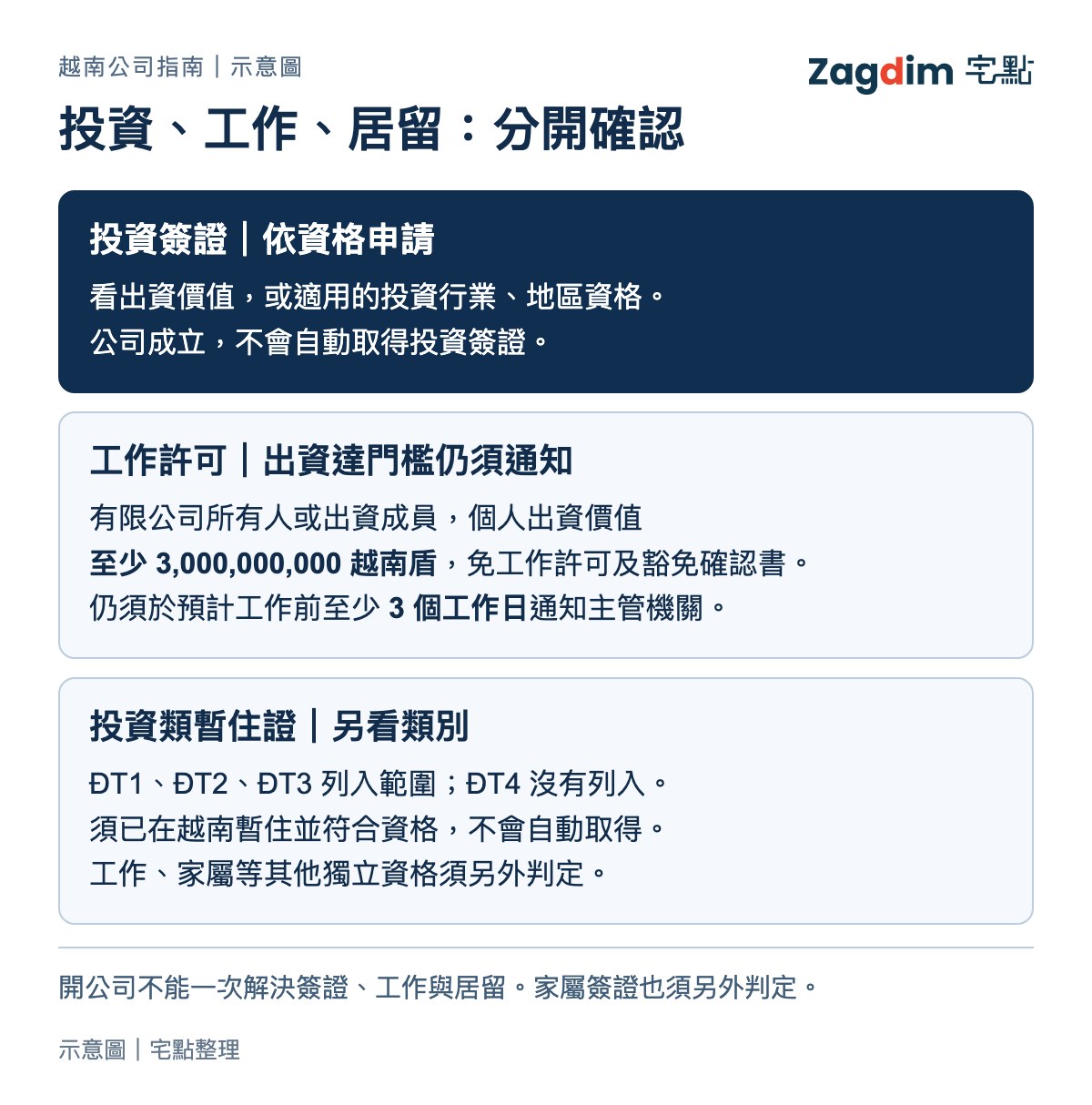
- Investment visa: depends on the capital contribution value, or the investment industry and region.
- Work permit: depends on whether you meet the exemption conditions.
- Residence card: has its own, separate scope of eligibility.
- Family visa: assessed separately.
When assessing how much capital to contribute, see also “How Much Charter Capital Should a Vietnam Company Register? Banking, Tax, and Operating Effects.”
Frequently Asked Questions
Does registering a company automatically activate an investment visa?
No. An investment visa must be applied for separately, and you need to meet conditions such as holding a valid passport, providing proof of investment, not falling under entry-refusal grounds, and having an invitation or sponsorship, though the invitation/sponsorship requirement has statutory exceptions.
Does contributing VND 3 billion mean you are exempt from every work-related procedure?
No. An LLC owner or capital-contributing member whose contribution value is at least VND 3 billion does not need a work permit or a work-permit exemption confirmation, but still needs to notify the authority with the relevant information at least 3 working days before starting work.
Can an ĐT4 investment visa holder apply for an investment-type temporary residence card?
No. ĐT4 is not within the scope of the investment-type residence card. The person may still be able to apply on some other basis, such as employment or family status, which needs to be assessed separately.
Key Terms
- Investment visa (ĐT series): A visa issued to a foreign investor, or a representative of a foreign investment organization, investing in Vietnam. It is divided into four classes, ĐT1 through ĐT4.
- Work permit: The document authorizing a foreigner to work in Vietnam. An LLC owner or capital-contributing member whose contribution value is at least VND 3 billion is not required to obtain one.
- Temporary residence card: A document a foreigner already residing temporarily in Vietnam can apply for if eligible. The maximum term of the investment-type residence card varies by whether the holder is ĐT1, ĐT2, or ĐT3.
- Family-member visa (TT): Under the investor-family path, this is limited to the spouse and children under 18 of an ĐT1, ĐT2, or ĐT3 holder; the TT visa also covers other statutory categories of applicant.
Notes on the Data
- Data was checked as of November 2, 2026.
- This article’s comparison of investment visas, work permits, and residence cards is compiled from the provisions of Vietnam’s consolidated Law on Entry, Exit, Transit, and Residence of Foreigners in Vietnam (Luật Nhập cảnh, xuất cảnh, quá cảnh, cư trú của người nước ngoài tại Việt Nam) and Decree No. 219/2025/NĐ-CP. It is not an official comparison table published directly by the authorities.
- That ĐT4 is not included in the scope of the investment-type residence card is inferred from Article 36, Clause 1, Point b of this law; it is not stated directly by the authorities.
- The procedure for obtaining a new visa after a change of purpose is set out in Article 19 of this law.
- The investment-incentivized industries and regions, and the industries encouraged for investment development, mentioned in this article are determined by the government; this article does not list them individually.
- Visa- and residence-related rules may change as the law is amended.
Need help with this? Talk to the Zagdim reader desk
Setting up a company in Vietnam does not automatically settle your visa, work permit, or residence status; Zagdim’s reader desk can help work out which of these applies to your situation and connect you with a suitable specialist.
Message the Zagdim reader desk on WhatsApp Message the Zagdim reader desk on LINE
Have a question about this guide? Leave a comment below, or ask Zagdim directly.
Your first stop for international property and global living.
Research and insights. Know what’s changing. Understand what matters.
Sources
- Office of the National Assembly, Vietnam, Consolidated Document No. 62/VBHN-VPQH consolidating the Law on Entry, Exit, Transit, and Residence of Foreigners in Vietnam
- Government of Vietnam, Decree No. 219/2025/NĐ-CP on foreign workers in Vietnam
Important Disclaimer
This article is a general compilation of information and does not constitute tax or legal advice for any individual case. Data was checked as of November 2, 2026. Vietnam’s regulations may be revised over time; please follow the current announcements of the relevant authorities, and consult a qualified professional for your own case.