































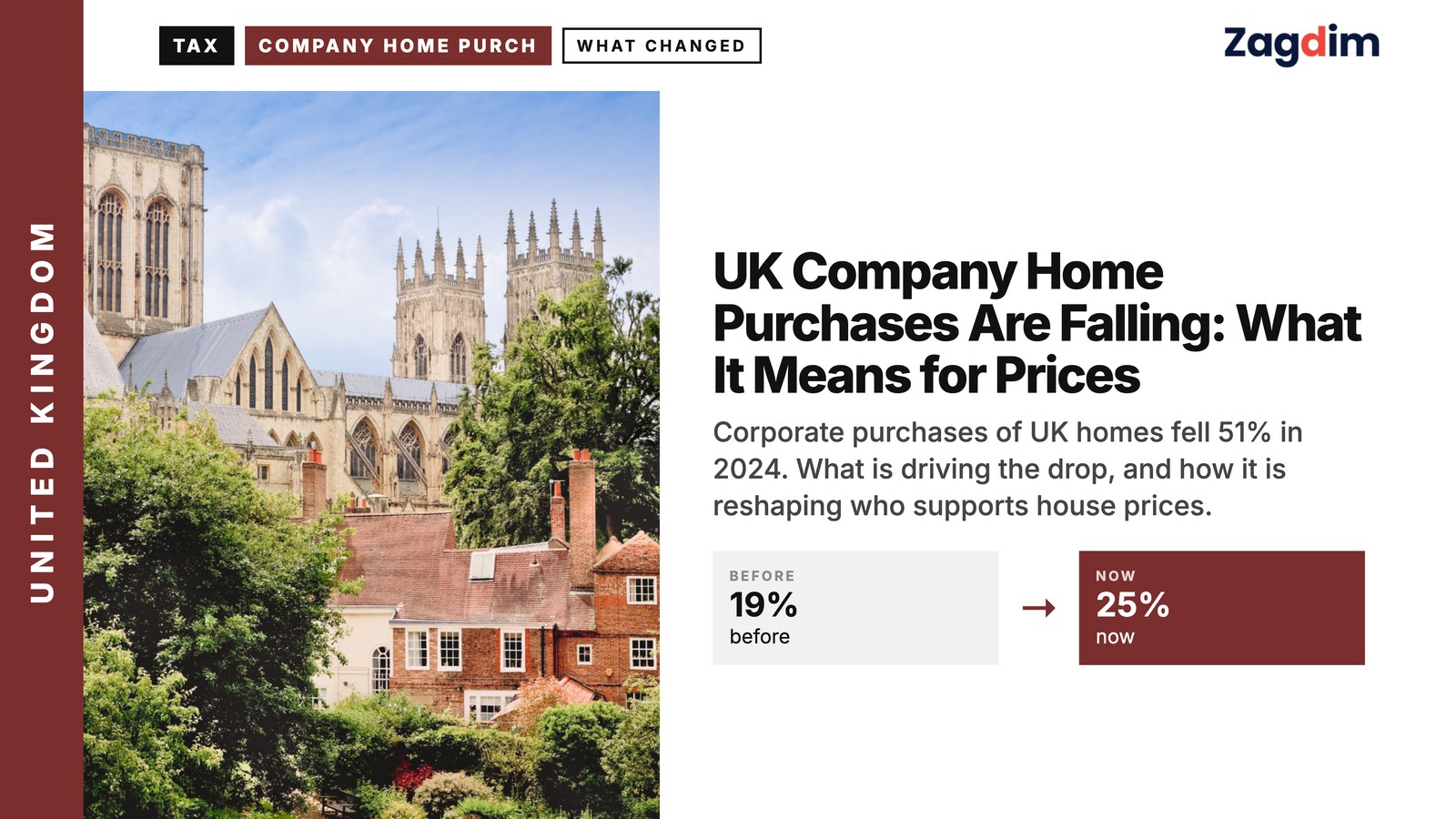
Corporate Purchases Drop Sharply, Signaling a Structural Shift
The latest data from HM Land Registry shows the UK property market is going through a structural shift. In 2024, the number of homes bought in a company’s name fell to around 29,000, down from about 60,000 in 2023 — a drop of 51%. At the same time, companies’ share of the overall market fell from a 2018 peak of 5.4% to 2.9%, the lowest level in nearly a decade.
This shift may reflect changes in market conditions, policy, and investment strategy that are all affecting how companies buy homes. So why does the volume of company-name purchases matter so much?
Why the Share of Company Purchases Matters
In the housing market, the volume of purchases made in a company’s name is a key indicator. Company purchases tend to carry an investment character, so they reflect not just investor confidence in the housing market, but also directly affect price trends, the balance of supply and demand in the rental market, and the flow of capital. How active company buying is tends to be an important signal of capital liquidity and the housing market’s appreciation potential. These buyers are not limited to large corporations — many individual investors also purchase property through a company structure to access tax advantages or financing leverage.
Market Background: Company Buying Peaked in 2013–2017
Looking back, 2013 to 2017 was the peak period for company-name home buying. At the time, global quantitative easing (QE) flooded the market with liquidity, and the Bank of England’s low interest rate policy drew large amounts of overseas capital into UK real estate, fueling investment demand. Company purchases reached a peak share of around 5% in 2018. Compared with that investment boom, the company-purchase share had fallen to 2.9% by 2024.
Key data points:
- 2013–2017: company-name home purchases hit a peak, reflecting strong investment demand in the market
- 2024: the company-purchase share fell to 2.9%, the lowest level in more than a decade
- Overall transactions fell from 1.2 million in 2023 to 1 million in 2024, a drop of 17%
Three Drivers Behind the Decline in Company Purchases
So why has the share of company purchases fallen so sharply? Three structural drivers are behind it, spanning market conditions, financing conditions, and policy change, and together they have reshaped investor behavior.
Higher Taxes Have Sharply Raised the Cost of Holding Property Through a Company
First, changes to the tax environment have significantly raised the cost for companies of holding property.
From April 1, 2023, the UK government raised the Corporation Tax rate on profits above £250,000 from 19% to 25%, an increase of 6 percentage points. While the £250,000 threshold is not easily reached by every company, for the large capital pools — previously from Russia, China, and elsewhere — that held multiple properties with high rental income, this change meaningfully increased their overall tax burden, further reducing returns on property investment and raising the cost of holding.
On top of that, from October 31, 2024, the UK government tightened stamp duty policy specifically for company-name purchases. For residential purchases above £500,000, the stamp duty rate rose from 15% to 17%, and the additional-property surcharge rose from 3% to 5%. For example, buying a second home worth £500,000 now carries roughly £20,000 in extra stamp duty. This policy change directly raised the cost of holding property through a company, narrowed the room for tax arbitrage, and further discouraged company capital from entering the market.
With the room for tax arbitrage narrowing further, the tax advantage of holding property through a company has weakened, becoming a major driver of company investors exiting the market.
Tighter Financing Has Limited Companies’ Ability to Use Leverage
Second, deteriorating financing conditions have limited companies’ room to use leverage.
The Bank of England raised interest rates repeatedly from 2022, taking the base rate from 0.1% in 2021 to a peak of 5.25% in 2023, before a cutting cycle brought it down to 3.75% as of September 2026. This pushed mortgage rates up directly: Buy-to-Let (BTL) mortgage rates for company purchases rose from 2.08% in 2021 to 5.68% in 2023, clearly higher than the equivalent rate for individual homebuyers (5.3%) over the same period.
Financing conditions have tightened across the board — according to the Financial Conduct Authority (FCA), the total value of BTL lending fell by 50% over two years, and banks raised the loan-to-value (LTV) thresholds for company investment loans. The share of loans with an LTV of 75% to 90% fell from 16.7% in 2021 to 6.8% in 2023, reflecting a significant narrowing of company financing options.
By comparison, lending conditions for owner-occupiers were relatively loose: the share of individual loans with an LTV of 75% to 90% rose from 30% to 40%, while the share with a 90% LTV rose from 4% to 6%. The data shows investment lending clearly tightening, forcing companies to commit more of their own capital and reducing the returns leverage can deliver, while lending for owner-occupied homes kept loosening.
Policy Uncertainty Is Accelerating the Exit of Company Capital
Finally, policy uncertainty has accelerated the exit of company capital from the market.
The Renters’ Rights Act 2025, which received Royal Assent on 27 October 2025, is having a structural impact on market behavior. One of its central reforms — the repeal of Section 21 of the Housing Act 1988, which bans no-fault evictions of tenants — took effect on 1 May 2026. This means landlords face greater legal risk and higher operating costs, which may lead some to sell up and exit the market. According to a survey by PropTech firm Goodlord, 26% of landlords said they planned to sell their rental properties, and 67% of letting agents believe landlords may choose to exit the market. This policy uncertainty has further reduced the number of company investors in the market.
Even so, market forces have never truly disappeared — they have simply shifted from one form to another.
Who Is Supporting House Prices Now?
As company capital recedes, the market’s driving force appears to be quietly shifting. Buyers with genuine housing need are gradually filling the gap left by capital. Looking again at the transaction numbers: while the number of company-name purchases fell by around 30,000, First Registrations — homes registered for the first time — rose from 36,000 in 2020 to 75,000 in 2024, nearly doubling, and their share of overall transactions rose from 3% to 8%, making them the main driver of market transactions. This marks a shift in market leadership toward first-time buyers and those moving up the housing ladder.
Will House Prices Be Affected?
House prices are set to see a structural split. As companies exit the market, the capital-driven effect fades, market liquidity falls, and the upward pressure on prices naturally weakens. London and other high-price markets, long favored by capital, have felt this first: Rightmove’s 2024 data shows London house prices have already fallen by around 8%. But supported by genuine housing need, some second-tier markets have held up relatively well. For example, Manchester city-center prices fell 9% over the past year, while prices in neighboring Salford, supported by genuine demand, rose about 3%. This reflects a typical “capital retreats, genuine demand steps in, regions diverge” pattern of market restructuring.
The market is also shifting from being “investment-driven” to “demand-driven,” led by owner-occupiers. Owner-occupier behavior tends toward “stable holding” rather than “quick in, quick out,” which lengthens holding periods and lowers market turnover. This behavioral shift should narrow the short-term swings in house prices, and the market trend should become more stable.
That said, whether house prices can hold their footing longer term still depends on whether company capital returns to the market, and whether demand from owner-occupiers can stay resilient.
Have a question about this guide? Leave a comment below, or ask Zagdim directly.
Your first stop for international property and global living.
Research and insights. Know what’s changing. Understand what matters.